Papules are small, raised and palpable skin lesions that are usually less than 1 centimetre in diameter. They may be red, pink, skin-coloured, brownish, smooth, rough, scaly or wart-like. It is important to understand that a papule is not one specific disease, but a dermatological term describing the shape of a skin lesion.
Papules may occur in acne, dermatitis, rosacea, psoriasis, folliculitis, insect bites, scabies, viral warts, molluscum contagiosum, allergic reactions and other skin conditions. Most papules are not dangerous, but their causes can be very different. Therefore, the most important thing is not only to “remove a papule” or “calm the rash”, but to understand why it has appeared.
What are papules?
A papule is a raised, firm or denser skin lesion without visible fluid or pus. It differs from a pustule, which contains pus, and from a vesicle, which contains fluid.
Papules may be:
- single or multiple;
- red, pink, skin-coloured or pigmented;
- smooth, rough, scaly or wart-like;
- itchy, painful, sensitive or without symptoms;
- on the face, body, arms, legs, skin folds or intimate area.
Why is a papule not a diagnosis?
A papule describes the appearance of a rash or skin lesion, but it does not define the disease. For example, a red papule on the face may be a sign of acne, a rosacea lesion, contact dermatitis or folliculitis. Itchy papules on the body may occur after insect bites, scabies, an allergic reaction or dermatitis.
For this reason, there is no single universal “papule treatment”. Treatment always depends on the cause.
Papule, pustule, vesicle, nodule and macule: what is the difference?
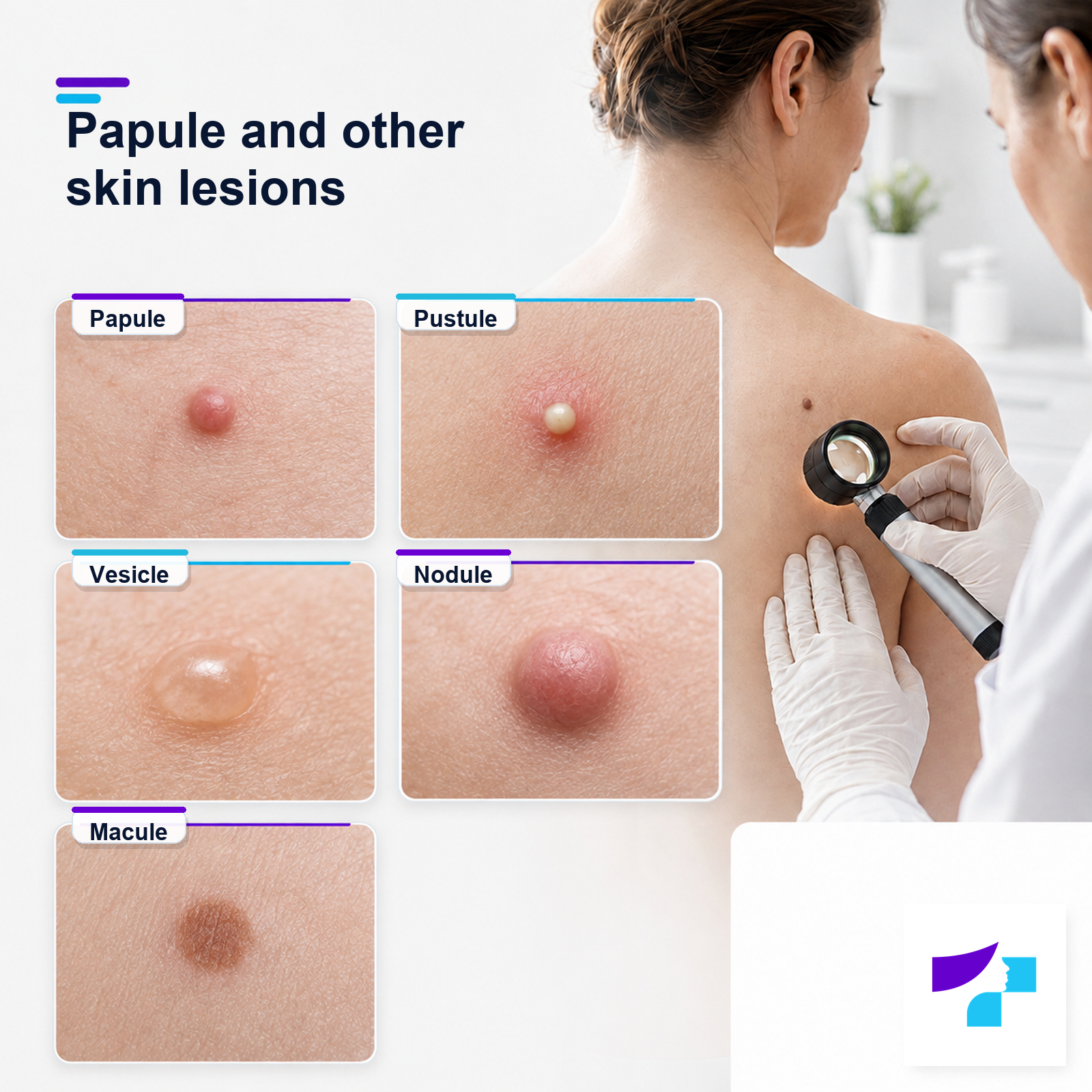
| Skin lesion | What it looks like | Main difference |
|---|---|---|
| Papule | Raised, palpable lesion up to 1 cm | No visible fluid or pus |
| Pustule | Raised lesion with a white or yellowish head | Contains pus |
| Vesicle | Small fluid-filled blister | Contains clear fluid |
| Nodule | Deeper, larger, firm lesion | Usually larger or deeper than a papule |
| Macule | Flat change in skin colour | Not raised |
| Plaque | Larger raised or thickened area | May form when several papules merge |
Why do papules form?
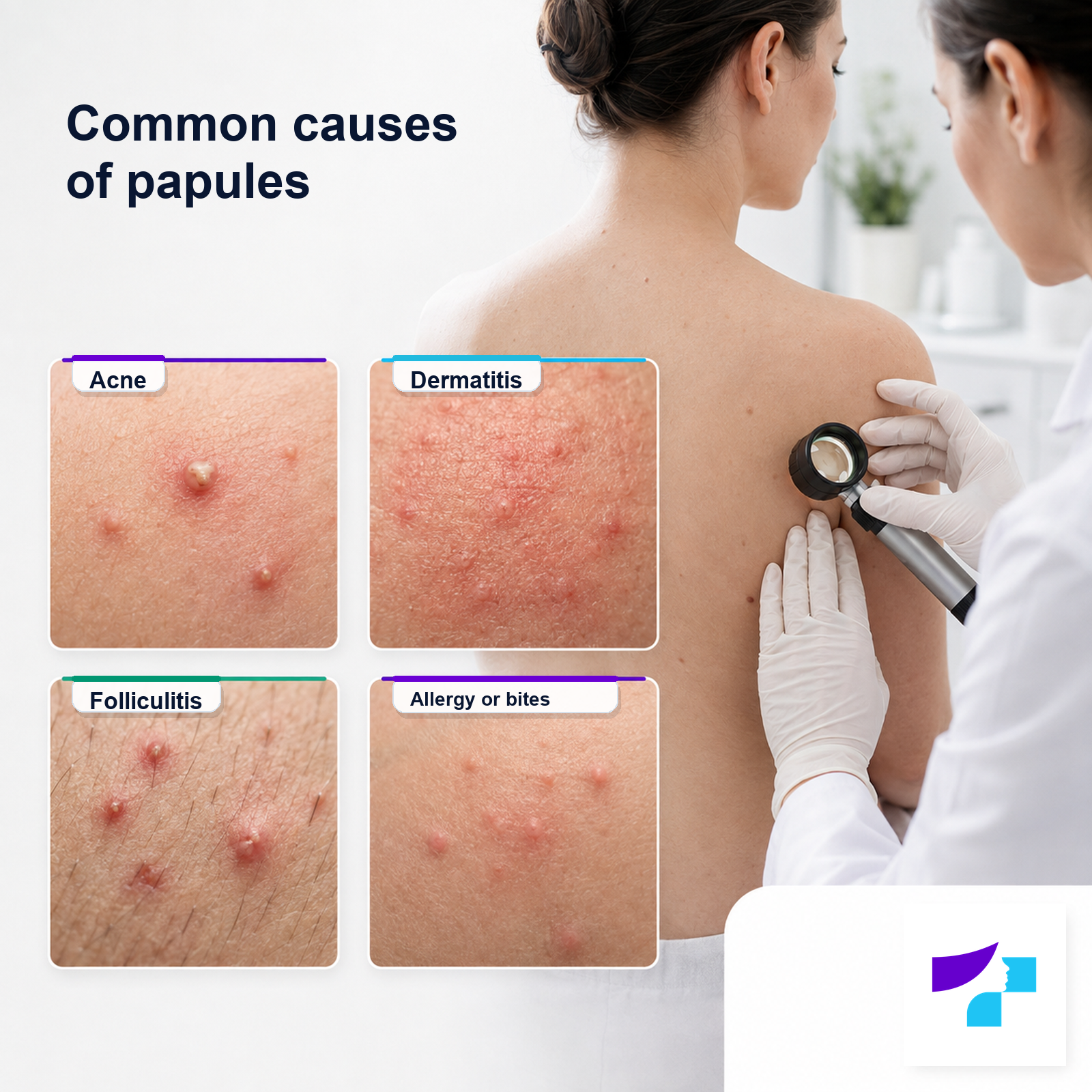
Papules form when inflammation, follicle blockage, infection, immune reaction, irritation or tissue thickening develops in the skin. Common causes include:
- acne;
- rosacea;
- atopic dermatitis;
- allergic contact dermatitis or irritant contact dermatitis;
- folliculitis;
- insect bites;
- scabies;
- psoriasis;
- viral warts;
- molluscum contagiosum;
- keratosis pilaris;
- medicine-induced rashes.
Less commonly, a papule-like lesion may also be an early sign of a precancerous or malignant skin process. Therefore, new, growing, bleeding, ulcerated or pigmented lesions should be shown to a dermatologist.
Acne papules
Acne papules are inflamed pimples without a visible pus-filled head. They develop when a hair follicle and sebaceous gland become blocked with sebum and dead skin cells, inflammation develops and the balance of skin microorganisms changes.
Acne papules differ from:
- blackheads, which are open comedones;
- whiteheads, which are closed comedones;
- pustules, in which pus is visible;
- deep nodules, which are larger, more painful and more likely to leave scars.
Acne papules should not be squeezed, because this may worsen inflammation, promote infection, scarring and post-inflammatory pigmentation.
Papules on the face
Papules on the face are often caused by acne, rosacea, perioral dermatitis, contact dermatitis, cosmetic irritation or folliculitis. If papules occur together with persistent redness, burning or sensitivity, rosacea is possible. If they are concentrated around the mouth, nose or eyes, perioral dermatitis should be considered.
Strong acid products, corticosteroid creams, antibiotics or caustic preparations should not be used on facial skin without a doctor’s advice.
Itchy papules
Itchy papules may be a sign of dermatitis, allergy, insect bites, scabies, hives, a medicine reaction or dry skin. Special attention should be paid to itching at night and rashes between the fingers, on the wrists, abdomen, buttocks or genital area, as this may indicate scabies.
If papules itch very severely, spread rapidly or occur together with fever, swelling, shortness of breath or mucosal lesions, medical help is needed.
Papule in allergy testing and hives reaction
In medicine, the word “papule” is also used to describe a skin reaction in allergy testing. For example, during a skin prick test, after histamine or an allergen is introduced, a raised papule with redness, or erythema, may form. This type of papule is usually a short-term reaction, not a permanent skin lesion.
Similarly, in hives, raised itchy skin lesions may appear and usually disappear relatively quickly. These temporary lesions should be distinguished from long-lasting papules related to acne, infections, dermatitis, warts or other skin diseases.
Papules in the intimate area
Papules in the intimate area should be assessed especially carefully. They may be harmless anatomical variants, but they may also be a sign of infection or a sexually transmitted infection.
Possible causes
- penile papules, which are usually a benign anatomical variant;
- Fordyce spots, which are related to visible sebaceous glands;
- folliculitis after shaving or friction;
- molluscum contagiosum;
- genital warts, also called condylomas;
- herpes or other infections;
- syphilis or other sexually transmitted infections;
- irritation, dermatitis or an allergic reaction.
Papules in the intimate area should not be squeezed, cauterised or treated with over-the-counter wart remedies without a doctor’s advice. If there is pain, ulcers, discharge, bleeding, rapid spread or a risk of a sexually transmitted infection, a dermatovenereologist, gynaecologist or urologist should be consulted.
Are papules contagious?
Papules themselves are not contagious, because a papule is a form, not a diagnosis. Contagiousness depends on the cause.
| Usually not contagious | May be contagious |
|---|---|
| Acne papules | Scabies |
| Rosacea | Molluscum contagiosum |
| Keratosis pilaris | Viral warts |
| Allergic dermatitis | Some bacterial, viral or sexually transmitted infections |
| Most non-infectious inflammatory rashes | Infectious rashes whose cause is determined by a doctor |
Are papules dangerous?
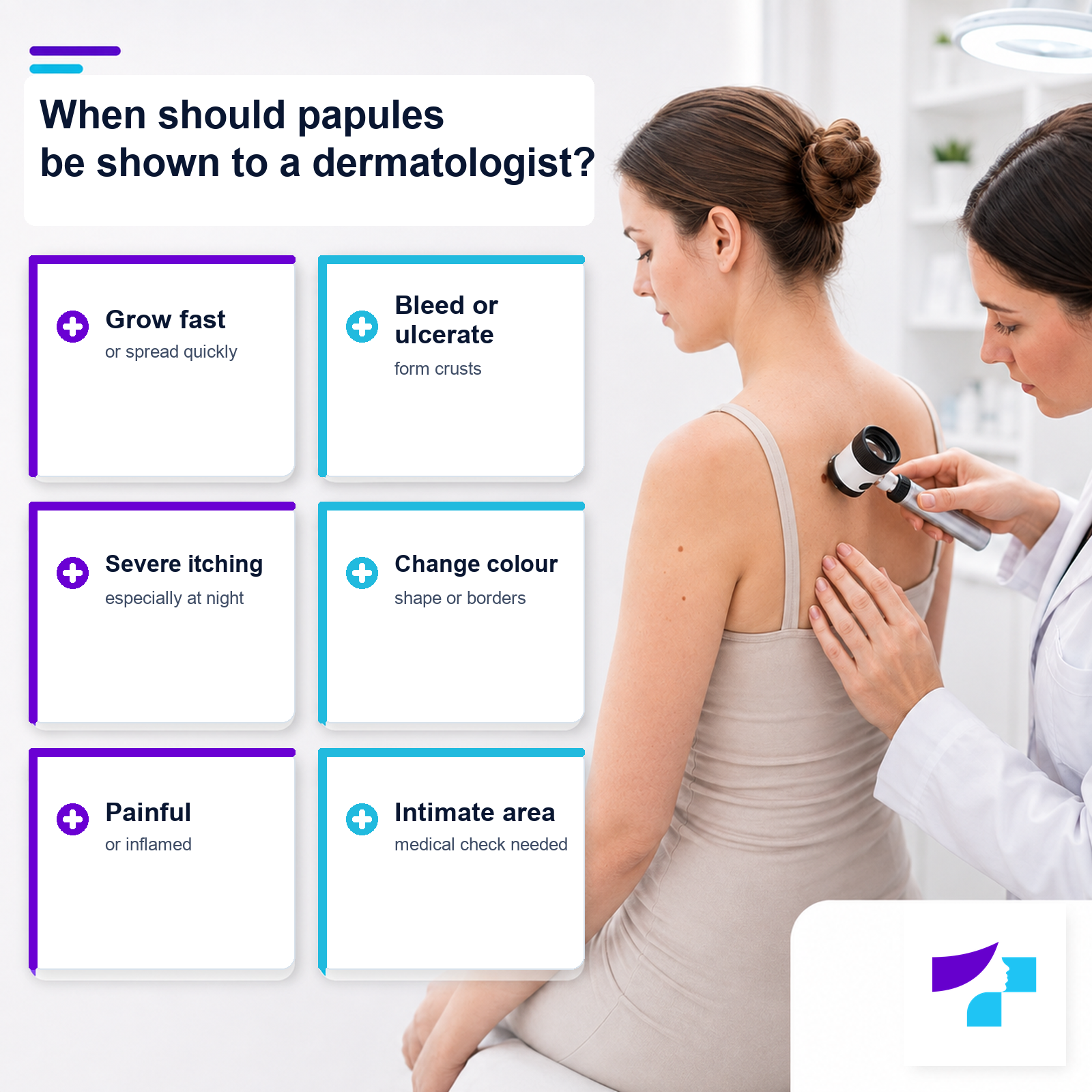
Papules are often not dangerous, but there are situations when medical help is needed. A dermatologist should be consulted if a papule or rash:
- grows or spreads rapidly;
- bleeds, ulcerates or forms a crust without a clear reason;
- is very painful or very itchy;
- changes colour, shape or borders;
- is pigmented, new or changing;
- affects the eyes, lips, mouth or genitals;
- appears after starting a new medicine;
- occurs together with fever or feeling unwell;
- occurs in a child, pregnant woman, older person or someone with a weakened immune system.
Especially important: any new or changing pigmented lesion should be shown to a dermatologist.
How does a doctor determine the cause of papules?
The doctor assesses the appearance, location, duration, itching, pain, spread, medicines used, cosmetics, contacts, travel history and other symptoms. Sometimes a skin examination is enough to make a diagnosis, but in other cases dermoscopy, skin scraping, swab, microbiological test, blood tests, allergy assessment or biopsy may be needed.
Dermoscopy helps examine skin structures in more detail. Biopsy and histological examination are needed if a lesion is unclear, atypical or if a more serious skin process is suspected.
How are papules treated?
Treatment of papules depends on the cause.
Treatment of acne papules
For acne papules, topical products such as benzoyl peroxide, azelaic acid, salicylic acid or retinoids may be used. In moderate or severe acne, a dermatologist may prescribe prescription treatment. Antibiotics should not be used without medical advice.
Treatment of other papules
In dermatitis, treatment may include removing the irritant, restoring the skin barrier, moisturisers and doctor-prescribed anti-inflammatory treatment. In infections, treatment may be antibacterial, antiviral, antifungal or antiparasitic. In the case of warts or other lesions, cryotherapy, topical treatment or another dermatological procedure may be needed.
What can be done at home?
Safe measures
- wash the skin gently;
- avoid aggressive scrubs;
- avoid new irritating products if the rash worsens;
- choose non-comedogenic cosmetics;
- use a moisturiser to restore the skin barrier;
- use sun protection;
- do not make a diagnosis based only on internet images.
What should not be done?
- do not squeeze, puncture or scratch papules;
- do not use alcohol, toothpaste, lemon, baking soda or apple cider vinegar;
- do not use antibiotics, corticosteroids or antiviral medicines on your own;
- do not apply acids to unclear lesions;
- do not use wart remedies on the face, eyelids, genitals or unclear skin lesions without a doctor’s advice.
Common myths about papules
| Myth | Fact |
|---|---|
| Papules are the same as pimples | Acne may cause papules, but not all papules are acne. |
| All papules are contagious | Contagiousness depends on the cause of the papules. |
| Papules can be safely squeezed | Squeezing may promote inflammation, scarring and pigmentation. |
| Red papules always mean allergy | They may be acne, dermatitis, rosacea, infection or another condition. |
| Itchy papules always mean scabies | Scabies is one possible cause, but not the only one. |
| Papules are caused by poor hygiene | They are often related to inflammation, hormones, the skin barrier, infections or immune reactions. |
| Sun treats papules | Sun exposure may worsen pigmentation and irritation. |
| Papules in children are always harmless | Rashes in children with fever or rapid spread should be assessed by a doctor. |
Summary
A papule is a type of skin lesion, not a diagnosis. It may be a sign of acne, dermatitis, rosacea, infection, insect bite, scabies, warts or another condition. Treatment depends on the cause, so persistent, changing, painful, bleeding, ulcerated, very itchy, pigmented or rapidly spreading papules should be assessed by a doctor.
Medical disclaimer
This information is for informational purposes only and does not replace a dermatologist consultation, diagnosis or treatment. Any new, changing, bleeding, ulcerated, painful, very itchy, rapidly spreading or pigmented skin lesion should be shown to a dermatologist. Do not use prescription medicines, antibiotics, corticosteroids, antiviral medicines, strong acids or caustic agents without a doctor’s advice. In the case of rashes in children, pregnant women, people with weakened immune systems or lesions in the intimate area, an appropriate doctor should be consulted.
References and authoritative sources
- DermNet: dermatology terminology and primary skin lesions
- DermNet: dermatology glossary
- Cleveland Clinic: acne papules, causes and treatment
- American Academy of Dermatology: acne treatment options
- American Academy of Dermatology: clinical guidelines for acne
- MSD Manuals: description of skin lesions and dermatological evaluation
- MedlinePlus: papule as a type of skin lesion
- National Health Service (NHS): patient information on rashes and skin conditions
- NCBI Bookshelf: medical books and reviews on dermatology topics
- PubMed: scientific publications on papules, acne, dermatitis and skin diseases
- Centre for Disease Prevention and Control of Latvia: public health information
- Ministry of Health of the Republic of Latvia: healthcare information and patient safety
