Folliculitis is inflammation of a hair follicle. A hair follicle is the skin structure from which a hair grows, and when this area becomes inflamed or infected, small red, pink, or pus-filled bumps may appear around hairs. They may itch, burn, feel tender, or be painful.
Mild folliculitis often resolves on its own or improves with gentle skin care, but painful, deep, pus-filled, widespread, or recurrent eruptions should be assessed by a doctor. Folliculitis can resemble acne, ingrown hairs, a boil, or contact dermatitis, so correct differentiation is important to avoid worsening the skin with unsuitable products.
Key Points
- Folliculitis is inflammation of a hair follicle and often looks like small bumps or pustules around hairs.
- It can occur after shaving, waxing, sweating, friction, tight clothing, sports equipment, or swimming in a poorly maintained pool or hot tub.
- The most common cause of bacterial folliculitis is Staphylococcus aureus, but folliculitis can also be caused by Pseudomonas, Malassezia yeasts, viruses, parasites, or mechanical irritation.
- Folliculitis is not the same as acne. Acne often includes comedones, or blackheads and whiteheads, while folliculitis more often appears as uniform bumps around hairs.
- Mild cases may be soothed by gentle washing, warm compresses, reducing friction, and taking a break from shaving.
- Antibiotics should not be used without medical advice. They do not help fungal folliculitis and may contribute to antibiotic resistance.
- See a dermatologist if the rash is painful, deep, spreading, recurrent, does not improve within 1–2 weeks, or is associated with fever, scarring, hair loss, or weakened immunity.
What Is Folliculitis?
Folliculitis is inflammation within a hair follicle. A hair follicle is a small “pocket” in the skin from which a hair grows. Sebaceous glands, blood vessels, nerve endings, and skin microorganisms are located around the follicle. If the follicle becomes irritated, blocked, injured, or colonized by microorganisms, inflammation can develop.
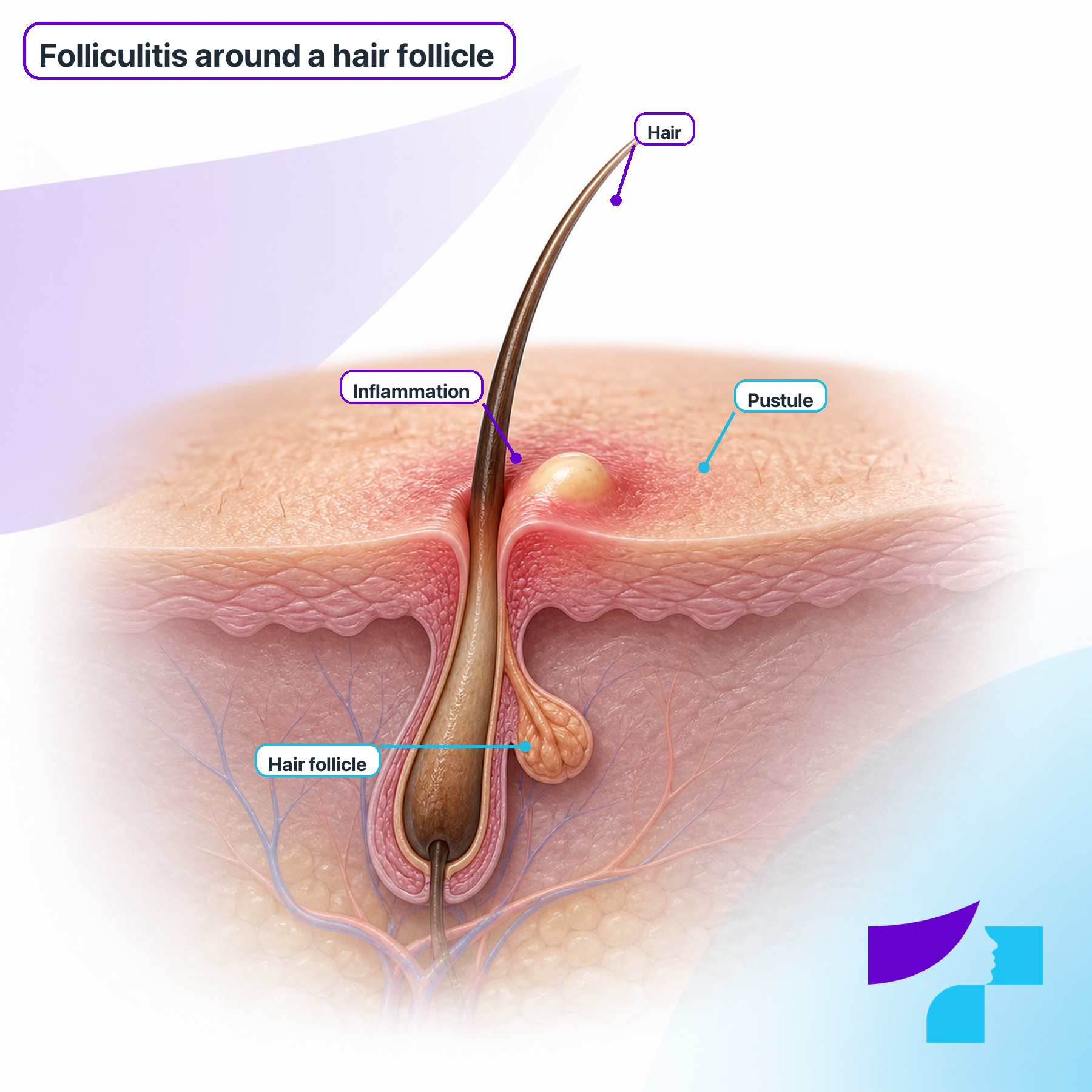
Folliculitis may be:
- infectious, when caused by bacteria, yeasts, viruses, or parasites;
- non-infectious, when the main cause is mechanical irritation, ingrown hairs, friction, occlusion, or irritating substances.
Bacterial folliculitis is one of the most common types, but not every “bump around a hair” means a bacterial infection. Treatment should therefore be matched to the likely cause.
What Does Folliculitis Look Like?
Folliculitis most often appears as small bumps around hair openings. Sometimes a hair can be seen in the center. Some bumps may have a white or yellowish pus-filled tip, medically called a pustule.
Typical signs include:
- red, pink, brownish, or violet bumps around hairs;
- small pustules with a pus-filled tip;
- itching, burning, or a stinging sensation;
- skin tenderness to touch;
- crusting if pustules break open;
- darker or lighter post-inflammatory marks after healing;
- painful nodules or abscess-like lesions in deeper cases.
On lighter skin, folliculitis more often looks pink or red. On darker skin, redness may be less visible, and inflammation may appear brownish, violet, greyish, or as darker post-inflammatory marks. This does not mean the inflammation is milder — pain, warmth, swelling, and pus are more important signs than color alone.
What Are the Symptoms of Folliculitis?
Mild folliculitis may cause only slight itching or discomfort, while more pronounced cases can be bothersome.
Common symptoms include:
- small bumps around hairs;
- pustules, or pus-filled bumps;
- itching;
- burning;
- pain;
- skin tenderness;
- redness or discoloration;
- crusting;
- recurrent rash in the same area.
A more severe or deeper infection may appear as a larger, warm, painful nodule. If a boil or abscess develops, pain is usually more pronounced, the lesion is deeper, and medical care may be needed.
Why Does Folliculitis Occur?
Folliculitis occurs when a hair follicle becomes irritated, injured, blocked, or infected. Several factors often act together, such as sweating, friction, tight clothing, shaving, and changes in the skin microbiome.
Common causes and contributing factors include:
- shaving, especially very close shaving or using a dull razor;
- waxing, epilation, or other hair removal methods;
- ingrown hairs;
- tight clothing, synthetic fabrics, sportswear;
- helmets, backpacks, protective equipment, or other pressure on the skin;
- excessive sweating;
- hot and humid weather;
- poorly maintained pools, spas, or hot tubs;
- oily, occlusive skin or hair care products;
- atopic dermatitis, acne, or other skin conditions;
- long-term antibiotic use;
- use of corticosteroid creams without medical guidance;
- diabetes mellitus;
- HIV or another form of immunosuppression;
- cancer treatment or other immunity-suppressing therapy.
Common Types of Folliculitis
| Type | Typical cause | How it usually looks | What patients should know |
|---|---|---|---|
| Bacterial folliculitis | Often Staphylococcus aureus | Pustules around hairs, itching or pain | Mild cases may be superficial, but recurrent or widespread disease should be assessed by a doctor |
| Pseudomonas folliculitis | Poorly maintained pool, hot tub, spa | Itchy or painful rash, often under swimsuit-covered areas | Usually linked to water exposure; prevention and water hygiene are important |
| Malassezia folliculitis | Overgrowth of yeast | Small, uniform, often very itchy bumps on the chest, back, shoulders, or forehead | Not true acne; antibiotics do not help |
| Pseudofolliculitis | Ingrown hairs after shaving | Bumps where the hair grows back into the skin | More common in the beard and bikini area; shaving technique is important |
| Boil | Deeper follicle infection | Large, painful, warm nodule with pus | May require medical assessment or drainage |
| Carbuncle | Deep infection of several follicles | Several connected boils, painful inflammatory area | More often requires medical treatment |
| Viral folliculitis | For example, herpes viruses | Blisters or painful grouped lesions | Requires a different treatment approach |
| Parasitic folliculitis | For example, Demodex | Follicular rash, often in specific areas | The diagnosis should be confirmed by a doctor |
Where on the Body Does Folliculitis Most Often Occur?
Folliculitis can occur almost anywhere hair grows. It is most common in areas exposed to sweating, friction, shaving, tight clothing, or occlusion.
Common locations include:
- scalp;
- face;
- beard area;
- neck;
- chest;
- back;
- shoulders;
- armpits;
- buttocks;
- thighs;
- legs;
- bikini and intimate area.
Folliculitis does not occur on the palms or soles because these areas do not have hair follicles.
Folliculitis After Shaving, Waxing, or Epilation
Folliculitis after shaving is one of the most common reasons people seek information. Shaving can cause tiny skin micro-injuries, allow bacteria to enter, or promote ingrown hairs. This is especially common in the beard, neck, bikini area, armpits, and legs.
Risk is increased by:
- a dull or unclean razor;
- very close shaving;
- shaving against the direction of hair growth;
- stretching the skin while shaving;
- shaving over already inflamed skin;
- sharing a razor;
- irritating aftershave products;
- tight clothing immediately after shaving;
- waxing or epilation that traumatizes follicle openings.
Prevention may include shaving less often, using a sharp and clean razor, shaving in the direction of hair growth, moisturizing the skin after shaving, and avoiding tight clothing immediately after hair removal. If the problem recurs, a dermatologist may recommend another hair removal strategy.
Scalp Folliculitis
Scalp folliculitis may appear as itchy or painful bumps under the hair, pustules, crusts, and discomfort when combing or washing the hair. Some people notice scalp tenderness or crusts left on the pillow.
Contributing factors include:
- excessive sweating;
- helmets, caps, or tight headwear;
- oily hair care products;
- hair oils or heavy pomades;
- shaving the scalp;
- scratching;
- tight hairstyles;
- dandruff or seborrheic dermatitis;
- diabetes or immunosuppression.
If scalp lesions are painful, recurrent, cause scarring, pus, or hair loss, a dermatologist should be consulted. Some inflammatory scalp diseases can permanently damage follicles, so long-lasting scalp folliculitis should not be ignored.
Folliculitis in the Intimate Area
Folliculitis in the bikini or intimate area often occurs after shaving, waxing, friction, tight underwear, sweating, or ingrown hairs. It may look like small bumps or pustules around hairs.
However, the intimate area is sensitive, and not every rash in this area is folliculitis. If there are blisters, ulcers, severe pain, discharge, burning during urination, enlarged lymph nodes, new sexual contacts, or lesions that do not seem related to hair follicles, other diagnoses, including sexually transmitted infections, should be considered. In such cases, it is better to see a doctor, dermatovenereologist, gynecologist, or urologist.
“Fungal Acne” or Malassezia Folliculitis
Malassezia folliculitis is often called “fungal acne” in everyday language, but medically it is not true acne. It is caused by increased growth of Malassezia yeasts inside hair follicles.
Typical features include:
- small, uniform bumps;
- often pronounced itching;
- location on the chest, back, shoulders, forehead, or hairline;
- worsening after sweating, heat, or occlusion;
- poor response to standard acne treatment;
- possible worsening after prolonged antibiotic use.
Important: antibiotics do not help fungal folliculitis because they do not act on yeasts. In some cases, they may alter the skin microbiome in a way that makes fungal folliculitis more noticeable. If “acne” is very itchy, uniform, and does not improve with acne products, the diagnosis should be reconsidered.
“Hot Tub” or Pseudomonas Folliculitis
Pseudomonas folliculitis, also known as “hot tub,” “jacuzzi,” or spa folliculitis, develops after contact with water in which disinfectant levels or pH are not properly maintained. It is caused by the bacterium Pseudomonas aeruginosa.
Typical features include:
- rash appearing after swimming in a pool, hot tub, spa, or jacuzzi;
- rash often located in areas covered by a swimsuit;
- itching, burning, or pain may occur;
- small pustules around follicles may be present;
- avoiding repeated exposure to poorly maintained water is usually important.
For prevention after swimming, remove the wet swimsuit, wash with soap, wash the swimsuit, and avoid pools or hot tubs if there are doubts about water maintenance.
How to Tell Folliculitis Apart From Acne
Folliculitis and acne may look similar because both can cause bumps and pustules. However, the mechanism and treatment often differ.
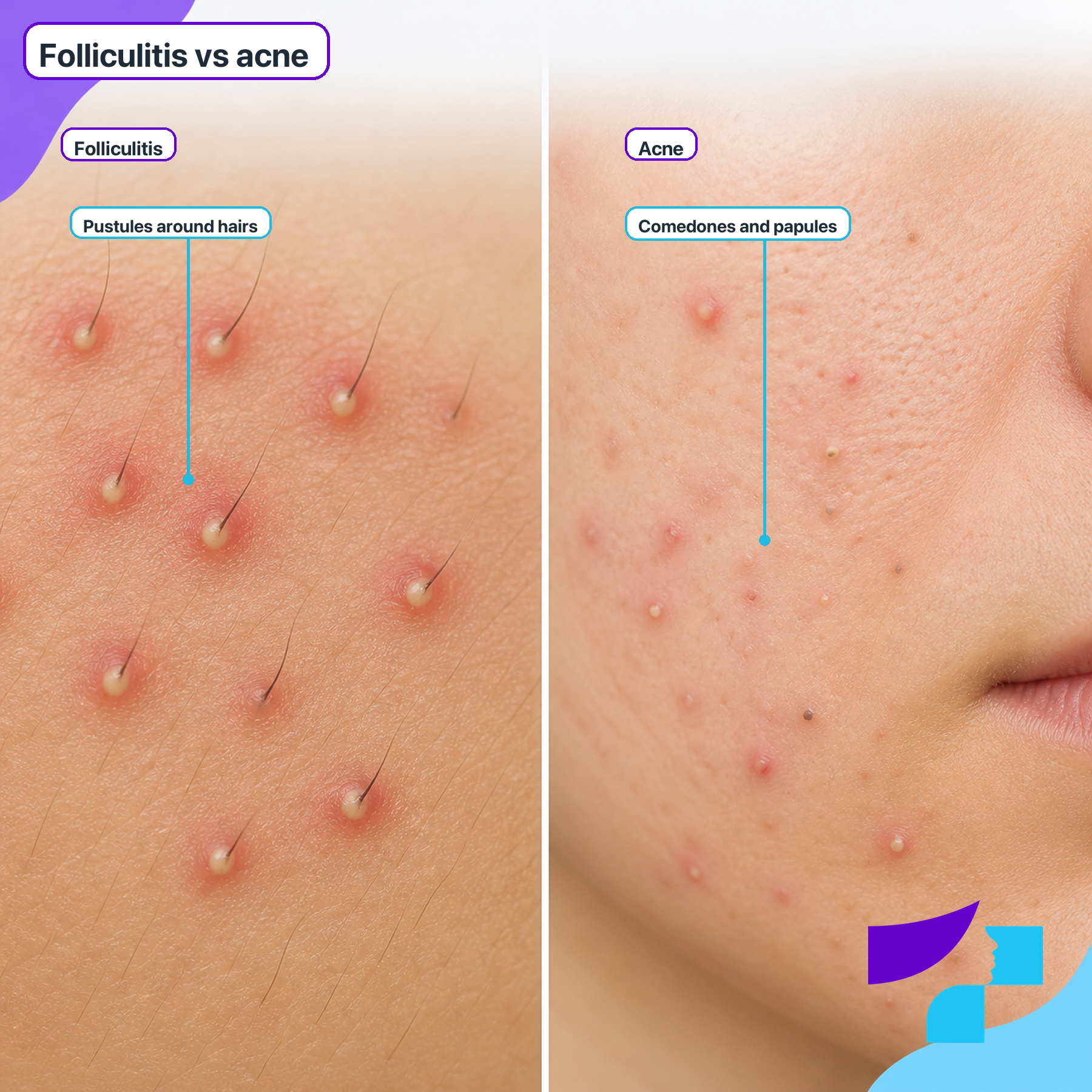
| Feature | Folliculitis | Acne |
|---|---|---|
| Main structure | Hair follicle | Hair follicle and sebaceous gland |
| Appearance | Uniform pustules or bumps around hairs | Comedones, papules, pustules, nodules, cysts |
| Comedones | Usually not typical | Blackheads and whiteheads are common |
| Itching | Common, especially in Malassezia folliculitis | May occur, but is not the main feature |
| Triggers | Shaving, sweating, friction, pool exposure, tight clothing | Hormones, sebum, comedones, genetics, cosmetics |
| Common areas | Beard, scalp, back, buttocks, legs, bikini area | Face, back, chest, shoulders |
| Treatment | Depends on the cause — antibacterial, antifungal, or irritation-reducing treatment | Acne treatment targeting comedones, inflammation, and sebum |
| When to see a doctor | If painful, pus-filled, spreading, or recurrent | If nodules, cysts, scars, or persistent acne are present |
How to Tell Folliculitis Apart From an Ingrown Hair
Ingrown hairs often occur after shaving, waxing, or epilation, when a hair does not grow straight out of the skin but grows back into it. This causes mechanical irritation and inflammation that may resemble folliculitis.
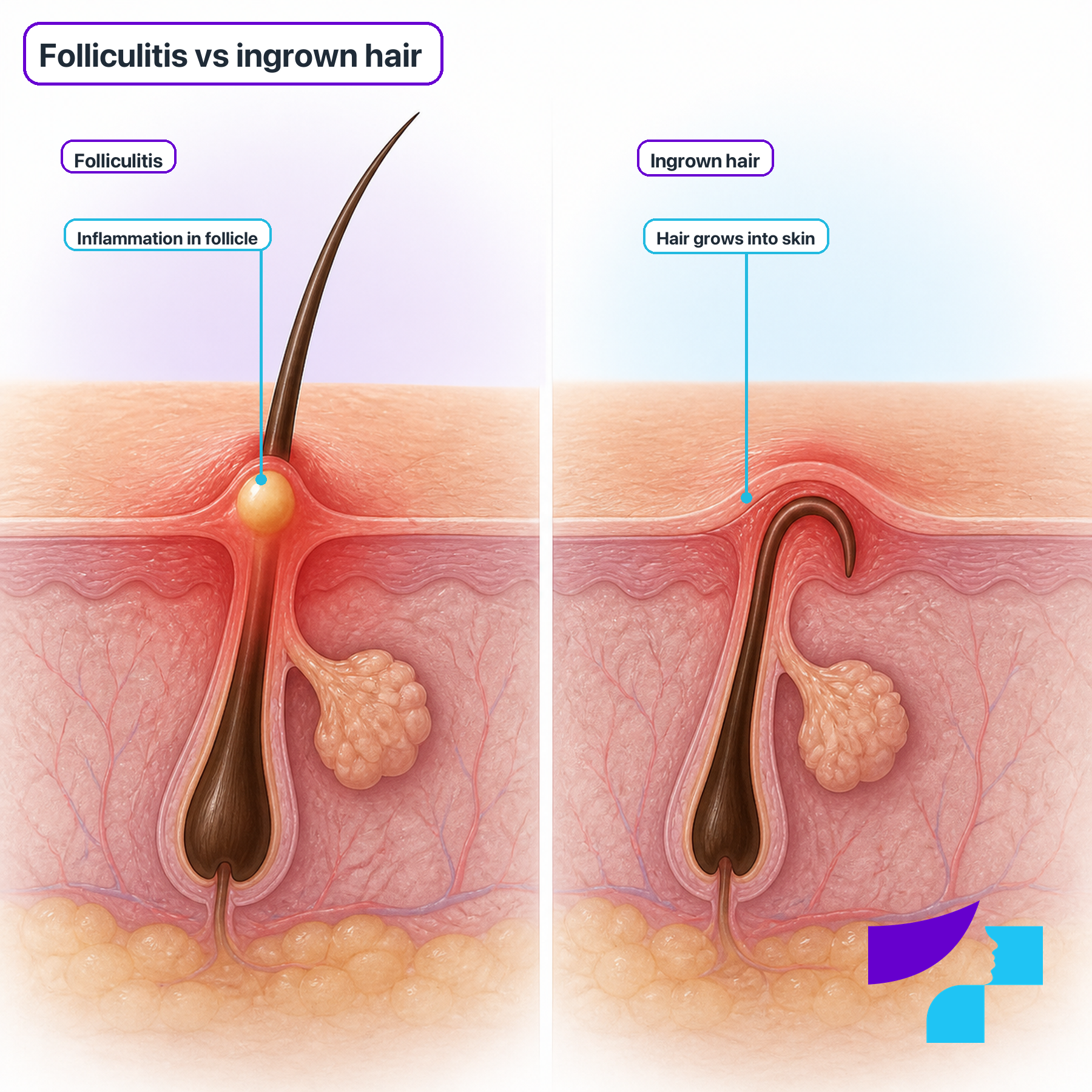
| Feature | Folliculitis | Ingrown hair |
|---|---|---|
| Cause | Inflammation or infection in the hair follicle | Hair grows into the skin and causes irritation |
| Appearance | Several pustules or bumps around follicles | One or more bumps, sometimes with a visible ingrown hair |
| Common areas | Anywhere hair grows | Beard, neck, bikini area, legs, armpits |
| Link with shaving | Common | Very typical |
| Treatment direction | Depends on the cause | Changing shaving technique, reducing inflammation, preventing ingrown hairs |
| When to see a doctor | If there is pus, pain, spreading, or recurrence | If pus, abscess, scars, or frequent recurrence develops |
How to Tell Folliculitis Apart From a Boil
A boil is a deeper infection of a hair follicle. It is usually larger and more painful than superficial folliculitis.
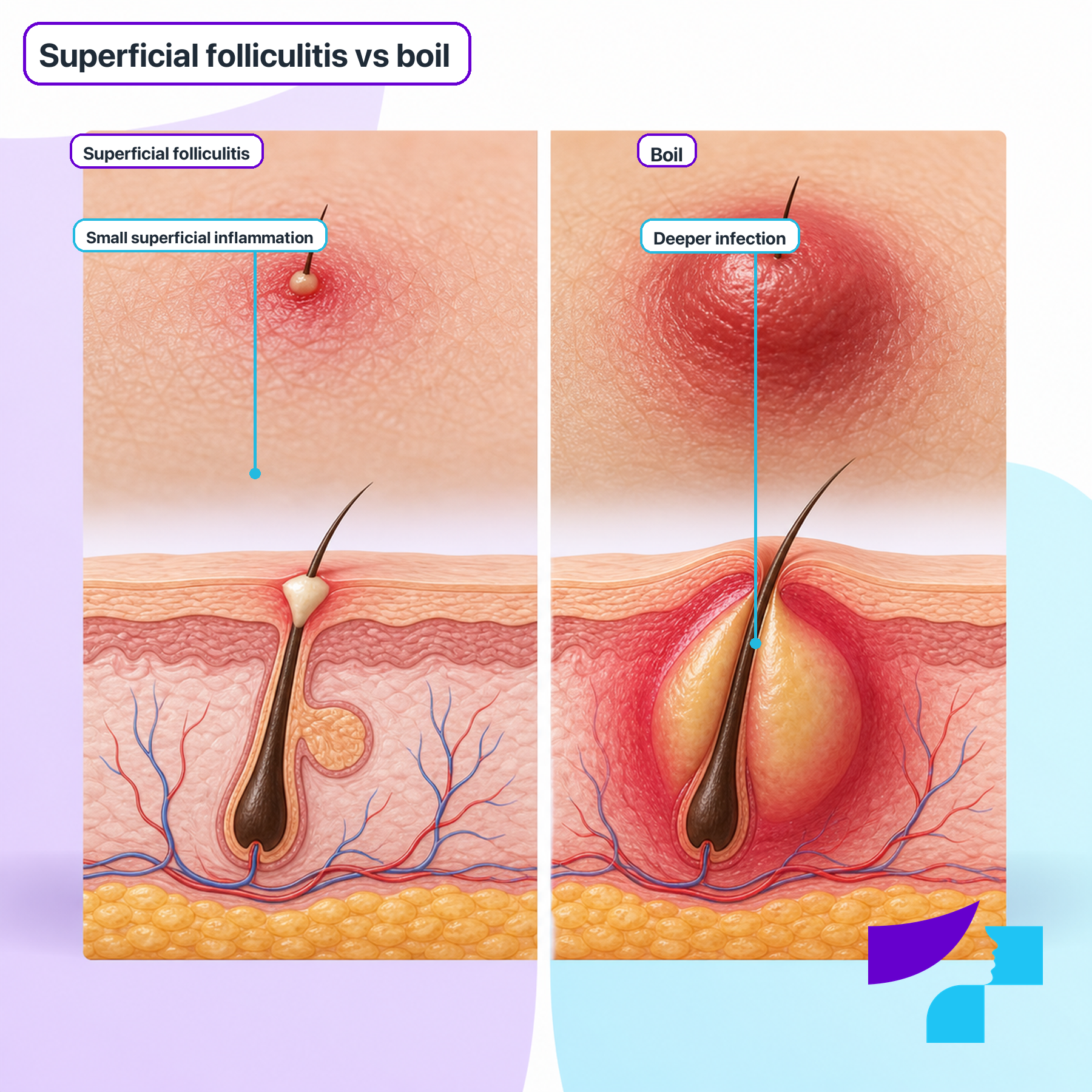
| Feature | Superficial folliculitis | Boil |
|---|---|---|
| Depth | Superficial inflammation of the follicle | Deeper infection of the follicle and surrounding tissue |
| Size | Small bumps or pustules | Large, painful nodule |
| Pain | Mild to moderate | Often pronounced |
| Pus | Small pustule | May have a larger pus collection |
| Risk of scarring | Usually low if superficial | Higher |
| Action | Self-care in mild cases | More often requires medical assessment |
If there is a large, painful, warm nodule with pus, it should not be squeezed. Improper squeezing can promote the spread of infection and scarring.
How to Tell Folliculitis Apart From Contact Dermatitis
Contact dermatitis is skin inflammation after contact with an irritant or allergen, such as cosmetics, fragrances, detergents, disinfectants, rubber, or metals.
| Feature | Folliculitis | Contact dermatitis |
|---|---|---|
| Main sign | Bumps or pustules around hairs | Redness, itching, burning, dryness, scaling |
| Distribution | Around follicles | Where the irritant came into contact with the skin |
| Pus | May be present | Usually absent unless there is secondary infection |
| Association | Shaving, sweating, friction, infection | New cream, deodorant, plaster, detergent |
| Treatment | Depends on the cause of folliculitis | Avoiding the irritant or allergen, restoring the skin barrier |
| When to see a doctor | If painful, pus-filled, or spreading | If swelling is pronounced, blisters appear, the face/eyes are involved, or it does not improve |
Bacterial Folliculitis or Malassezia Folliculitis?
| Feature | Bacterial folliculitis | Malassezia folliculitis |
|---|---|---|
| Cause | Often Staphylococcus aureus | Malassezia yeasts |
| Appearance | Pustules around follicles, sometimes painful | Small, uniform, often itchy bumps |
| Common areas | Beard, scalp, armpits, buttocks, legs | Back, chest, shoulders, forehead |
| Itching | May occur | Often pronounced |
| Association | Shaving, friction, trauma | Sweating, heat, occlusion, antibiotic use |
| Antibiotics | May be needed topically or systemically if prescribed by a doctor | Ineffective because the cause is not bacterial |
| Treatment | Antiseptics or antibacterial therapy after medical assessment | Antifungal treatment after diagnostic confirmation |
Mild Superficial Folliculitis or Deep Infection?
| Feature | Mild superficial folliculitis | Deep infection, boil, or abscess |
|---|---|---|
| Size | Small pustules or bumps | Large, painful nodule |
| Pain | Mild | Pronounced |
| Skin warmth | Slight or absent | The skin is often warm |
| Spread | Limited | May expand |
| General symptoms | Usually absent | Fever, chills, or weakness may occur |
| Risk of scarring | Low | Higher |
| Action | Gentle self-care and observation | Medical assessment, sometimes drainage or prescription treatment |
Is Folliculitis Contagious?
In most cases, folliculitis is not highly contagious. It often results from skin irritation, micro-injuries, sweating, friction, or microorganisms already present on the skin.
However, in some cases bacteria can spread:
- through shared razors;
- through shared towels;
- through close skin contact;
- via unclean sports equipment;
- if pustules are squeezed and pus reaches other skin areas;
- in poorly maintained pools or hot tubs.
To reduce the risk of spread, do not share razors or towels, do not squeeze pustules, wash sports clothing, and use clean towels.
When Should You See a Doctor for Folliculitis?
See a doctor or dermatologist if:
- the rash spreads quickly;
- there is severe pain;
- redness, warmth, or swelling increases;
- fever, chills, or weakness develops;
- red streaks appear on the skin;
- there is a large pus-filled area;
- several boils develop;
- the rash is on the face near the eyes;
- folliculitis keeps recurring;
- the rash does not improve within 1–2 weeks;
- scarring or hair loss occurs;
- the patient has diabetes, HIV, immunosuppression, cancer treatment, or another condition that weakens immunity.
Seek care more urgently if the skin inflammation spreads rapidly, the skin is warm and painful, or fever or feeling unwell develops. These signs may indicate a deeper skin infection.
How Can You Tell if It Might Be Mild Folliculitis?
Mild folliculitis is possible if:
- there are a few small bumps or pustules around hairs;
- there is no fever;
- the rash is not spreading rapidly;
- there is no severe pain;
- the rash appeared after shaving, sweating, friction, or tight clothing;
- symptoms gradually improve when the skin is no longer irritated.
See a doctor if:
- the rash is deep, painful, or widespread;
- there is pus or an abscess-like lesion;
- the rash recurs;
- fever, chills, or weakness develops;
- scarring, hair loss, or pigmentation changes occur;
- immunity is weakened;
- it is unclear whether the rash is truly folliculitis.
How Does a Doctor Diagnose Folliculitis?
A doctor often diagnoses folliculitis clinically — by examining the skin and talking with the patient. A typical sign is a pustule or inflamed bump around a hair follicle.
During the visit, the doctor may ask:
- how long the rash has been present;
- whether it itches, hurts, or burns;
- whether there is pus;
- whether the rash recurs;
- whether there has recently been shaving, waxing, or epilation;
- whether there has been exposure to a pool, spa, or hot tub;
- whether there is excessive sweating or tight sports clothing;
- which skin or hair products are being used;
- whether antibiotics or corticosteroid creams have been used;
- whether diabetes, HIV, immunosuppression, or other conditions are present.
Additional tests are usually not needed in mild, typical cases. They may be needed if folliculitis is severe, recurrent, atypical, or does not improve with initial treatment.
Possible tests include:
- a swab or bacterial culture to identify bacteria and antibiotic susceptibility;
- KOH test or microscopy if fungal folliculitis is suspected;
- dermoscopy to assess the rash more closely;
- rarely, a skin biopsy if other diseases need to be excluded.
How Is Folliculitis Treated?
Treatment depends on the cause, depth and extent of the rash, the patient’s immunity, and whether folliculitis recurs. There is no single treatment that works for every type of folliculitis.
Treatment goals include:
- reducing inflammation;
- removing triggering factors;
- reducing excessive growth of microorganisms;
- preventing the spread of infection;
- reducing the risk of scarring and pigmentation changes;
- preventing recurrence.
In mild cases, gentle skin care, reducing friction, taking a break from shaving, and warm compresses may be enough. If a bacterial infection is present, a doctor may recommend topical antibacterial products or antiseptic washes. More severe or widespread cases may require systemic therapy. If fungal folliculitis is present, an antifungal approach is needed, not antibiotics. If there is an abscess or large boil, drainage may sometimes be required.
Specific prescription drug doses or individual treatment regimens should not be given in the article because they must be determined by a doctor after assessing the skin.
What Can You Do at Home for Mild Folliculitis?
If the rash is limited, there is no fever, no rapid spreading, and no pronounced pain, gentle self-care may help.
You can:
- gently wash the affected area with lukewarm water and a mild cleanser;
- apply warm, moist compresses to reduce discomfort;
- avoid shaving the affected area until inflammation settles;
- wear loose, breathable clothing;
- wash and change clothing after sweating;
- use a clean towel each time;
- avoid heavy, oily, occlusive products on the skin;
- avoid friction and pressure on the affected area.
If symptoms worsen within a few days or there is no improvement within 1–2 weeks, self-treatment should not be continued without medical consultation.
What Should You Not Do With Folliculitis?
You should not:
- squeeze pustules;
- scratch the rash;
- shave over active inflammation;
- use someone else’s antibiotics or leftover antibiotics at home;
- use corticosteroid creams without medical advice;
- use aggressive scrubs during active inflammation;
- disinfect the skin with overly irritating products;
- use several strong products at the same time;
- rely only on pictures seen online;
- ignore painful, deep, or recurrent lesions.
Squeezing pustules can promote the spread of infection, increase inflammation, and raise the risk of scarring or post-inflammatory marks.
Why Does Folliculitis Recur?
Recurrent folliculitis means the triggering cause should be looked for. It does not always mean poor hygiene.
Common reasons for recurrence include:
- constant shaving or ingrown hairs;
- tight clothing or sportswear;
- regular sweating and friction;
- work clothing, helmets, or protective equipment;
- oily skin or hair care products;
- unrecognized Malassezia folliculitis;
- long-term or repeated antibiotic use;
- carriage of Staphylococcus aureus on the skin or in the nose;
- diabetes mellitus;
- immunosuppression;
- coexisting acne, dermatitis, or another skin condition;
- incorrectly chosen treatment.
In recurrent folliculitis, a dermatologist may recommend a culture, review skin care and shaving habits, assess sweating and friction, and exclude similar conditions.
How to Prevent Folliculitis
It is not always possible to prevent folliculitis completely, but the risk can be reduced significantly.
After shaving
- use a clean, sharp razor;
- do not shave too closely;
- shave in the direction of hair growth;
- do not shave the same area repeatedly several times;
- do not shave over inflamed skin;
- use a gentle moisturizer after shaving;
- do not put on tight clothing immediately afterward;
- do not share razors.
After sport and sweating
- wash as soon as possible;
- change sweaty clothing;
- wash sportswear after use;
- choose breathable fabrics;
- reduce friction from backpacks, helmets, and equipment.
After a pool or hot tub
- remove the wet swimsuit;
- wash with soap;
- wash the swimsuit;
- avoid pools or spas if there are doubts about water maintenance;
- if the rash recurs after visiting a specific place, avoid that place.
In everyday life
- keep the skin clean, but do not overwash;
- use non-comedogenic and not overly oily products;
- choose looser clothing in areas prone to friction;
- treat dermatitis, acne, or other skin conditions;
- do not scratch or squeeze inflamed areas.
How to Prepare for a Dermatology Appointment
Before the appointment, it is useful to note:
- when the rash started;
- where it appears;
- whether it itches, hurts, or burns;
- whether there is pus;
- whether the rash recurs;
- whether there has been shaving, waxing, or epilation;
- whether there has been exposure to a pool, spa, or hot tub;
- whether the rash worsens after sports or sweating;
- which skin, hair, and shaving products are used;
- which medications have been used in recent months;
- whether diabetes, HIV, immunosuppression, or other chronic diseases are present;
- which products have already been tried and whether they helped.
If possible, do not apply decorative cosmetics to the affected area before the visit, and take photos when the rash is most pronounced.
Common Myths About Folliculitis
| Myth | Fact |
|---|---|
| Folliculitis is always an infection | Not always. It can also be promoted by mechanical irritation, friction, or ingrown hairs. |
| Folliculitis is the same as acne | No. They may look similar, but the mechanism and treatment differ. |
| Folliculitis can be squeezed | No. Squeezing can spread infection and increase the risk of scarring. |
| Antibiotics always help | No. They do not help fungal folliculitis and should be used only as directed by a doctor. |
| Folliculitis is always contagious | In most cases it is not highly contagious, but bacteria can spread through razors or towels. |
| Folliculitis always goes away on its own | Mild cases may resolve, but deep, widespread, or recurrent cases should be assessed by a doctor. |
| Shaving must always be stopped completely | Not always. Sometimes changing the technique or method is enough. |
| “Fungal acne” is true acne | No. Malassezia folliculitis is not true acne. |
| Hot tub rash is an allergy | Not always. It may be Pseudomonas folliculitis. |
| Recurrent folliculitis means poor hygiene | No. It may be promoted by sweating, friction, skin diseases, the microbiome, or immunity. |
Summary
Folliculitis is inflammation of hair follicles that often appears as small bumps or pustules around hairs. It may be associated with shaving, sweating, friction, tight clothing, pools, or infection. Mild folliculitis often improves with gentle self-care, but painful, deep, widespread, recurrent, or pus-filled inflammation should be assessed by a dermatologist. It is especially important not to use antibiotics without medical guidance and not to delay a visit if there is fever, rapid spread, scarring, hair loss, or weakened immunity.
Medical Disclaimer
This information is intended for educational purposes and does not replace medical consultation, diagnosis, or treatment. If the rash is painful, spreading, pus-filled, associated with fever, chills, weakness, recurrence, scarring, hair loss, or weakened immunity, consult a doctor or dermatologist. Do not use antibiotics, prescription medicines, corticosteroid creams, or aggressive skin products without medical guidance.
References and Authoritative Sources
- DermNet: bacterial folliculitis, clinical features, causes, and treatment principles
- Merck Manual Professional: folliculitis, diagnosis, and treatment
- Mayo Clinic: folliculitis symptoms and causes
- Mayo Clinic: folliculitis diagnosis and treatment
- American Academy of Dermatology Association: patient information about folliculitis
- Cleveland Clinic: folliculitis causes, symptoms, treatment, and prevention
- U.S. Centers for Disease Control and Prevention: prevention of hot tub rash, or Pseudomonas folliculitis
- NCBI Bookshelf: medical literature resources on skin infections and folliculitis
- Centre for Disease Prevention and Control of Latvia: public health information
- Ministry of Health of the Republic of Latvia: health care and public health information
