Allergy is an exaggerated immune system reaction to an allergen — a substance that usually does not cause health problems for most people. Allergy can affect the skin, eyes, nose, airways, digestive system or, in severe cases, the whole body.
Allergic reactions can be very different. In one person, allergy may cause sneezing and watery eyes in spring; in another, it may cause itchy rashes, hives, swelling, abdominal pain, vomiting or shortness of breath. Sometimes symptoms begin within minutes after contact with an allergen, while in other cases they develop only after several hours or days.
In Medart dermatological practice, skin manifestations of allergy are especially important — skin allergy, contact allergy, allergic contact dermatitis, hives, angioedema, contact urticaria, atopic dermatitis, facial and eyelid dermatitis, hand and foot dermatitis, as well as pseudoallergic or allergy-like reactions. However, allergy is not only a skin problem. It may also be related to food, pollen, dust mites, animals, medicines, latex, insect stings, cosmetics or occupational substances.
Allergy cannot be safely diagnosed based on one symptom or one test result alone. The most important questions are when the symptoms appear, what they may be related to, whether they recur and whether test results match the patient’s real-life symptoms.
What is allergy?
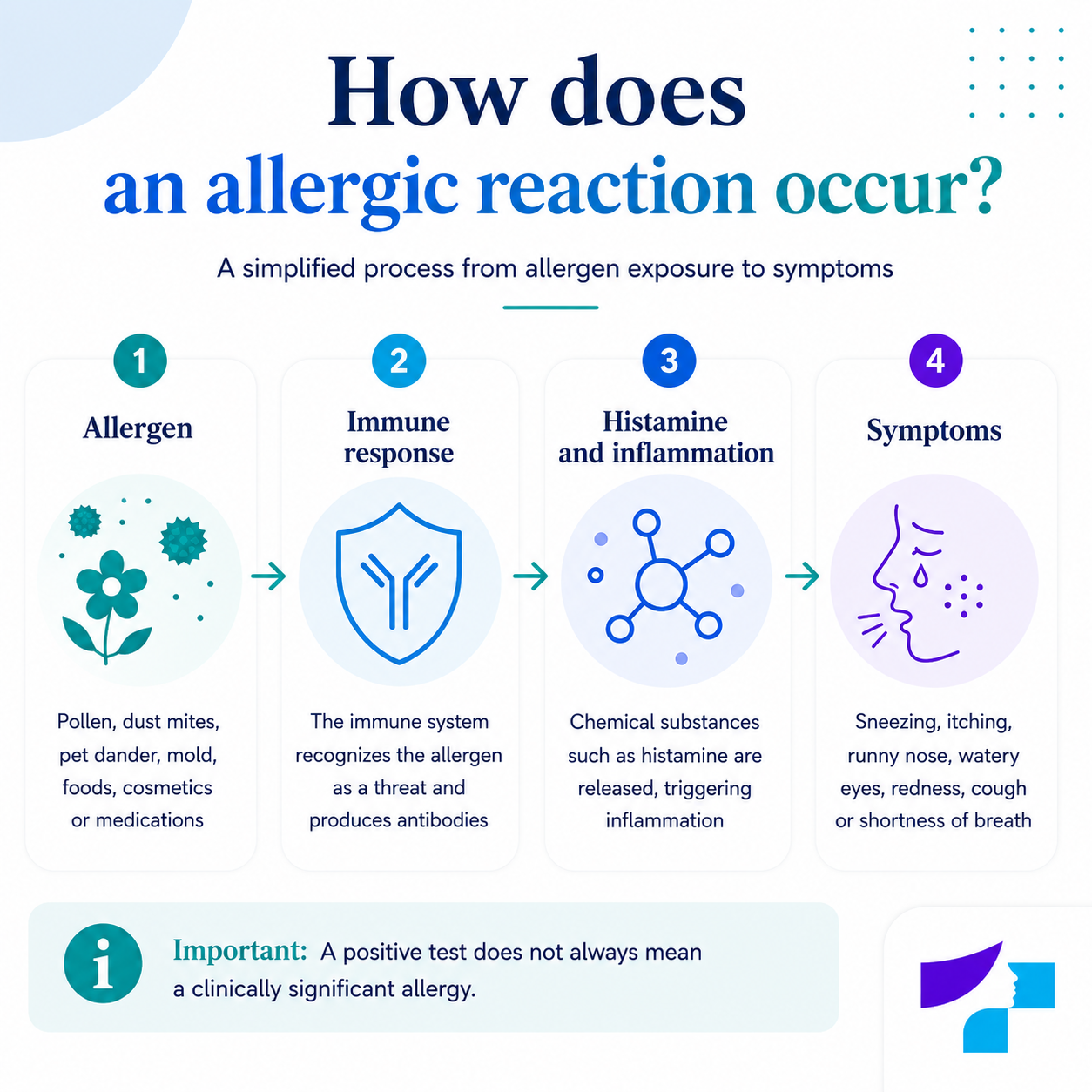
Allergy occurs when the immune system mistakenly recognises a usually harmless substance as a threat and starts an excessive defence reaction against it. This substance is called an allergen. When the body comes into contact with an allergen, inflammatory substances such as histamine may become activated, causing itching, redness, swelling, sneezing, runny nose, watery eyes, hives or other symptoms.
An allergic reaction may be immediate or delayed. Immediate reactions often start within minutes to a few hours after contact with an allergen, for example after a specific food, medicine, insect sting or latex exposure. Delayed reactions may appear after several hours or days. This is typical, for example, of contact allergy to nickel, fragrances, preservatives, hair dyes, cosmetic ingredients or occupational chemicals.
It is important to understand that allergy is not one specific symptom. It is a type of immune reaction that can present differently in different people.
How does an allergic reaction occur?
For allergy to develop, the body may first become sensitive to a specific allergen. This process is called sensitisation. Sensitisation means that the immune system has “recognised” the allergen and may react with symptoms during later exposure.
However, sensitisation does not always mean disease. A person may have a positive allergy test to a certain allergen but have no symptoms in real life. This is why allergy diagnosis cannot be based only on a blood test or a skin test. The doctor must assess whether the test result matches the patient’s symptoms and real-life reactions.
Allergic reactions can involve different immune mechanisms. Some allergies are associated with immunoglobulin E, or IgE antibodies. These reactions are often faster and may be related to food, pollen, animals, dust mites, latex or insect venom. Other reactions, such as allergic contact dermatitis, are delayed and involve cellular immune mechanisms.
What are allergens?
Allergens are substances that can trigger an allergic reaction in sensitive people. They may be found in the air, food, medicines, cosmetics, household chemicals, the workplace or on different surfaces that come into contact with the skin.
Common allergens include:
- pollen;
- house dust mites;
- animal dander, saliva and skin particles;
- mould spores;
- food products;
- medicines;
- insect venom;
- latex;
- nickel and other metals;
- fragrances;
- preservatives;
- cosmetic ingredients;
- hair dyes;
- rubber and adhesive ingredients;
- occupational chemicals.
In some people, symptoms are caused by one clear allergen; in others, several factors may be involved. The severity of a reaction may depend on the amount of allergen, the type of exposure, the condition of the skin or mucous membranes, the season, infections, stress, underlying diseases and medicines being used.
Common allergy symptoms
Allergy symptoms may affect one part of the body or several organ systems at the same time. Sometimes symptoms are mild and short-lived, while in other cases they may be severe and require urgent medical help.
Common allergy symptoms include:
- itching;
- skin redness;
- rash;
- hives;
- swelling of the skin or mucous membranes;
- sneezing;
- runny or blocked nose;
- watery eyes;
- red or itchy eyes;
- cough;
- wheezing;
- shortness of breath;
- chest tightness;
- nausea;
- vomiting;
- abdominal pain;
- diarrhoea;
- dizziness or fainting in a severe reaction.
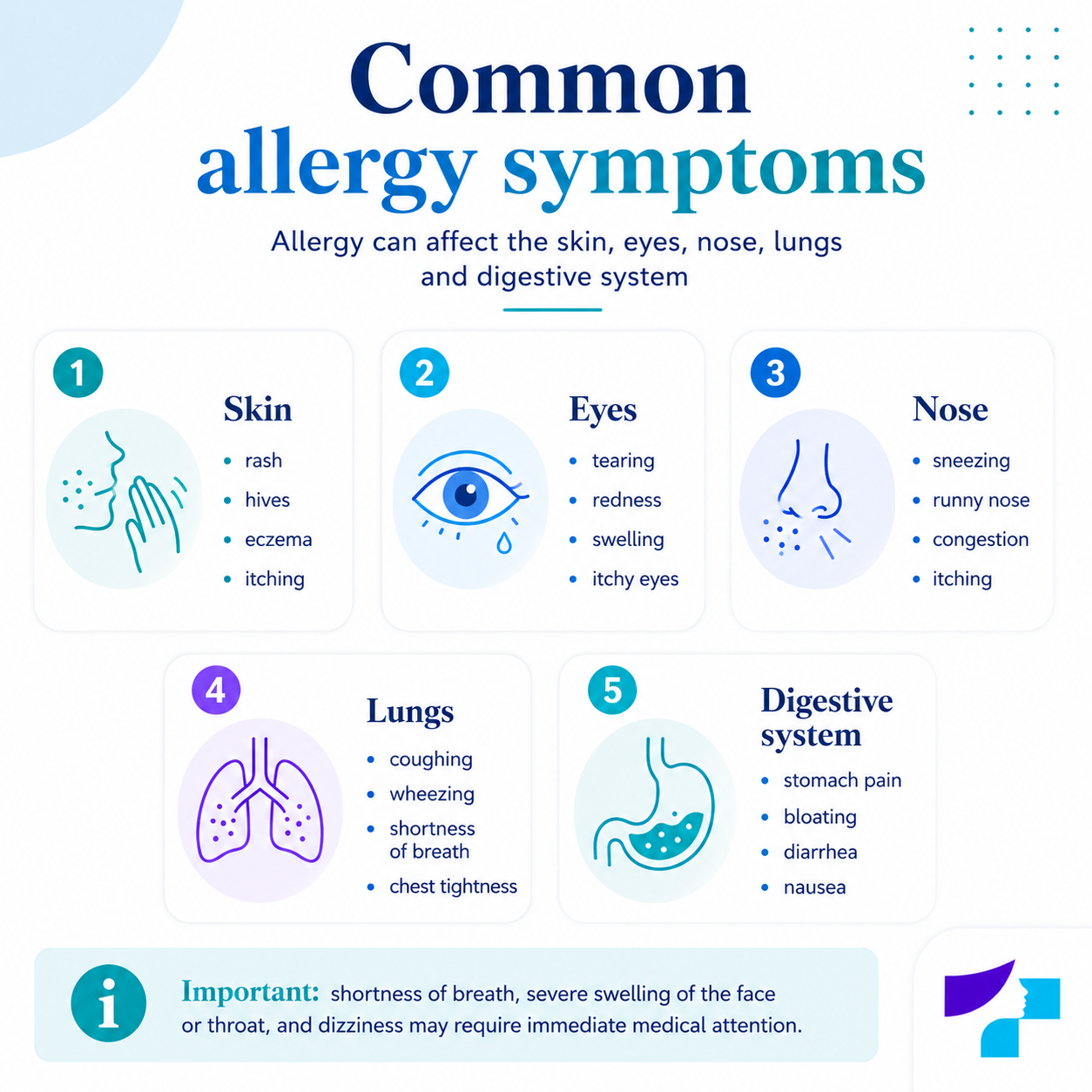
Not every rash, itch, runny nose or digestive symptom means allergy. Similar symptoms may be caused by infections, irritation, chronic skin diseases, autoimmune diseases, medicine side effects, insect bites or other causes.
Skin allergy symptoms
The skin is one of the most common places where allergy becomes visible. Skin allergy may appear suddenly or develop gradually. It may be localised to one area or spread more widely.
Skin allergy may cause:
- itching;
- redness;
- rash;
- hives;
- swelling;
- blisters;
- dry or scaly skin;
- cracks;
- burning sensation;
- skin thickening in long-term inflammation;
- eczema-like skin changes.
Skin allergy is not one specific diagnosis. It is a general term for different reactions that appear on the skin. In one patient, it may be hives; in another, allergic contact dermatitis, a flare of atopic dermatitis, contact urticaria or an allergy-like reaction that is not a classic IgE-mediated allergy.
In dermatology, it is therefore important to assess not only that the skin is itchy or red, but also what the rash looks like, how quickly it appears, how long it lasts, where on the body it is located and whether it is related to food, medicines, cosmetics, the workplace, jewellery, gloves or other exposures.
Sudden, raised and very itchy wheals that change location are more typical of acute urticaria, or hives. Delayed redness, itching, blisters, dryness and cracks at the contact site are more suggestive of contact dermatitis. Dry, chronically inflamed and repeatedly itchy skin may be a sign of atopic dermatitis. Inflammation of the face and eyelids is often related to cosmetics, eye drops, nail cosmetics, hair dyes or fragrances; more information is available in the article Facial and eyelid dermatitis.
If skin symptoms are persistent, recurrent or unclear, an examination by a dermatologist is recommended.
Nose, eye and airway symptoms
Allergy often affects the mucous membranes of the nose, eyes and airways. This is especially typical of allergy to pollen, dust mites, animals or mould.
Nose and eye symptoms may include:
- frequent sneezing;
- runny nose;
- blocked nose;
- itching in the nose;
- itching in the throat or palate;
- watery eyes;
- red eyes;
- swollen eyelids;
- burning or a gritty feeling in the eyes.
Airway symptoms may include:
- cough;
- wheezing;
- shortness of breath;
- chest tightness;
- reduced exercise tolerance;
- worsening asthma symptoms.
Shortness of breath, wheezing or chest tightness should not be ignored. These symptoms may be related to bronchial asthma or a severe allergic reaction and require medical assessment.
Digestive symptoms
Food allergy may also affect the digestive system. Symptoms may appear quickly after eating a specific food or develop more gradually.
Possible symptoms include:
- itching in the mouth;
- swelling of the lips, tongue or throat;
- nausea;
- vomiting;
- abdominal pain;
- diarrhoea;
- bloating;
- in children — restlessness, refusal of food or poor weight gain if the problem is long-lasting.
Digestive symptoms alone do not always mean food allergy. They may also be caused by food intolerance, infection, irritable bowel syndrome, enzyme deficiency or other digestive disorders. Therefore, excluding foods from the diet should be done carefully and with a clear reason, especially in children.
When can allergy be dangerous?
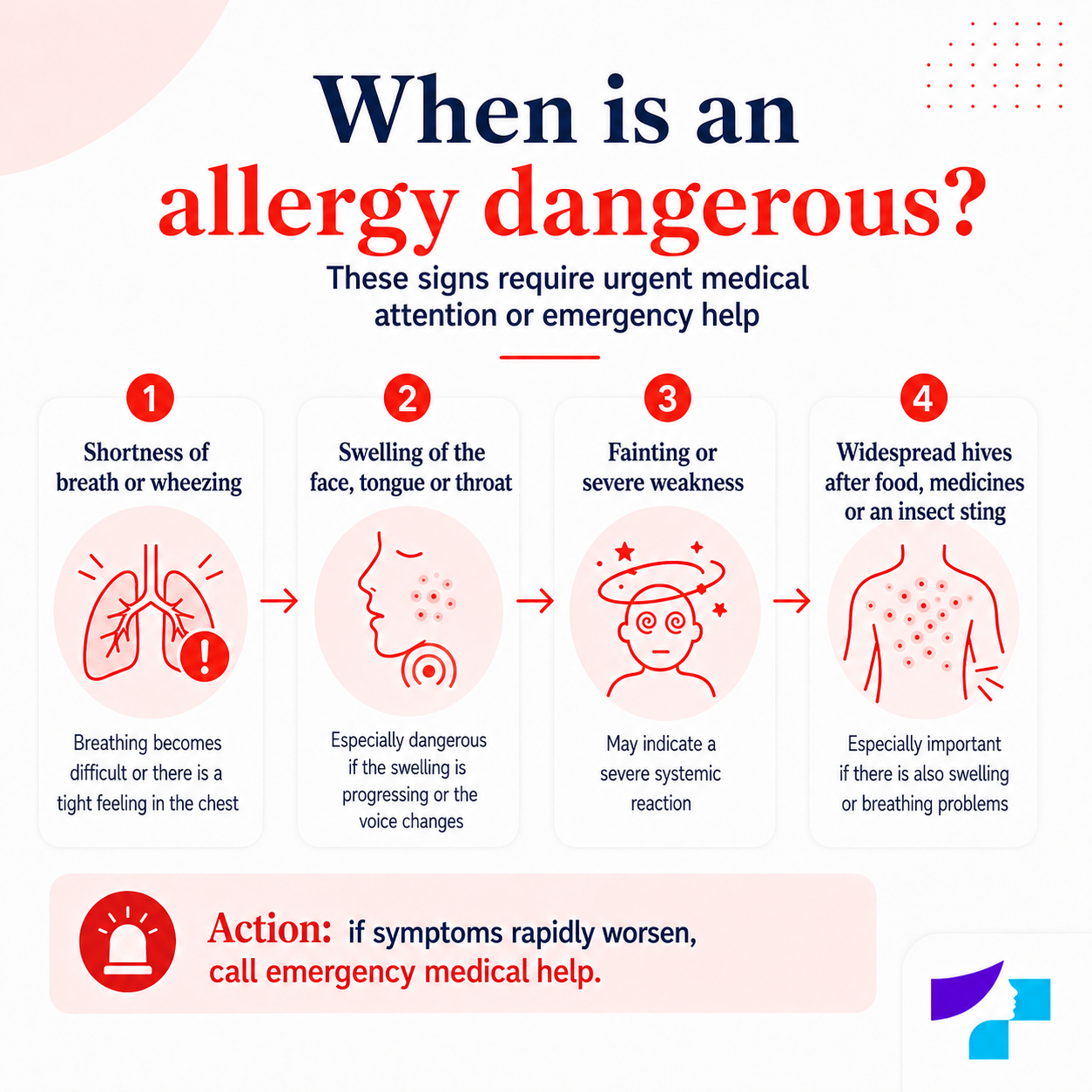
Allergy can be dangerous when the reaction becomes systemic — when it affects not only one area but several organ systems or interferes with breathing and circulation.
Urgent medical help is needed if any of the following occur:
- difficulty breathing;
- wheezing;
- chest tightness;
- rapid swelling of the lips, tongue, face or throat;
- hoarseness after possible allergen exposure;
- fainting;
- severe dizziness;
- confusion;
- sudden weakness;
- widespread hives together with swelling or breathing problems;
- a reaction after food, medicine or an insect sting that is rapidly worsening.
In these situations, you should not wait to see whether the symptoms will pass on their own. Emergency medical help should be called.
Anaphylaxis — when is emergency help needed?
Anaphylaxis is a severe, rapid and potentially life-threatening allergic reaction. It may develop after exposure to a food allergen, medicine, insect sting, latex or another allergen. Anaphylaxis may affect the skin, airways, cardiovascular system and digestive system at the same time.
Anaphylaxis may present with hives, swelling, shortness of breath, wheezing, a feeling of throat tightness, vomiting, abdominal pain, dizziness, a drop in blood pressure or fainting. In some people, skin symptoms may not be prominent, so a severe reaction should not be assessed only by the presence or absence of a rash.
People who have previously had anaphylaxis or who have been identified by a doctor as being at high risk of a severe reaction may be given an individual emergency action plan. Following such a plan is especially important in food, medicine or insect venom allergy.
Common causes of allergy
Allergy may be caused by different allergens. Some act through the airways, some through the skin or digestive system, and some by injection or sting, such as medicines or insect venom.
Food allergens
Food allergy is more commonly caused by:
- milk;
- eggs;
- wheat;
- soy;
- peanuts;
- tree nuts;
- fish;
- shellfish;
- sesame.
Food allergy symptoms may be mild, but they may also be severe. The severity of a reaction cannot always be predicted only from previous experience. If swelling, breathing problems, fainting or severe hives have occurred after eating a food, medical assessment is needed.
Airborne allergens
Airborne allergens most often cause symptoms in the nose, eyes and airways. They may include:
- pollen;
- house dust mites;
- animal dander;
- animal saliva and skin particles;
- mould spores.
Pollen allergy is usually seasonal — symptoms worsen at certain times of the year. Dust mite allergy is more often year-round and may worsen in the bedroom, at night or in the morning.
Contact allergens
Contact allergy occurs when the skin comes into contact with a substance to which a person has become sensitised. Common contact allergens include:
- nickel;
- chromium;
- cobalt;
- fragrances;
- preservatives;
- hair dye ingredients;
- cosmetic products;
- nail care products;
- latex;
- rubber ingredients;
- adhesives;
- occupational chemicals;
- disinfectants and cleaning products.
Contact allergy is often chronic or recurrent because a person may not know for a long time which substance is causing the reaction. In such cases, a dermatologist’s examination and patch tests are important.
Medicines, latex and insect stings
Medicine allergy may be mild, but it can also be severe. It may present with rash, hives, swelling, shortness of breath or a systemic reaction. If medicine allergy is suspected, it is important to write down the name of the medicine, when it was taken, when symptoms started and what the reaction looked like. The suspected medicine should not be “tested” again by the patient.
Insect sting allergy may present with a large local swelling or a systemic reaction. If shortness of breath, dizziness, fainting, widespread hives or swelling of the face and throat appear after a sting, emergency help is needed.
Latex may cause both skin reactions and immediate allergic reactions. This is especially important for people who often come into contact with medical gloves, certain medical devices or occupational materials.
Types of allergy
Allergy is not one disease that looks the same in all patients. Below are common types of allergy and allergy-like conditions that often raise practical questions for patients.
Skin allergy
Skin allergy may be related to food, medicines, contact allergens, insect bites, cosmetics or other substances. It may present with itching, rash, redness, hives, swelling, blisters, dryness or eczema-like skin inflammation.
It is important to remember that skin allergy may be mimicked by other diseases. For example, fungal infection, scabies, bacterial infection, rosacea, psoriasis, seborrhoeic dermatitis, atopic dermatitis and other skin diseases may cause itching or rash. Therefore, persistent or recurrent skin symptoms should be assessed by a dermatologist.
Atopic dermatitis
Atopic dermatitis is a chronic inflammatory skin disease in which impaired skin barrier function, inherited tendency and inflammation play an important role. It is often associated with allergic predisposition, but atopic dermatitis is not simply “skin allergy”.
In atopic dermatitis, the skin is often dry, sensitive, itchy and inflamed. The disease may have flares and periods of improvement. Allergens may worsen the disease in some patients, but they are not always the main cause.
Treatment of atopic dermatitis focuses on restoring the skin barrier, regular moisturising, controlling inflammation and identifying provoking factors. Allergy testing should be targeted and clinically justified, not performed automatically in every patient.
Acute urticaria, or hives
Acute urticaria, or hives, presents with sudden, raised, very itchy wheals that may change location and disappear within a few hours. Sometimes hives are related to allergy, but they may also be triggered by infections, medicines, food, physical factors or other causes.
Patients with hives often suspect a specific food, but this is not always confirmed. The timing of the reaction, recurrence of symptoms and possible triggers should therefore be assessed carefully.
If hives occur together with swelling of the face, lips, tongue or throat, shortness of breath, dizziness or fainting, emergency help is needed.
Angioedema
Angioedema is deeper swelling of the skin or mucous membranes. It may affect the lips, eyelids, face, tongue, throat, hands, feet or other parts of the body. Angioedema may be associated with an allergic reaction, hives, medicines or other mechanisms.
Swelling of the tongue, throat or airways is especially dangerous because it may make breathing difficult. If swelling progresses rapidly or shortness of breath appears, emergency medical help should be called.
The cause of angioedema is not always a classic allergy, so recurrent episodes require medical assessment.
Contact urticaria
Contact urticaria is a rapid skin reaction that appears after direct contact with a specific substance. It may present with itching, redness, swelling or hive-like changes at the contact site.
Contact urticaria differs from allergic contact dermatitis. Contact urticaria usually appears quickly, whereas contact dermatitis more often develops after several hours or days. Triggers may include latex, food products, animal-derived substances, cosmetics or occupational allergens.
If contact urticaria is associated with airway symptoms, swelling or a generalised reaction, urgent medical assessment is needed.
Contact allergy and contact dermatitis
Contact allergy is a delayed allergic reaction after skin contact with a specific substance. It may also develop to a substance that has previously been used for a long time without obvious problems. For example, a person may use the same cosmetic product for years and later become allergic to one of its ingredients.
Allergic contact dermatitis often presents with:
- itching;
- redness;
- swelling;
- blisters;
- dry skin;
- scaling;
- cracks;
- thickened skin in long-term inflammation.
The reaction often starts where the skin has been in contact with the allergen. Nickel allergy may appear under jewellery, a belt buckle or a watch. Hair dye allergy may affect the scalp, ears, face and neck. Cosmetic allergy often appears on the face, eyelids, lips or hands.
Patch tests are especially important in the diagnosis of contact allergy. They help identify the specific substance that should be avoided in the future.
Facial and eyelid dermatitis
Facial and eyelid dermatitis often raises suspicion of allergy because eyelid skin is thin and sensitive. Symptoms may include redness, itching, swelling, scaling, burning or dryness.
Possible triggers include cosmetics, eye drops, nail polish or gel polish, hair dye, fragrances, preservatives, facial care products, occupational substances or airborne irritants. Sometimes eyelid dermatitis is caused by a substance that is not applied directly to the eyelids, for example nail cosmetics or hair products.
Self-treatment in this area should be especially cautious because unsuitable products may irritate the eyes or the thin eyelid skin.
Hand and foot dermatitis
Hand and foot dermatitis may be related to allergy, irritation, atopic tendency, moisture, friction, disinfectants, gloves, household chemicals or occupational substances. Hands are often affected by repeated washing, disinfection, cleaning products and mechanical stress.
Symptoms may include:
- dryness;
- itching;
- cracks;
- redness;
- blisters;
- skin thickening;
- pain;
- burning.
In hand dermatitis, irritation and contact allergy often occur together. Therefore, persistent or recurrent symptoms may require a dermatologist’s examination and patch tests.
Systemic contact dermatitis
Systemic contact dermatitis may develop in people who are already sensitised to a specific contact allergen, but symptoms appear not only at the site of direct skin contact. The reaction may be triggered when the allergen enters the body by another route, for example through food, medicines or medical materials.
This condition is not as easy to recognise as ordinary contact dermatitis because the rash may be more widespread or recur without an obvious contact with the allergen. A detailed medical history, dermatologist assessment and targeted diagnostics are therefore especially important.
Pseudoallergy
Pseudoallergy is an allergy-like reaction whose symptoms may resemble a classic allergy, but the mechanism is not the same as in IgE-mediated allergy. A person may have hives, redness, itching, swelling, a feeling of heat, digestive symptoms or feeling unwell after a certain food, medicine or other substance, while classic allergy tests do not always confirm allergy.
This does not mean that the symptoms are “imaginary”. They may be real and troublesome, but a different diagnostic approach is needed to explain them.
Pseudoallergy should be considered especially when symptoms recur but allergy tests do not match the complaints, reactions are associated with several different foods or substances, or there is no clear single allergen. In such situations, broad food exclusions or medication use without medical advice should be avoided.
Food allergy
Food allergy is an immune system reaction to a specific food or its proteins. It may range from itching in the mouth or hives to a severe systemic reaction.
Food allergy symptoms may include:
- itching in the mouth or throat;
- swelling of the lips, tongue or face;
- hives;
- skin redness;
- vomiting;
- abdominal pain;
- diarrhoea;
- cough;
- wheezing;
- shortness of breath;
- dizziness or fainting in a severe reaction.
Food allergy should not be confused with food intolerance. Intolerance is more often related to the digestive system, for example enzyme deficiency or individual sensitivity to certain substances. Food allergy is an immune reaction and in some cases may be life-threatening.
In children, some food allergies may lessen with age, but this is not guaranteed. In adults, food allergy may also appear for the first time. Unnecessary elimination diets without a diagnosis may lead to nutritional deficiencies, especially in children.
Pollen allergy
Pollen allergy is often also called seasonal allergy or hay fever. It occurs when the immune system reacts to tree, grass or weed pollen.
Typical symptoms include:
- sneezing;
- runny nose;
- blocked nose;
- itchy eyes;
- watery eyes;
- red eyes;
- itching in the throat;
- cough;
- tiredness due to poor sleep quality.
Pollen allergy may worsen asthma symptoms. Some people may also have cross-reactions with foods, for example itching in the mouth or throat after eating certain fresh fruits, vegetables or nuts. In such cases, medical assessment is needed because the severity of reactions may differ.
Dust mite allergy
Dust mites are microscopic organisms that live in house dust, especially in mattresses, pillows, blankets, upholstered furniture and textiles. Allergy is caused not by “dust” itself, but by dust mite particles and their waste products.
Dust mite allergy may cause:
- blocked nose;
- sneezing;
- runny nose;
- itching in the nose;
- eye irritation;
- cough;
- worsening asthma symptoms;
- worsening symptoms at night or in the morning.
Symptoms are often year-round rather than seasonal. Reducing allergen exposure in the living environment is important, although complete avoidance of dust mites is usually not possible.
Animal allergy
Allergy to cats or dogs is not only an allergy to fur. Allergens may be found in animal dander, saliva, skin particles and urine proteins. This is why symptoms may persist even if the home has been cleaned or the animal is temporarily not in the room.
Animal allergy may cause:
- sneezing;
- runny nose;
- blocked nose;
- itchy and watery eyes;
- cough;
- wheezing;
- skin itching or rash after contact with an animal.
If the animal already lives at home, the situation should be assessed individually. Environmental measures may help in some cases, but more severe symptoms require consultation with an allergist or another doctor.
Medicine allergy
Medicine allergy is an immune system reaction to medicines or their ingredients. It may present with skin rash, hives, itching, swelling, breathing difficulties or severe reactions. However, not every unpleasant reaction after taking medicine is an allergy. Sometimes it is a side effect, intolerance or a manifestation of the underlying illness.
If medicine allergy is suspected, it is important to write down:
- the name of the medicine;
- the dose and route of administration, if known;
- when the medicine was taken;
- when symptoms started;
- what the symptoms were;
- whether emergency help was needed;
- which medicines were used to reduce the reaction.
The suspected medicine should not be taken again by the patient to “check” whether the reaction returns. This may be dangerous. Further assessment should be carried out by a doctor.
Skin allergy — which Medart article can help next?
Skin allergy may present in many different ways, so one symptom does not always mean one diagnosis. Itching, redness, rash, swelling or dry skin may be related to allergy, irritation, chronic dermatitis, hives or other skin diseases.
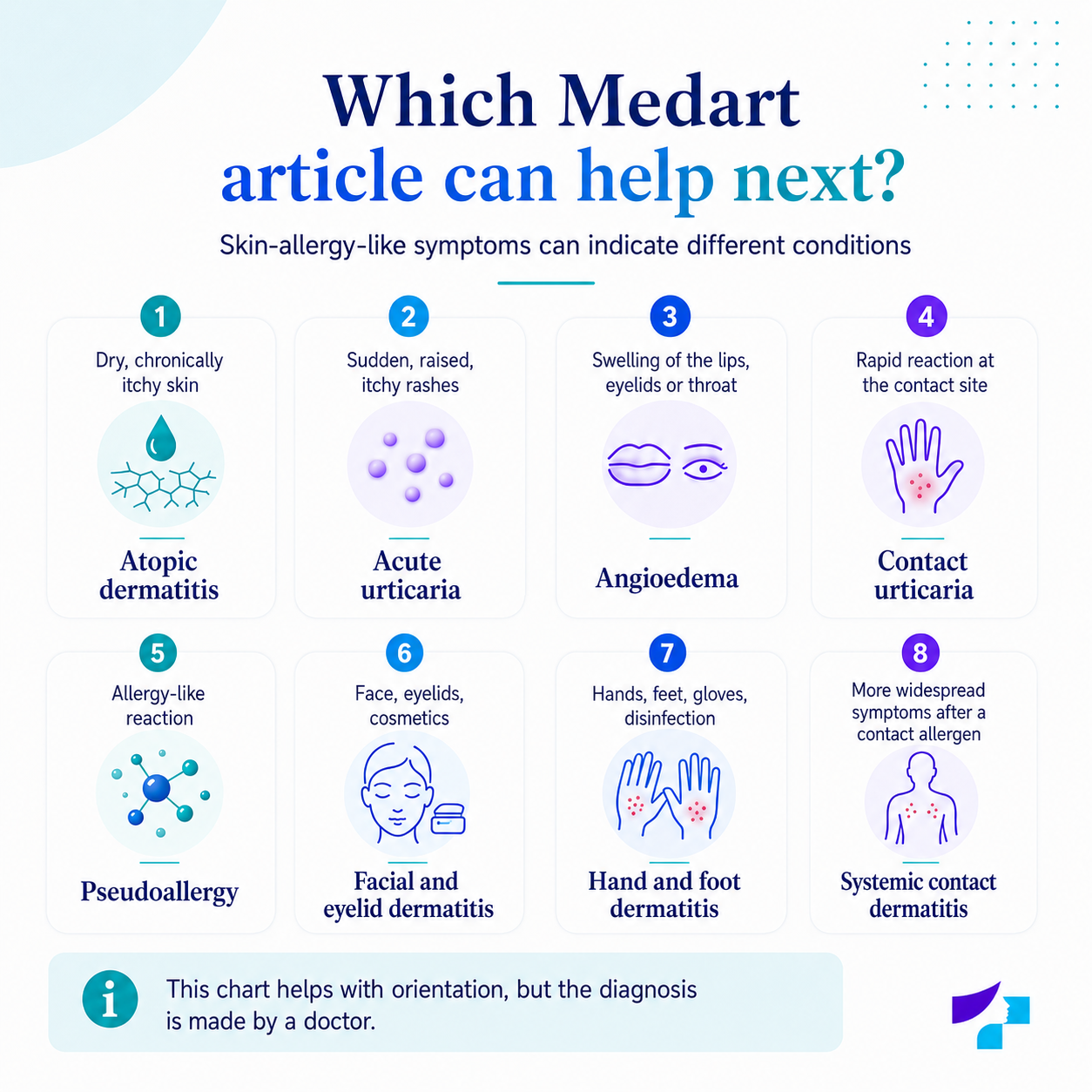
If the skin is dry, sensitive, chronically inflamed, itchy and the condition recurs, especially in children or people with allergic predisposition, read more in the article Atopic dermatitis.
If sudden, raised and very itchy wheals appear, change location and disappear within a few hours, acute urticaria, or hives, may be possible. Hives may be related to allergy, infection, medicines, food or other triggers.
If swelling of the lips, eyelids, face, tongue or throat appears with or without rash, angioedema should be considered. Rapid swelling of the tongue, throat or airways may be dangerous and requires emergency help.
If the reaction appears directly after skin contact with a specific substance and causes hive-like swelling or itching at the contact site, contact urticaria may be possible. It differs from allergic contact dermatitis, which usually develops later.
If symptoms resemble allergy but classic allergy mechanisms or tests do not confirm it, pseudoallergy may be possible. In such situations, symptoms may be real, but their mechanism differs from classic allergy.
If rash, itching or redness affects the face, eyelids or the area around the eyes, especially after using cosmetics, eye drops, nail polish, hair dye or skin care products, the article Facial and eyelid dermatitis may be useful.
If the problem mainly affects the hands or feet, for example with cracks, itching, dryness, blisters or skin thickening, especially in relation to work, moisture, gloves, disinfectants or household chemicals, read more in the article Hand and foot dermatitis.
If a contact allergen causes not only a local reaction at the contact site but broader or recurrent skin symptoms, systemic contact dermatitis may be possible. In such cases, dermatologist assessment and accurate allergen identification are especially important.
Allergy in children
Allergies in children may present differently than in adults. Food allergy, atopic dermatitis, allergic rhinitis and asthma symptoms may be more common. In children, it is especially important to avoid unnecessary diets, as they may affect growth, nutrient intake and quality of life.
A doctor should be consulted if a child has:
- recurrent rash or itching;
- widespread hives;
- swelling of the face, lips or eyelids;
- vomiting or diarrhoea after a specific food;
- cough, wheezing or shortness of breath;
- suspected food or medicine allergy;
- poor weight gain or dietary restrictions because of suspected allergy.
Some children may outgrow certain food allergies, but this should not be assumed without medical assessment. Allergy test selection in children should be based on symptoms, age and the clinical situation.
Allergy in adults
Allergy may also appear for the first time in adulthood. This may happen after repeated exposure to an allergen, occupational exposure, new cosmetics or medicines, a change of living environment, a pet entering the household or other factors.
In adults, common allergy-related issues include:
- seasonal allergy;
- contact allergy;
- cosmetic-related skin inflammation;
- occupational dermatitis;
- medicine allergy;
- insect sting allergy;
- food allergy;
- a combination of allergic rhinitis and asthma.
If symptoms recur or affect sleep, work, exercise, daily activities or skin condition, long-term self-treatment alone is not recommended.
How to distinguish allergy from other conditions?
Allergy may look similar to other diseases. Correct differentiation is important so that treatment is effective and safe.
Allergy or a common cold?
Allergy is more often associated with itching in the nose or eyes, sneezing, watery nasal discharge, watery eyes and symptoms that recur in a specific environment or season. A common cold more often starts with sore throat, tiredness, signs of infection and sometimes fever.
If runny nose and sneezing recur in a similar way every spring or after contact with animals, allergy is more likely. If symptoms are short-lived, with fever and a general feeling of illness, infection may be possible.
Allergy or food intolerance?
Food allergy is an immune system reaction. It may present with hives, swelling, itching in the mouth, vomiting, breathing symptoms or, in severe cases, anaphylaxis. Food intolerance is more often related to digestive symptoms such as bloating, abdominal pain or diarrhoea and is usually not life-threatening.
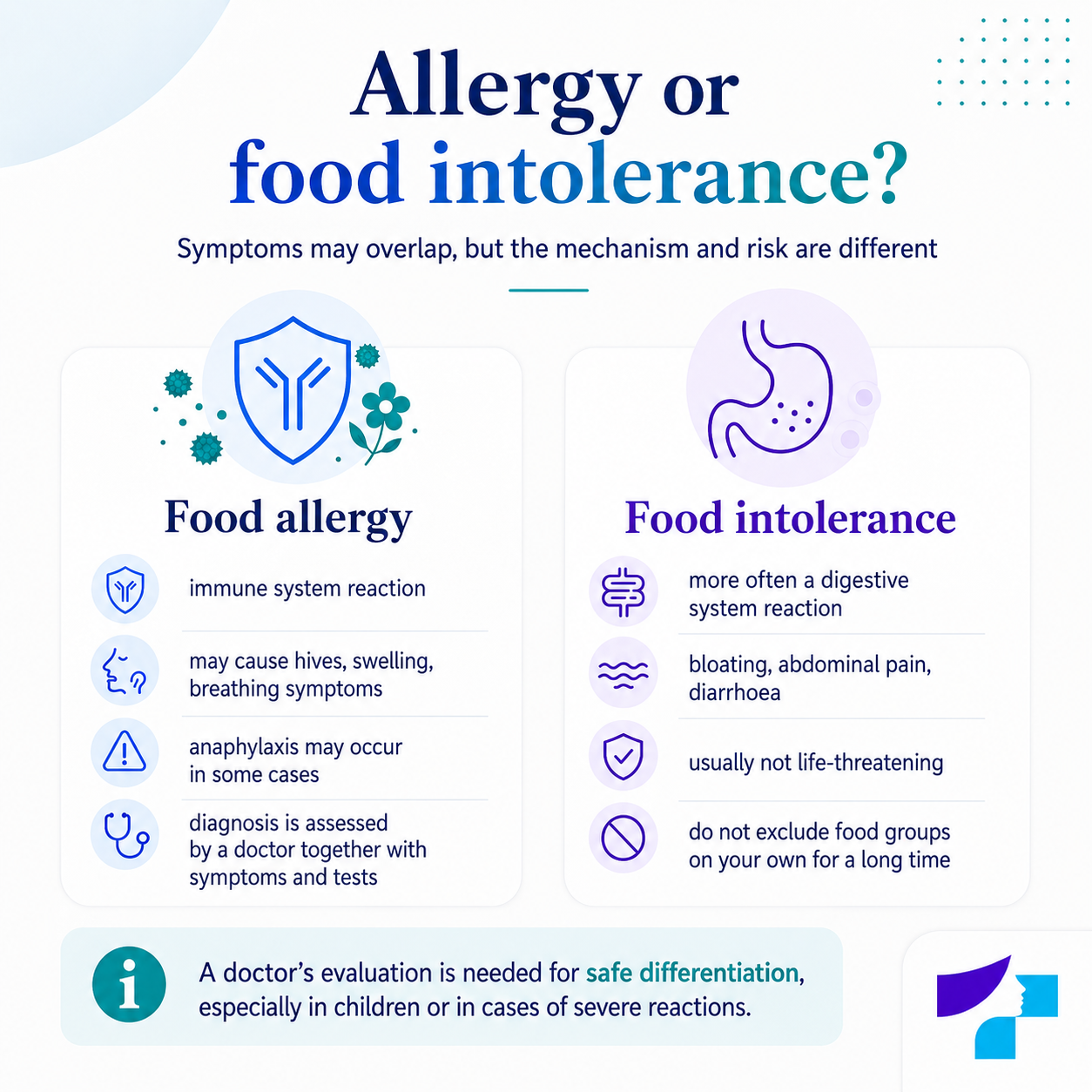
However, symptoms may overlap. Therefore, self-diagnosis and long-term exclusion of several foods without a doctor or dietitian should be avoided.
Allergy or skin infection?
Skin allergy often itches and may be associated with redness, rash or swelling. Infection is more often associated with pain, warmth in the affected area, pus, marked swelling, rapid spread or fever.
If a skin lesion becomes painful, produces pus, forms an ulcer, red streaks appear, temperature rises or there is general weakness, medical assessment is needed.
Allergy or atopic dermatitis?
Atopic dermatitis is not simply “skin allergy”. It is a chronic inflammatory skin disease in which impaired skin barrier function, inherited tendency, environmental factors and inflammation play an important role. Allergens may worsen the disease in some patients, but they are not always the only or main cause.
In atopic dermatitis, treatment focuses on skin care, moisturising, controlling inflammation and identifying provoking factors. Allergy testing should be targeted and clinically justified, not performed automatically in every patient.
Allergy or irritation?
Allergy and irritation may look similar, but their mechanisms differ. Allergy is an immune system reaction to a specific allergen. Irritation occurs when a substance directly damages the skin or mucous membranes.
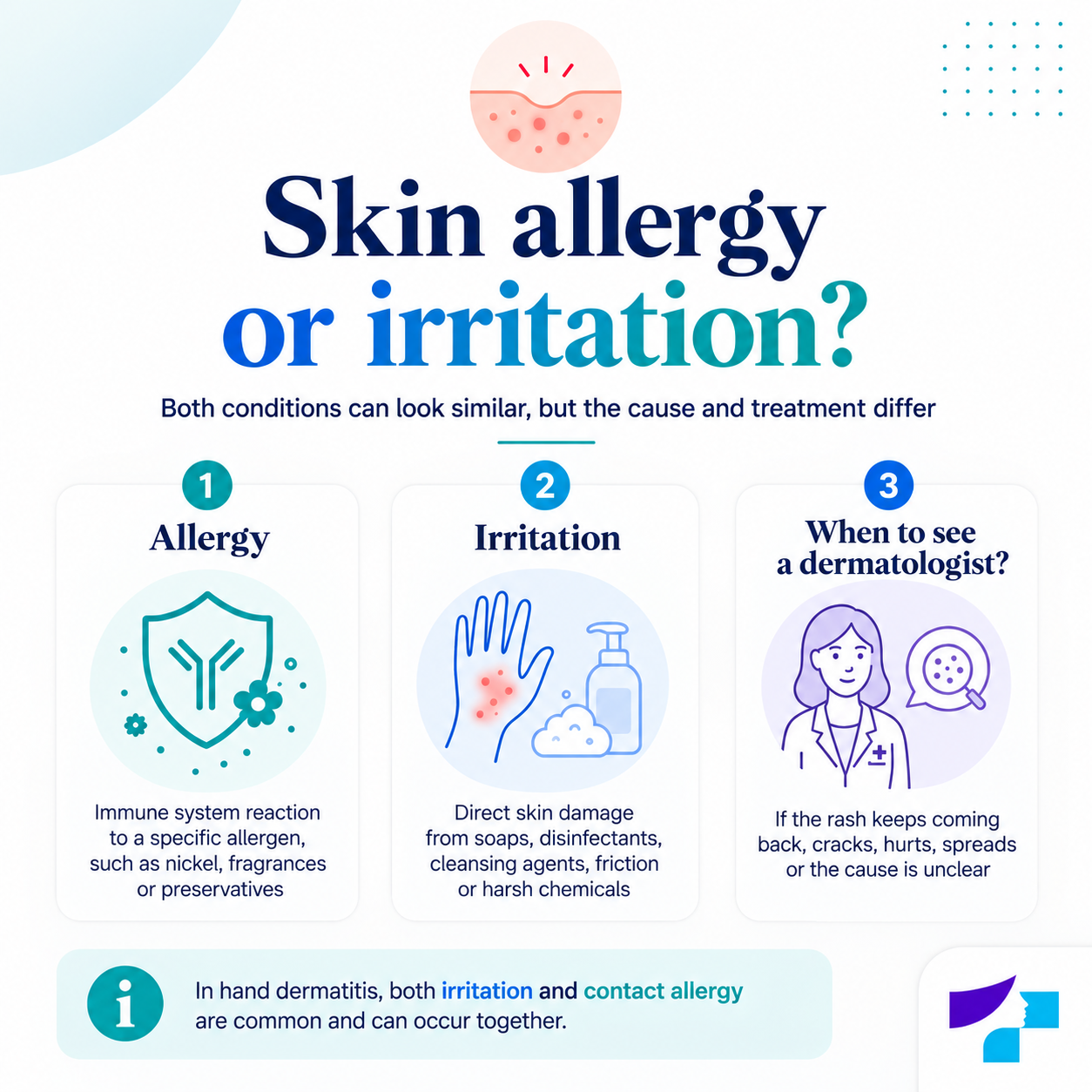
Irritation may be caused by:
- frequent hand washing;
- disinfectants;
- soap;
- cleaning products;
- solvents;
- acids or alkalis;
- friction;
- moisture;
- cold;
- work gloves and sweating under them.
In hand dermatitis, irritation and contact allergy often occur together. Chronic hand eczema, cracks, itching or skin thickening should therefore be assessed by a dermatologist.
Allergy or pseudoallergy?
Sometimes a person has symptoms that strongly resemble allergy — hives, redness, itching, swelling, a feeling of heat, digestive symptoms or feeling unwell after a certain food, medicine or other substance. However, tests do not always confirm a classic allergy.
In such situations, pseudoallergy, or an allergy-like reaction, may be possible. Its symptoms may resemble allergy, but the mechanism is not the same as in classic IgE-mediated allergy.
Pseudoallergy should be considered especially when symptoms recur but allergy tests do not match the complaints, reactions are associated with several different foods or substances, or no clear single allergen is identified.
How to find out what you are allergic to?
Allergy diagnosis begins not with a test panel, but with a conversation and analysis of symptoms. The doctor needs to understand when symptoms started, how often they recur, during which season they worsen and which foods, medicines, cosmetics or occupational substances may be related to the reaction.
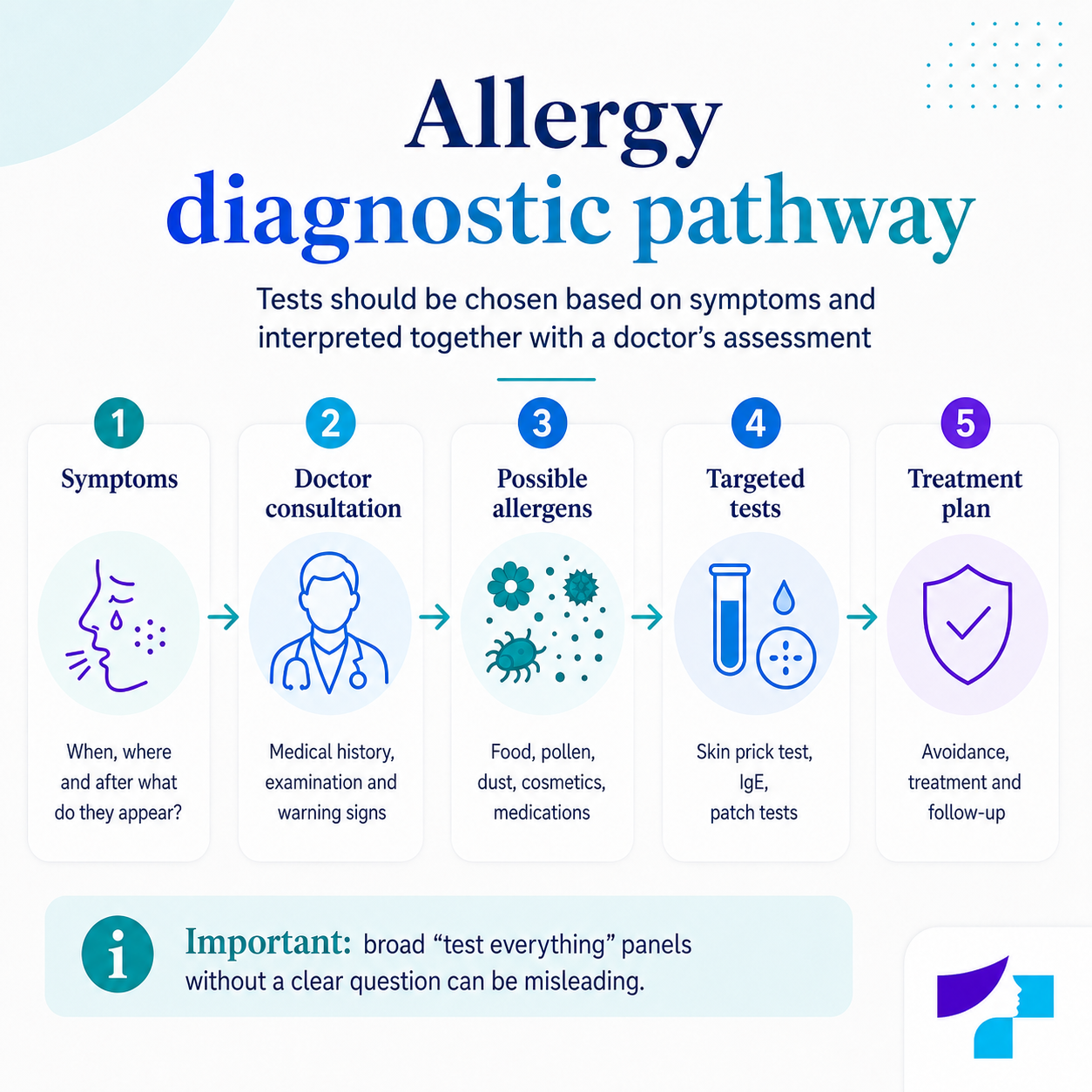
Useful information for the doctor includes:
- when the symptoms started;
- how quickly they appear after contact with a possible allergen;
- how long the symptoms last;
- whether the reaction recurs;
- whether symptoms are seasonal;
- whether they appear at home, at work, at school or outdoors;
- which foods have been eaten;
- which medicines have been used;
- which cosmetics or household chemicals have been used;
- whether there are pets;
- whether there is asthma, atopic dermatitis or other allergic disease;
- whether allergic diseases occur in the family.
A symptom diary, food diary or photographs taken when symptoms are visible may also be helpful. This is especially useful if the rash has already improved by the time of the consultation.
Allergy diagnostics
Several methods may be used in allergy diagnostics. They are chosen according to the symptoms and the suspected allergen. There is no single test that can answer all questions about all types of allergy.
Common diagnostic methods include:
- medical consultation and history taking;
- skin examination;
- skin prick tests;
- specific IgE blood tests;
- patch tests;
- challenge tests under medical supervision;
- additional investigations if other diseases need to be excluded.
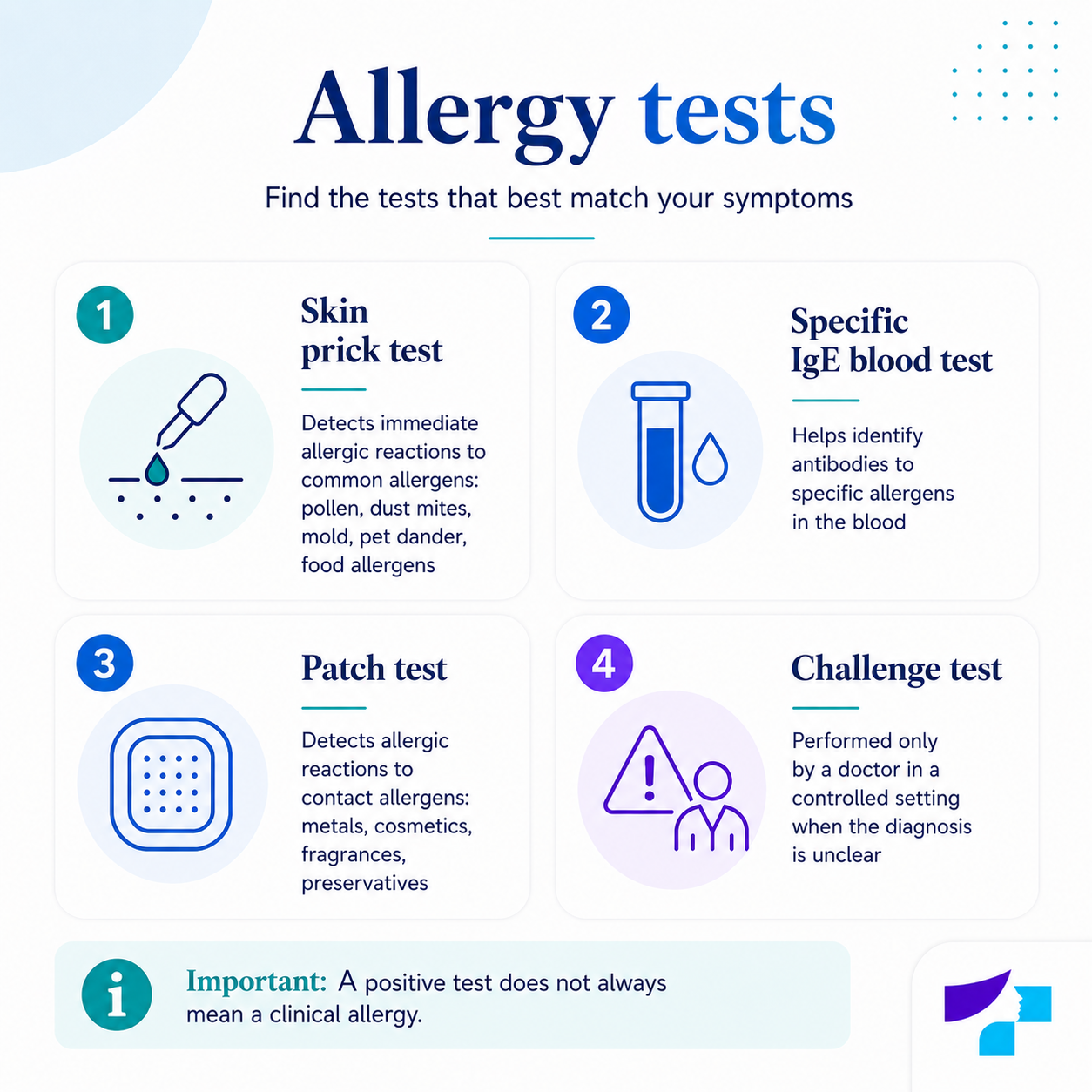
It is important to understand that allergy tests should not be performed “for everything”. Very broad, unstructured test panels may show sensitisation to substances that do not actually cause symptoms. This may lead to unnecessary anxiety, dietary restrictions or incorrect treatment.
Skin prick tests
The skin prick test is one of the most commonly used tests for immediate-type allergy. It may be used when allergy to pollen, dust mites, animals, mould or certain food allergens is suspected.
During the test, a small amount of allergen is applied to the skin and allowed to enter the upper layer of the skin through a very shallow prick. After a set time, the doctor assesses whether a reaction — redness and a raised bump — has developed. The test helps detect sensitisation, but the result must be interpreted together with symptoms.
Some anti-allergy medicines may need to be stopped before skin tests because they can affect the result. This should always be agreed with the doctor. Essential medicines should not be stopped without medical advice, especially if they are needed to control other diseases.
Specific IgE in blood
Specific IgE is a blood test that helps detect the body’s sensitivity to specific allergens. It may be useful when skin testing cannot be performed, when there are widespread skin lesions, when a patient is taking medicines that cannot be stopped, or when additional confirmation is needed.
However, a specific IgE result should not be interpreted separately from the clinical situation. A positive result may indicate sensitisation, but it does not always mean that the allergen actually causes symptoms. A negative result also does not always completely exclude all forms of allergy, especially if the reaction mechanism is not IgE-mediated.
Patch tests
Patch tests are the most important investigation for allergic contact dermatitis. They are used when contact allergy to metals, cosmetics, fragrances, preservatives, hair dyes, rubber, adhesives, occupational substances or other skin-contacting materials is suspected.
Unlike the skin prick test, patch test reactions are not assessed immediately. Allergens are applied to the skin for a certain period, and the reaction is assessed later. This helps detect delayed allergic reactions.
These tests are especially important for people with chronic hand dermatitis, facial or eyelid inflammation, reactions after cosmetics, hair dye, nail care products, jewellery or occupational substances.
Challenge tests
Challenge tests involve controlled exposure to a possible allergen under medical supervision. They may be used in specific situations, for example when food or medicine allergy is being assessed and the diagnosis is unclear.
Challenge tests must not be performed at home on one’s own initiative. They can be dangerous if there is a risk of a severe reaction. The need for such testing is assessed by a doctor.
What does a positive allergy test mean?
A positive allergy test means that the body is sensitive to a specific allergen. However, it does not always mean that this allergen actually causes symptoms.
For example, a person may have a positive test to a certain food but eat that food without any reaction. In this situation, excluding the food may be unnecessary. This is why test results must be assessed together with symptoms, timing of the reaction, amount of allergen and the patient’s medical history.
In allergy diagnostics, the question is not only “is the test positive?”, but “does this positive test explain the patient’s symptoms?”
How to prepare for allergy tests?
Preparation depends on the type of test. Before the consultation, it is useful to prepare information about symptoms, medicines, diet, cosmetics, workplace exposures and previous reactions.
It is useful to bring:
- a list of medicines used;
- a list of food supplements;
- names of cosmetics or skin care products;
- photographs of rashes;
- a symptom diary;
- information about the timing of reactions after food, medicine or contact exposure;
- previous test and investigation results.
The doctor should be asked about antihistamines or other medicines before testing. Some medicines may affect skin tests, but they should not be stopped without agreement with a doctor.
How is allergy treated?
Allergy treatment depends on the type of allergy, symptom severity, allergen, patient age, underlying diseases and lifestyle. There is no single treatment method that works for all allergies.
The main principles of treatment are:
- identifying the possible allergen;
- reducing or preventing contact with the allergen;
- controlling symptoms;
- treating inflammation;
- restoring the skin barrier if the skin is affected;
- assessing allergen-specific immunotherapy if appropriate;
- creating an action plan for severe reactions.
Treatment must be individualised. Mild seasonal allergy and severe food or medicine allergy cannot be treated in the same way.
Avoidance of the allergen
If the allergen is known and clinically relevant, reducing exposure is important. This may involve dietary changes, workplace adjustments, checking cosmetic ingredients, dust mite reduction measures at home or avoiding specific medicines.
However, allergen avoidance should not become unjustified. If it is unclear whether a specific substance causes symptoms, broad restrictions may do more harm than good. This is especially true in children’s diets.
In contact allergy, accurate identification of the allergen is very practical because the patient can avoid a specific substance rather than avoiding all cosmetics or household products.
Symptomatic treatment
Symptomatic treatment helps reduce itching, rashes, runny nose, eye symptoms or skin inflammation. Different approaches may be used, such as:
- antihistamines;
- nasal sprays;
- eye drops;
- topical anti-inflammatory medicines;
- skin moisturisers and barrier-repair products;
- airway treatment if asthma symptoms are present;
- doctor-prescribed treatment for more severe reactions.
This article does not provide specific doses or individual treatment regimens, because these must be chosen by a doctor, taking into account the patient’s age, symptoms, underlying conditions, pregnancy, other medicines and reaction severity.
Restoring the skin barrier
If allergy or inflammation affects the skin, restoring the skin barrier is an important part of treatment. A damaged skin barrier becomes more sensitive to irritants and allergens, so symptoms may continue even after the original trigger has been removed.
Skin care may include:
- gentle washing products;
- regular moisturising;
- avoidance of fragrances and irritating ingredients;
- hand protection at work or at home;
- avoiding rubbing and scratching the skin;
- doctor-prescribed anti-inflammatory treatment if needed.
The skin of the eyelids, face, hands and genital area is especially sensitive, so self-treatment with strong products in these areas may be risky.
Allergen-specific immunotherapy
Allergen-specific immunotherapy is a treatment method in which the body is gradually accustomed to a specific allergen in order to reduce symptoms and the need for symptomatic medicines. It affects the allergy mechanism rather than only temporarily reducing symptoms.
Immunotherapy may be considered in selected cases, for example in pollen, dust mite or insect venom allergy. It is not suitable for all types of allergy and is not a quick method. Careful medical assessment, confirmed diagnosis and patient adherence are required.
What should not be done in allergy?
In allergy, decisions should not be based only on guesswork. Incorrect self-diagnosis may delay proper treatment or create unnecessary restrictions.
It is not recommended to:
- diagnose yourself based only on the appearance of a rash;
- assume that every rash is an allergy;
- use strong topical medicines for a long time without medical advice;
- perform challenge tests with food or medicines at home;
- take again a medicine that caused a severe reaction;
- start broad elimination diets without medical justification;
- interpret allergy tests without assessing symptoms;
- ignore shortness of breath, swelling, fainting or severe hives;
- exclude several food groups from a child’s diet without medical or dietitian supervision.
If symptoms are severe or recurrent, the safest approach is medical consultation.
When should you see a dermatologist?
A dermatologist is needed when allergy or suspected allergy appears on the skin. This is especially important if rashes are persistent, recurrent, unclear or do not respond to usual skin care.
A dermatologist should be consulted if there is:
- recurrent skin rash;
- marked itching;
- eczema-like inflammation;
- skin cracks;
- blisters;
- facial or eyelid inflammation;
- reactions after cosmetics;
- reactions after hair dye or nail care products;
- chronic hand dermatitis;
- suspected contact allergy;
- hives or angioedema with skin symptoms;
- uncertainty whether the rash is really allergy.
A dermatologist can assess whether patch tests, other allergy diagnostics or investigations are needed to exclude infection, chronic skin disease or another cause.
When should you see an allergist?
An allergist is needed when symptoms suggest systemic, airway, food, medicine or more severe allergy. Consultation with an allergist is especially important if there has been a severe reaction or the allergen is unclear.
An allergist should be consulted if there is:
- recurrent allergic reactions;
- suspected food allergy;
- suspected medicine allergy;
- a reaction after an insect sting;
- shortness of breath, wheezing or asthma symptoms;
- long-lasting allergic rhinitis;
- seasonal symptoms that significantly affect everyday life;
- a need to assess allergen-specific immunotherapy;
- previous anaphylaxis;
- a need for an action plan for severe allergy.
Sometimes both dermatologist and allergist involvement is needed, for example when there are skin rashes and at the same time suspected food, medicine or airway allergy.
How to prepare for a medical consultation?
To make the consultation as useful as possible, it is helpful to collect information about symptoms and possible triggers in advance.
Before the appointment, it is useful to note:
- when the symptoms started;
- how often they recur;
- how long they last;
- what they look like or how they feel;
- whether symptoms are seasonal;
- whether they appear after a specific food;
- whether they are related to medicines;
- which cosmetics or household chemicals have been used;
- whether there is any occupational connection;
- whether there are pets;
- which treatments have already been tried;
- whether they helped;
- whether severe reactions have occurred.
If possible, photographs of the rash or swelling are useful. This is especially important when symptoms appear episodically and are not visible during the appointment.
How to reduce the risk of allergy symptoms recurring?
Not all allergies can be fully prevented, but in many cases symptoms can be reduced when the trigger is known and an action plan has been prepared.
The following may help:
- avoiding a known allergen;
- checking the ingredients of cosmetics and skin care products in contact allergy;
- regular moisturising if the skin is dry and sensitive;
- dust mite reduction measures if allergy is confirmed;
- planning for the pollen season;
- using doctor-prescribed treatment during the season or during a flare;
- having an action plan for severe reactions;
- occupational protection measures;
- avoiding self-treatment with unsuitable products.
The key is not to “live without all allergens”, but to understand which allergens actually cause symptoms in the individual person.
Medical disclaimer
This information is intended for informational and educational purposes only. It does not replace medical consultation, diagnosis or treatment. If a person has recurrent, unclear or severe allergy symptoms, marked skin rashes, shortness of breath, swelling of the face, lips, tongue or throat, fainting, or a reaction after a medicine, food or insect sting, a doctor should be consulted or emergency medical help should be called. Allergy tests, analyses and treatment should be selected under medical guidance, taking into account symptoms and the patient’s health condition.
References and authoritative sources
- Centre for Disease Prevention and Control of Latvia — public health information and patient education resources
- Children’s Clinical University Hospital portal “Vesela pasaule” — information about allergy and children’s health
- Pauls Stradiņš Clinical University Hospital — patient education materials and clinical information
- European Academy of Allergy and Clinical Immunology — international information on allergy diagnosis and treatment
- American Academy of Allergy, Asthma & Immunology — allergy information for patients and healthcare professionals
- American College of Allergy, Asthma & Immunology — explanations of allergy symptoms, tests and treatment options
- European Academy of Dermatology and Venereology — dermatology education and guideline resource
- American Academy of Dermatology Association — information on skin allergies, dermatitis and skin disease recognition
- DermNet — internationally recognised dermatology resource on skin allergy, hives, dermatitis and contact allergy
- Mayo Clinic — patient information about allergy symptoms, diagnosis and treatment
- Cleveland Clinic — educational information about allergies, anaphylaxis and allergy testing
- National Health Service — patient information about allergies, symptoms and emergency warning signs
- National Institute for Health and Care Excellence — clinical guidance and recommendations for allergy assessment
- World Allergy Organization — international information about allergic diseases and anaphylaxis
- World Health Organization — international health information and public health resources
- Centers for Disease Control and Prevention — public health information and patient education materials
