Acute urticaria, also known as hives, is a sudden skin reaction with itchy, raised, pink, pale or skin-coloured rashes. They may appear anywhere on the body, quickly change shape and location, disappear in one area and then appear elsewhere. Acute hives last up to 6 weeks; if symptoms continue for longer, the condition is assessed as chronic urticaria.
For the patient, hives often look like suddenly appearing itchy patches, “bumps”, raised areas of skin or swellings. The condition may be mild and resolve on its own, but in some cases hives can also be a sign of a severe allergic reaction — anaphylaxis. That is why it is important to understand not only what the rash looks like, but also whether there are any dangerous accompanying symptoms.
It is very important to remember: hives are not the same as “allergy”. Allergy is only one of the possible causes of hives. Acute hives may be triggered by infections, medicines, food, insect stings, cold, heat, sweating, physical activity, pressure on the skin, stress or other factors. In some patients, the exact cause cannot be identified, especially if the symptoms resolve quickly and do not recur. In children, acute hives are often associated with infections.
Key points
- Acute urticaria, or hives, is a sudden skin reaction with itchy, raised wheals.
- Acute hives last up to 6 weeks; longer-lasting or recurrent symptoms may indicate chronic urticaria.
- Hives are not always caused by an allergy — they are often triggered by infections, medicines, physical factors or an unknown cause.
- Hives themselves are not contagious, although the infection that triggered them may be contagious.
- In children, acute hives are often caused by infections rather than food allergy.
- An individual hive usually disappears within 24 hours, although new wheals may appear in other areas.
- Emergency medical help is needed if hives are accompanied by shortness of breath, swelling of the tongue, throat or face, dizziness, fainting, vomiting or a rapid worsening of general condition.
- Allergy tests are not necessary for every patient — they are performed selectively when there is a suspected specific allergen.
How to know whether this article applies to you
This article may be useful if you or your child has suddenly developed itchy, raised rashes that change location, disappear and then appear elsewhere. It will help you understand what hives look like, how they differ from other skin conditions, when they may be related to allergy and when the cause is more often an infection, medication or another trigger.
If the rash is accompanied by breathing difficulties, swelling of the lips, tongue, throat or face, dizziness, fainting, repeated vomiting or a rapid worsening of general condition, this article is not intended as a reason to continue self-treatment — emergency medical help is needed in such a situation.
What do hives look like?
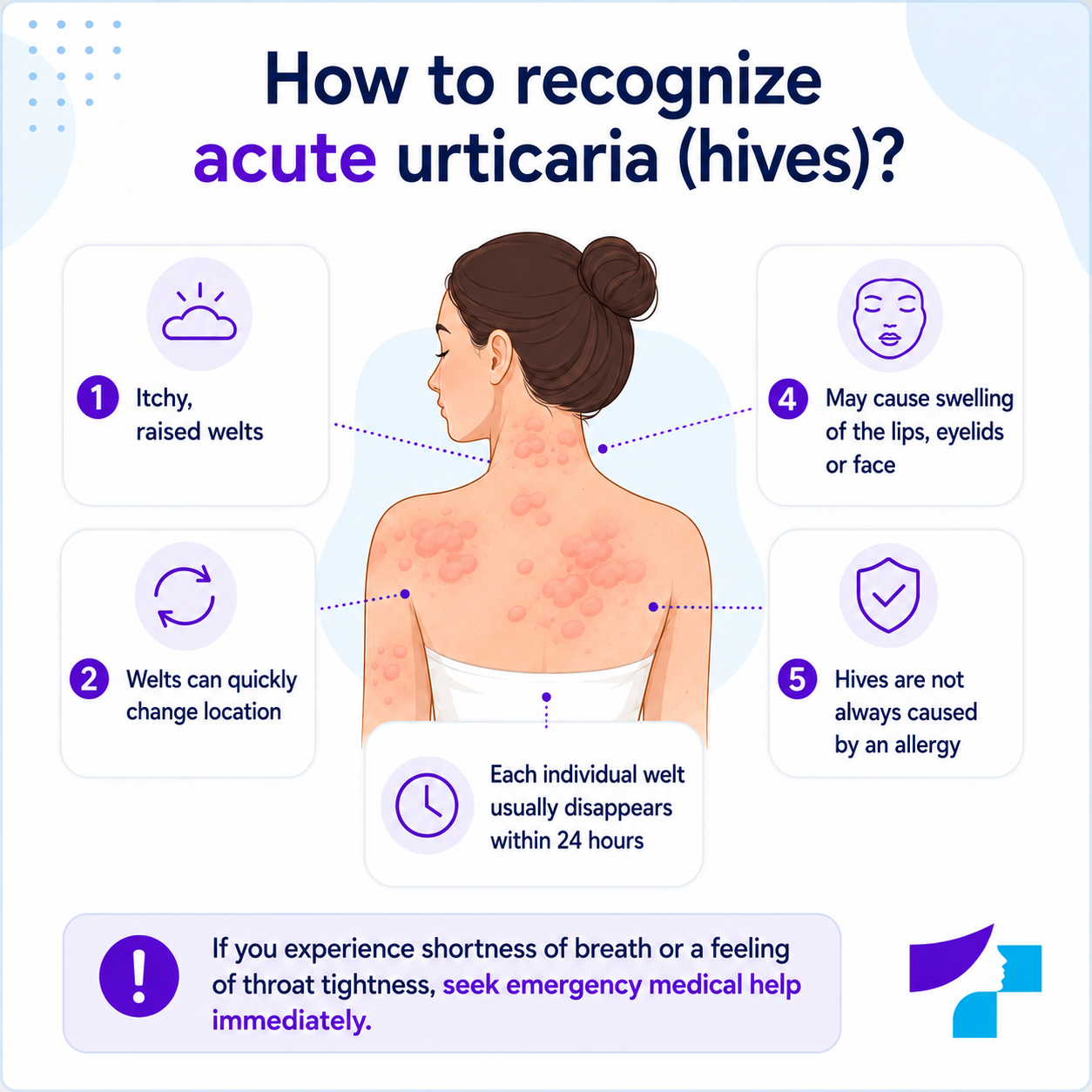
Hives usually appear as raised, itchy skin lesions. They may be small or widespread, round, oval, irregular in shape, separate or merged into larger areas. Sometimes they are red with a paler centre; at other times they may be pink, pale or almost skin-coloured.
A very typical feature is that the rash changes. One wheal may disappear within a few hours but appear elsewhere on the body on the same day. An individual hive usually does not remain in exactly the same place for longer than 24 hours. If the rash remains in one place for several days, becomes painful, leaves bruising, peeling or pigmentation, other diagnoses should also be considered and a medical examination is needed.
Hives may occur on the abdomen, back, arms, legs, neck, face or across the whole body. They may also appear together with angioedema — deeper swelling of the skin or mucous membranes, most commonly affecting the eyelids, lips, cheeks, tongue, throat, hands or feet. Angioedema is not always life-threatening, but swelling of the tongue, throat or airways is an emergency.
Symptoms of acute hives
The main symptom of acute hives is itching. In some patients the itching is mild, while in others it is very intense and interferes with sleep, concentration or everyday activities. The rash may also cause a burning or tingling sensation.
Common symptoms include:
- suddenly appearing itchy, raised wheals;
- pink, pale or skin-coloured patches;
- a rash that changes shape and location;
- wheals merging into larger areas;
- skin redness;
- a burning or tingling sensation;
- swelling of the eyelids, lips or face;
- worsening of itching in warmth, after a hot shower or after sweating.
If hives are accompanied by shortness of breath, wheezing, hoarseness, difficulty swallowing, swelling of the tongue or throat, dizziness, fainting, vomiting or sudden weakness, it is no longer only a skin problem — it may be a sign of anaphylaxis. In this situation, emergency medical help must be called.
Acute and chronic hives — the difference
Acute hives last up to 6 weeks. They often start suddenly and may last from a few hours to several days or weeks. Chronic hives mean that urticarial wheals, angioedema or both recur or persist for longer than 6 weeks.
This difference is important because in acute hives it is often enough to discuss the situation with a doctor, examine the skin, assess possible triggers and relieve symptoms. In chronic hives, however, the doctor may plan a more detailed assessment, especially if symptoms are frequent, severe or significantly affect quality of life.
Acute spontaneous and triggered hives
Acute hives are sometimes also described according to whether a specific trigger can be identified.
Acute spontaneous hives appear without a clearly identifiable external cause or in a situation where the cause is not obvious. For example, a person notices a rash but cannot link it to a specific food, medicine, insect sting, cold exposure or physical activity.
Triggered, or inducible, hives appear after a specific factor — for example, cold, heat, sweating, physical exertion, pressure on the skin, vibration or sun exposure. This classification helps the doctor understand whether a specific trigger should be looked for and how the patient can reduce the risk of recurrence.
Common causes of acute hives
Acute hives occur when immune cells in the skin release histamine and other inflammatory mediators. This causes widening of blood vessels, leakage of fluid into the tissues, itching and raised wheals. However, this does not mean that every case is a classic allergy.
Common triggering factors include infections, medicines, food, food additives, insect stings, latex, cosmetics, household chemicals, cold, heat, sweating, physical activity, pressure on the skin, stress, alcohol and an unknown or idiopathic cause.
Infections
Viral and other infections are among the most common causes of acute hives, especially in children. Hives may appear during or after a cold, flu-like illness, sore throat, intestinal infection or another infection. In such cases, the skin reaction may be part of the immune system’s response, not a direct allergy to a food product.
Medicines
Hives may be triggered by various medicines. Particular attention is usually paid to antibiotics, painkillers and anti-inflammatory medicines, such as non-steroidal anti-inflammatory drugs, as well as other medicines. If a rash appears after starting a new medicine, the doctor should be informed.
Important: if hives appear during antibiotic treatment, the cause may be either the medicine itself or the infection for which the medicine was prescribed. It is therefore not correct to automatically conclude that the patient definitely has an allergy to that specific antibiotic. This should be assessed by a doctor.
Food
Food may cause hives, especially if the rash appears soon after eating a specific product and recurs in similar situations. Particular attention is often paid to nuts, fish, seafood, eggs, milk, wheat, fruit or food additives, although each patient’s case must be assessed individually.
It is not recommended to follow a very strict diet or exclude many foods without a medical reason, especially in children. Unjustified dietary restrictions may reduce diet quality and create unnecessary anxiety.
Insect stings
Insect stings may cause a local skin reaction or more widespread hives. If hives after a sting are accompanied by breathing difficulties, dizziness, fainting, vomiting or swelling of the face and throat, a severe allergic reaction should be considered.
Physical factors
In some people, hives are triggered by cold, heat, sweating, physical activity, pressure on the skin, vibration or sun exposure. In these cases, wheals appear in predictable situations, for example after exercise, in cold water, after tight clothing or pressure from a bag strap.
Stress and alcohol
Stress is not always the main cause of hives, but it may worsen symptoms or contribute to recurrence. Alcohol may also increase redness, itching and skin reactivity in some people, so it is advisable to avoid alcohol during active hives.
Unknown cause
In some cases, the exact cause of acute hives cannot be found. This is common, especially when symptoms resolve and do not recur. Broad investigations or “allergy tests for everything” are not always needed in such situations.
Are hives always an allergy?
No. This is one of the most common misconceptions among patients. Acute hives may be an allergic reaction, but they may also be related to infection, medicines, physical factors or an unknown cause. In children, infections are a particularly common trigger.
Allergy is more likely when hives repeatedly appear soon after a specific food, medicine, insect sting, latex or another clear exposure. The situation should be taken especially seriously if skin symptoms are combined with respiratory, circulatory or gastrointestinal symptoms.
Are hives contagious?
Hives themselves are not contagious. A person cannot “catch” hives from another person’s skin rash.
However, if hives appear during a viral or other infection, the underlying infection may be contagious, not the hives themselves. For example, a child may have a respiratory infection during which hives appear; in such a case, other people may catch the infection, but not hives as a skin reaction.
Hives in children
Acute hives are relatively common in children. They can be very worrying for parents because the rash appears suddenly, may be widespread and can look pronounced. However, in children the cause of acute hives is often an infection rather than a food allergy.
In a child, hives usually look like itchy, raised patches that change location. The rash may appear on the abdomen, back, arms, legs, face or all over the body. Sometimes the child also has a runny nose, cough, fever, sore throat or abdominal symptoms.
A doctor should be consulted if:
- the hives are widespread or very pronounced;
- the child feels unwell;
- there is fever, sleepiness or marked weakness;
- there is swelling of the lips, eyelids, face or tongue;
- there are breathing difficulties;
- there is vomiting, dizziness or fainting;
- the hives appeared after a medicine, food or insect sting;
- symptoms recur or do not resolve.
Allergy tests are not always necessary for a child. They are useful when the doctor’s discussion with the parents suggests a clear link with a specific allergen — for example, a particular food, medicine or insect sting.
Hives in adults
In adults, acute hives may appear after an infection, medicine, food, alcohol, stress, physical activity, cold, heat or without a clear cause. If hives are mild and resolve quickly, it is often enough to assess possible triggers and relieve symptoms.
In adults, it is particularly important to review medicines taken in the previous days or weeks, including painkillers, anti-inflammatory medicines, antibiotics and dietary supplements. Suspected medicine-related reactions should be discussed with a doctor rather than stopping prescribed treatment on one’s own.
Hives after infection
Hives may appear during or after an infection. This is especially common in children but may also occur in adults. A person may notice that the rash appears together with a runny nose, cough, sore throat, fever or abdominal symptoms.
In such a situation, hives do not necessarily mean that the person has a food allergy or an allergy to medicine. The doctor assesses the overall picture: infection symptoms, medicines used, the appearance and duration of the rash, accompanying symptoms and whether the reaction recurs.
Hives after medicines and antibiotics
If hives appear after taking a medicine, this should always be taken seriously. However, not every rash during medicine use means a true allergy to that medicine. In the case of antibiotics, it is especially important to remember that the infection itself may trigger hives.
A medicine-related reaction is more likely if:
- hives started after beginning a new medicine;
- the reaction recurs after taking the same medicine again;
- there is also swelling of the lips, eyelids, tongue or face;
- there are breathing difficulties, dizziness or vomiting;
- the reaction was rapid and pronounced.
If a reaction to a medicine is suspected, this information should be written down and discussed with a doctor. A suspected medicine should not be used again without a doctor’s advice.
Hives after eating
Hives after eating may be related to food allergy, but this is not the only possible explanation. Food allergy is more likely if the rash repeatedly appears soon after eating a specific product, especially if it is combined with swelling of the lips or tongue, vomiting, wheezing, shortness of breath, dizziness or rapid worsening of general condition.
If a person notices hives after eating on one occasion, it is not recommended to immediately exclude broad food groups. It is better to write down what was eaten, how quickly symptoms appeared, how long they lasted and whether there were any other symptoms. This information helps the doctor decide whether an allergist consultation or targeted allergy tests are needed.
Can hives be caused by sun, heat, sweating or exercise?
In some people, hives-like rashes appear after sun exposure, heat, sweating or physical activity. However, not every “sun rash” is solar urticaria. Sun exposure may also cause other skin reactions, such as light-induced rashes, contact photodermatitis or medicine-induced photosensitivity.
Solar urticaria is more likely when the rash appears very quickly after sun exposure and resolves relatively quickly after sun exposure stops. Cholinergic, or heat- and sweat-triggered, hives may be considered when small, itchy wheals appear after physical activity, a hot shower, sauna, emotional stress or situations where the body overheats.
If a rash after sun exposure lasts for several days, recurs, is pronounced or looks atypical, it should be assessed by a dermatologist. In such cases, hives need to be distinguished from other sun-induced skin diseases.
Hives and angioedema
Angioedema is deeper swelling that may appear together with hives or separately. The eyelids, lips, face, hands, feet or genital area are most commonly affected. Angioedema may be unpleasant and frightening, but it is not always life-threatening.
A dangerous situation occurs when swelling affects the tongue, throat, larynx or airways. If a person has difficulty breathing, speaking or swallowing, if the voice becomes hoarse or there is a sensation of throat swelling, emergency medical help must be called immediately.
When can hives be dangerous?
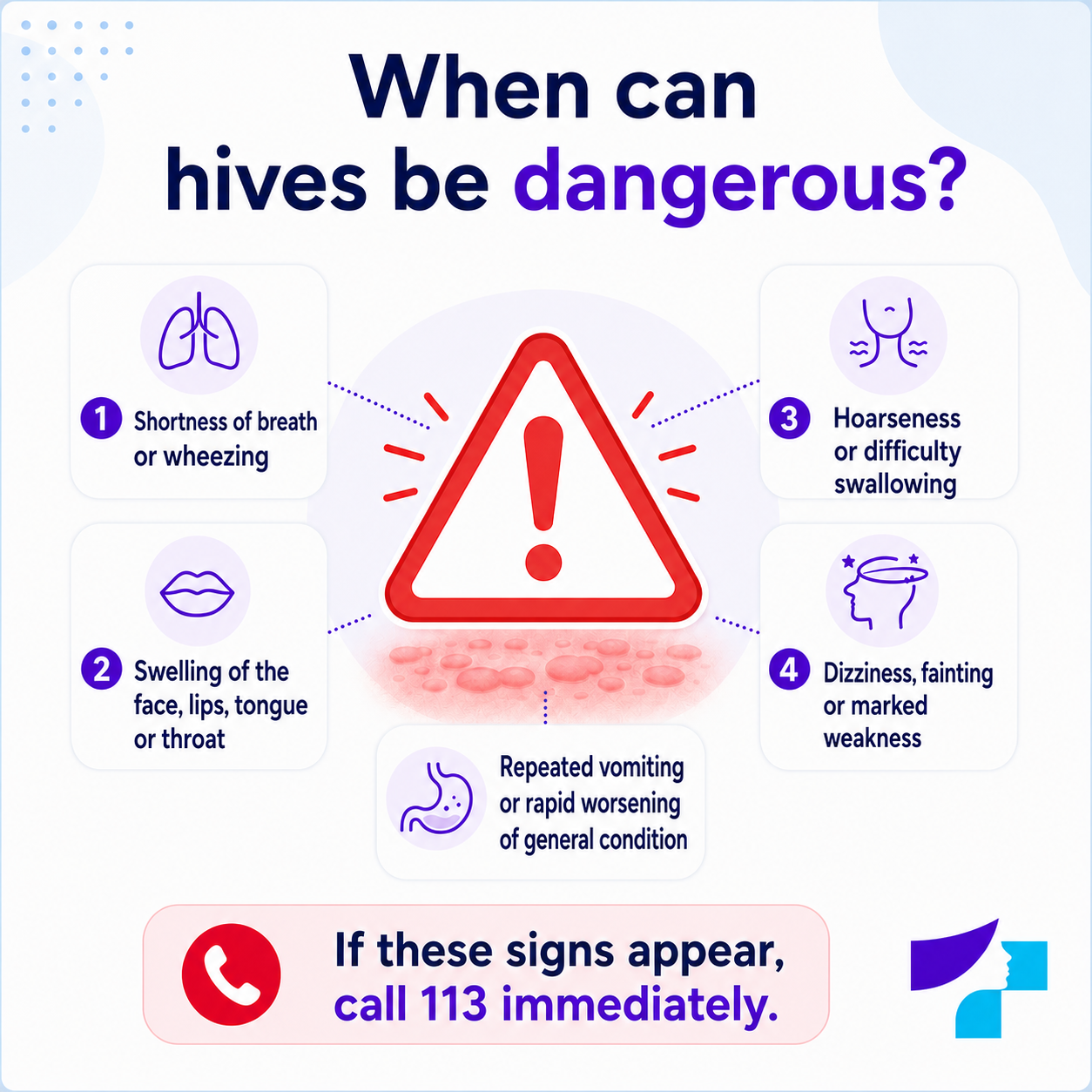
Most cases of acute hives are not life-threatening, but hives can be one of the signs of anaphylaxis. Anaphylaxis is a severe, rapid and potentially life-threatening systemic allergic reaction that may affect the skin, airways, circulation and gastrointestinal tract.
Emergency medical help should be called if hives are accompanied by any of the following signs:
- shortness of breath;
- wheezing or difficulty breathing;
- swelling of the tongue, throat or larynx;
- hoarseness;
- difficulty swallowing;
- dizziness, fainting or impaired consciousness;
- pressure or tightness in the chest;
- repeated vomiting;
- severe abdominal pain after a possible allergen exposure;
- rapid worsening of general condition;
- marked weakness or paleness.
In this situation, it is not advisable to wait and see whether the rash will pass. Skin symptoms may be only one part of a severe reaction.
What to do if hives suddenly appear
If hives appear suddenly, the right action depends on the severity of the symptoms.
If there are danger signs
If hives are accompanied by shortness of breath, swelling of the tongue or throat, difficulty swallowing, dizziness, fainting, repeated vomiting or rapid worsening of general condition, emergency medical help must be called immediately. In this situation, hives may be a sign of anaphylaxis.
If hives are pronounced but there are no emergency signs
If the rash is widespread, very itchy, recurrent, does not resolve or is accompanied by swelling of the lips, eyelids or face, a doctor should be contacted. This is especially important in children, pregnant women, people with chronic illnesses and cases where hives appeared after a medicine, food or insect sting.
If hives are mild
If hives are mild, there are no breathing problems, no pronounced swelling and general condition is good, the skin may be cooled, heat and overheating should be avoided, the skin should not be scratched, and possible triggers should be written down. A doctor or pharmacist can advise on suitable symptom relief.
How does a doctor diagnose acute hives?
A doctor usually diagnoses acute hives based on the patient’s story and a skin examination. The medical history is very important — when the rash started, how long it persists, whether it changes location, what happened before it appeared, what medicines were used, whether there was an infection, new foods, an insect sting, physical activity or other possible triggers.
The doctor may ask:
- when the first rash appeared;
- how quickly it spread;
- whether each wheal disappears within 24 hours;
- whether there is swelling of the face, lips or tongue;
- whether there are breathing difficulties;
- whether there was vomiting, dizziness or fainting;
- whether there has recently been an infection;
- what medicines have been taken;
- whether symptoms are related to food, alcohol, exercise, cold or heat;
- whether similar episodes have occurred before.
If the rash has already disappeared by the time of the visit, photographs on a phone showing what the rash looked like can be very useful.
Are tests needed in acute hives?
Not always. In mild and short-lasting acute hives, especially if there are no danger signs and symptoms resolve, broad testing is often not needed. Diagnosis is based mainly on discussion with the patient and skin examination.
In acute hives, it is usually not necessary to immediately perform a broad panel of blood tests or allergy tests. A precise discussion with the doctor is much more valuable: when the rash started, how quickly it disappeared, what happened beforehand and whether there were any dangerous accompanying symptoms. Investigations are targeted — they should be chosen according to specific suspicions, not “for everything”.
Blood tests or additional investigations may be needed if:
- hives are severe;
- symptoms recur;
- hives do not resolve;
- the rash is atypical;
- there is suspicion of infection or another disease;
- angioedema is present;
- there is suspicion of a medicine- or food-related reaction;
- symptoms are approaching the 6-week mark or continue for longer.
Allergy tests are useful when there is a specific suspected situation. They are not a universal test that always shows “what caused the hives”.
How to distinguish hives from other skin diseases
Hives are not always easy to distinguish from other rashes, especially from a description alone. However, there are signs that can help orientation.
Hives or eczema?
Hives appear suddenly, itch, change location and each wheal usually disappears within 24 hours. Eczema is more often characterised by dry, inflamed, scaly or cracked skin that persists for longer and often recurs in specific body areas.
Hives or contact dermatitis?
Contact dermatitis more often develops where the skin has been in contact with an irritant or allergen — for example cosmetics, metal, glove material, disinfectant or a plant. The rash usually lasts longer and may include redness, blisters, peeling or cracking. Hives are more often migratory and appear as raised, itchy wheals.
Hives or chickenpox?
Chickenpox is characterised by blisters at different stages of development, fever and signs of infection. Hives usually are not blisters; they are raised, itchy and change location.
Hives or anaphylaxis?
Hives affect the skin. Anaphylaxis is a systemic reaction in which skin symptoms may be combined with respiratory, circulatory or gastrointestinal symptoms. If there is shortness of breath, throat swelling, dizziness, fainting or repeated vomiting, the situation should be treated as an emergency.
When might a rash not be hives?
Another skin disease should be considered if the rash:
- remains in exactly the same place for longer than 24 hours;
- is more painful than itchy;
- leaves bruising, brownish patches or peeling skin;
- looks like blisters or pus-filled lesions;
- is accompanied by high fever and marked malaise;
- appears only after sun exposure and lasts for several days;
- recurs for longer than 6 weeks.
In such cases, a medical examination is needed because the rash may be related to eczema, contact dermatitis, viral rashes, medicine reactions, photosensitivity, urticarial vasculitis or other conditions.
Treatment of acute hives
The aim of treating acute hives is to reduce itching and rash, remove the known trigger and recognise dangerous signs in time. If the cause is clear, for example a specific medicine, food or insect sting, the next steps should be discussed with a doctor.
Second-generation antihistamines are generally preferred because they cause less drowsiness than first-generation medicines. The specific medicine, duration of use and suitability for a child, pregnant woman or person with other diseases should be determined by a doctor or pharmacist.
In more severe cases, the doctor may prescribe additional treatment. Corticosteroids are not necessary for every patient and should not be used without medical advice. In anaphylaxis, the treatment approach is different: it is an emergency condition requiring immediate medical help.
What can be done at home to reduce symptoms?
In mild hives, if there are no danger signs, simple measures may help:
- cool the skin with a cool compress;
- avoid hot showers, baths or saunas;
- do not rub or scratch the skin;
- wear loose, soft clothing;
- avoid alcohol;
- avoid intense physical activity if it worsens symptoms;
- write down possible triggers;
- take photographs of the rash if it changes or disappears before the doctor’s visit.
If a medicine is suspected to have caused hives, it should not be used again without medical advice. If the medicine was prescribed for a serious illness, stopping or replacing it should be decided by a doctor.
What should be avoided during hives?
During hives, it is advisable to avoid factors that may worsen itching and the skin reaction:
- hot showers;
- sauna;
- intense heating or overheating;
- alcohol;
- tight, rubbing clothing;
- scratching the skin;
- self-treatment with unverified remedies;
- reusing a suspected medicine without medical advice.
It is not recommended to start a broad “allergy diet” if there is no clear link with a specific food. This approach often does not help and may cause unnecessary dietary restrictions.
How long do hives usually last?
Acute hives may last for a few hours, several days or several weeks, but by definition they do not exceed 6 weeks. An individual wheal usually disappears within 24 hours, although new wheals may appear in other areas.
If symptoms continue for longer than 6 weeks, recur frequently or significantly affect quality of life, a medical assessment is needed to determine whether it is chronic urticaria or another condition.
When should you see a dermatologist, allergist or family doctor?
A doctor should be consulted if:
- hives are widespread, pronounced or very itchy;
- symptoms do not resolve or recur for several days;
- there is swelling of the face, lips, eyelids or tongue;
- there is suspicion of a reaction to a medicine;
- hives appear after a specific food or insect sting;
- hives appear in a child, pregnant woman or person with other serious illnesses;
- the rash is not typical for hives;
- individual lesions remain in one place for longer than 24 hours;
- symptoms are approaching the 6-week mark.
A family doctor can assess the general condition and the necessary first steps. A dermatologist helps assess the nature of the skin rash and distinguish hives from other skin diseases. An allergist is particularly important if a food, medicine, insect sting or other allergic reaction is suspected.
What to write down and photograph before the doctor’s visit
If hives recur or disappear before the visit, photographs and a short symptom diary are very helpful. Write down:
- when the rash started;
- how long it lasted;
- whether it changed location;
- what you ate in the previous few hours;
- what medicines or dietary supplements you used;
- whether there was infection, fever, cough, runny nose or abdominal symptoms;
- whether there was physical activity, heat, cold, sauna, sun exposure or stress;
- whether there was swelling of the face, lips, eyelids or tongue;
- whether there were breathing difficulties, dizziness, vomiting or fainting;
- whether a similar reaction has happened before.
Photographs are especially useful because hives may disappear before the appointment. It is best to photograph the rash in good light, from different distances and, if possible, repeatedly — to show whether it changes.
How to prevent hives from recurring
Prevention depends on the cause. If the trigger is known, it should be avoided. For example, if a doctor confirms a reaction to a specific medicine, this should be recorded in the medical documentation and healthcare professionals should be informed.
If hives recur, a symptom diary is helpful. It can include the start time of the rash, possible links with food, medicines used, infection symptoms, physical activity, alcohol, stress, cold or heat exposure, insect stings, and the duration and severity of the reaction.
This information helps the doctor understand whether targeted investigations are needed.
References and authoritative sources
- Children’s Clinical University Hospital / Veselapasaule: hives
- DermNet: acute urticaria — causes, signs and treatment
- DermNet: angioedema
- DermNet: anaphylaxis
- EAACI / GA²LEN / EuroGuiDerm / APAAACI: international guideline for the definition, classification, diagnosis and management of urticaria
- NICE Clinical Knowledge Summaries: urticaria treatment and patient management
- Medicine.lv: hives — symptoms, causes, diagnosis and treatment
- Doctus: hives — acute and chronic
Medical disclaimer
The information in this article is intended for informational and educational purposes and does not replace a consultation with a dermatologist, diagnosis or treatment. Symptoms of hives and similar skin rashes may be related to various skin, allergic, infectious or other health conditions, so self-diagnosis and self-treatment may be incorrect. If hives are pronounced, recur, do not resolve, appear in a child or pregnant woman, or occur after taking a medicine, consult a doctor or another appropriate healthcare professional. If hives are accompanied by breathing difficulties, swelling of the face, lips, tongue or throat, dizziness, impaired consciousness, repeated vomiting or rapid worsening of general condition, emergency medical help is required.
