Skin patch
A skin patch is a localised area that differs from the surrounding skin in colour, surface, texture or sensation. It may be red, pink, brownish or skin-coloured; flat or raised; smooth, rough, scaly, itchy, painful or free of noticeable symptoms.
In this article, “skin patch” is used as a broad, patient-friendly description rather than as a diagnosis. The visible change may take the form of a macule, papule, plaque, nodule, scaly area, inflammation or another type of skin lesion. To understand what it may represent, a doctor assesses its appearance, size, borders, location, duration, symptoms and changes over time.
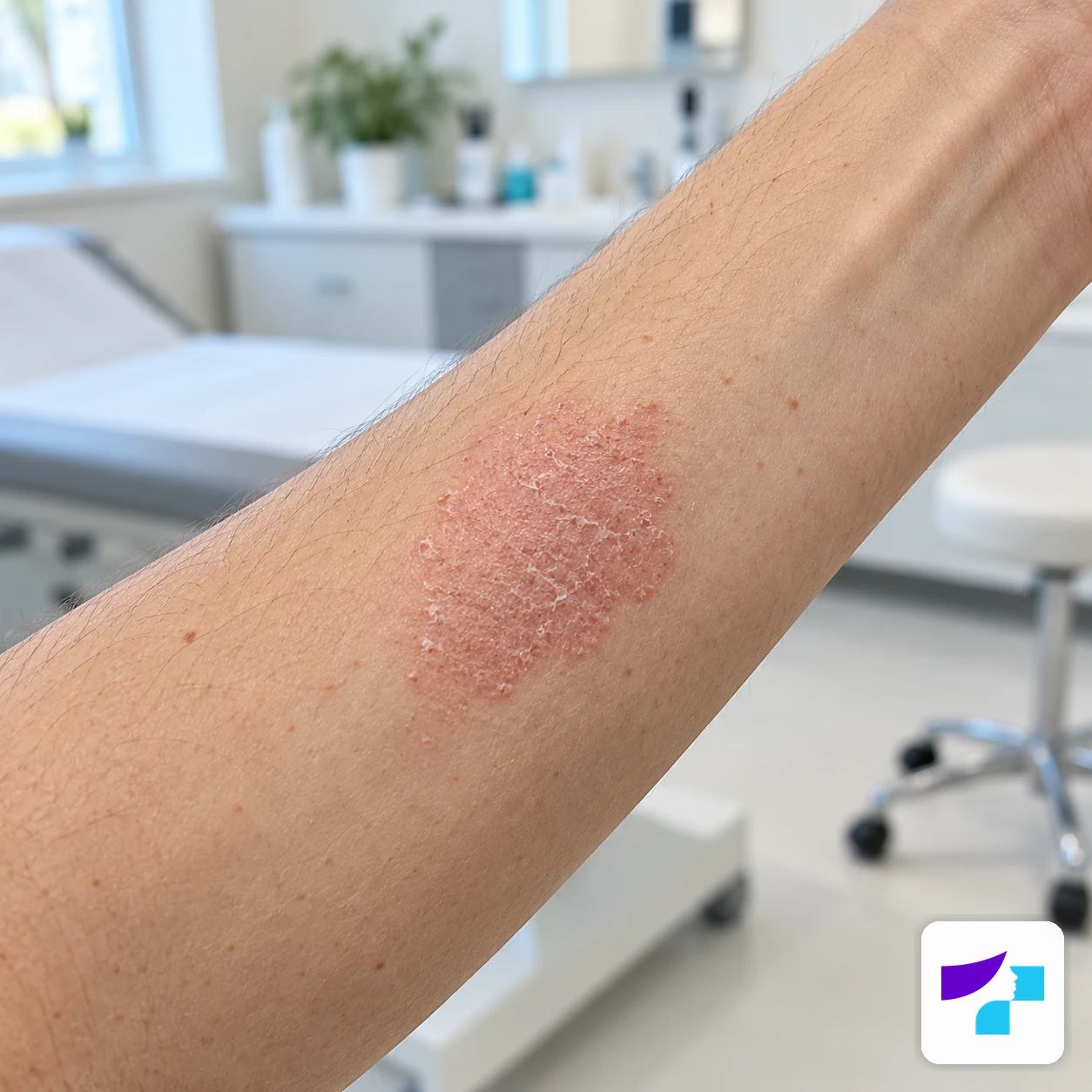
A localised pink-red, scaly area of skin. Its appearance describes the visible skin change but does not by itself establish a diagnosis.
Important: this article discusses a localised dermatological change in the skin. It does not refer to a focus of infection in the epidemiological sense.
What is a skin patch?
A skin patch is one or more localised areas of altered skin. A person may describe it as a “spot”, “area”, “thickened patch”, “scaly area”, “red mark” or “rash in one place”.
Put simply, a skin patch means that a visible or palpable change is present, but the term alone does not identify the disease causing it.
What can a skin patch look like?
A skin patch may have many different appearances. It may be:
- red, pink, brown, violet, white or skin-coloured;
- flat or raised;
- smooth, rough, scaly, moist or crusted;
- round, oval, ring-shaped or irregular;
- clearly defined or have blurred borders;
- a single isolated area or one of several similar patches;
- itchy, painful, burning or completely symptom-free.
It is especially important to determine whether the patch is changing: whether it is growing, spreading, bleeding, ulcerating, peeling, becoming painful or recurring.
A skin patch is not a diagnosis
The term “skin patch” does not by itself mean psoriasis, a fungal infection, eczema or any other specific disease. It is simply a way of describing the location and appearance of a skin change.
For example, a red, scaly patch may be a sign of psoriasis, but fungal infection, eczema, seborrhoeic dermatitis and actinic keratosis may look similar. A round patch may be caused by a fungal infection, but not always. An itchy patch may be associated with an allergic reaction, dermatitis, fungal infection or another skin condition.
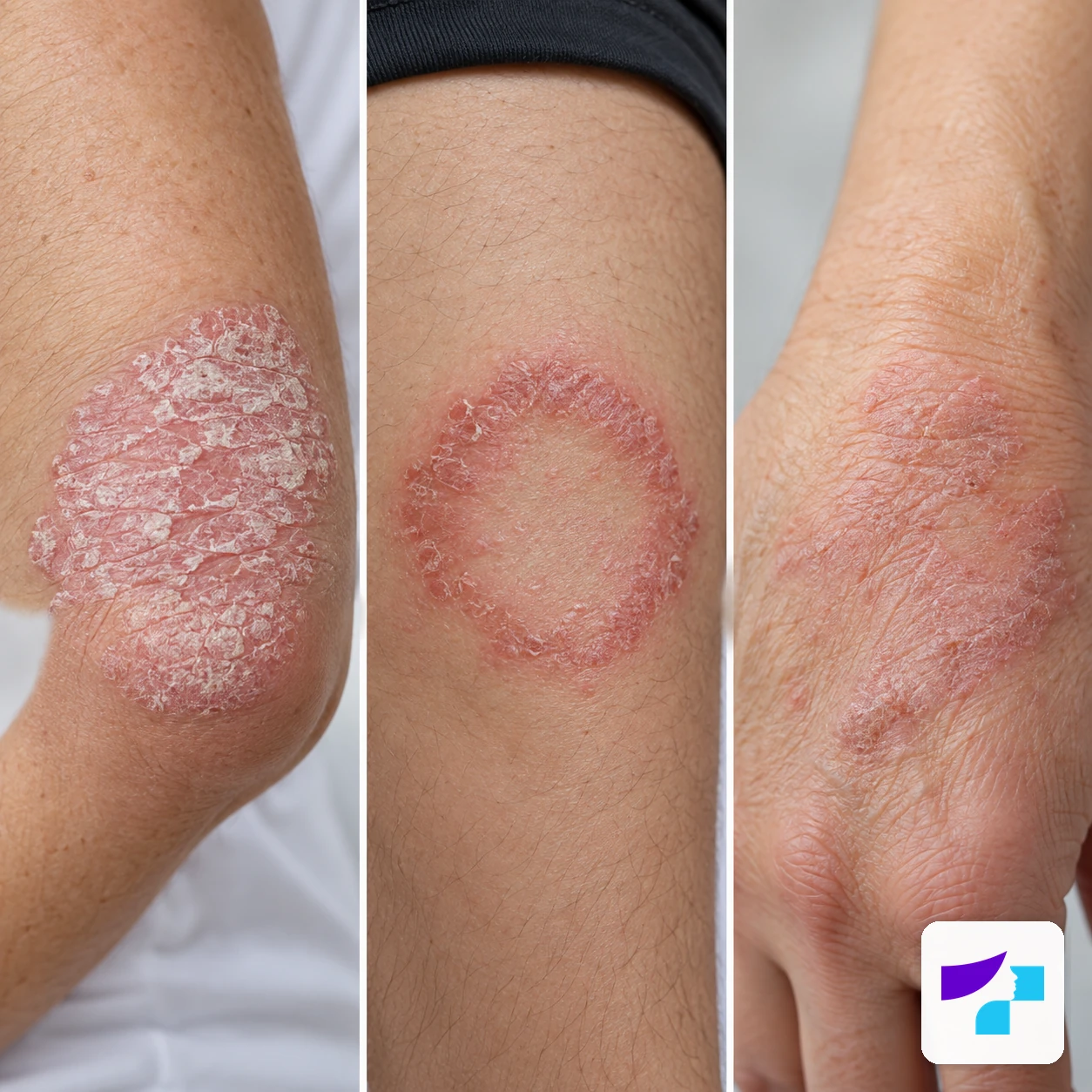
An illustrative comparison: a psoriasis-like scaly plaque, a ring-shaped patch resembling a fungal infection and a dry, inflamed eczema-like patch. Different conditions can look similar, so an image alone cannot establish the diagnosis.
For this reason, a diagnosis should not be made from online images alone. Similar-looking rashes can have different causes in different people.
Skin patch, papule, macule, plaque and nodule: what is the difference?
| Term | Meaning |
|---|---|
| Macule | A flat change in skin colour that cannot be felt as raised. |
| Papule | A small, raised and palpable skin lesion. |
| Plaque | A larger, thickened or raised area of skin. |
| Nodule | A deeper, firmer lesion in the skin or subcutaneous tissue. |
| Vesicle | A small, fluid-filled skin lesion. |
| Pustule | A raised skin lesion containing purulent material. |
| Skin patch | A broad, patient-friendly description of a localised skin change; in clinical dermatology, the lesion is described more precisely by its morphology. |
A patient may notice a “patch”, while a dermatologist determines whether the change is a macule, papule, plaque, nodule or another type of lesion.
Why do skin patches develop?
Skin patches can develop for many reasons. Common groups of causes include:
- inflammatory skin conditions, such as psoriasis, eczema and atopic dermatitis;
- irritant or allergic reactions, such as contact dermatitis;
- infections caused by fungi, bacteria or viruses;
- inflammation of the sebaceous glands or hair follicles, such as acne or folliculitis;
- inflammatory changes associated with seborrhoeic dermatitis;
- rosacea and other conditions causing facial redness;
- sun-related skin damage, such as actinic keratosis;
- benign, precancerous or malignant skin lesions.
A patch may also appear after skin irritation or friction, use of a new cosmetic product or medicine, or contact with occupational substances, plants, animals or an infectious agent.
Common types of skin patches and possible causes
Red skin patch
A red patch usually indicates erythema, or redness of the skin. It may be caused by inflammation, irritation, allergy, infection, psoriasis, dermatitis, rosacea or another skin condition.
A red patch does not automatically mean infection. Medical advice is needed, however, if it becomes hot, painful or swollen, enlarges quickly, produces pus or is accompanied by fever.
Scaly or dry skin patch
A scaly patch develops when keratinised cells accumulate and shed more visibly from the skin surface. This may occur with psoriasis, eczema, fungal infection, seborrhoeic dermatitis or actinic keratosis.
Psoriasis often causes clearly defined red or pink, thickened patches with white or silvery scales. A fungal infection may appear as a round or ring-shaped scaly patch that expands outwards. Seborrhoeic dermatitis often affects the scalp, face, sides of the nose, eyebrows, area behind the ears and chest, causing pink areas with white or yellowish scales.
Itchy skin patch
Itching is common in dermatitis, eczema, fungal infections, hives, insect bites and some forms of psoriasis. An itchy patch should not be scratched until it bleeds, as scratching damages the skin barrier, may cause crusting and can promote a secondary bacterial infection.
If itching disturbs sleep, the patch spreads, recurs or does not improve, a dermatologist consultation is recommended.
Can a skin patch be psoriasis?
Yes. A skin patch may be a sign of psoriasis. The most common form, plaque psoriasis, typically causes clearly defined, red, thickened and scaly areas of skin. They often appear on the elbows, knees, scalp and lower back.
Psoriasis is not contagious. It is not a fungal, bacterial or viral infection. Other skin conditions may nevertheless resemble psoriasis, so the diagnosis should be made by a doctor.
Can a skin patch be a fungal infection?
Yes. A fungal skin infection may cause a round, ring-shaped, red, scaly and itchy patch. It may have a more active, more noticeably scaly edge and a calmer centre, although this appearance is not present in every case.
Fungal skin infections may be contagious. They can spread from another person, an animal, shared objects or another part of the body, such as the feet or nails. If a fungal infection is suspected, a doctor may take a skin scraping for microscopy or fungal culture.
Important: if a fungal infection is mistakenly treated with a corticosteroid cream, the appearance of the rash may change and the infection may spread or worsen.
Is a skin patch contagious?
Whether a patch is contagious depends on its cause, not on the fact that it is described as a patch.
Usually not contagious
- psoriasis patches;
- eczema and atopic dermatitis;
- contact dermatitis;
- rosacea;
- seborrhoeic dermatitis;
- many benign skin lesions.
May be contagious
- fungal infections;
- impetigo;
- scabies;
- some viral rashes;
- certain bacterial infections.
If similar rashes appear in several family members, the patch spreads quickly or infection is suspected, seek medical advice.
Skin patches on the face, hands, legs and scalp
The location of a skin patch helps the doctor assess its possible causes.
| Location | Possible causes |
|---|---|
| Face | Rosacea, contact dermatitis, seborrhoeic dermatitis, acne, fungal infection or pigmented lesions. |
| Scalp | Psoriasis, seborrhoeic dermatitis, fungal infection or folliculitis. |
| Hands | Contact dermatitis, eczema, psoriasis, fungal infection or irritation caused by occupational exposure. |
| Legs | Psoriasis, eczema, fungal infection, insect bites, circulatory changes or inflammatory conditions. |
| Skin folds | Candidiasis, intertrigo, inverse psoriasis or irritation. |
| Palms and soles | Eczema, psoriasis, fungal infection or conditions causing skin thickening. |
Self-treatment carries a greater risk when the face, eyes, mouth or genital area is affected, or when skin changes cover a large area of the body.
How does a dermatologist diagnose a skin patch?
A dermatologist begins by asking questions and examining the skin. The doctor will ask when the patch appeared, whether it is changing, itching, hurting, peeling or bleeding, and whether there has been exposure to new cosmetic products, medicines, animals, plants, occupational substances or possible sources of infection.
During the examination, the doctor assesses:
- the colour of the patch;
- its shape and borders;
- its surface and depth;
- its size and distribution;
- symmetry;
- scales, crusts, blisters, pus, fissures or ulcers;
- the nails, hair and mucous membranes, when relevant.
Sometimes examination alone is enough to make a diagnosis. In other cases, dermoscopy, skin scraping, microbiological culture, blood tests or biopsy may be needed.
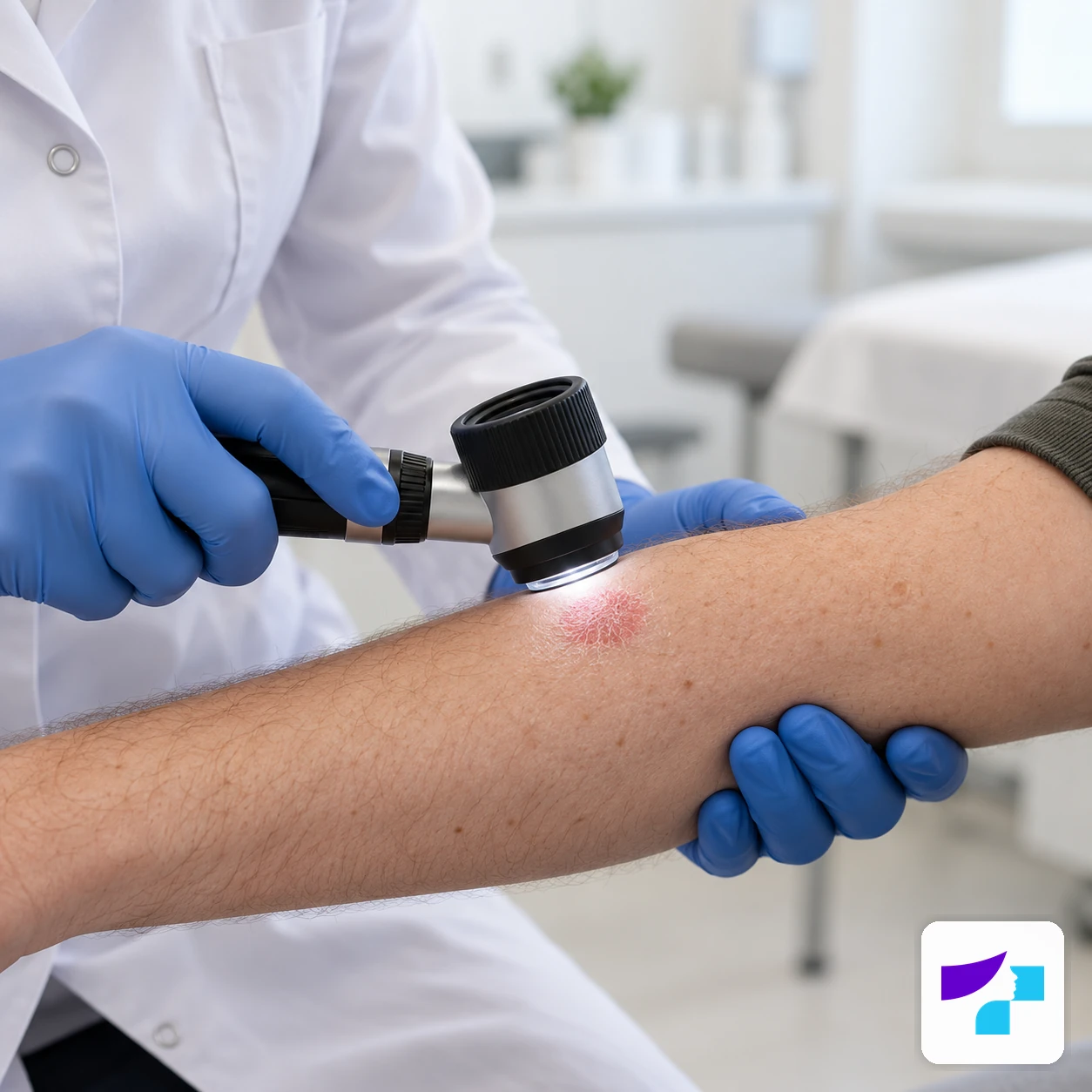
A dermatologist examining a skin patch with a dermatoscope. Depending on the type of patch, other investigations may also be needed to clarify the diagnosis.
When are dermoscopy, tests or biopsy needed?
Dermoscopy
Dermoscopy is an examination of the skin using magnification and special lighting. It is particularly important when assessing pigmented, changing or otherwise suspicious skin lesions, although a dermatologist may also use it to evaluate other skin changes.
Skin scraping and culture
Testing for fungus may be needed when a patch is round, scaly, spreading or does not improve with treatment. A bacterial culture may be required when there is pus, oozing, crusting or suspicion of a bacterial infection.
Biopsy
A biopsy involves taking a small sample of skin tissue for histological examination. It may be needed when the diagnosis is unclear, a patch does not resolve, grows, bleeds, ulcerates, looks atypical or a precancerous or malignant process must be ruled out. Having a biopsy does not in itself mean that a person has cancer; biopsy is also used to diagnose inflammatory skin diseases.
How are skin patches treated?
Treatment depends on the cause. There is no single cream that is suitable for every skin patch.
Possible treatment approaches include:
- restoring the skin barrier and moisturising dry or irritated skin;
- avoiding the irritant or allergen in contact dermatitis;
- anti-inflammatory treatment for dermatitis or psoriasis;
- antifungal treatment for fungal infection;
- antibacterial treatment for certain bacterial infections;
- dermoscopic monitoring, biopsy or removal when a lesion is suspicious.
The basic principle is simple: first identify the likely cause, then select the appropriate treatment.
What should not be done at home?
If a new or unexplained skin patch appears, do not:
- squeeze, pierce, cut or repeatedly scratch it;
- burn or cauterise it with acids, vinegar, alcohol, lemon, baking soda or other irritating substances;
- use a corticosteroid cream for a prolonged period without medical advice;
- use antibiotics without medical advice;
- make a diagnosis solely from images found online;
- ignore bleeding, ulceration, rapid growth or changes in pigmentation.
Incorrect self-treatment may worsen an infection, alter the appearance of the rash and delay the correct diagnosis.
When should you see a doctor?
Consult a dermatologist or general practitioner if the patch:
- grows or spreads quickly;
- changes colour, shape or surface;
- becomes painful, hot, markedly red or swollen;
- bleeds, ulcerates or fails to heal;
- produces pus, blood or other fluid;
- becomes hard or fixed;
- is associated with fever or feeling significantly unwell;
- is located near the eyes, in the mouth, on the lips or in the genital area;
- affects a large area of the body;
- is a new or changing pigmented lesion;
- is unexplained or causes concern.
The threshold for seeking medical advice should be lower for children, pregnant women, older adults and people with a weakened immune system, especially when a skin change is progressing rapidly, painful or associated with general illness.
Seek urgent medical help if a rash is accompanied by difficulty breathing or swallowing, swelling of the lips, tongue or eyes, widespread blistering, skin peeling, a high temperature or rapidly worsening general condition.
Common myths about skin patches
| Myth | The facts |
|---|---|
| A skin patch always means one specific disease. | It is a descriptive term, not a diagnosis. |
| Every skin patch is contagious. | Contagiousness depends on the cause. |
| A red patch always means infection. | Redness may also be caused by allergy, irritation, psoriasis or dermatitis. |
| A scaly patch is always psoriasis. | It may also be caused by fungal infection, eczema, seborrhoeic dermatitis or keratosis. |
| A round patch is always a fungal infection. | A round shape is only one feature; other characteristics must also be assessed. |
| An itchy patch is always an allergy. | Many inflammatory, infectious and other skin conditions can cause itching. |
| One universal cream helps every skin patch. | An unsuitable cream may mask symptoms or worsen the condition. |
| A biopsy always means cancer is suspected. | Biopsy also helps diagnose inflammatory and other non-cancerous conditions. |
| Antibiotics help all skin patches. | Antibiotics are appropriate only for certain bacterial infections. |
Summary
A skin patch is a localised skin change, not a specific diagnosis. It may take the form of a papule, macule, plaque, nodule, scaly area or another lesion. Its significance is assessed from its appearance, symptoms, location and changes over time.
Some patches are associated with non-contagious conditions such as psoriasis, eczema or contact dermatitis. Others may be infectious, as in some fungal infections. Less commonly, a new, changing, bleeding, ulcerated or pigmented patch may indicate a more serious skin process.
If a skin patch does not resolve, changes or causes concern, the safest step is to have it assessed by a doctor.
Medical disclaimer
This information is for educational purposes and does not replace medical consultation, diagnosis or treatment. Any new, growing, painful, bleeding, ulcerated, rapidly changing, inflamed, infected, pigmented, hard, fixed or otherwise unexplained skin change should be assessed by a doctor. Do not use prescription medicines, antibiotics, corticosteroids, cauterising substances or invasive home methods without medical advice. Children, pregnant women and people with a weakened immune system, as well as anyone with changes affecting the face, eyes, mouth, genital area or a large area of skin, should seek timely medical advice.
References and authoritative sources
- DermNet: dermatological terminology and the description of skin lesions
- MSD Manual Professional Edition: types and description of skin lesions
- American Academy of Dermatology: adult rashes and signs that require medical attention
- DermNet: psoriasis symptoms, types and treatment
- DermNet: tinea corporis, or ringworm of the body
- DermNet: skin biopsy and its diagnostic uses
Content author
Frequently Asked Questions
Consultation fee
| Specialists | Clients of the clinic | First visit |
|---|---|---|
| Dermatologist Dr. Med. assistant professor Māra Rone-Kupfere | 76.00 € | 80.00 € |
| Dermatologist Dace Buile | 66.50 € | 70.00 € |
| Dermatologist Gunita Buiksa | 57.00 € | 60.00 € |
| Dermatologist Ilona Zablocka | 57.00 € | 60.00 € |
| Dermatologist Zanda Bogdanova | 57.00 € | 60.00 € |




 +1
 +1
 +1 242
 +1 246
 +1 268
 +1 441
 +20
 +212
 +213
 +216
 +218
 +220
 +221
 +222
 +223
 +223
 +224
 +225
 +226
 +227
 +228
 +229
 +230
 +231
 +232
 +234
 +235
 +236
 +237
 +238
 +239
 +239
 +240
 +241
 +242
 +243
 +244
 +245
 +248
 +249
 +250
 +251
 +252
 +253
 +254
 +255
 +256
 +257
 +258
 +260
 +261
 +262
 +263
 +264
 +265
 +266
 +267
 +268
 +269
 +269
 +27
 +284
 +290
 +291
 +297
 +298
 +299
 +30
 +31
 +32
 +33
 +34
 +340
 +345
 +350
 +351
 +352
 +353
 +354
 +355
 +356
 +358
 +359
 +36
 +370
 +371
 +372
 +373
 +374
 +375
 +376
 +377
 +378
 +380
 +385
 +386
 +387
 +389
 +39
 +39
 +40
 +41
 +41
 +420
 +421
 +43
 +45
 +46
 +47
 +473
 +48
 +49
 +500
 +501
 +502
 +503
 +504
 +505
 +506
 +507
 +509
 +51
 +52
 +53
 +54
 +55
 +56
 +57
 +58
 +590
 +591
 +593
 +594
 +594
 +595
 +596
 +597
 +598
 +60
 +61
 +62
 +63
 +64
 +649
 +65
 +66
 +664
 +671
 +672
 +672
 +672
 +673
 +674
 +675
 +676
 +677
 +678
 +679
 +680
 +681
 +682
 +683
 +684
 +686
 +687
 +688
 +689
 +690
 +691
 +692
 +6982
 +7
 +7
 +7
 +7
 +758
 +767
 +784
 +809
 +809
 +81
 +82
 +84
 +850
 +852
 +853
 +856
 +86
 +868
 +869
 +876
 +880
 +885
 +886
 +90
 +91
 +92
 +93
 +94
 +95
 +960
 +961
 +962
 +963
 +964
 +965
 +967
 +968
 +971
 +972
 +973
 +974
 +975
 +976
 +977
 +98
 +993
 +994
 +995
 +996
 +996