Eczema is a common inflammatory skin condition that may appear as itching, dryness, redness, scaling, cracks, blisters or oozing. In some people, eczema appears briefly after contact with an irritating substance, while in others it follows a chronic course with repeated flare-ups.
It is important to know that eczema is not contagious. It cannot be passed to another person through touch, everyday contact or shared objects. However, eczema can be very disruptive: itching can disturb sleep, scratching damages the skin, and visible skin rashes may affect wellbeing and quality of life.
Eczema is not one single disease. It is a broad term for several types of skin inflammation, including atopic dermatitis, contact dermatitis, hand eczema, dyshidrotic eczema, nummular eczema, seborrheic dermatitis and stasis dermatitis. For this reason, eczema treatment should always be tailored to the specific type of eczema, its severity, the affected area, the patient’s age and possible triggers.
In brief: the most important facts about eczema
- Eczema is skin inflammation commonly associated with itching, dryness, redness or scaling.
- Eczema is not contagious.
- Atopic dermatitis is one of the most common forms of eczema.
- Eczema is often linked to a weakened skin barrier and increased skin sensitivity.
- Flare-ups may be triggered by soaps, disinfectants, fragrances, cold weather, sweating, stress, allergens or infections.
- Moisturising the skin with emollients is a cornerstone of treatment, even when the skin looks better.
- Topical corticosteroids should not be used without control, but when used correctly they can be an important part of treatment.
- Eczema on the face, eyelids, hands and in children requires particular care.
- If eczema oozes, hurts, worsens quickly or interferes with sleep, a dermatologist should be consulted.
What is eczema?
Eczema is an inflammatory skin condition in which the skin barrier does not function as well as it should. A healthy skin barrier helps retain moisture and protects against irritants, allergens and microorganisms. In eczema, the skin loses moisture more quickly, becomes dry and sensitive, and is more prone to inflammation.
In medicine, the term “dermatitis” is also used and means skin inflammation. In everyday language, the words “eczema” and “dermatitis” are often used similarly, but an accurate diagnosis is important because different types of dermatitis can have different causes and treatments.
In eczema, itching often leads to scratching, and scratching further damages the skin barrier. This creates the itch-scratch cycle: the skin itches, the person scratches, inflammation increases, and the itching becomes even more intense.
What does eczema look like?
Eczema can look different depending on its type, duration, skin colour and the affected body area.
Common signs include:
- dry, rough skin;
- redness or a darker inflamed area;
- intense itching;
- skin scaling;
- cracks, especially on the hands or feet;
- small blisters;
- oozing or fluid discharge;
- crusting;
- skin thickening in areas of chronic scratching;
- lighter or darker marks after inflammation.
On lighter skin, eczema often appears pink or red. On darker skin, it may look purple, greyish, dark brown or less visibly red. For this reason, the severity of eczema should not be assessed by redness alone.
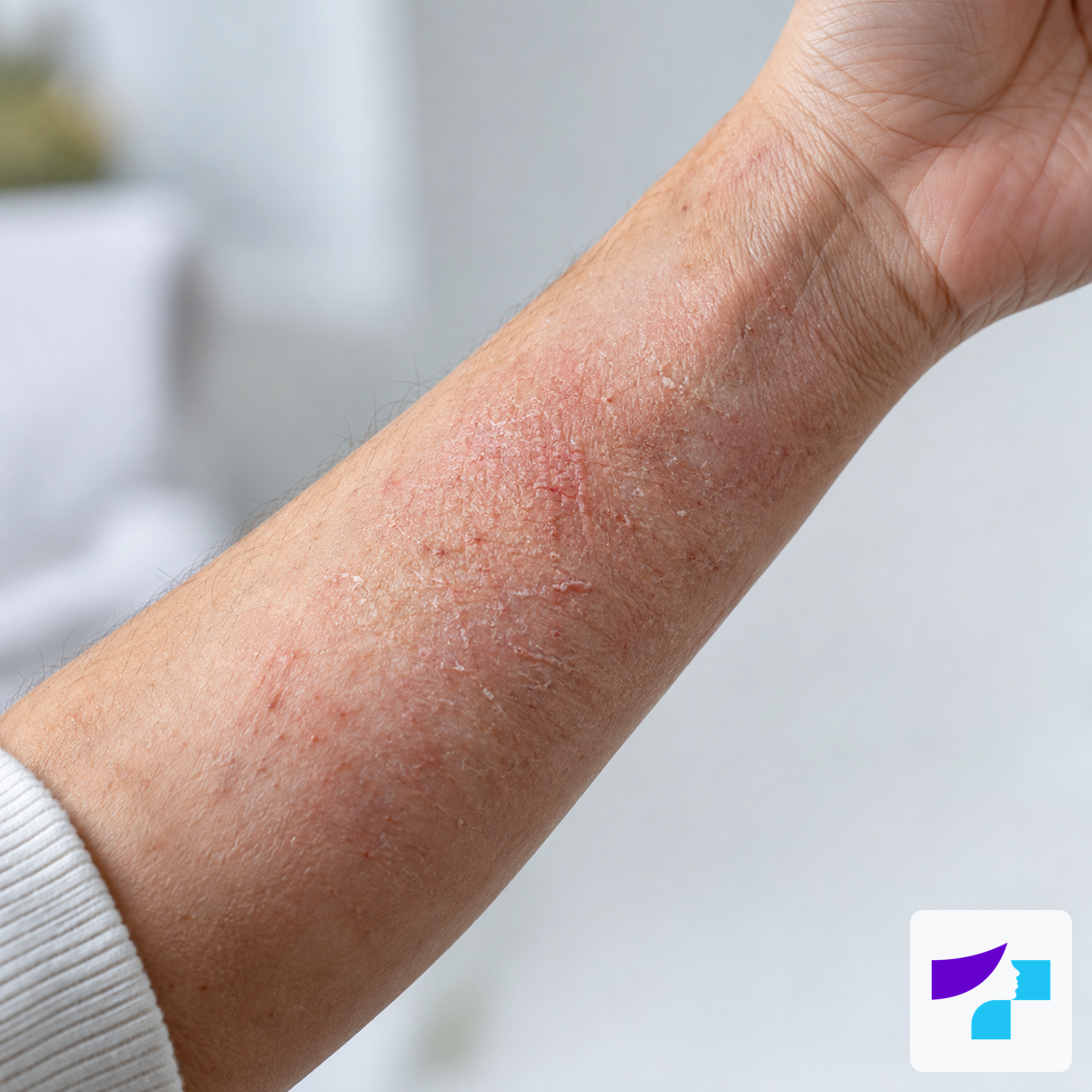
The image illustrates redness, dryness and scaling characteristic of eczema on the forearm. The appearance of eczema can vary between individuals.
Dry skin or eczema: how to tell the difference?
Dry skin and eczema may look similar, but they are not the same. Dry skin usually causes tightness and scaling, while eczema includes inflammation, itching, redness, cracks or recurrent flare-ups.
| Sign | Dry skin | Eczema | When to see a dermatologist |
|---|---|---|---|
| Itching | Milder, often after washing | Frequent, sometimes very intense | If it disturbs sleep or leads to scratching until the skin bleeds |
| Redness | Usually mild or temporary | Persistent and recurrent during flare-ups | If redness does not go away or spreads |
| Cracks | May occur with marked dryness | Common, especially in hand eczema | If cracks hurt, bleed or ooze |
| Oozing | Not typical | May occur during acute inflammation | If fluid, crusting or pus appears |
| Response to cream | Usually improves with moisturising | May also require anti-inflammatory treatment | If moisturising is not enough |
Eczema should also be distinguished from psoriasis, fungal infection, scabies, rosacea and other skin conditions. If a rash is persistent, unusual or recurrent, it is safer to have it assessed by a dermatologist.
Common symptoms of eczema
| Symptom | How it appears | What it may mean |
|---|---|---|
| Itching | Mild to very intense | Active inflammation and skin barrier damage |
| Dryness | Tight, rough, scaly skin | Moisture loss in the skin |
| Redness | Red, pink, purple or darker patches | Skin inflammation |
| Cracks | Painful lines in the skin | Marked dryness or hand eczema |
| Blisters | Small itchy fluid-filled lesions | Acute or dyshidrotic eczema |
| Oozing | The skin becomes wet and releases fluid | Marked inflammation or infection risk |
| Crusts | Yellowish or brownish crusting | Possible bacterial infection |
| Thickened skin | Rougher, harder, darker skin | Chronic scratching |
Types of eczema
| Type of eczema | Main signs | Common areas | Important note |
|---|---|---|---|
| Atopic dermatitis | Dryness, itching, recurrent flare-ups | Skin folds, face, neck, hands | Often begins in childhood |
| Contact dermatitis | Inflammation after contact with an irritant or allergen | Hands, face, eyelids | Patch testing may be needed |
| Hand eczema | Cracks, dryness, pain, itching | Palms, fingers | Often related to work and frequent washing |
| Dyshidrotic eczema | Small, deep, itchy blisters | Palms, fingers, feet | Should be distinguished from fungal infection |
| Nummular eczema | Round, coin-shaped patches | Arms, legs, body | May resemble fungal infection |
| Seborrheic dermatitis | Greasy scaling, redness | Scalp, eyebrows, nasal folds | Antifungal treatment may be needed |
| Stasis dermatitis | Itching, brownish skin, swelling | Lower legs | Linked to venous insufficiency |
Atopic dermatitis
Atopic dermatitis, also called atopic eczema, is one of the most common chronic forms of eczema. It often begins in childhood but may continue into adulthood or first appear in adults.
This condition is associated with skin barrier dysfunction, genetic predisposition and immune system activity. Some patients also have a family history of asthma, allergic rhinitis or other atopic conditions.
Contact dermatitis
Contact dermatitis occurs when the skin becomes inflamed after contact with an irritating substance or allergen. Irritant contact dermatitis may be caused by frequent hand washing, disinfectants, cleaning products, solvents, water and friction.
Allergic contact dermatitis occurs when the immune system reacts to a specific substance, such as nickel, fragrances, preservatives, hair dyes, cosmetic ingredients or latex.
Hand eczema
Hand eczema is common in people who work daily with water, soaps, disinfectants, chemicals or gloves. It may affect healthcare workers, hairdressers, cooks, cleaners, mechanics and others.
Hand eczema may cause dryness, cracks, pain, itching, skin thickening and sometimes blisters. If hand eczema does not improve, both irritant factors and possible contact allergy should be assessed.
Dyshidrotic eczema
Dyshidrotic eczema usually appears as small, deeper, very itchy blisters on the palms, sides of the fingers or feet. After the blisters settle, the skin may peel, crack and become painful.
Flare-ups may be promoted by sweating, stress, irritants, metal allergens or skin infections. In some cases, fungal infection must be ruled out.
Seborrheic dermatitis
Seborrheic dermatitis most often affects the scalp, eyebrows, nasal folds, ears and centre of the chest. It often appears with redness and greasy or yellowish scales. On the scalp, it is commonly recognised as dandruff.
Nummular eczema
Nummular eczema forms round or oval, coin-shaped inflamed patches. They often appear on the arms, legs or body and may itch, scale or ooze.
Stasis dermatitis
Stasis dermatitis usually affects the lower legs and is associated with venous insufficiency. The skin may become itchy, brownish, dry, inflamed and fragile. Leg swelling is also common. In this case, treatment should address not only skin inflammation but also venous circulation problems.
Causes and triggers of eczema
The causes of eczema are not the same for everyone. It often develops due to a combination of several factors.
Possible causes and contributing factors include:
- genetic predisposition;
- skin barrier damage;
- increased immune system response;
- dry air and cold climate;
- sweating and overheating;
- frequent washing;
- soaps, shower gels and disinfectants;
- fragrances and cosmetic ingredients;
- household chemicals;
- nickel, latex or other contact allergens;
- stress and lack of sleep;
- skin infections;
- workplace factors.
The role of diet in eczema should be assessed carefully. Some children with atopic dermatitis may also have food allergy, but eczema is not always caused by food. Eliminating broad food groups without medical assessment may be unnecessary and can even be harmful in children.
What can trigger an eczema flare-up?
An eczema flare-up is a period when symptoms become more pronounced: the skin itches more, becomes drier, redder, painful, swollen or starts to ooze.
Common triggers include:
- hot showers or baths;
- harsh soaps;
- disinfectants;
- fragranced cosmetics;
- wool or rough fabrics;
- sweating;
- cold and dry air;
- dust, pollen or animal allergens;
- stress;
- lack of sleep;
- infections;
- intense scratching;
- inappropriate or insufficient moisturising.
Eczema by body area
Eczema on the hands
In hand eczema, it is especially important to reduce contact with water, cleaning products and disinfectants. Hands should be washed with a mild cleanser, dried carefully after washing and regularly treated with a fragrance-free cream or ointment.
If the hands crack, bleed, hurt or eczema interferes with work, a dermatologist consultation is recommended.
Eczema on the face and eyelids
The skin on the face and eyelids is thin and sensitive. Eczema in these areas may be triggered by cosmetics, fragrances, eye drops, nail polish, hair dye or contact allergy.
Strong topical corticosteroids should not be used long-term on the face or eyelids without medical supervision. In these areas, gentler anti-inflammatory treatment often needs to be considered.
Eczema in children
In children, eczema is often associated with atopic dermatitis. In infants, it may appear on the cheeks, scalp and outer surfaces of the arms and legs. In older children, the elbow and knee folds, hands, neck and face are more commonly affected.
Treating eczema in children requires regular moisturising, gentle washing and a clear flare-up treatment plan. Dietary restrictions should not be introduced without medical assessment. If a child has widespread or recurrent rashes, a paediatric dermatologist consultation is recommended.
Eczema on the legs
Eczema on the legs may be related to dry skin, atopic dermatitis, contact dermatitis, fungal infection or venous insufficiency. If eczema appears on the lower legs together with swelling, brownish skin colour or a heavy feeling in the legs, circulation problems should also be assessed.
How is eczema diagnosed?
A dermatologist usually diagnoses eczema by examining the skin and asking about symptoms, duration, flare-ups, affected areas and possible triggers.
It is important to mention:
- work environment;
- cosmetics and washing products;
- glove use;
- hobbies;
- pets;
- allergies;
- family medical history;
- previously used creams and medicines.
In some cases, additional tests may be needed:
- patch tests if contact allergy is suspected;
- skin scraping if fungal infection must be excluded;
- swab or culture if bacterial infection is suspected;
- dermoscopy or other tests in unclear cases.
Stepwise eczema treatment
Eczema treatment is usually gradual. The goal is to restore the skin barrier, reduce inflammation, prevent infection risk and reduce the frequency of flare-ups.
| Situation | Possible approach | Note |
|---|---|---|
| Dry, sensitive skin without marked inflammation | Emollients, gentle washing, reducing irritants | Skin care should be regular |
| Mild flare-up | Emollients and a short course of local anti-inflammatory treatment | Treatment should be adapted to the area and age |
| Facial or eyelid eczema | Gentle care, calcineurin inhibitors or another doctor-prescribed treatment | Caution is needed with steroids |
| Recurrent hand eczema | Workplace protection, emollients, anti-inflammatory treatment, contact allergy assessment | Daily habits often need to be changed |
| Oozing or crusting | Assessment and treatment of infection | Antibacterial or antiviral medicines may be needed |
| Chronic or widespread eczema | Phototherapy or systemic treatment | Dermatologist supervision is needed |
| Severe atopic dermatitis | Biologic therapy or JAK inhibitors | Indications and safety must be assessed |
Eczema treatment
Moisturising and emollients
Regular moisturising is the foundation of eczema treatment. Emollients help restore the skin barrier, reduce dryness, lower the risk of cracks and may help reduce itching.
Emollients should be used not only during flare-ups, but also when the skin looks better. Products without fragrances and irritating additives are usually preferred.
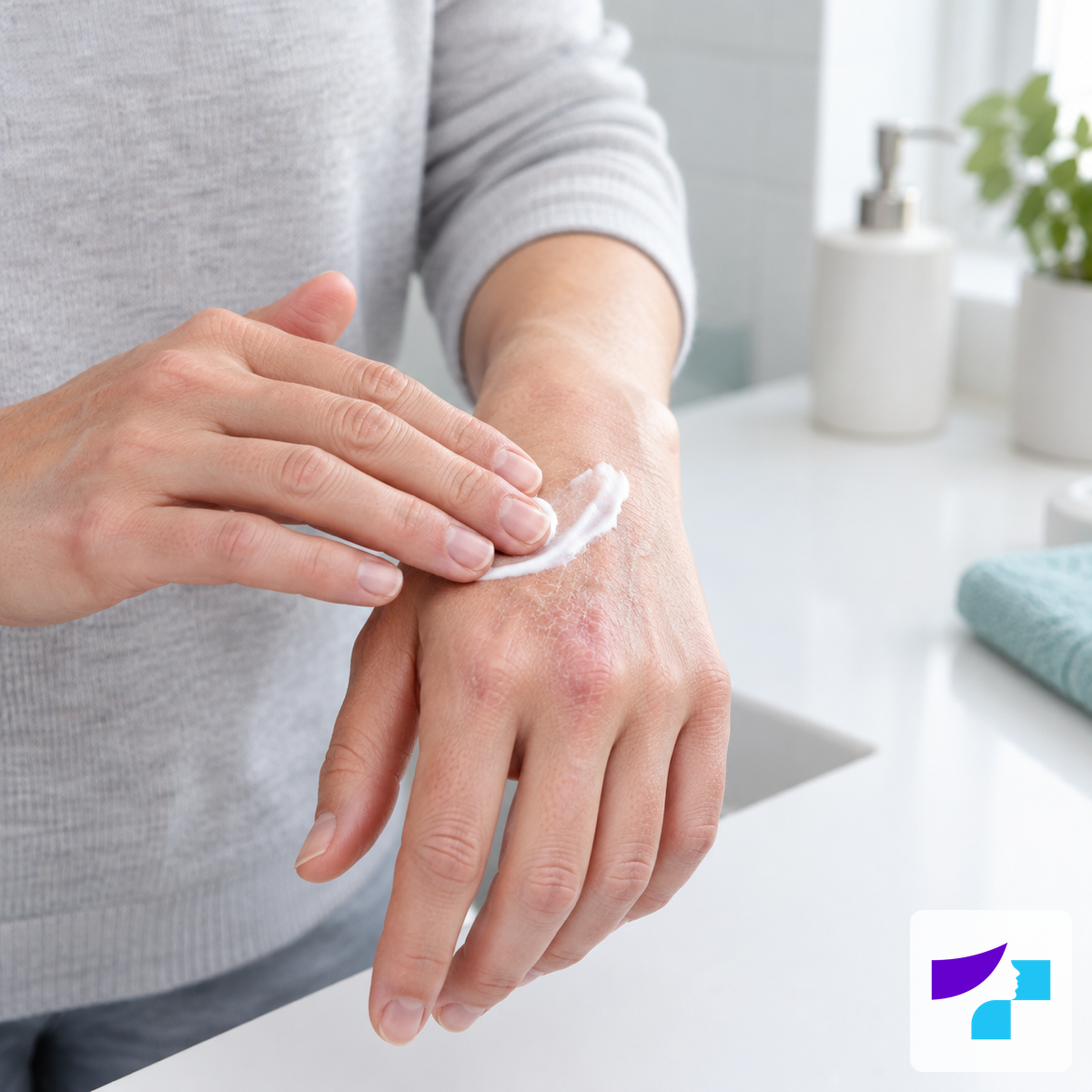
The image shows moisturising cream being applied to dry forearm skin. Regular use of emollients helps maintain the skin barrier.
Gentle washing
For eczema, short lukewarm showers are recommended. Hot water, harsh soaps and fragranced shower gels should be avoided. After washing, the skin should be gently patted dry rather than rubbed, and moisturiser should be applied within a few minutes.
Avoiding triggers
If the factors that worsen eczema are known, reducing them is an important part of treatment. In hand eczema, contact with water, cleaning products and disinfectants should be reduced. In facial and eyelid eczema, cosmetics, eye drops, fragrances, hair dyes and nail products should be assessed.
Topical corticosteroids
Topical corticosteroids are anti-inflammatory medicines used on the skin during eczema flare-ups. They can reduce redness, itching and inflammation when used at the right strength, in the right area and for the right duration.
Patients often worry about “hormonal creams”. These concerns are understandable, because incorrect or excessive use may cause side effects such as thinning of the skin or pigment changes. However, when used as directed by a doctor, topical corticosteroids are one of the most important treatments for eczema flare-ups.
Calcineurin inhibitors
Calcineurin inhibitors, such as tacrolimus and pimecrolimus, are topical anti-inflammatory medicines. They may be especially useful in sensitive areas such as the face, eyelids, neck or skin folds.
At first, they may cause a temporary burning or warming sensation. These medicines should be used as directed by a doctor.
Antihistamines
Antihistamines may help some patients when itching disturbs sleep. However, they do not treat the underlying inflammatory mechanism of eczema and should not be considered the main treatment for eczema.
Treating infection
Skin affected by eczema is more vulnerable to infections. Signs of infection may include:
- honey-coloured or yellowish crusting;
- pus;
- increasing pain;
- marked swelling;
- rapidly increasing redness;
- fever;
- feeling unwell;
- painful blisters resembling cold sores.
A particularly serious situation is herpes virus infection on skin affected by atopic dermatitis. If painful blisters, fever or rapid worsening appear, medical help should be sought urgently.
Phototherapy
Phototherapy may be suitable for certain chronic or more widespread cases of eczema when topical treatment is not enough. It is performed in controlled doses and under medical supervision. Phototherapy is not the same as sunbathing.
Systemic treatment for severe eczema
If eczema is severe, widespread, frequently flares or significantly affects sleep and quality of life, a dermatologist may consider systemic treatment. This may include immunomodulating medicines, biologic therapy or JAK inhibitors. These treatments are not intended for every patient, and careful safety assessment is required.
Seasonal eczema control
In winter
In winter, eczema is often worsened by cold air, heating, low indoor humidity and thick clothing. During this period, thicker emollients, more frequent moisturising and avoiding hot showers may be needed.
In summer
In summer, eczema may be worsened by sweating, overheating, sunscreens or chlorinated water. Breathable clothing, rinsing the skin after swimming and using sunscreen suitable for sensitive skin are recommended.
Diet and eczema
Eczema is not always caused by diet. Some children with atopic dermatitis may have food allergy, but eliminating foods without medical assessment is not recommended.
Children in particular should not have milk, eggs, wheat or other food groups removed from their diet without medical advice, as this may cause nutritional deficiencies. If food allergy is suspected, medical assessment and, if needed, allergy testing are recommended.
What should not be done with eczema?
In eczema, it is not recommended to:
- scratch the skin until it bleeds;
- use harsh scrubs;
- wash with hot water;
- use fragranced creams, oils or soaps on inflamed skin;
- use prescription medicines for a long time without medical advice;
- stop prescribed treatment too early;
- exclude broad food groups without medical reason;
- treat persistent eczema only with home remedies;
- ignore signs of infection;
- sunbathe with the aim of “drying out” eczema.
When should you see a dermatologist?
A dermatologist should be consulted if:
- eczema does not improve or often returns;
- itching disturbs sleep;
- cracks, pain, oozing or crusting appear;
- infection is suspected;
- eczema affects the face, eyelids, hands or genital area;
- a child has widespread or rapidly worsening rashes;
- contact allergy is suspected;
- regular moisturisers are not enough;
- prescription medicines may be needed;
- the condition affects work, school, sleep or emotional wellbeing.
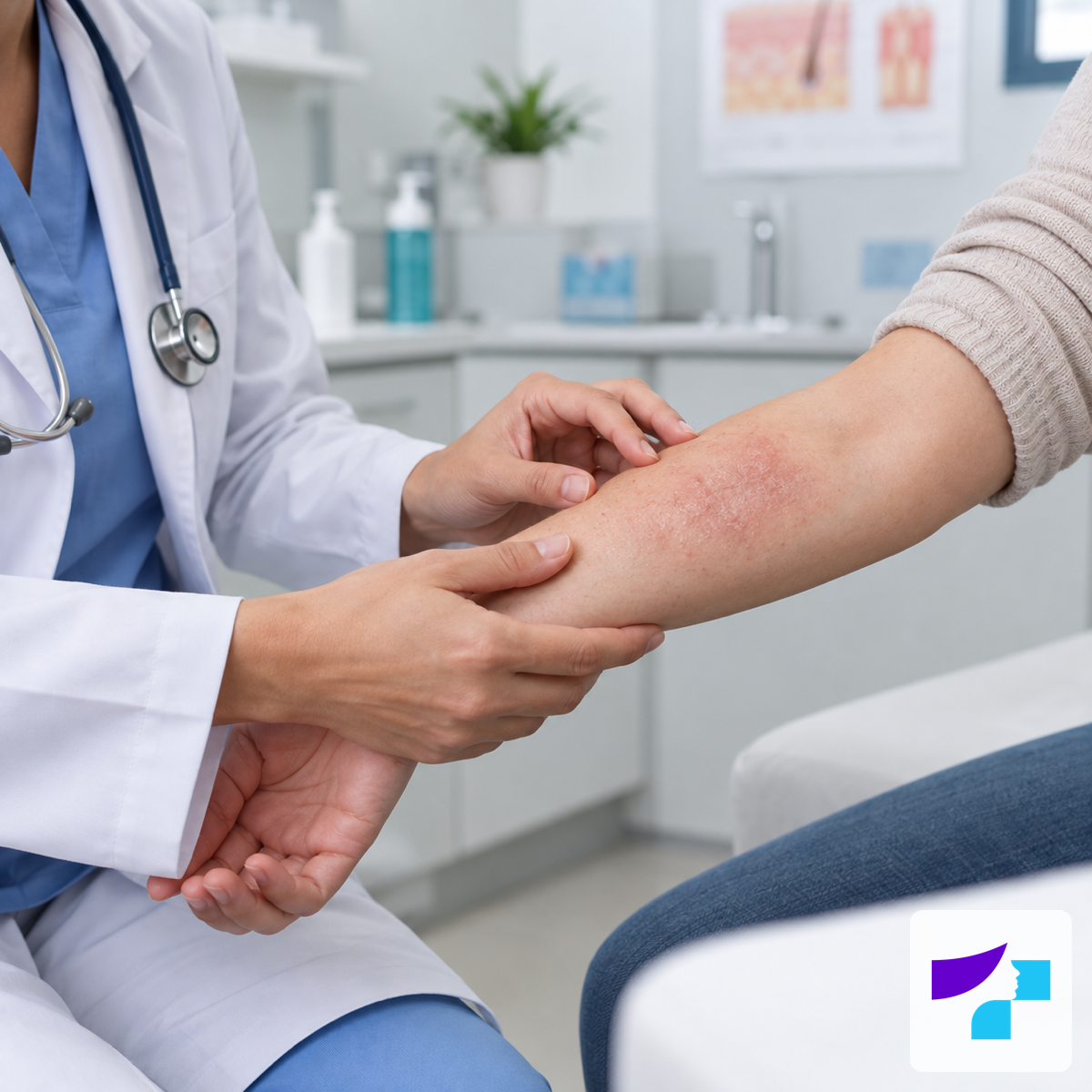
The image illustrates a dermatologist examining a patient’s forearm skin during a consultation. A skin examination and assessment of symptoms help establish a diagnosis and select treatment.
Common myths about eczema
Myth: eczema is contagious.
Eczema is not an infectious disease and is not contagious.
Myth: eczema is always caused by food allergy.
Food allergy may be important for some patients, but it is not the only or always the main cause of eczema.
Myth: one cream is enough.
Sometimes proper skin care is enough, but chronic or severe eczema often requires a broader treatment plan.
Myth: hormonal creams are always dangerous.
Incorrect use can carry risks, but topical corticosteroids used as prescribed by a doctor can be safe and effective.
Myth: when the skin looks better, moisturising is no longer needed.
Emollients should also be used during remission because they help maintain the skin barrier.
Myth: sunbathing cures eczema.
Controlled phototherapy may help in certain cases, but sunbathing is not a safe treatment method.
Myth: natural remedies are always safe for sensitive skin.
Essential oils, plant extracts and fragrances may irritate the skin or cause an allergic reaction.
Summary
Eczema is a common, non-contagious inflammatory skin condition that may appear with itching, dryness, redness, cracks, blisters or oozing. It may be temporary, but in many patients it follows a chronic course with recurrent flare-ups.
Effective treatment is based on accurate diagnosis, restoring the skin barrier, reducing triggers and controlling inflammation. In milder cases, regular moisturising and gentle care may help significantly, while more severe cases may require prescription medicines, phototherapy or systemic treatment.
A dermatologist consultation helps determine the type of eczema, identify factors that worsen it and create a safe, realistic treatment plan.
References and authoritative sources
- American Academy of Dermatology: patient information about eczema
- American Academy of Dermatology: atopic dermatitis diagnosis and treatment
- American Academy of Dermatology: signs of infection in children with eczema
- DermNet: dermatitis and types of eczema
- DermNet: treatment of atopic dermatitis
- National Eczema Association: patient information about eczema
- National Eczema Association: eczema treatment options
- National Institute for Health and Care Excellence (NICE): diagnosis and treatment of atopic eczema in children
