Contact dermatitis at a glance
- Contact dermatitis is inflammation of the skin after contact with an irritant or allergen.
- It is usually not contagious.
- There are two main types: irritant contact dermatitis and allergic contact dermatitis.
- Irritant contact dermatitis develops when a substance or environmental factor damages the skin barrier.
- Allergic contact dermatitis is a delayed immune reaction to a specific allergen.
- Both types can occur at the same time.
- Contact dermatitis commonly affects the hands, face, eyelids, neck, feet and areas exposed to cosmetics, metals, gloves, footwear or occupational substances.
- Treatment is based on identifying and avoiding the trigger and restoring the skin barrier.
- For recurrent or unexplained contact dermatitis, a dermatologist may recommend patch testing.
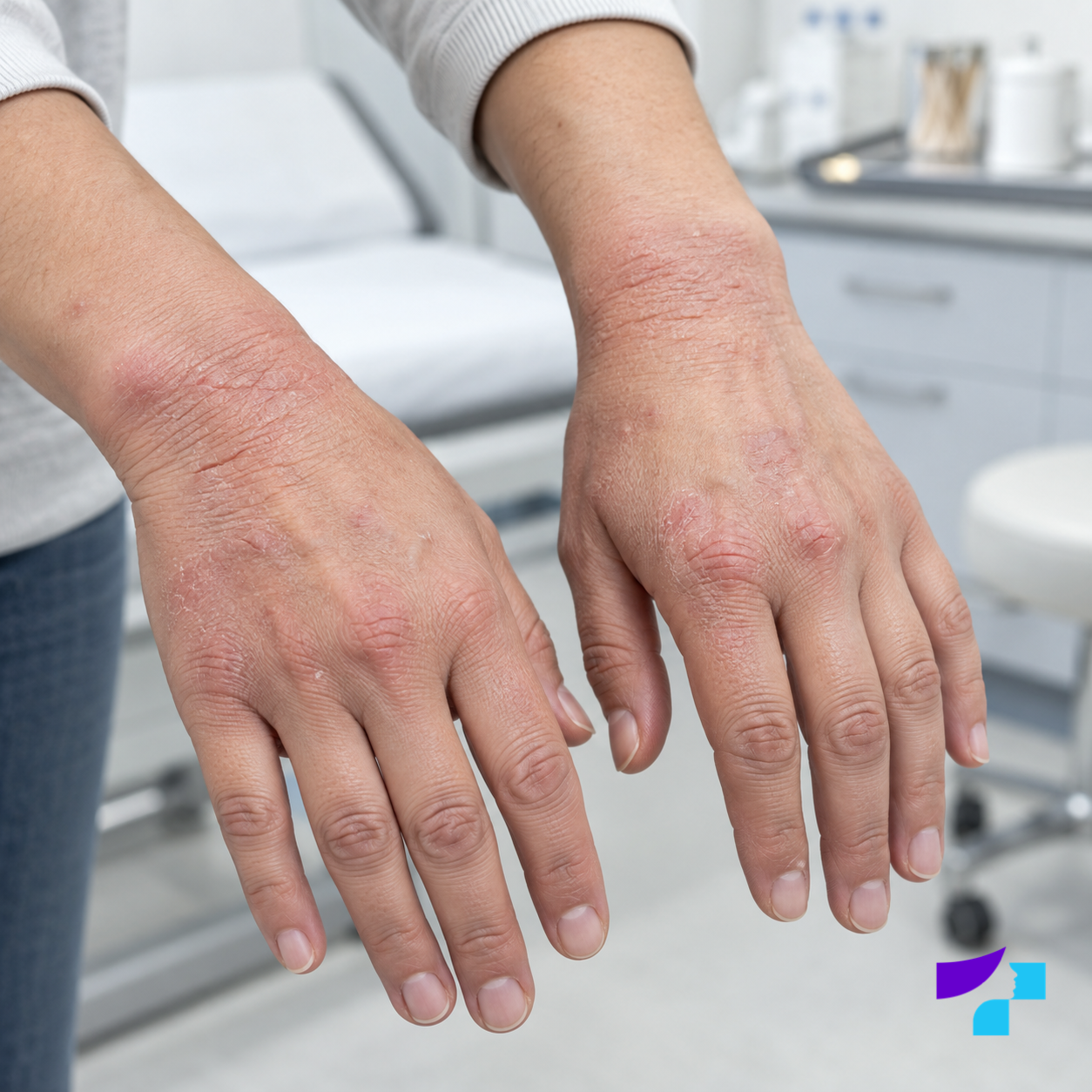
Contact dermatitis on the hands may cause redness, dryness, scaling and cracking of the skin.
What is contact dermatitis?
Contact dermatitis is inflammation that develops after the skin comes into contact with a substance that irritates it or causes an allergic reaction. It may cause redness, itching, burning, dryness, scaling, blisters, cracks or weeping skin.
Simply put, contact dermatitis means that the skin has reacted to something it has touched. The trigger may be a cosmetic product, fragrance, metal, glove, shoe, disinfectant, soap, cleaning product, hair dye, nail product or occupational substance.
Contact dermatitis is one of the types of dermatitis. It may be mild and short-lived, but it can also become chronic, painful and recurrent, especially if the trigger is not identified.
How does contact dermatitis develop?
Contact dermatitis develops in two main ways.
In the first, the skin barrier is directly damaged by an irritating substance or condition, such as frequent washing, disinfectants, cleaning products, friction, sweat or moisture. This is called irritant contact dermatitis.
In the second, the immune system begins to recognise a specific substance as an allergen. After further exposure, a delayed skin reaction develops. This is called allergic contact dermatitis.
Some people have both mechanisms. For example, frequent washing may first make the hands dry and sensitive, after which an allergy to an ingredient in gloves, creams or an occupational product may develop.
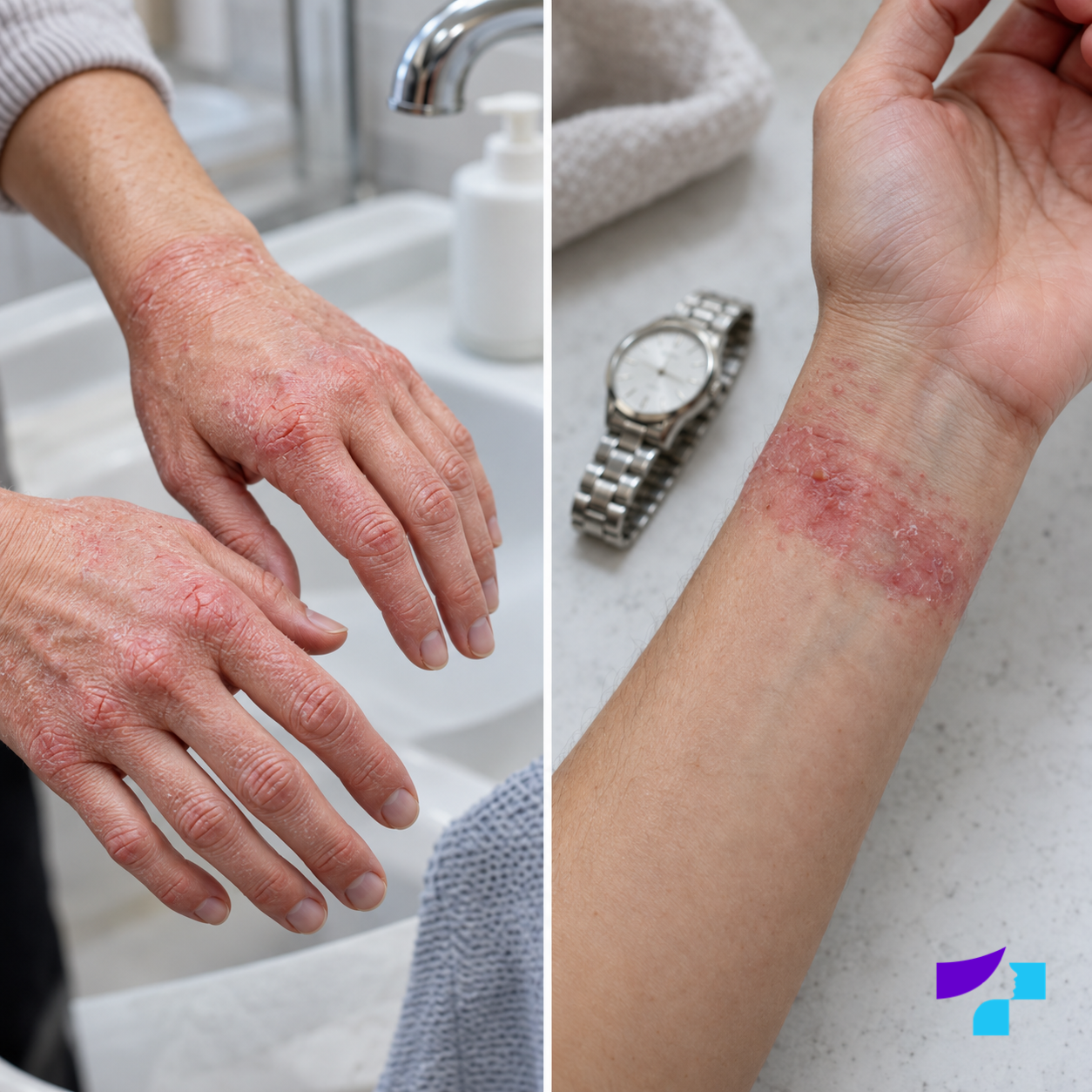
Left: irritant contact dermatitis after repeated exposure of the hands to water and cleansing agents. Right: allergic contact dermatitis at the site of contact with a watch.
How quickly does contact dermatitis appear?
The time it takes for contact dermatitis to appear depends on its type.
Irritant contact dermatitis may appear within minutes or hours after exposure to a strong irritant. It may also develop gradually over days or weeks when the skin is repeatedly exposed to water, soaps, disinfectants, gloves or friction.
Allergic contact dermatitis usually does not appear immediately. Symptoms more often begin several hours to one or two days after contact with the allergen. This delay can make it difficult to identify the product or substance responsible.
What are the types of contact dermatitis?
| Type | Cause | Typical onset | Typical appearance | Common examples | Diagnosis |
|---|---|---|---|---|---|
| Irritant contact dermatitis | Direct damage to the skin barrier | Rapid or gradual | Dryness, burning, cracks, redness and soreness | Soaps, disinfectants, cleaning products and wet work | Examination and assessment of habits and occupational exposure; patch testing may be needed to rule out contact allergy |
| Allergic contact dermatitis | Immune reaction to a specific allergen | Often after several hours or days | Itching, redness, blisters, swelling and scaling | Nickel, fragrances, preservatives, hair dye and rubber additives | Patch testing and assessment of exposure to the suspected allergen |
| Systemic contact dermatitis | A contact allergen enters the body systemically in a previously sensitised person | May be delayed | A flare at previously affected sites or more widespread eczema | In selected cases, nickel in food or ingredients in medicines | Medical assessment, patch testing and exposure analysis |
Read more about this particular systemic form in the article Systemic contact dermatitis.
Acute, subacute and chronic contact dermatitis
Contact dermatitis may change over time.
| Stage | Typical appearance | What it means for the patient |
|---|---|---|
| Acute contact dermatitis | Redness, swelling, itching, blisters and weeping | The reaction is active; the skin should be protected and the trigger removed |
| Subacute contact dermatitis | Less weeping, crusting, peeling and dryness | Inflammation is subsiding, but the skin barrier has not yet recovered |
| Chronic contact dermatitis | Dry, thickened, rough and cracked skin | Irritation, allergy or unsuitable skin protection often continues |
Chronic contact dermatitis is especially common on the hands. It may interfere with work, handwashing, cooking, tool use and everyday activities.
What does contact dermatitis look like?
Common signs include:
- redness;
- itching;
- burning;
- soreness or stinging;
- dryness;
- scaling;
- peeling skin;
- swelling;
- small blisters;
- weeping;
- crusting;
- cracks;
- skin thickening in chronic cases.
Marked itching and blisters are more typical of allergic contact dermatitis, while burning, soreness, dryness and cracking are more typical of irritant contact dermatitis. In practice, these features may overlap.
What commonly causes contact dermatitis?
Common triggers include:
- cosmetics;
- fragrances;
- preservatives;
- soaps;
- disinfectants;
- cleaning products;
- metals, especially nickel;
- chromium and cobalt;
- gloves;
- latex and rubber additives;
- footwear and shoe adhesives;
- hair dye;
- nail polish, gel nail products and acrylates;
- eyelash adhesive;
- plants;
- occupational chemicals;
- medicines applied to the skin.
Important: labels such as “hypoallergenic”, “natural” or “dermatologically tested” do not mean that a product cannot cause contact dermatitis in a particular person.
What can the location of contact dermatitis reveal about its cause?
| Location | Possible causes |
|---|---|
| Eyelids | Eye cosmetics, hair dye, eye drops, eyelash adhesive and face creams |
| Hands | Washing, disinfectants, gloves, cleaning products, occupational substances, nickel and nail products |
| Neck | Perfume, jewellery, hair products and textile dyes |
| Face | Cosmetics, sunscreen, masks, shaving products, fragrances and preservatives |
| Armpits | Deodorants, fragrances, preservatives and shaving products |
| Feet | Footwear, rubber, chromium, nickel, shoe adhesives, sweating and friction |
| Genital area | Hygiene products, condoms, lubricants, topical medicines and fragrances |
Contact dermatitis on the hands
The hands are among the most common sites of contact dermatitis. Every day they may be exposed to water, soaps, disinfectants, cleaning products, food, metals, gloves and occupational substances.
Hand contact dermatitis often causes dry, rough skin, cracks on the fingers, redness, itching, burning, small blisters or pain when using the hands. Read more about this location in the Medart article Hand and foot dermatitis.
Contact dermatitis on the face and eyelids
The skin of the face and eyelids is particularly sensitive. Eyelid dermatitis may be caused not only by products applied directly to the eyelids, but also by substances transferred to the eye area from the hands, nails, hair or facial cosmetics.
Possible triggers include eye cosmetics, face creams, sunscreen, make-up removers, nail polish, gel nail products, hair dye, eyelash adhesive, fragrances, preservatives and eye drops. Read more in Facial and eyelid dermatitis.
Contact dermatitis on the feet and footwear dermatitis
Foot contact dermatitis is often associated with footwear, sweating and friction. When the rash affects the tops of the feet or toes, or follows areas of shoe contact, shoe materials or adhesives may be involved.
Possible causes include:
- shoe adhesives;
- rubber components;
- chromium in leather footwear;
- nickel in metal components;
- dyes;
- sweating;
- tight footwear;
- damp socks.
If peeling and cracks are mainly between the toes, a fungal infection of the feet should be ruled out.
Occupational contact dermatitis
Contact dermatitis is a common occupational skin problem. It may affect a person’s ability to work and quality of life because the hands can become painful, cracked, bleeding or sensitive during everyday tasks.
Higher-risk occupations include:
- healthcare workers;
- hairdressers;
- cooks;
- cleaning staff;
- mechanics;
- construction workers;
- metalworkers;
- beauty professionals;
- agricultural workers;
- people who frequently work with gloves or water.
An important clue: if the dermatitis improves at weekends or during holidays but returns at work, tell your dermatologist.
Contact dermatitis in children
In children, contact dermatitis may be caused by either irritation or allergy. Common triggers include moisture, friction, saliva, nappies, wet wipes, hygiene products, fragrances, creams, adhesive dressings, textile dyes, metal parts and sunscreens.
Children’s skin is more sensitive, so potent medicated creams should not be used without medical advice, especially on the face, eyelids, skin folds or nappy area. Medical advice is needed if the rash does not clear, weeps, becomes painful, spreads rapidly or is accompanied by fever.
Contact dermatitis or another skin condition?
| Condition | Typical features | What helps distinguish it? |
|---|---|---|
| Contact dermatitis | Rash after contact with an irritant or allergen | Location, product and occupational history, and patch testing when contact allergy is suspected |
| Atopic dermatitis | Chronically dry, itchy skin, often beginning in childhood | Atopic tendency, asthma, allergic rhinitis and family history |
| Fungal infection | Scaling and cracks, often on the feet, in the groin or on only one limb | Fungal testing |
| Psoriasis | Thick, well-defined scaly plaques | Nail changes and psoriasis elsewhere on the body |
| Urticaria | Sudden, raised, itchy wheals that change location | Rapid appearance and disappearance |
| Bacterial infection | Pain, pus, warmth, swelling and crusting | Medical examination and, in some cases, a swab or culture |
| Drug eruption | Rash after starting a medicine | Timing of medicine use and medical assessment |
For more about an atopic background, read the Medart article Atopic dermatitis.
How is contact dermatitis diagnosed?
A dermatologist diagnoses contact dermatitis by examining the skin, assessing the course of symptoms and discussing possible triggers.
The doctor may ask:
- when the rash began;
- where it first appeared;
- whether a new cream, cosmetic, soap or detergent was used;
- whether gloves, new footwear, hair dye or nail products were used;
- about working conditions;
- whether symptoms improve on days off;
- whether similar reactions have occurred before;
- which treatments have already been used;
- whether there is a history of atopic dermatitis, psoriasis or fungal infection.
What is patch testing?
Patch testing is an investigation used to detect delayed contact allergy. Small amounts of allergens are placed in special chambers on the back, and the skin reactions are assessed by a clinician at specified times.
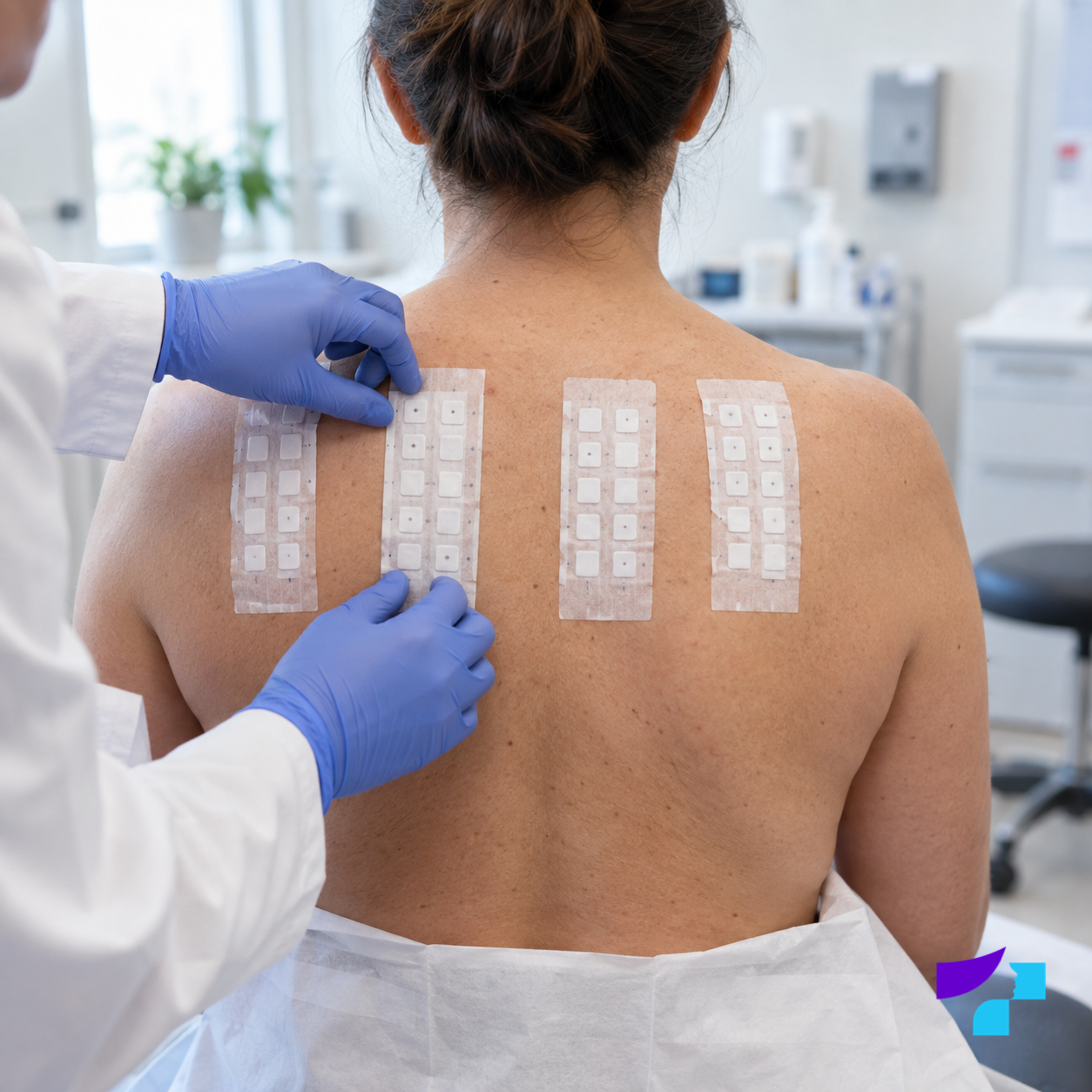
During patch testing, allergen chambers are attached to the back for a set period, and the skin reactions are assessed later by a clinician.
Patch testing may help identify allergy to nickel, chromium, cobalt, fragrances, preservatives, rubber additives, hair dye ingredients, acrylates, shoe adhesives or ingredients in topical medicines.
Not every patient needs patch testing. It is particularly useful when dermatitis is recurrent or chronic, affects the hands, face or eyelids, appears to be work-related or has no clear cause.
What does a positive patch test mean, and what does it not mean?
A positive patch test means that the skin has become sensitised to a particular substance. However, it does not automatically mean that this substance is causing all of the current skin symptoms.
The doctor must assess:
- whether the person is actually exposed to the substance;
- whether the rash location matches the possible exposure;
- whether the timing of symptoms is consistent with contact allergy;
- whether another cause, such as irritation, fungal infection, psoriasis or atopic dermatitis, is present.
Blood tests and specific IgE tests are generally not the main method for diagnosing allergic contact dermatitis because contact allergy is usually a delayed-type reaction.
What is a ROAT?
A repeated open application test, or ROAT, involves repeatedly applying a small amount of a specific product to a small area of skin to assess whether it causes a reaction. It is sometimes used to investigate a suspected cosmetic or skincare product.
Important: a ROAT should not be regarded as a universal self-test. It is safer to perform it only on a dermatologist’s recommendation, especially after a severe reaction or when the rash affects the face or eyelids, weeps, is swollen or the diagnosis is unclear.
How is contact dermatitis treated?
The main principle of treatment is to identify the trigger and stop exposure to it. If the provoking substance continues to touch the skin, dermatitis may return even after temporary improvement.
The treatment plan may include:
- stopping exposure to the trigger;
- rinsing the skin after recent exposure;
- reducing exposure to irritants;
- restoring the skin barrier;
- regular use of emollients and moisturisers;
- topical anti-inflammatory treatment prescribed by a doctor;
- patch testing if allergy is suspected;
- assessment for fungal or bacterial infection when symptoms are atypical;
- a plan to improve occupational protection or change gloves or footwear.
Specific treatment should be selected by a dermatologist or treating doctor. This is especially important when dermatitis is widespread, painful, weeping, recurrent or affects the face, eyelids or genital area.
What can be done at home for mild contact dermatitis?
If the reaction is mild and clearly linked to a specific product, the first step is to stop using it.
The following may help:
- rinse the skin with lukewarm water after recent exposure to an irritant;
- do not reapply the suspected product;
- avoid fragranced or active products on inflamed skin;
- use a simple fragrance-free moisturiser if it does not irritate the skin;
- protect the skin from friction, sweat and repeated chemical exposure;
- write down what may have caused the reaction.
See a doctor if symptoms do not resolve, become worse or recur.
What should be avoided with contact dermatitis?
A person with contact dermatitis should avoid:
- introducing several new products at the same time;
- continuing to use a product that clearly worsens the rash;
- using potent prescription creams without medical guidance;
- rubbing or scratching inflamed skin;
- using scrubs, acids, retinoids or alcohol-containing products on inflamed skin;
- assuming that every rash is an allergy;
- assuming that contact dermatitis is contagious;
- treating a possible fungal infection as dermatitis without a diagnosis;
- self-testing with strongly irritating substances;
- delaying medical advice when there is pus, pain, weeping, marked swelling or rapid deterioration.
How can recurrent contact dermatitis be prevented?
To reduce the risk of recurrence:
- avoid confirmed allergens;
- choose fragrance-free products if the skin is sensitive;
- do not reapply a suspected product to “test” it without medical advice;
- protect the hands from wet work and chemicals;
- use suitable gloves when needed;
- restore the skin barrier with a moisturiser after washing;
- clean or replace make-up brushes regularly;
- review jewellery, watches, footwear and occupational materials if the rash repeatedly occurs in the same place;
- keep a copy of patch test results if testing has been performed.
When should you see a dermatologist?
Consult a dermatologist if:
- the rash does not resolve within one to two weeks;
- contact dermatitis recurs;
- symptoms affect the face, eyelids or genital area;
- there is marked itching, pain, swelling or weeping;
- there is pus, yellow crusting or fever;
- dermatitis interferes with work or daily life;
- occupational dermatitis is suspected;
- it is unclear whether the condition is allergy, irritation, fungal infection, psoriasis or infection;
- patch testing may be needed.
Seek medical help more urgently if the rash is accompanied by rapid swelling, shortness of breath, swelling of the face or lips, fainting or a widespread acute reaction.
How should you prepare for a dermatology appointment?
Before the appointment, prepare:
- the date when symptoms began;
- photographs from the beginning of the flare;
- a list of all creams, cosmetics and cleaning products used;
- information about new footwear, gloves, jewellery, watches, hair dye or nail products;
- information about occupational substances and gloves;
- a list of medicines and food supplements;
- notes on what worsens and what improves the symptoms;
- results of previous investigations or patch tests, if available.
If possible, bring product packaging or photographs of ingredient lists.
Summary
Contact dermatitis is a common form of skin inflammation that develops after contact with an irritant or allergen. It is usually not contagious, but it can be very disruptive, especially when it affects the hands, face, eyelids or feet.
The key is to determine whether the reaction is caused by damage to the skin barrier, allergy or both mechanisms. In mild cases, stopping exposure and using gentle skin care may be sufficient. Recurrent, unexplained, painful or widespread contact dermatitis requires assessment by a dermatologist.
Medical disclaimer
This information is for educational purposes and does not replace a dermatology consultation, diagnosis or treatment. Treatment for contact dermatitis depends on the cause, severity and location of symptoms, skincare habits, occupational environment, exposure to allergens or irritants and medical assessment. Seek medical advice if the rash does not resolve, recurs, becomes painful or weeps, produces pus, is accompanied by extensive swelling or fever, or affects the face, eyelids or genital area.
References and authoritative sources
- American Academy of Dermatology Association: contact dermatitis diagnosis and treatment
- American Academy of Dermatology Association: causes of contact dermatitis
- DermNet: contact dermatitis types, clinical features and diagnosis
- DermNet: allergic contact dermatitis
- MedlinePlus: patient information about contact dermatitis
- Mayo Clinic: contact dermatitis symptoms and causes
- European Society of Contact Dermatitis: 2026 guideline for diagnostic patch testing
- PubMed: diagnostic approach in allergic and irritant contact dermatitis
