Skin fungus is a common fungal skin infection that can affect the feet, the spaces between the toes, the groin, the body, the face, the scalp and the nails. It may cause itching, redness, scaling, cracks, burning, ring-shaped patches or changes in skin colour.
Although a fungal skin infection is usually not life-threatening, it can be unpleasant, contagious and recurrent. If untreated, the infection may spread to other parts of the body, to family members or, for example, from the feet to the nails.
Important: not every red, itchy or scaly patch is a fungal infection. Similar symptoms may be caused by eczema, psoriasis, allergic contact dermatitis, seborrheic dermatitis, rosacea, erythrasma or a bacterial infection. For unclear, widespread, recurrent or long-lasting rashes, a dermatologist consultation is important.
In Brief: The Key Facts About Skin Fungus
- Skin fungus is treatable, but it can spread and come back.
- The most common symptoms are itching, redness, scaling, cracks and ring-shaped patches.
- Many types of fungal skin infection are contagious and can spread through skin contact, towels, shoes, floors, sports equipment or animals.
- Fungi grow more easily in warm, moist environments: closed shoes, skin folds, swimming pools, showers and changing rooms.
- Fungal infection on the feet, in the groin, on the scalp, nails or body may require different treatment approaches.
- An antifungal cream or ointment helps only when the diagnosis is correct and the treatment is used for long enough.
- Corticosteroid or “hormonal” creams used without a diagnosis can mask and worsen a fungal infection.
- Scalp fungus and nail fungus often require doctor-prescribed treatment, not only an over-the-counter cream.
- Children, people with diabetes and patients with a weakened immune system need particular caution.
- Prevention is as important as treatment, because the infection can return from shoes, towels, surfaces or an untreated source.
What Is Skin Fungus?
Skin fungus, or a fungal skin infection, is an infection caused by microscopic fungi. In medicine, the terms dermatophytosis, skin mycosis or tinea are often used when the infection is caused by dermatophytes.
Dermatophytes are fungi that affect keratin-containing tissues: the outer layer of the skin, hair and nails. This is why dermatophyte infections can affect the feet, groin, body, scalp and nails.
In everyday language, “skin fungus” may refer to several different conditions:
| Condition | Cause | Typical location | Important to know |
|---|---|---|---|
| Dermatophytosis or tinea | Dermatophytes | Feet, groin, body, scalp, nails | Often contagious; may spread from people, animals or surfaces. |
| Candida skin infection | Candida yeast | Skin folds, under the breasts, groin, nappy area | More often associated with moisture, friction, diabetes or a weakened immune system. |
| Tinea versicolor or pityriasis versicolor | Overgrowth of Malassezia yeast | Back, chest, shoulders, neck | Not the same as classic contagious dermatophytosis; often recurs in heat and sweating. |
| Malassezia folliculitis or “fungal acne” | Malassezia overgrowth in hair follicles | Back, chest, shoulders, less often the face | It is not true acne and is usually not a classic contagious fungal skin infection. |
Types of Fungal Skin Infection
| Type | Where it usually occurs | What it looks like | Common treatment approach |
|---|---|---|---|
| Athlete’s foot or tinea pedis | Between the toes, on the soles | Itching, cracks, scaling, white macerated skin, sometimes blisters | Antifungal cream, spray or powder, foot and shoe hygiene. |
| Jock itch or tinea cruris | Groin, inner thighs, buttock area | Red, itchy, well-defined patches, often with a more active edge | Antifungal cream, keeping the area dry, reducing friction, checking for athlete’s foot at the same time. |
| Body ringworm or tinea corporis | Arms, legs, abdomen, back or other body areas | Ring-shaped red patches with a scaly edge and a paler centre | Topical antifungal medicines; doctor-prescribed therapy in more widespread cases. |
| Facial tinea or tinea faciei | Face | Red, scaly, sometimes ring-shaped patch | Dermatologist assessment, because it can resemble rosacea or dermatitis. |
| Scalp ringworm or tinea capitis | Hair-bearing scalp | Scaling, broken hairs, round patches of hair loss, sometimes inflammation | Usually requires doctor-prescribed oral antifungal medication. |
| Nail fungus or onychomycosis | Fingernails or toenails | Thickened, brittle, yellowish or brownish nails | Confirmation of the diagnosis and longer treatment. |
| Candida skin infection | Skin folds, under the breasts, armpits, groin | Red, moist, irritated skin, sometimes with cracks and soreness | Antifungal therapy, reducing moisture and friction. |
| Tinea versicolor | Back, chest, shoulders, neck | Lighter, pink or brownish patches with fine scaling | Antifungal shampoos, creams or doctor-prescribed treatment; colour may recover slowly. |
Symptoms of Skin Fungus
Symptoms of a fungal skin infection can vary depending on the type of infection, its location and the individual characteristics of the skin.
Common signs include:
- itching;
- redness;
- skin scaling;
- scaly patches;
- cracks in the skin;
- burning or stinging;
- moist, macerated skin between the toes;
- ring-shaped rashes with a more pronounced edge;
- lighter, darker or brownish patches on the body;
- blisters or erosions in athlete’s foot;
- broken hairs or patches of hair loss in scalp ringworm;
- thickening, crumbling and colour changes of the nails in nail fungus.
Sometimes fungal skin infection is very itchy, while in other cases symptoms are mild. In tinea versicolor, a person may mainly notice white or brownish patches rather than severe itching.
What Does Skin Fungus Look Like in Different Body Areas?
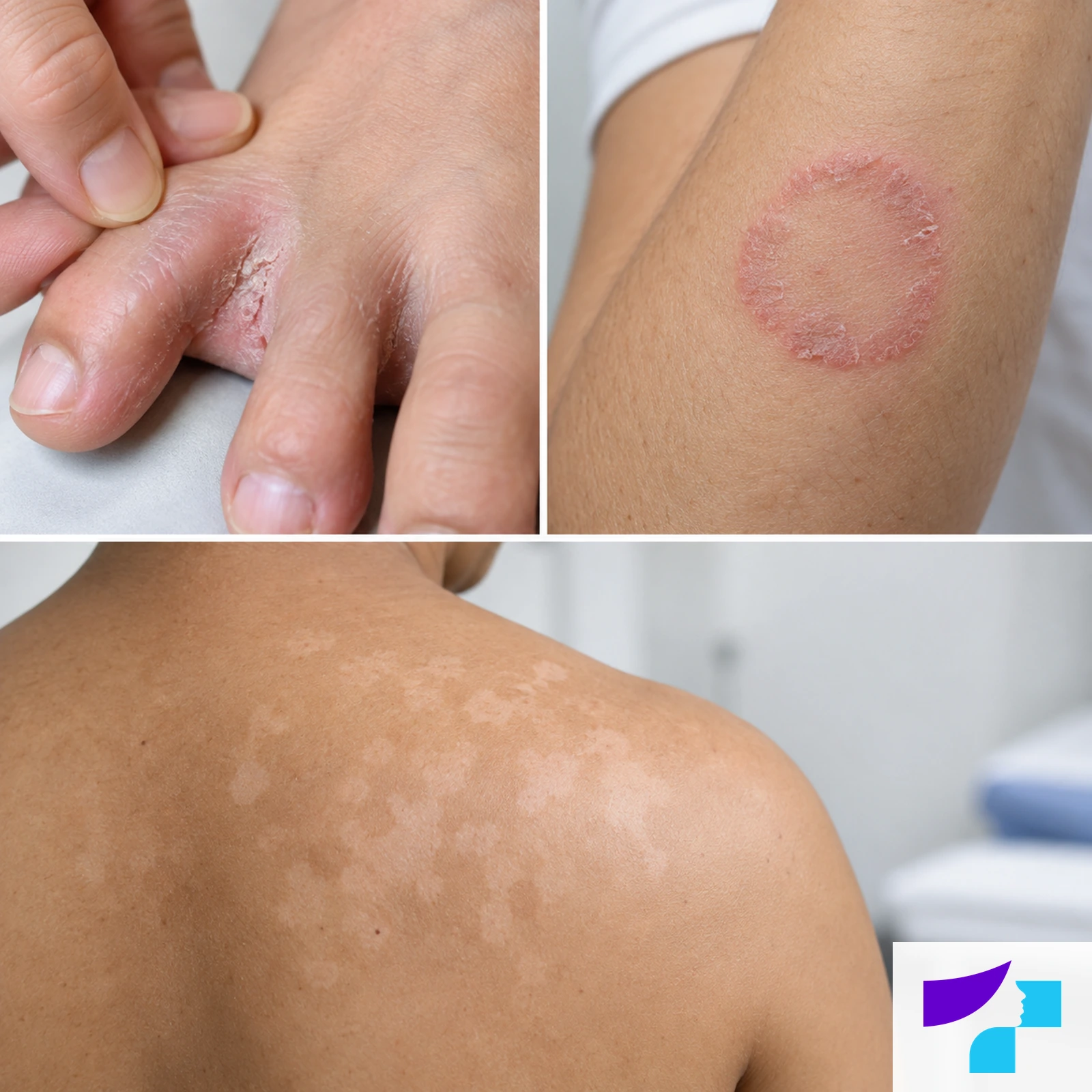
Illustrative visual: the upper-left panel shows scaling and cracks between the toes; the upper-right panel shows a ring-shaped, scaly patch on the body; and the lower panel shows lighter patches on the back, characteristic of tinea versicolor. The image illustrates possible appearances and does not confirm a diagnosis.
Skin Fungus on the Feet
Fungal infection on the feet often begins between the toes, especially between the fourth and fifth toes. The skin may become white, moist, cracked, scaly and itchy. Burning, unpleasant odour or small blisters may also occur.
Athlete’s foot is more common in people who sweat a lot, wear closed shoes, exercise, visit swimming pools or use public showers without sandals. If untreated, it can spread to the nails or other body areas.
Fungus Between the Toes
Fungus between the toes is one of the most typical forms of athlete’s foot. This area easily becomes moist and poorly ventilated, creating favourable conditions for fungal growth.
Treatment is not only about applying an antifungal medicine. It is also important to:
- dry the spaces between the toes carefully;
- change socks daily or more often if they become damp;
- dry and rotate shoes;
- avoid tight, non-breathable shoes for long periods;
- wear sandals in public showers.
Fungal Infection in the Groin
Fungal infection in the groin, or jock itch, usually appears as red, itchy, well-defined patches in the groin, inner thighs or buttock area. The patches may have a raised, scaly edge, and symptoms often worsen with sweating, friction or tight clothing.
It is important to know that jock itch is often linked with athlete’s foot. Fungi may be transferred from the feet to the groin via hands, towels or clothing. Therefore, when treating groin fungus, the feet and nails should also be assessed.
Skin Fungus on the Face
Fungal infection on the face may look like a red, scaly, round or irregular patch. It may resemble rosacea, seborrheic dermatitis, eczema or an allergic reaction.
The facial skin is sensitive, so long-term self-treatment is not recommended. Corticosteroid creams should especially not be used without a diagnosis, because they may alter the appearance of the infection, temporarily reduce redness and allow the fungus to spread.
Skin Fungus on the Back
Fungal-looking patches on the back are often related to tinea versicolor, also called pityriasis versicolor. It appears as lighter, pink, brownish or mottled areas with fine scaling. Itching may be mild or absent.
After treatment, colour changes may remain for several weeks or months. This does not always mean the infection is still active. Fine scaling, new patches or spreading are more suggestive of active infection.
Scalp Fungus
Fungal infection of the scalp is more common in children. It may cause:
- scaling;
- broken hairs;
- round patches of hair loss;
- itching;
- redness;
- painful inflammation or swelling.
Scalp ringworm in a child usually cannot be treated with a cream or shampoo alone. Doctor-prescribed oral treatment is often needed. Family members, close contacts and pets may also need to be considered as possible sources of infection.
Skin Fungus in Children
Children may develop fungal skin infection after contact with another child, a pet, contaminated objects or during sports activities. In children, it is especially important not to miss scalp ringworm, because it can cause broken hairs and spread within a group setting.
A dermatologist should be consulted if a child has hair loss, widespread patches, painful inflammation, pus, fever or rapidly spreading rashes.
Nail Fungus and Fungal Infection Around the Nails
Nail fungus may cause thickening of the nail, yellow, white or brownish colour, crumbling, brittleness and separation of the nail from the nail bed. However, similar nail changes may also be caused by trauma, psoriasis, eczema or other nail diseases.
For this reason, it is advisable to confirm the diagnosis with testing before long-term treatment. Nail fungus usually requires longer treatment than fungal infection of the skin.
What Causes Skin Fungus?
A fungal skin infection develops when fungi reach the skin and begin to multiply under favourable conditions. Heat, moisture, sweating, friction and damage to the skin barrier all increase the risk.
Common routes of infection and risk factors include:
- contact with an infected person;
- contact with an infected animal;
- shared towels, socks, shoes, combs, hats or sports equipment;
- walking barefoot in public showers, swimming pools and changing rooms;
- closed, tight or non-breathable shoes;
- excessive sweating;
- minor skin injuries;
- tight or synthetic clothing;
- excess body weight and friction in skin folds;
- diabetes;
- a weakened immune system;
- use of immunosuppressive medicines;
- not drying the skin properly after washing.
Signs of infection may appear after a few days, several weeks or even later. The incubation period depends on the type of fungus, the immune system, the skin condition and the amount of exposure.
Is Skin Fungus Contagious?
Yes, many types of fungal skin infection are contagious. The infection can spread:
- through direct skin contact;
- from the feet to the groin or other body areas;
- through towels, shoes, socks, bedding or clothing;
- through combs, hats or hair accessories;
- from moist public surfaces;
- from animals to humans.
Fungal spores can remain in the environment for a long time, especially in hair, skin flakes, textiles and moist surfaces. This is why infection can recur if only the skin is treated while the source - shoes, towels, a pet or another untreated body area - is not addressed.
How Is Skin Fungus Diagnosed?
Sometimes a dermatologist can make the diagnosis based on the appearance of the skin and symptoms. In many cases, however, tests are needed because fungal skin infection can resemble other skin diseases.
Diagnostic methods may include:
- dermatologist examination;
- dermoscopy;
- skin scraping for microscopy;
- fungal culture;
- testing nail material;
- testing hair or scalp material;
- Wood’s lamp examination in selected cases;
- bacterial testing if secondary bacterial infection is suspected.
A skin scraping is usually taken from the active, scaly edge of the patch. If antifungal medicines or corticosteroid creams have already been used, the results may be harder to interpret.
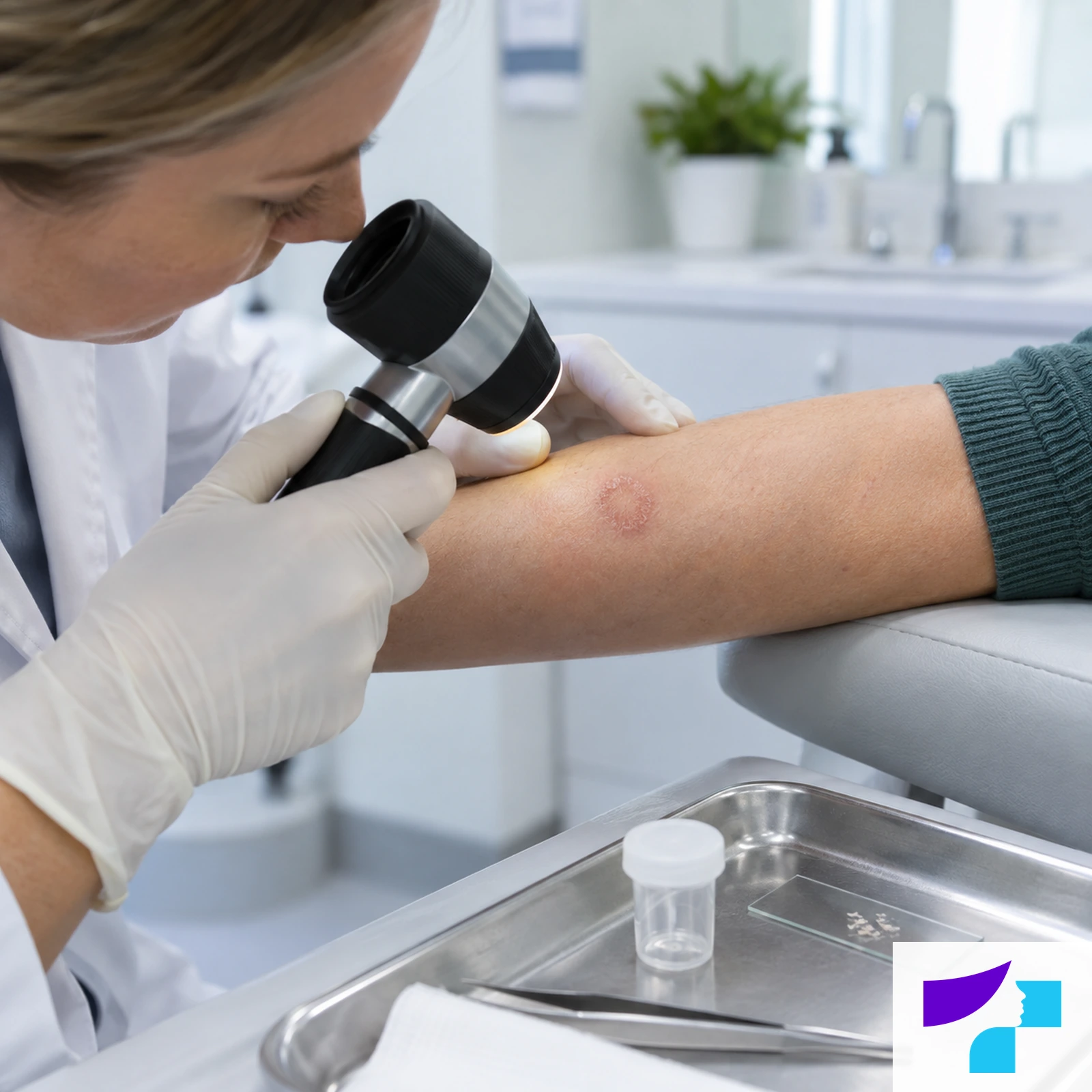
Illustrative visual: a dermatologist examines a skin patch with a dermatoscope. When needed, a skin scraping is collected for microscopy or fungal culture to confirm the diagnosis.
Why Not Treat It “Blindly”?
Self-treatment is common because antifungal creams are widely available. The problem is that many skin diseases can look similar.
Incorrect treatment can:
- prolong the infection;
- allow the fungus to spread;
- mask symptoms;
- increase the risk of recurrence;
- delay the correct diagnosis;
- worsen the condition if a corticosteroid cream is used without antifungal treatment.
Particular caution is needed with combination creams that contain a corticosteroid. They may quickly reduce redness and itching, but if the cause is fungal, the infection may become more widespread and less typical.
Treatment of Skin Fungus
Treatment depends on the site, extent and type of infection, as well as the patient’s age and general health.
Mild, limited fungal skin infections are often treated with topical antifungal medicines. Widespread, recurrent, scalp or nail infections may require doctor-prescribed systemic treatment.
Important: treatment should be continued for as long as stated in the medicine instructions or recommended by the doctor. If treatment is stopped as soon as itching improves, the infection may come back.
Antifungal Creams and Ointments
An antifungal cream or ointment is usually used for localised infections. These products may contain different antifungal substances, such as azoles or terbinafine.
Basic principles:
- apply the product to clean, dry skin;
- treat a small area of surrounding skin as well;
- follow the recommended frequency and duration;
- do not stop treatment too early;
- wash your hands after application to avoid spreading the infection;
- consult a doctor if there is no improvement or the condition worsens.
An antifungal cream will not help if the rash is not caused by fungus. It may also be insufficient for scalp, nail, widespread or deeper infections.
Antifungal Sprays, Solutions and Powders
Sprays, solutions and powders may be useful for athlete’s foot, especially when sweating is increased or it is difficult to reach the spaces between the toes.
Powders can help keep the skin drier, but they do not replace treatment when an active infection is present. It is also important to dry shoes, change socks and avoid prolonged moisture.
Antifungal Tablets
Antifungal tablets may be needed if:
- there is scalp ringworm;
- there is nail fungus;
- the infection is widespread;
- topical therapy does not help;
- the infection keeps recurring;
- hair-bearing areas are affected;
- the patient has a weakened immune system.
These medicines should be used only under medical supervision. The doctor must assess contraindications, possible interactions with other medicines and liver health.
Treatment in Children
Treatment in children should be selected carefully. Topical medicines may be suitable for some limited skin infections, but scalp ringworm in children usually requires doctor-prescribed oral treatment.
The source of infection should also be considered: family members, other children, sports activities, pets, combs, hats and bedding.
Treatment During Pregnancy and Breastfeeding
During pregnancy and breastfeeding, treatment should be chosen together with a doctor. Not all medicines are suitable in this period, and antifungal tablets should not be used without medical advice.
When Should You See a Dermatologist?
A dermatologist should be consulted if:
- the rash spreads quickly;
- there is severe pain, swelling, pus or fever;
- the face, scalp, nails or genital area is affected;
- the patient is a child;
- the person has diabetes;
- the immune system is weakened;
- the patient uses immunosuppressive medicines;
- symptoms do not improve after topical treatment;
- the infection keeps recurring;
- it is unclear whether the rash is truly fungal;
- a corticosteroid cream was used and the rash has become atypical;
- the infection is widespread, painful or unusually persistent;
- symptoms began after travel or contact with someone who has a widespread or unusual fungal infection.
How to Tell Skin Fungus Apart From Other Conditions
| Condition | What may look similar | What helps distinguish it | Why medical assessment is needed |
|---|---|---|---|
| Eczema | Itching, redness, scaling | Often lacks a typical ring-shaped edge; may be linked to dryness, irritants or atopy. | Treatment is very different. |
| Psoriasis | Red, scaly patches | More often thicker plaques, typical locations and nail changes. | Antifungal cream will not treat psoriasis. |
| Allergic contact dermatitis | Itching, redness, swelling | Link with a new cosmetic product, clothing, metals or skincare product. | The irritant or allergen needs to be identified. |
| Intertrigo | Redness and irritation in skin folds | Often related to friction, sweating and moisture; Candida may be added. | A combined approach may be needed. |
| Erythrasma | Brownish or reddish patches in folds | A bacterial condition that can resemble jock itch. | Treatment is different. |
| Bacterial infection | Redness, pain, moisture | There may be pus, heat, fever or rapid worsening. | Antibacterial treatment may be needed. |
| Seborrheic dermatitis | Redness and scaling on the face or scalp | Typically affects eyebrows, nasolabial folds and scalp. | Incorrect treatment can prolong symptoms. |
| Rosacea | Facial redness, sensitivity, burning | Often facial flushing, visible blood vessels and sensitive skin. | Steroids and unsuitable products may worsen the condition. |
| Acne or Malassezia folliculitis | Bumps on the face, chest or back | “Fungal acne” is often made of similar-sized itchy bumps, more commonly on the body. | Treatment differs from ordinary acne treatment. |
Prevention of Skin Fungus
Prevention is important both for avoiding a first infection and for reducing the risk of recurrence.

Illustrative visual: drying the feet after washing and everyday foot hygiene items. Carefully drying between the toes, wearing clean socks, keeping shoes dry and using sandals in public showers help reduce the risk of athlete's foot.
Recommendations:
- dry the skin carefully after washing;
- pay special attention to the spaces between the toes and skin folds;
- change socks and underwear every day;
- choose breathable shoes;
- dry shoes regularly;
- avoid wearing the same closed shoes every day if they do not have time to dry;
- wear sandals in public showers, swimming pools and changing rooms;
- do not share towels, shoes, socks, combs or nail scissors;
- wash hands after touching possibly infected skin or animals;
- treat athlete’s foot if jock itch is also present;
- have a pet checked by a veterinarian if it has skin lesions or hair loss;
- complete the full treatment course.
What Not to Do With Skin Fungus
- Do not use corticosteroid creams without a diagnosis.
- Do not scratch or injure the skin.
- Do not share towels, shoes or socks.
- Do not stop treatment too early.
- Do not hide widespread rashes with cosmetics.
- Do not treat a child’s scalp ringworm with shampoo alone.
- Do not use antifungal tablets without medical advice.
- Do not use aggressive home remedies such as vinegar, alcohol or irritating solutions on inflamed skin.
- Do not ignore fungal infection if you have diabetes or a weakened immune system.
Common Myths About Skin Fungus
Myth: Skin fungus happens only because of poor hygiene
People with good hygiene can also become infected. Moisture, sweating, shared spaces and contact with an infected person, animal or surface increase the risk.
Myth: Skin fungus always goes away on its own
Symptoms may sometimes improve, but the infection often remains, spreads or comes back.
Myth: Every itchy patch is fungus
Itching and scaling may also be caused by eczema, psoriasis, allergy, bacterial infection or other skin diseases.
Myth: It is enough to use a cream for a few days
Treatment usually needs to continue longer than the first symptoms last. Too short a course increases the risk of recurrence.
Myth: A corticosteroid cream cures skin fungus
Corticosteroids may reduce redness and itching, but they do not destroy fungi and may worsen the infection.
Myth: Nail fungus can be cured as quickly as skin fungus
Nail fungus treatment is usually longer because the nail grows slowly.
Myth: A child’s scalp ringworm can be treated with shampoo alone
Scalp ringworm often requires oral treatment under medical supervision.
Myth: After treatment, fungus never comes back
The infection can return if moisture, sweating, contaminated shoes or repeated contact with the source remain.
Summary
Skin fungus is a common, contagious and treatable skin infection. It may appear as itchy, red, scaly patches, cracks between the toes, groin redness, scalp scaling or nail changes.
A correct diagnosis matters because fungal skin infection may resemble eczema, psoriasis, allergy, erythrasma or a bacterial infection. Mild forms are often treated with topical antifungal medicines, but scalp, nail, widespread or recurrent infections require a dermatologist consultation.
To prevent recurrence, treatment should address not only the cream, but also the feet, shoes, towels, clothing, pets and other possible sources of infection.
References and Authoritative Sources
- U.S. Centers for Disease Control and Prevention (CDC): basic information about ringworm and dermatophyte skin infections
- U.S. Centers for Disease Control and Prevention (CDC): treatment of fungal skin infections
- U.S. Centers for Disease Control and Prevention (CDC): prevention and emerging information on dermatophyte infections
- American Academy of Dermatology: diagnosis and treatment of ringworm
- American Academy of Dermatology: self-care for ringworm
- DermNet: tinea and dermatophyte infections
- DermNet: athlete’s foot or tinea pedis
- DermNet: body ringworm or tinea corporis
- DermNet: jock itch or tinea cruris
- DermNet: laboratory tests for fungal infection
- DermNet: Candida infection of skin folds
- DermNet: tinea versicolor or pityriasis versicolor
