Athlete’s foot is a common, contagious fungal infection of the skin on the feet. Medically, it is called tinea pedis. It most often affects the skin between the toes, but it can also appear on the soles, heels and sides of the feet.
Athlete’s foot is usually caused by dermatophytes - fungi that grow in the outer layer of the skin and use keratin, a protein found in skin and nails. The infection thrives in warm, moist environments: sweaty feet, tight shoes, shared showers, swimming pools and gym changing rooms.
In most cases, athlete’s foot can be treated with over-the-counter antifungal medicines and proper foot care. However, the infection can come back, spread to the nails or other areas of the body, and in some patients cause complications.
Important: if the foot or leg becomes very red, hot, swollen or painful, if pus, fever or red streaks on the skin appear, or if symptoms occur in a person with diabetes, weakened immunity or circulation problems, contact a doctor. If the infection spreads rapidly or severe general symptoms occur, call 113 or 112.
Short answer
Athlete’s foot is a fungal skin infection of the feet that usually causes itching, peeling, cracks and white, moist skin between the toes. It is contagious and often spreads in shared showers, swimming pools, changing rooms or through towels, socks and shoes. Treatment includes antifungal medicines and keeping the feet dry.
What is athlete’s foot?
Athlete’s foot is a superficial skin infection caused by fungi. The name may suggest that it affects only athletes, but this is not true. Athlete’s foot can occur in anyone if the fungi have suitable conditions to grow.
The infection often starts between the fourth and fifth toes, where the skin is usually more moist, compressed and poorly ventilated. From there it can spread to other toe spaces, the sole, heel or sides of the foot.
What is tinea pedis?
Tinea pedis is the medical name for a dermatophyte infection of the feet. “Tinea” refers to a dermatophyte fungal infection of the skin, while “pedis” refers to the foot.
The most common causes are:
- Trichophyton rubrum;
- Trichophyton interdigitale;
- Epidermophyton floccosum.
These microorganisms can grow in the outer layer of the skin, especially when the skin is moist, sweaty, damaged or kept in closed shoes for long periods.
What does athlete’s foot look like?
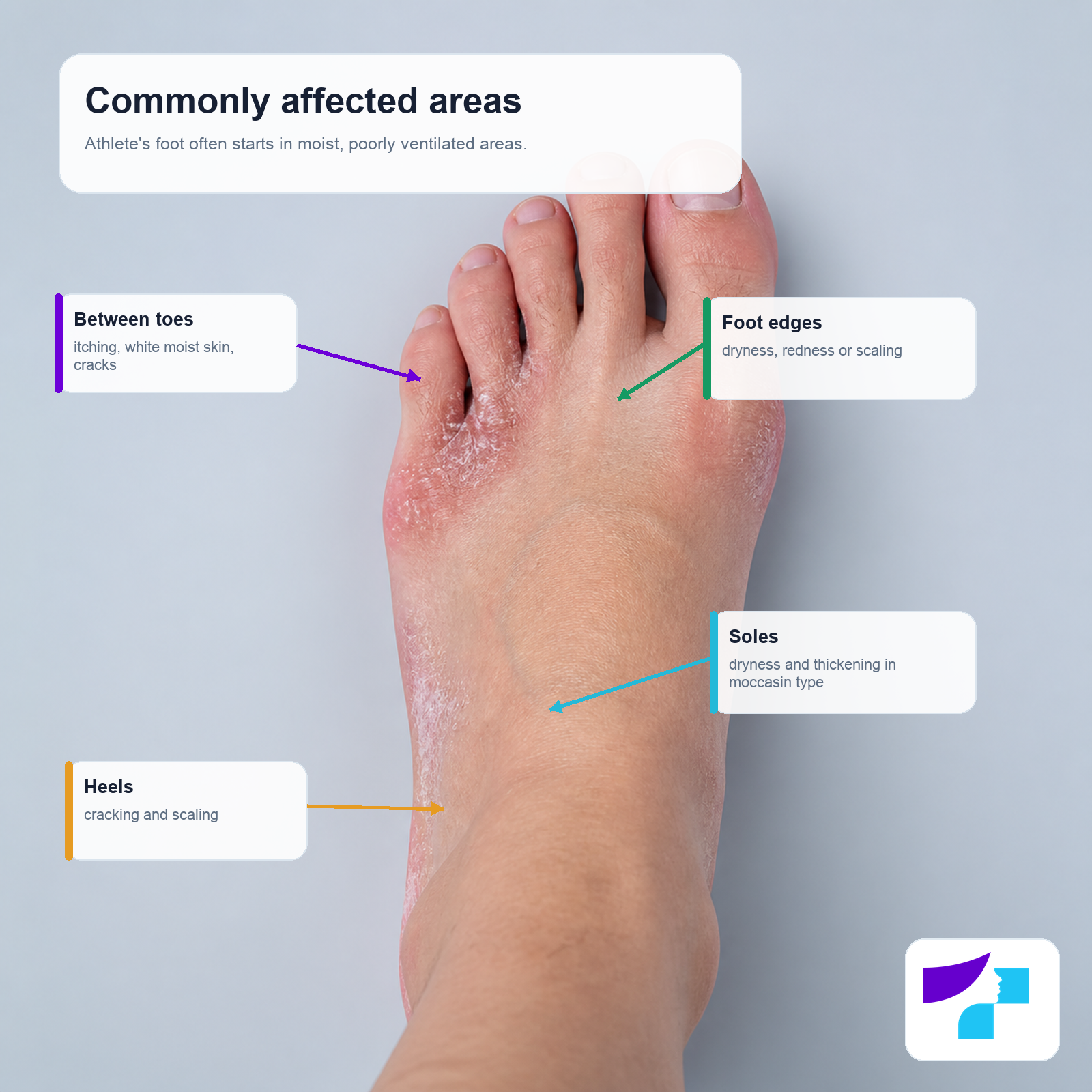
Athlete’s foot does not always look the same. In some people it causes mild itching and peeling between the toes, while in others it causes cracks, blisters, dry scaly skin or more widespread inflammation of the foot.
Common signs include:
- itching between the toes;
- burning, stinging or prickling sensations;
- white, moist, macerated skin between the toes;
- cracks in the skin;
- peeling or scaling skin;
- dry, thickened skin on the soles or sides of the feet;
- redness, which on darker skin may appear brown, purple or greyish;
- small blisters or blister-like lesions;
- unpleasant foot odour, especially if bacteria are also present.
3-5 signs that may suggest athlete’s foot
| Sign | What it may mean |
|---|---|
| Itchy, white and moist skin between the toes | Typical interdigital form of athlete’s foot |
| Cracks and peeling between the toes | Damage to the outer skin layer caused by fungi |
| Dry, scaly skin on the soles and sides of the feet | Possible moccasin-type tinea pedis |
| Blisters on the soles or sides of the feet | Possible vesiculobullous form |
| Athlete’s foot together with thickened, yellowish nails | Possible connection with fungal nail infection |
Main types of athlete’s foot
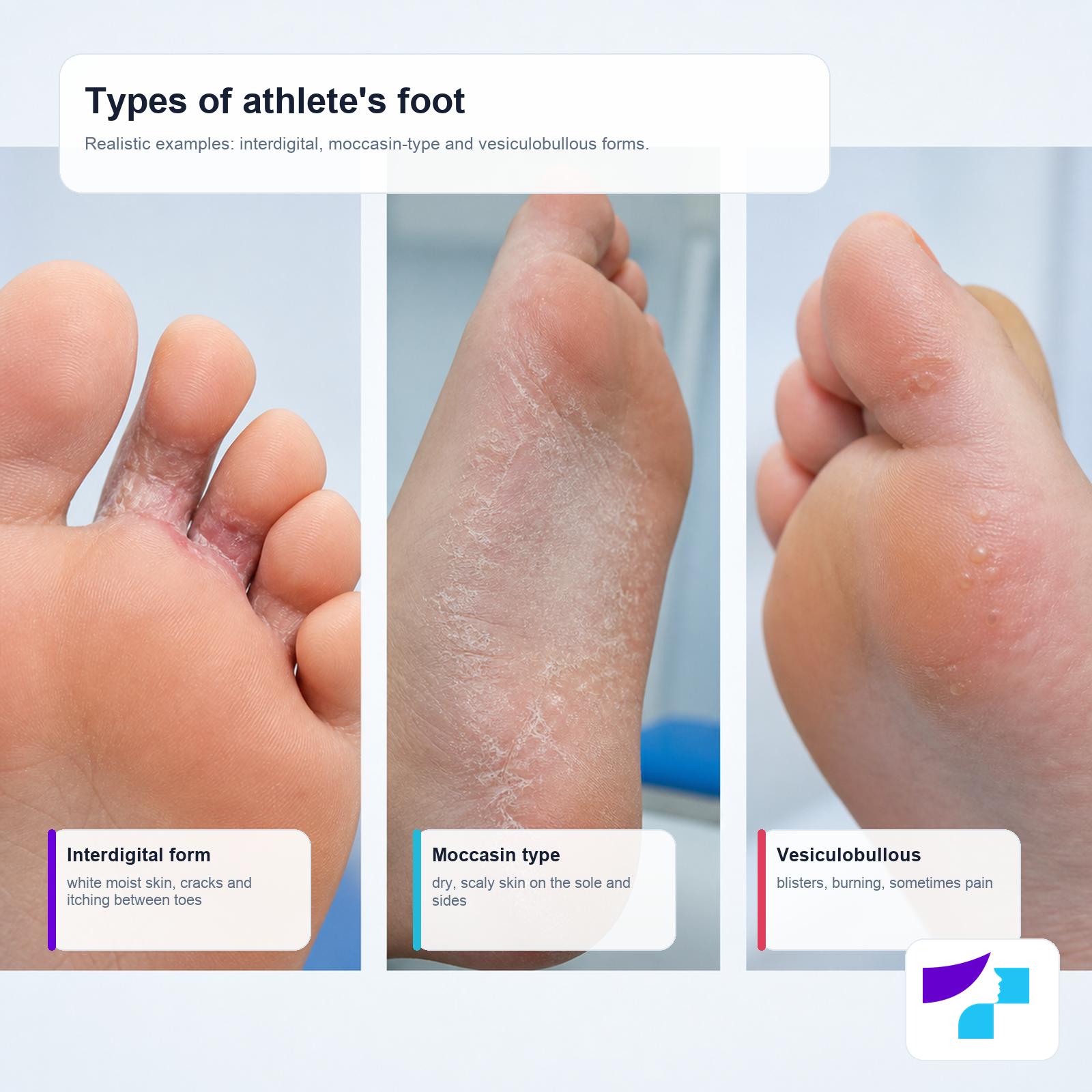
| Type | Typical signs | Where it usually appears |
|---|---|---|
| Interdigital form | Itching, white moist skin, cracks, peeling | Between the toes, especially between the 4th and 5th toes |
| Moccasin-type tinea pedis | Dry, thickened, scaly skin | Soles, heels, sides of the feet |
| Vesiculobullous form | Blisters, burning, sometimes pain | Soles or sides of the feet |
| Ulcerative or bacterially complicated form | Oozing, ulcers, pain, bad odour, pus | Most often between the toes |
Why does athlete’s foot develop?
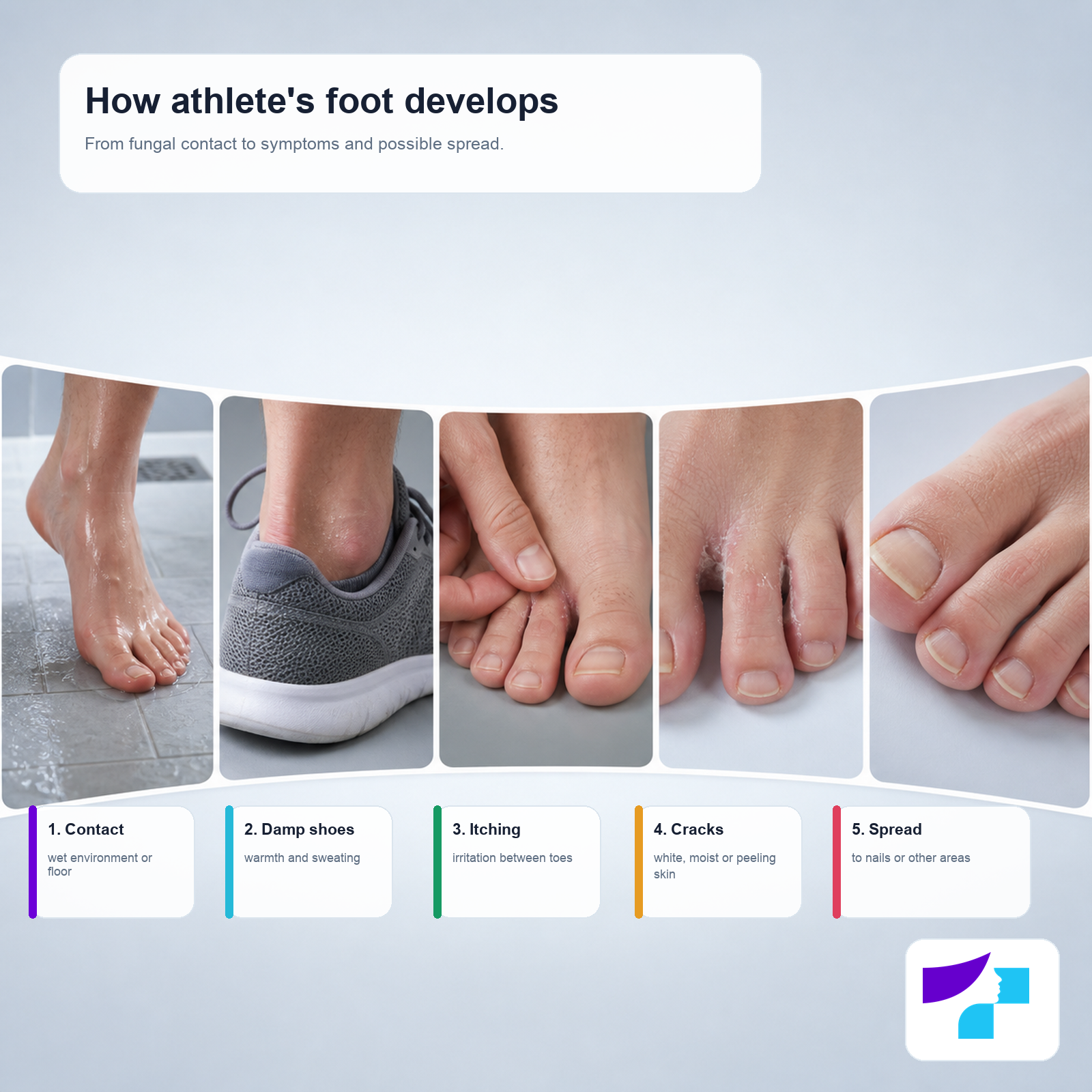
Athlete’s foot develops when dermatophytes reach the skin of the foot and suitable conditions allow them to grow. Fungi thrive particularly well in warm, moist environments.
Common risk factors:
- sweaty feet;
- tight, poorly ventilated or synthetic shoes;
- damp socks;
- infrequent sock changes;
- walking barefoot in swimming pools, showers and changing rooms;
- cracks, abrasions or blisters in the skin;
- fungal nail infection;
- diabetes;
- weakened immunity;
- circulation problems;
- work or sport in shoes where the feet remain hot and sweaty for long periods.
Athlete’s foot does not mean poor hygiene. It can also occur in people who wash regularly if their feet often stay moist or are exposed to sources of infection.
How can athlete’s foot spread?
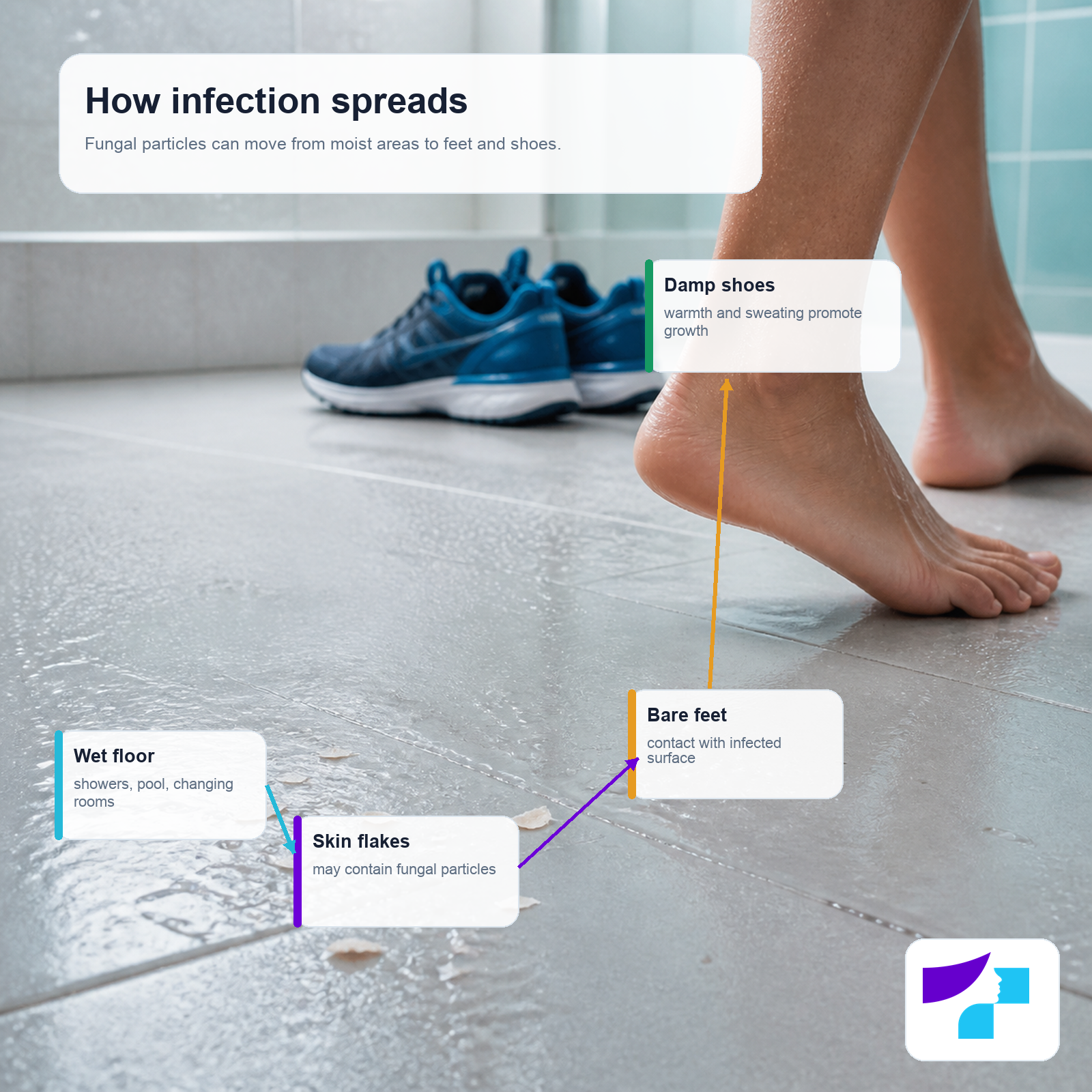
Athlete’s foot spreads through direct or indirect contact. Fungal particles can be found on skin flakes, floors, towels, socks, shoes and damp surfaces.
Common ways of infection:
- walking barefoot in shared showers;
- floors in swimming pools, saunas or gym changing rooms;
- sharing towels, socks or shoes;
- direct contact with infected skin;
- spread from the skin of the feet to the nails;
- spread from the feet to the hands when affected skin is scratched or touched.
Is athlete’s foot contagious?
Yes, athlete’s foot is contagious. It can spread to other people and also to other areas of the same person’s body. For example, fungi from the feet can spread to the hands, groin or nails.
To reduce the risk of spreading:
- do not share towels;
- do not share socks or shoes;
- wear flip-flops or shower shoes in shared showers;
- wash your hands after touching affected skin;
- treat the infection for long enough.
Athlete’s foot and fungal nail infection
Athlete’s foot and fungal nail infection are not the same thing, but they are often related. Athlete’s foot affects the skin, while fungal nail infection, or onychomycosis, affects the nails.
Signs of fungal nail infection may include:
- thickened nails;
- yellowish, brownish or white nail colour;
- brittle, crumbling nails;
- changes in nail shape;
- unpleasant odour or thickening under the nail.
If athlete’s foot often comes back and nail changes are also present, the nails may be a source of repeated infection. In this case, a consultation with a doctor or podiatrist may be needed.
Athlete’s foot or eczema: how to tell the difference?
Not every itch, crack or peeling between the toes is caused by fungi. Eczema, contact dermatitis, psoriasis, erythrasma, candidiasis or simple skin dryness can look similar.
| Feature | Athlete’s foot | Eczema or contact dermatitis | Psoriasis | Erythrasma |
|---|---|---|---|---|
| Cause | Dermatophyte fungus | Inflammation, irritation or allergy | Chronic inflammatory disease | Bacterial infection |
| Contagiousness | Contagious | Not contagious | Not contagious | May be related to the skin microbiota |
| Typical location | Between the toes, soles, sides of the feet | Areas of contact or irritation | Often symmetrical and may occur elsewhere on the body | Moist skin folds, sometimes between the toes |
| Appearance | Peeling, cracks, maceration, sometimes blisters | Itching, redness, dryness or oozing | Thick scales, more clearly defined patches | Brownish or reddish-brown patches |
| Test | Can be confirmed with a KOH test or culture | Fungal test is negative | Diagnosis based on clinical signs | Special examination may be used |
Important: steroid creams can help in eczema, but if the true cause is a fungal infection, they can mask or worsen it. If the diagnosis is unclear, it is better to consult a doctor.
When should you see a doctor for athlete’s foot?

See a doctor if:
- over-the-counter antifungal medicines do not help;
- symptoms do not improve within 2-4 weeks;
- the infection often comes back;
- there is severe pain;
- pus, oozing, ulcers or bad odour appear;
- the foot or leg is hot, painful and swollen;
- there is fever or red streaks on the skin;
- you have diabetes;
- you have weakened immunity;
- you have circulation problems;
- the infection spreads to the nails, hands, groin or other areas;
- the patient is a child, pregnant person or someone with significant underlying health conditions.
Possible complications
In most cases, athlete’s foot is localised and treatable. However, untreated or recurrent infection can cause problems.
Possible complications:
- spread of infection to the nails;
- spread of infection to the hands or groin;
- deeper cracks and painful skin;
- secondary bacterial infection;
- cellulitis - a deeper infection of the skin and subcutaneous tissues;
- long-lasting, recurrent or chronic infection.
The risk of complications is higher in people with diabetes, weakened immunity, poor circulation or chronic foot wounds.
How is athlete’s foot diagnosed?
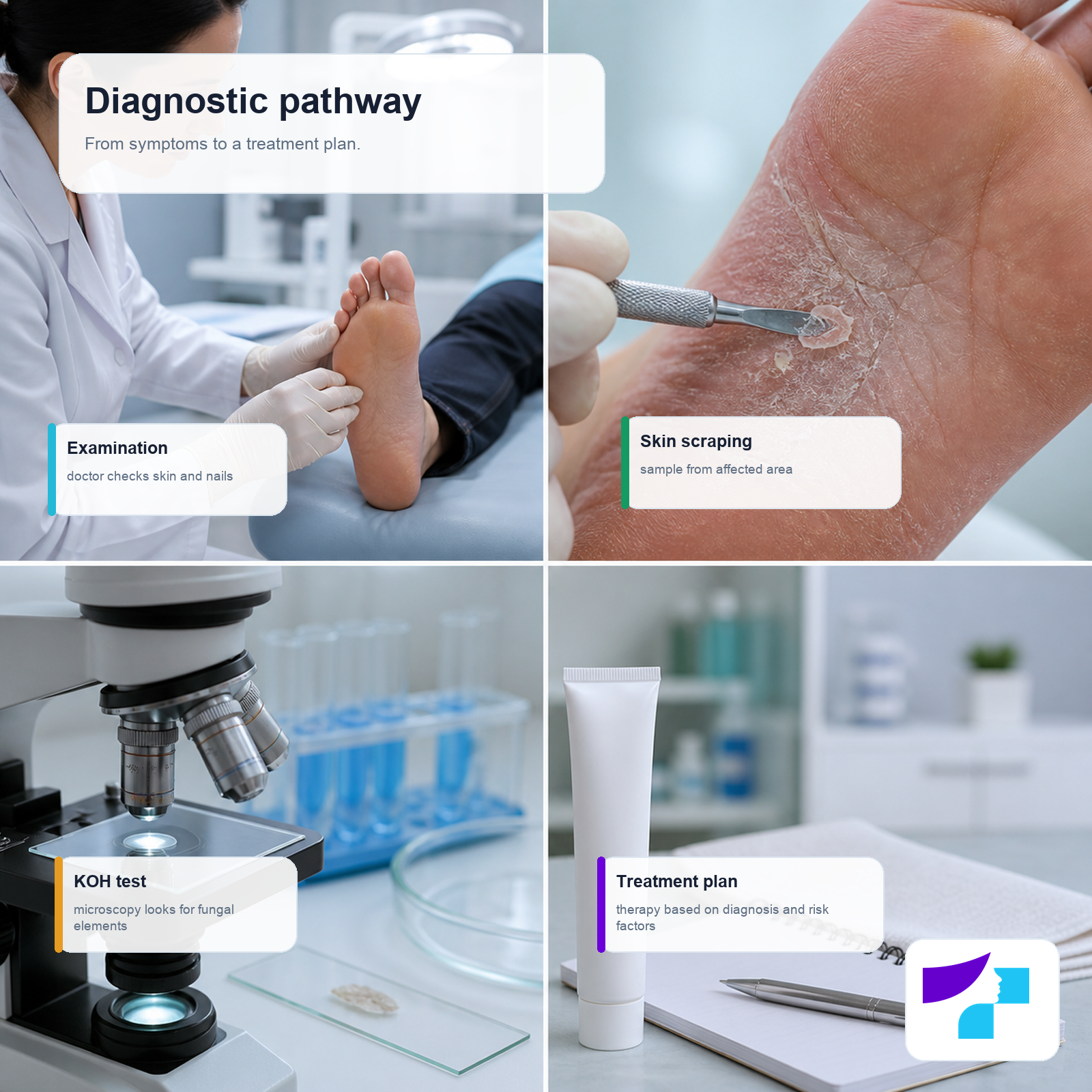
In many cases, a doctor can recognise athlete’s foot by its symptoms and the appearance of the skin. However, visual examination is not always enough because athlete’s foot can resemble other skin conditions.
Possible tests:
- skin scraping from the affected area;
- microscopy;
- KOH test to look for fungal elements;
- fungal culture to identify the cause more precisely;
- additional assessment if eczema, psoriasis, erythrasma, candidiasis or bacterial infection needs to be ruled out.
Laboratory confirmation is especially useful if the infection recurs, treatment does not help, the affected area is extensive or oral antifungal treatment is being considered.
How is athlete’s foot treated?
Mild to moderate athlete’s foot is usually treated with topical antifungal medicines - creams, gels, sprays or powders. These can be bought at a pharmacy, but a pharmacist or doctor can help choose the most suitable option.
Commonly used medicine groups:
- allylamine antifungals, such as terbinafine;
- azole antifungals, such as clotrimazole, miconazole or similar medicines;
- antifungal powders or sprays, especially for moisture control and prevention.
Main treatment principles:
- use the medicine for as long as stated in the instructions or recommended by a doctor/pharmacist;
- do not stop treatment as soon as itching improves;
- keep the feet dry at the same time;
- change socks and ventilate shoes;
- check whether fungal nail infection is present;
- see a doctor if the infection is recurrent or widespread.
Oral antifungal medicines may be needed in more severe, widespread, recurrent cases or when fungal nail infection is also present. They should be used only after a doctor’s assessment, because underlying conditions, drug interactions and possible side effects must be considered.
What can be done at home?
For mild athlete’s foot, the following may help:
- wash the feet daily and dry carefully between the toes;
- wear clean, dry socks;
- change socks more often if the feet sweat;
- choose breathable shoes;
- avoid wearing the same shoes for several days in a row;
- allow shoes to dry completely;
- wear flip-flops or shower shoes in shared showers and changing rooms;
- use an over-the-counter antifungal medicine according to instructions;
- use antifungal powder or shoe hygiene products if the feet sweat heavily.
What should you avoid if you have athlete’s foot?
You should avoid:
- scratching the affected skin;
- walking barefoot in shared showers;
- sharing towels, socks or shoes;
- using only moisturising cream between the toes if the skin there is white and moist;
- using prescription medicines without a doctor’s advice;
- using steroid creams for a long time without medical advice;
- stopping antifungal treatment too early;
- ignoring symptoms if you have diabetes or weakened immunity.
How can athlete’s foot be prevented from coming back?
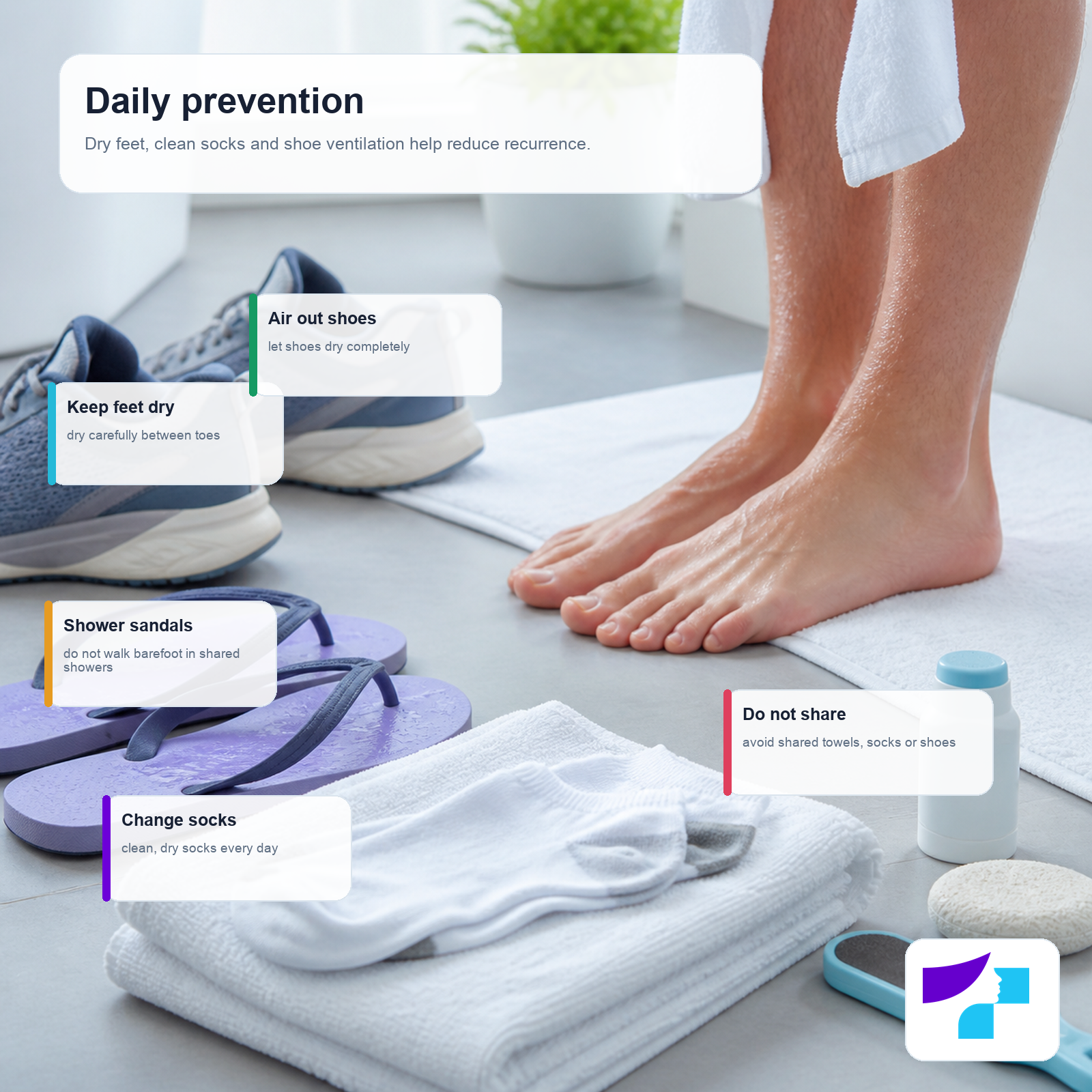
Recurrence is common because fungi can remain in shoes, socks, nails or damp shared areas. Prevention is just as important as treatment.
| Situation | What to do |
|---|---|
| After showering | Dry the feet carefully, especially between the toes |
| Daily | Wear clean, dry socks |
| After sport | Change socks and air out shoes |
| In shoes | Alternate shoes and allow them to dry |
| In shared areas | Wear flip-flops or shower shoes |
| At home, if someone has a fungal infection | Do not share towels, socks or shoes |
| If fungal nail infection is present | Consult a specialist about treatment |
Athlete’s foot in children, adults and during pregnancy
Athlete’s foot can occur in children, but it is more common in teenagers and adults. If a child has itching, cracks or peeling on the feet, it is advisable to consult a doctor because eczema or other skin conditions can look similar in children.
During pregnancy, it is advisable to consult a doctor or pharmacist before using antifungal medicines. Not all medicines are suitable in every situation, and treatment should be chosen individually.
In people with diabetes, foot problems can be more serious, so if athlete’s foot is suspected, it is advisable to seek medical advice early.
How to prepare for a doctor’s appointment
Before the appointment, it is useful to note:
- when the symptoms started;
- whether they affect one or both feet;
- whether there is itching, pain, cracks, blisters or pus;
- which medicines or products have already been used;
- whether there are nail changes;
- whether diabetes, weakened immunity or circulation problems are present;
- whether symptoms come back repeatedly;
- whether there has been recent exposure to a swimming pool, gym, sauna or shared showers.
Evidence, uncertainties and newer approaches
Well established: athlete’s foot is caused by dermatophytes; moisture, warmth, tight shoes and damaged skin increase the risk; topical antifungal medicines are effective in most cases; keeping the feet dry reduces the risk of recurrence.
Practical challenges: not every inflammation between the toes is fungal. In some cases, fungi, bacteria and irritant dermatitis may occur at the same time. In recurrent infection, shoes, nails, work environment and treatment that was too short should all be considered.
Newer topics in medicine: more attention is being paid to more precise laboratory diagnosis, prevention of recurrent infections, antifungal resistance in some dermatophytes and treatment forms that are more convenient for patients.
Common myths about athlete’s foot
| Myth | Fact |
|---|---|
| Athlete’s foot affects only athletes | It can occur in anyone |
| Athlete’s foot always goes away on its own | Antifungal treatment is often needed |
| Itching between the toes always means a fungal infection | Eczema, irritation or bacterial infection can look similar |
| It is only a cosmetic problem | Untreated infection can spread and cause complications |
| Antifungal treatment can be stopped when itching improves | Treatment that is too short increases the risk of recurrence |
| Steroid cream always helps | In fungal infection, it can mask or worsen the infection |
| Good hygiene always prevents it | Hygiene helps, but shoes, sweating and environment also affect risk |
| Athlete’s foot means poor hygiene | This is not true; the infection is very common |
Summary
Athlete’s foot is a common, contagious and usually treatable fungal infection of the skin on the feet. Typical symptoms include itching, peeling, cracks and white moist skin between the toes, but the infection can also affect the soles, heels and sides of the feet. In most cases, antifungal medicines and careful foot drying help. Medical advice is needed if symptoms do not improve, recur, or if there is significant pain, pus, swelling, fever or the patient belongs to a higher-risk group.
Medical Disclaimer
This information is intended for educational purposes and does not replace medical consultation, diagnosis or treatment. If you have diabetes, a weakened immune system, circulatory problems, severe pain, pus, fever, a hot and swollen foot, signs that the infection is spreading, or if symptoms do not improve, seek medical advice. Do not use prescription medicines without a doctor’s instructions. If foot skin symptoms are unclear, recurrent or long-lasting, we invite you to book a dermatologist consultation.
References and authoritative sources
- UK National Health Service (NHS): patient information on athlete’s foot, symptoms and treatment
- American Academy of Dermatology Association: athlete’s foot prevention and foot care advice
- DermNet: clinical information on Tinea pedis signs, diagnosis and treatment
- NCBI Bookshelf, StatPearls: Tinea Pedis review of causes, diagnosis and treatment
- MedlinePlus: patient information on athlete’s foot
- Mayo Clinic: athlete’s foot symptoms, causes and treatment options
- Cleveland Clinic: athlete’s foot types, symptoms, causes and treatment
- MSD Manuals: athlete’s foot, or Tinea pedis, patient information
- Centre for Disease Prevention and Control of Latvia: national public health information source
