Nail fungus, or onychomycosis, is a chronic nail infection caused by pathogenic fungi. It most often affects toenails, especially the big toenail, and usually develops slowly: at first, a small yellowish or white change appears at the edge of the nail; later the nail may become thickened, brittle, crumbly, deformed, or separate from the nail bed. Onychomycosis is not only a cosmetic problem. It may cause pain, discomfort in shoes, spread to other nails, and increase the risk of more serious foot infections in people with diabetes, circulatory disorders, or weakened immunity.
The key point is that not every yellow, thickened, or crumbly nail is nail fungus. Similar changes may be caused by trauma, psoriasis, eczema, bacterial infection, pressure from shoes, and, more rarely, more serious nail diseases. For accurate treatment, nail fungus often needs diagnostic confirmation: examination of nail material by microscopy, fungal culture, PCR, or another laboratory method.
Short answer
Nail fungus is a fungal infection of the nail. Common signs include yellow nails, thickened nails, brittle nails, crumbling, changes in nail shape, or separation from the nail bed. Mild cases may respond to topical antifungal nail products, while a more extensive, long-lasting, or multi-nail infection often requires prescription treatment assessed by a doctor. Treatment usually takes months because nails grow back slowly.
What is onychomycosis, or nail fungus?
Onychomycosis is a fungal infection of the nail plate, nail bed, or surrounding nail structures. The word “onychomycosis” means a fungal disease of the nails. In everyday language, it is called nail fungus.
The infection may be caused by:
- dermatophytes — the most common cause of toenail fungus;
- yeasts, such as Candida, more often affecting fingernails or the nail fold;
- non-dermatophyte moulds, which may be important in selected cases, especially in an already damaged nail.
Dermatophytes use keratin — the protein that forms the outer layer of the skin, hair, and nails. This is why they can affect both the skin of the feet and the nails. If an infection begins as athlete’s foot and is not treated, it may spread to the nails.
Why is nail fungus not only a cosmetic problem?
At first, many people notice only visual changes: the nail becomes yellowish, dull, or slightly thicker. However, onychomycosis is an infection, not simply a change in nail appearance.
Untreated or long-lasting nail fungus may:
- spread to other nails;
- maintain athlete’s foot and repeated skin irritation;
- make the nail so thick that it becomes difficult to trim;
- cause pain, pressure, and discomfort in shoes;
- increase the risk of cracks, wounds, and bacterial infection;
- affect quality of life by causing embarrassment or avoidance of swimming pools, saunas, beaches, and open footwear.
Special care is needed for people with diabetes, peripheral circulatory disorders, or immunosuppression. In these groups, even small foot problems can become more complicated.
How can nail fungus affect quality of life?
Nail fungus may seem like a minor issue until it starts interfering with everyday life. A thickened or deformed nail may press in shoes, hurt while walking, make sports uncomfortable, and make nail care difficult. Some people avoid saunas, swimming pools, beaches, open shoes, or pedicures because they feel self-conscious about the appearance of their nails.
This matters because the goal of treatment is not only a “better-looking nail”. The goal is to reduce infection, discomfort, the risk of further spread, and help the patient return safely to everyday activities.
How does nail fungus develop?
Nail fungus develops when fungi reach the nail or surrounding skin and find suitable conditions: warmth, moisture, friction, closed shoes, microtrauma, and reduced nail barrier function. Toenails are affected more often than fingernails because they are more often exposed to a warm and moist shoe environment.
The infection may be promoted by:
- long-term damp or poorly ventilated shoes;
- tight shoes that injure the nail edge;
- excessive foot sweating;
- walking barefoot in shared showers, swimming pools, gyms, and saunas;
- untreated athlete’s foot;
- shared towels, socks, shoes, or nail tools;
- nail trauma during sports, work, hiking, or running.
Onychomycosis usually does not start suddenly. It develops gradually, and this slow course can create the misleading impression that the problem is not serious.
Mechanism of infection
For nail fungus to develop, three conditions usually coincide: the presence of fungi, microdamage to the nail or skin, and an environment in which fungi can multiply.
A typical sequence is:
- fungi reach the skin of the feet or the nail, for example in a shared wet environment or from athlete’s foot;
- a microcrack, trauma, or nail separation allows fungi to enter the nail structure;
- fungi gradually damage keratin;
- thickened, crumbly material accumulates under the nail;
- the nail becomes yellowish, thick, brittle, deformed, or lifted from the nail bed.
This process may be worsened by repeated trauma. That is why nail fungus can be harder to treat and more likely to recur in athletes, people wearing tight work shoes, or shoes that press on the big toe.
Symptoms of nail fungus
Symptoms of nail fungus vary depending on the type, duration, and extent of infection. Most often, changes begin at the free edge or side edge of the nail.
Early signs
- a small white, yellowish, or brownish spot at the edge of the nail;
- brittleness of the nail edge;
- a duller nail surface;
- mild thickening under the nail;
- slight lifting of the nail from the free edge.
Late signs
- markedly thickened nails;
- yellow, brown, grey, white, or sometimes greenish nails;
- crumbling, breaking, cracking, or ragged nail edges;
- separation of the nail from the nail bed;
- crumbly thickening under the nail;
- deformation of the nail and pressure in shoes;
- pain, discomfort, or unpleasant odour;
- similar changes appearing in other nails.
The 3–5 main signs that most often suggest nail fungus are nail colour change, thickening, crumbling, separation from the nail bed, and simultaneous athlete’s foot.
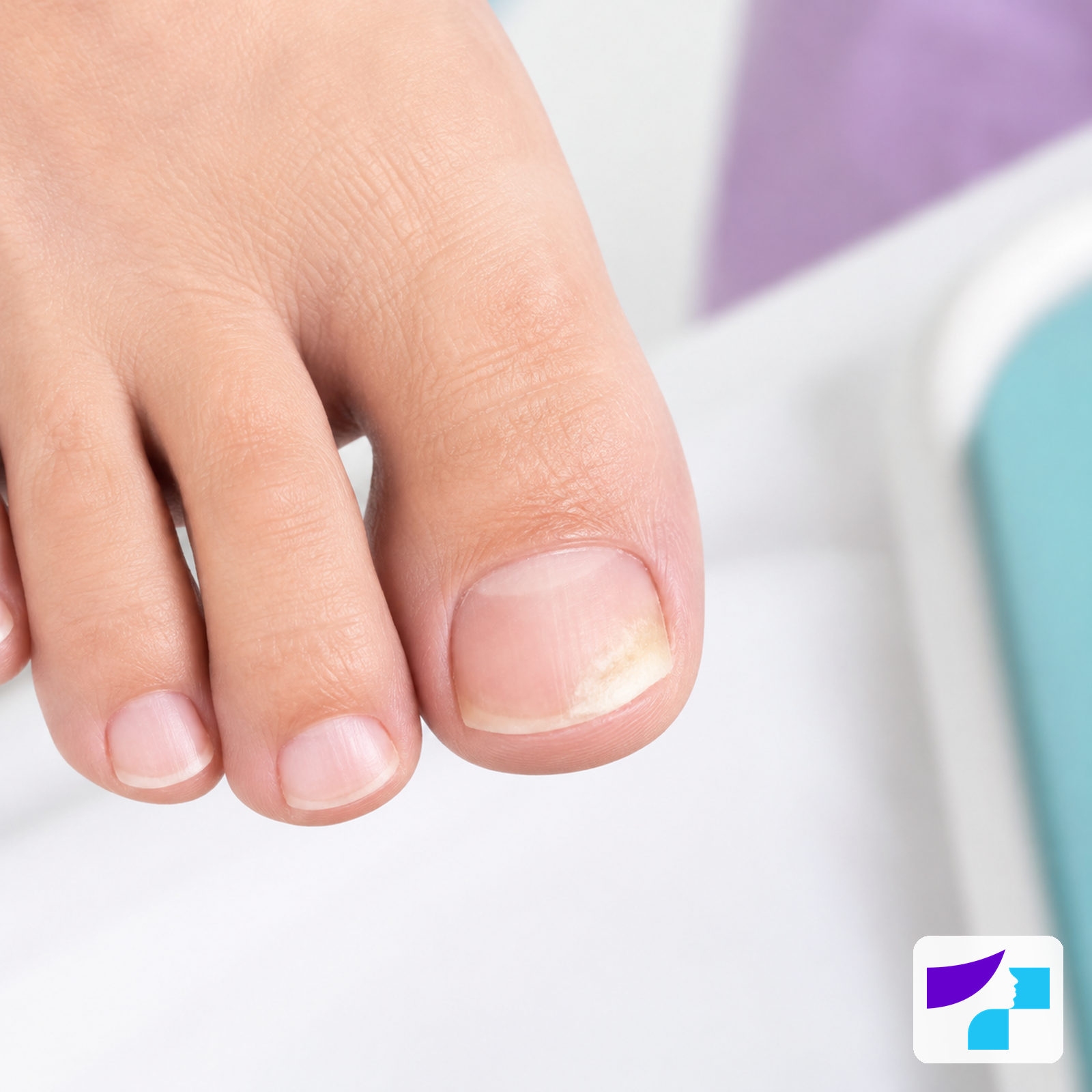
What does nail fungus look like in the early stage?
In the early stage, nail fungus often appears as a small yellowish or white area at the tip or side of the nail. The nail may become slightly more brittle but may not yet be painful. At this stage, people often think the nail has been bruised, damaged by shoes, or changed after nail polish.
Early-stage infection matters because a small infection is usually easier to control than long-standing onychomycosis with a thick, deformed nail. Still, visual guessing is not enough if long-term treatment is being considered. If the diagnosis is unclear, the nail should be checked.
How does nail fungus progress over time?
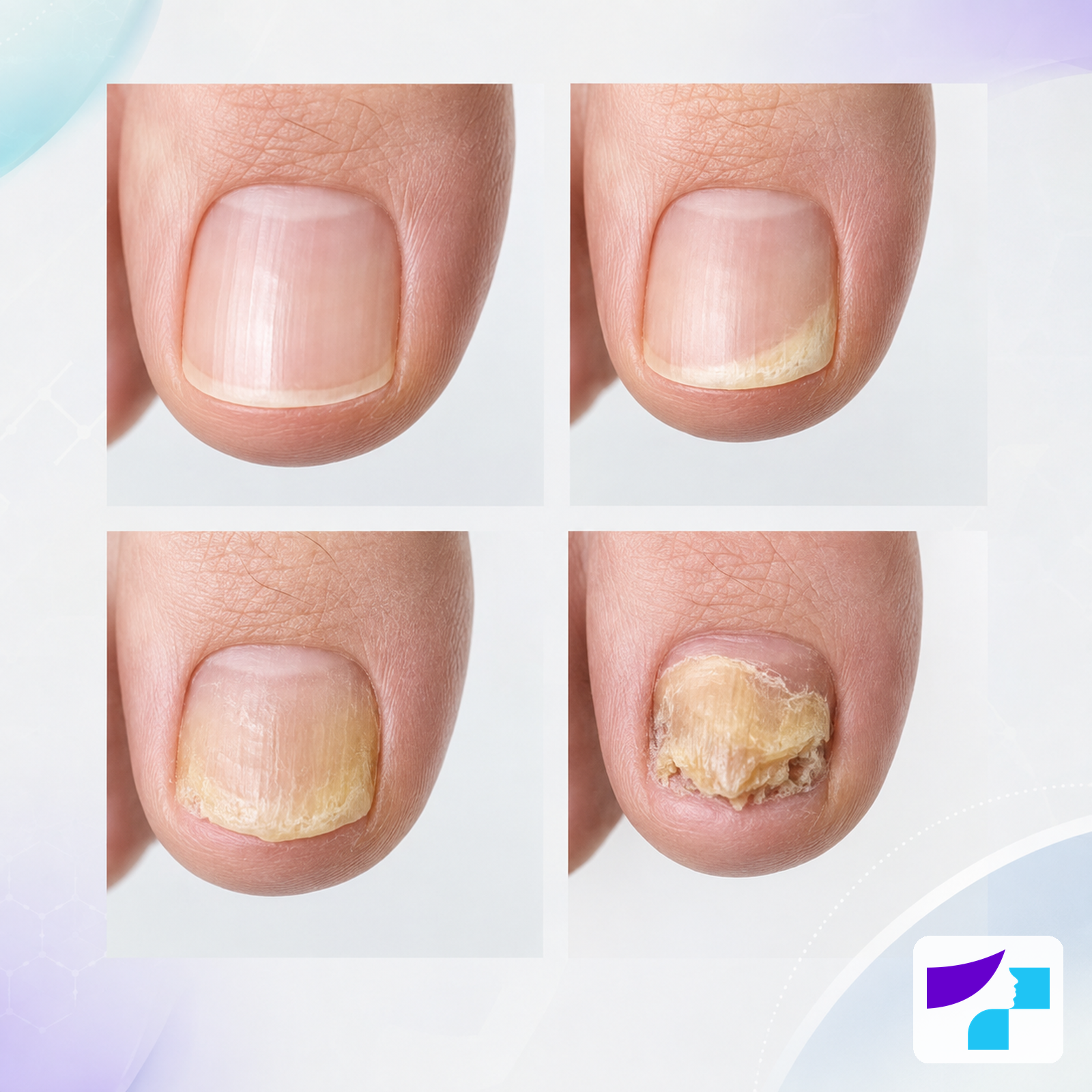
Nail fungus usually has a chronic and slow course. Toenails grow slowly, so both progression and treatment results may take time to become visible.
| Stage | What happens in the nail | What the person notices |
|---|---|---|
| Contact with fungi | Fungi reach the skin of the foot or the nail | There may be no symptoms |
| Early stage | The infection begins at the nail edge or surface | White or yellow spot, slight crumbling |
| Spread within the nail | Fungi damage keratin and thickening accumulates under the nail | The nail becomes thicker, more brittle, and harder to trim |
| Progressive onychomycosis | The damage involves a larger part of the nail | The nail deforms, separates, and may hurt |
| Recovery during treatment | The infection is controlled, but the damaged nail must be replaced by new growth | A healthier nail band grows from the base |
Toenail fungus and fingernail fungus: what is the difference?
Toenail fungus is more common. Toenails are more often injured in shoes, exposed to a moist environment, and grow more slowly, so treatment results take longer. The big toenail is affected most often.
Fingernail fungus is less common and may be linked to frequent wet work, chronic inflammation of the nail fold, Candida infection, or damage to the skin barrier. Fingernails grow faster, so visible recovery is usually faster than in toenails.
Types of nail fungus
Onychomycosis has several clinical types. Patients do not need to identify the exact type themselves, but this classification helps explain why nail fungus does not always look the same.
| Type | Typical appearance | Why it matters |
|---|---|---|
| Distal lateral subungual onychomycosis | Starts at the free or side edge; the nail becomes yellowish, thickened, and crumbly | The most common form of toenail fungus |
| White superficial onychomycosis | White, crumbly patches on the nail surface | May look superficial or cosmetic, but may be fungal |
| Proximal subungual onychomycosis | Changes start closer to the nail base | Rarer; sometimes prompts evaluation of immune status |
| Candida onychomycosis | More often in fingernails; the nail fold may be red or swollen | Often linked to wet work, chronic paronychia, or barrier damage |
| Mixed or non-dermatophyte infection | May resemble other forms, sometimes with unusual colour | Requires more precise laboratory diagnostics |
Localised and extensive nail fungus
Treatment depends not only on whether fungi are present, but also on how much of the nail is affected.
A more localised and milder infection usually means that:
- a small part of the nail is affected;
- one or a few nails are involved;
- there is no marked thickening;
- there is no pain, pus, or inflammation of the surrounding skin;
- the person has no major risk factors.
A more extensive infection usually means that:
- a large part of the nail is affected;
- several nails are involved;
- the nail is thick, deformed, or separated;
- there is discomfort in shoes;
- the infection has lasted for months or years;
- there is diabetes, poor circulation, or immunosuppression.
This distinction helps explain why one patient may be treated locally, while another may need doctor-guided systemic or combined treatment.
Who is at higher risk?
Nail fungus can affect anyone, but risk factors significantly influence the likelihood of infection and the difficulty of treatment.
- older adults;
- people with diabetes;
- people with peripheral circulatory disorders;
- people with weakened immunity;
- athletes;
- people with athlete’s foot;
- people with psoriasis or other nail diseases;
- people with excessive foot sweating;
- people who often use swimming pools, gyms, saunas, and shared showers;
- people who wear tight, closed, or poorly ventilated shoes;
- people whose nails are repeatedly traumatised.
In diabetes, nail fungus should not be viewed as “just an ugly nail”. If redness, swelling, pain, a wound, discharge, or changes in foot sensation occur, medical assessment is needed.
Athletes and nail fungus
Athletes may have a higher risk of nail fungus because several factors act together: sweating, closed sports shoes, changing rooms and showers, repeated nail trauma, pressure on the big toes, and prolonged moisture. Runners, football players, dancers, hikers, and people who train regularly in tight footwear may be particularly affected.
- choose shoes that do not press on the front edge of the nail;
- change socks after training;
- allow shoes to dry completely;
- wear shower sandals in shared showers;
- treat athlete’s foot early;
- do not ignore repeated trauma to the big toenail.
If the nail regularly becomes dark, separates, or deforms after sport, it may be trauma, fungus, or a combination of both. Diagnosis is especially important in such cases.
Is nail fungus contagious?
Yes, nail fungus can be contagious, although exposure does not mean that everyone will develop onychomycosis. Moisture, microtrauma, athlete’s foot, footwear, and individual risk factors matter.
- from one nail to other nails;
- from the skin of the feet to the nails;
- through shared nail tools;
- through shared shoes, socks, or towels;
- in shared wet environments.
At home, it is important not to share nail tools, towels, or shoes. Nail scissors, clippers, and files should be disinfected after use.
Nail fungus or another nail disease?
This is one of the most important parts of the article because several conditions can look similar.
| Condition | What may resemble nail fungus | What may help distinguish it |
|---|---|---|
| Nail trauma | Colour change, separation, thickening | Clear link with impact, running, hiking, or tight shoes |
| Psoriasis | Pitting, thickening, separation, yellowish patches | Psoriasis patches on the skin, symmetrical involvement of several nails |
| Eczema/contact dermatitis | Nail fold inflammation, brittle nails | Skin irritation, wet work, allergens, or irritants |
| Bacterial infection | Greenish or dark colour, pain | Marked inflammation, moisture, pus, pain |
| Subungual lesions | Nail deformity or a dark line | Unilateral, changing, dark, or bleeding changes should be shown to a doctor |
If a nail suddenly becomes dark without clear trauma, if a black or brown stripe appears, or if there is bleeding, ulceration, pain, or rapid progression, it should not be explained only as fungus. A dermatologist’s assessment is needed.
How is nail fungus diagnosed?
A dermatologist or another specialist assesses the nails, the skin of the feet, and the spaces between the toes. The doctor may ask about symptom duration, footwear, sports, trauma, athlete’s foot, chronic diseases, products used, and medicines.
- clinical examination;
- dermoscopy — magnified nail examination;
- microscopy of nail material;
- fungal culture to identify the organism;
- PCR, if available;
- histology if the diagnosis is unclear.
Laboratory confirmation is especially important before oral prescription therapy. It helps avoid unnecessary treatment when the nail change is not fungal and supports more appropriate treatment planning.
How to prepare for nail sample testing?
If the doctor plans to take nail material for fungal testing, the sample should be as good as possible. Exact instructions are always provided by the clinic or laboratory, but general principles include:
- do not cover the nails with nail polish or gel polish before the visit;
- do not apply artificial nails to the affected nail;
- inform the doctor about all antifungal products already used;
- do not aggressively file or cut the affected area just before the visit;
- bring previous test or treatment information, if available.
If medicated nail lacquer or another antifungal product has been used for a long time, test sensitivity may be reduced. The doctor may advise whether treatment should be paused before sampling.
When should nail fungus be shown to a doctor?
You should see a dermatologist, family doctor, or another qualified specialist if:
- the nail thickens, crumbles, changes colour, separates, or the changes progress;
- several nails are affected;
- there is pain, redness, swelling, pus, or a wound;
- you have diabetes, poor circulation, or weakened immunity;
- the infection interferes with walking, sports, or wearing shoes;
- over-the-counter products have not helped;
- oral antifungal treatment is being considered;
- the nail changes are dark, rapid, bleeding, or unclear.
Seek medical help promptly if redness, swelling, severe pain, fever, pus, a wound in a diabetic patient, or signs of spreading infection appear.
How to prepare for a dermatologist visit?
- when the nail changes began;
- which nails are affected;
- whether there has been trauma or tight footwear;
- whether there is itching, peeling, or cracks between the toes;
- which products have already been used and for how long;
- which medicines you take daily;
- whether you have diabetes, liver or kidney disease, or circulatory disorders;
- whether you are pregnant, planning pregnancy, or breastfeeding.
If possible, do not cover the nails with gel polish or decorative polish before the visit, as this may make examination harder. If antifungal products have already been used, tell the doctor because this may affect test results.
Treatment of nail fungus
Treatment depends on the cause and severity. There is no “one product for everyone” approach. The doctor assesses the number of affected nails, extent of infection, nail thickness, causative organism, general health, possible drug interactions, and safety risks.
- stop the fungal infection;
- allow a healthier nail to grow back;
- reduce thickening, pain, and shoe discomfort;
- treat athlete’s foot at the same time;
- reduce the risk of recurrence.
How does the doctor choose treatment?
| Situation | Commonly considered approach | Important note |
|---|---|---|
| Small part of the nail affected, nail not very thick | Topical antifungal nail products, regular nail care | Results require patience and correct use |
| One or a few nails affected with thickening | Topical treatment with nail debridement or combined approach | A podiatrist may be needed |
| Several nails or a large nail area affected | Doctor-assessed systemic prescription therapy | Safety and interactions must be assessed first |
| Athlete’s foot is present | The skin of the feet should also be treated | Otherwise the nail may be reinfected |
| Diabetes, poor circulation, or immunosuppression | Early doctor involvement | Self-treatment is not a safe strategy |
Topical antifungal nail products
Topical products include lacquers, solutions, or other preparations applied to the nail. They may be suitable for milder cases when only a small part of the nail is affected and there is no marked thickening. The main challenge is the hard nail structure: the product must penetrate deeply enough.
A doctor or podiatrist may therefore recommend gentle reduction of thickening, regular nail care, and correct duration of use. Treatment should not be stopped after the first visible improvement.
Systemic prescription therapy
For more extensive infection, the doctor may consider oral prescription antifungal medicines. This may be more effective in deeper or multi-nail infection, but safety assessment is required.
Blood tests may be needed before systemic treatment, especially to assess liver function, and medicines and comorbidities should be reviewed. Treatment choices require particular caution during pregnancy, breastfeeding, and in liver or kidney disease.
This article does not provide instructions for prescription medicines. Specific treatment is determined by a doctor.
Nail debridement and podiatry care
If the nail is very thick, deformed, or painful, medical nail care may be needed. It may reduce pressure in shoes, make nail care easier, and help topical products reach the affected area better.
Do not try to aggressively cut, drill, or deeply file the nail at home. This may injure the skin, cause a wound, and increase the risk of bacterial infection.
Laser and other procedures
Laser procedures, photodynamic therapy, and other physical methods are being studied and are sometimes used as additional methods. Evidence is mixed, and results may depend on the type of infection, nail thickness, treatment protocol, and combination with other treatment.
Laser should therefore not be seen as a guaranteed or universal treatment for nail fungus. If a procedure is offered, the patient should know its purpose, the number of sessions, how results will be assessed, and whether the diagnosis has been confirmed in a laboratory.
An important distinction: improvement in nail appearance is not the same as laboratory-confirmed cure of the infection. Promises of a very fast, complete, and lasting result should be assessed cautiously, especially if the causative organism has not been confirmed.
How long does nail fungus treatment take?
Treatment requires patience. Even during successful therapy, the damaged part of the nail does not disappear immediately. A healthier nail grows from the base while the old damaged nail is gradually replaced.
Full visible recovery usually takes longer in toenails than in fingernails. Treatment results should therefore be assessed by healthier growth from the base, not by an immediate change in the whole nail plate. A rapid “miracle result” is not realistic.
Can nail fungus come back?
Yes. Onychomycosis may recur, especially if risk factors remain: athlete’s foot, damp shoes, old contaminated footwear, nail trauma, poor ventilation, diabetes, circulatory disorders, or incomplete treatment.
After improvement, prevention is part of the treatment process. If a yellowish nail edge, thickening, crumbling, or signs of athlete’s foot return, it is better to react early rather than wait for marked deformity.
Does immunity develop after nail fungus?
After nail fungus, lasting immunity usually does not develop. A person may be infected again if similar conditions return or the same risk factors remain.
The immune system matters, but the nail is a slow-growing structure with limited ability to recover quickly. Hygiene, shoe care, treatment of athlete’s foot, and reducing nail trauma remain important after successful treatment.
How to reduce risk at home?
- wash and dry the feet carefully, especially between the toes;
- change socks daily or more often if feet sweat;
- choose breathable shoes;
- allow shoes to dry between uses;
- wear shower sandals in shared showers and pools;
- trim nails regularly and gently;
- disinfect nail tools;
- do not share shoes, socks, towels, or nail tools;
- treat athlete’s foot if present.

What should not be done if nail fungus is suspected?
- do not treat the nail only with home remedies for a long time if changes progress;
- do not aggressively cut, tear, drill, or deeply file a thickened nail;
- do not hide a progressing infection under gel polish or decorative polish;
- do not use prescription antifungal medicines without a doctor;
- do not ignore pain, redness, swelling, pus, or a wound;
- do not postpone medical care if you have diabetes or immunosuppression;
- do not assume every yellow nail is automatically fungal.
Home remedies such as vinegar, baking soda, tea tree oil, or harsh disinfectants may irritate the skin and delay accurate treatment. They must not replace diagnostics, especially in long-lasting or extensive nail changes.
Common myths about nail fungus
Does nail fungus always go away by itself?
No. It is usually a persistent infection that often remains or progresses without treatment.
Do yellow nails always mean fungus?
No. Yellow nails may also be caused by trauma, psoriasis, shoe pressure, nail polish, or other diseases.
Is nail fungus only cosmetic?
No. It may cause pain, discomfort, spread, and be important in risk groups.
Can an ordinary athlete’s foot cream cure nail fungus?
Not always. Skin creams often do not penetrate the nail plate deeply enough.
Does laser guarantee cure?
No. Laser effectiveness varies and it is more often considered an additional method than a universal solution.
Is nail fungus caused by poor hygiene?
Not only. Hygiene matters, but footwear, moisture, trauma, athlete’s foot, age, and health status are also important.
Can nail fungus be hidden under gel polish?
This is not a good solution if the infection is progressing. Coatings can hide changes and interfere with treatment.
Is treating only the affected nail enough?
Not always. If athlete’s foot or contaminated footwear remains, the infection may return.
What is well proven in medicine and what is still being studied?
Well proven
- onychomycosis is a fungal infection that more often affects toenails;
- many nail diseases can resemble nail fungus;
- laboratory diagnostics help choose appropriate treatment;
- topical products alone may be insufficient in extensive infection;
- systemic treatment must be assessed individually for safety and interactions;
- treatment takes months because nails grow slowly;
- prevention reduces the risk of recurrence.
Areas still being studied
- faster and more accessible diagnostic methods;
- the role of fungal biofilms in treatment failure;
- antifungal resistance;
- new topical formulations with better nail penetration;
- combined treatment;
- the real role of laser, photodynamic therapy, and other procedures;
- better recurrence-prevention strategies for high-risk patients.
Summary
Nail fungus, or onychomycosis, is a common, slowly progressive nail infection. It most often begins as a small colour change or crumbling at the nail edge, but over time the nail may become thickened, deformed, and separated from the nail bed. Toenail fungus is more common than fingernail fungus because toenails are more often exposed to a warm, moist, and traumatic shoe environment.
Accurate diagnosis is important because similar nail changes may be caused by trauma, psoriasis, eczema, bacterial infection, and other diseases. Treatment may include topical antifungal products, doctor-assessed systemic treatment, nail care, treatment of athlete’s foot, and prevention. Rapid results are not realistic because a healthier nail must grow back gradually.
Medical disclaimer
The information in this article is educational and informative. It does not replace a dermatologist consultation, diagnosis, or individually prescribed treatment. If you notice changes in nail colour, thickness, shape, or structure, or if there is pain, redness, swelling, pus, a wound, diabetes, circulatory disorders, weakened immunity, or spreading infection, consult a dermatologist, family doctor, or another qualified healthcare professional. Do not use prescription antifungal medicines, aggressive nail procedures, or unverified home remedies without medical advice.
Content author
Dermatologist Dr. med. Dace Buile
References and authoritative sources
- UK National Health Service (NHS): fungal nail infection
- American Academy of Dermatology (AAD): nail fungus diagnosis and treatment
- DermNet: fungal nail infections
- Mayo Clinic: nail fungus symptoms and causes
- Journal of the German Dermatological Society: S1 guideline for onychomycosis diagnosis and treatment
- American Family Physician: evidence-based review of onychomycosis
- Centre for Disease Prevention and Control of Latvia: public health information
- Ministry of Health of the Republic of Latvia: health sector information
