Rosacea is a chronic inflammatory skin disease that most often affects the central part of the face: the cheeks, nose, chin and forehead. It may appear as facial redness, a feeling of heat, burning, increased skin sensitivity, visible small blood vessels, as well as papules and pustules that can resemble acne in adulthood.
Rosacea is not contagious and is not caused by poor hygiene. It is also not simply a “red face” or a cosmetic feature. In some patients, rosacea significantly affects daily comfort, self-confidence and quality of life because the skin may become very sensitive and react to skin care products, weather, heat, stress or diet.
Rosacea usually cannot be “cured forever”, but it can often be well controlled. The goal is to reduce redness, inflammation, burning, eruptions and the frequency of flare-ups, while restoring the skin barrier and choosing treatment according to the specific type of rosacea.
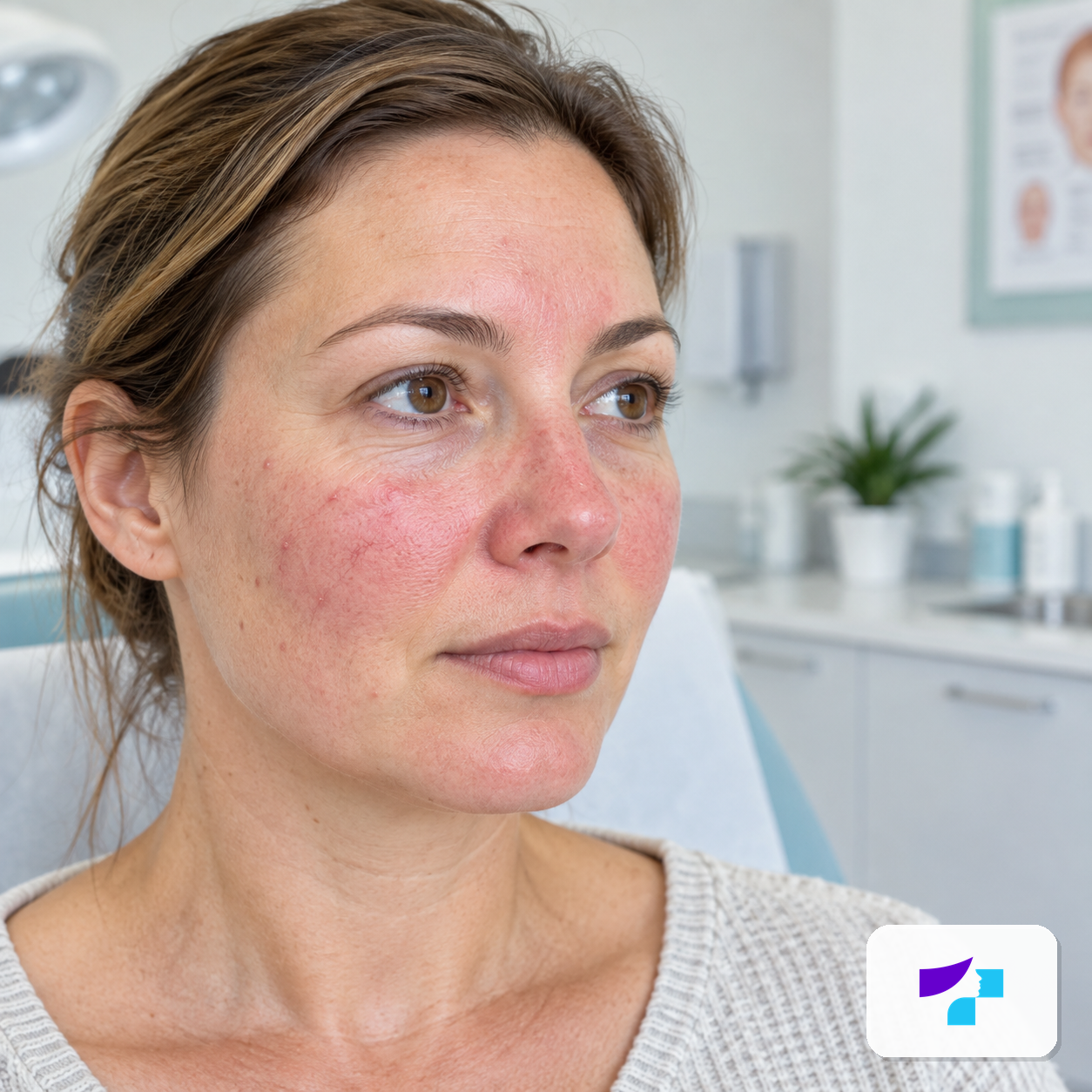
The visual shows typical rosacea redness in the central part of the face, especially on the cheeks and nose, with visible small blood vessels and signs of sensitive skin.
Key points about rosacea
- Rosacea is a chronic but controllable skin disease.
- It most often begins in adulthood, often after the age of 30.
- The main symptoms of rosacea are facial redness, burning, sensitivity, dilated capillaries, papules and pustules.
- Rosacea on the face most often affects the cheeks, nose, chin and forehead.
- Rosacea is not contagious and is not an allergy, although the symptoms may sometimes look similar.
- Rosacea and acne are not the same: in rosacea, comedones, or blackheads and whiteheads, are usually absent.
- Flare-ups may be triggered by sun, heat, cold, wind, alcohol, spicy foods, hot drinks, stress and unsuitable cosmetics.
- Daily use of SPF 30-50 is one of the most important parts of rosacea control.
- Laser therapy and IPL can help with redness and dilated capillaries, but they do not always replace medical treatment.
- The best result is usually achieved with an individual plan: diagnosis, gentle skin care, control of triggers and treatment prescribed by a dermatologist.
What is rosacea?
Rosacea is a chronic inflammatory skin disease based on the interaction of several factors: increased reactivity of facial blood vessels, inflammatory processes, skin barrier disruption, genetic predisposition and environmental influences. The disease often fluctuates: there are periods when the skin is calmer and periods when symptoms worsen.
Patients often describe rosacea as red, hot, sensitive or “burning” facial skin. At first, redness may appear only after a hot drink, alcohol, stress, physical activity or a sudden change in temperature. Later, it may become longer-lasting or persistent. Over time, dilated capillaries, inflammatory eruptions, skin roughness or eye symptoms may appear.
Rosacea is not the same disease in every patient. In one person, redness and capillaries dominate; in another, papules and pustules; in another, eye irritation or thickening of the skin on the nose. Therefore, rosacea treatment is not one universal procedure or one “best cream”.
What are the symptoms of rosacea?
Rosacea symptoms may be mild, moderate or severe. They may change over time and combine differently in different patients.
Most common signs
- temporary facial redness, or flushing episodes;
- persistent redness on the cheeks, nose, forehead or chin;
- a feeling of heat in the face;
- burning, tingling, stinging or skin tightness;
- very sensitive skin that poorly tolerates cosmetics;
- dry or easily irritated facial skin;
- visible small blood vessels, or telangiectasia;
- red papules;
- pustules, or pus-filled eruptions, without comedones;
- skin swelling or roughness;
- dry eyes, a gritty sensation, tearing or eyelid redness;
- in long-standing cases, skin thickening, most often in the nose area.
It is advisable to see a dermatologist if redness becomes persistent, eruptions recur, the skin burns or hurts, eye symptoms appear, or skin care products that were previously well tolerated suddenly start causing irritation.
Types of rosacea
Rosacea was previously often divided into subtypes, but today dermatologists increasingly assess the dominant features or phenotypes: redness, capillaries, inflammatory eruptions, eye symptoms or skin thickening. In practice, this is useful because treatment should be adapted to the visible symptoms.
| Type of rosacea | What it looks like | Common symptoms | Possible treatment |
|---|---|---|---|
| Erythematotelangiectatic rosacea | Persistent redness, red cheeks, visible capillaries | Flushing, heat, burning, sensitivity | SPF, trigger control, gentle skin care, redness-reducing medicines if prescribed by a doctor, IPL, vascular laser |
| Papulopustular rosacea | Redness with red bumps and pustules | Inflammatory eruptions, burning, sensitive skin | Azelaic acid, metronidazole, ivermectin, doxycycline or another treatment prescribed by a dermatologist |
| Phymatous rosacea | Skin thickening, rough surface, more often around the nose | Changes in nose shape or skin texture | Anti-inflammatory treatment if inflammation is active, CO2 laser, Er:YAG laser, radiofrequency or surgical correction after assessment |
| Ocular rosacea | Red eyelids, dry or irritated eyes | Gritty sensation, tearing, dryness, light sensitivity | Eyelid hygiene, artificial tears, warm compresses, treatment prescribed by an ophthalmologist or dermatologist |
One patient may have several rosacea manifestations at the same time. For example, persistent redness and capillaries may be combined with papules, pustules and dry eyes.
What causes rosacea?
Rosacea does not have one single cause. It develops under the influence of several factors, and these factors may differ from patient to patient.
Possible mechanisms
- genetic predisposition;
- increased reactivity of facial blood vessels;
- overactive innate immune response;
- skin barrier disruption;
- changes in the skin microbiome;
- increased number of Demodex mites or increased skin reaction to them;
- neurovascular mechanisms related to flushing and a feeling of heat;
- environmental factors such as UV radiation, wind, cold and heat.
The Demodex mite is often mentioned in relation to rosacea. It is a normal part of the adult skin microflora, and finding it on the skin does not in itself mean that it is the cause of rosacea. In some patients, Demodex may be involved in maintaining inflammation, especially in papulopustular rosacea, but rosacea is not simply a “mite infection”. Therefore, treatment should be based on a diagnosis made by a dermatologist, not only on one finding or assumption.
What triggers rosacea flare-ups?
Rosacea flare-ups are often caused by factors that dilate facial blood vessels, irritate the skin or increase inflammation. These are called triggers. Not all patients have the same triggers, so it is important to observe your own skin reactions.
| Trigger | How it may affect the skin | What can be done |
|---|---|---|
| Sun and UV radiation | Increases redness, burning and inflammation | Use SPF 30-50 every day, choose a hat and shade |
| Heat, sauna, hot baths | Promotes facial flushing and a feeling of heat | Avoid overheating, choose moderate temperatures |
| Cold and wind | Irritates the skin barrier and increases sensitivity | Protect the face, use a barrier-supporting cream |
| Alcohol, especially red wine | May cause sudden flushing | Observe individual reaction, limit triggering drinks |
| Spicy foods | May increase flushing and burning | Reduce intake if symptoms appear |
| Hot drinks | Increase the feeling of heat in the face | Let the drink cool to a lukewarm temperature |
| Stress and emotions | May cause flushing episodes | Look for stress-reduction strategies |
| Intense physical activity | Raises body temperature and promotes flushing | Exercise in a cooler environment, plan breaks |
| Unsuitable cosmetics | Damages the skin barrier and causes burning | Choose gentle fragrance-free products |
| Scrubs, strong acids, retinoids during a flare-up | May increase inflammation and sensitivity | Use only on specialist advice |
| Corticosteroid creams on the face without a doctor’s instruction | May reduce redness temporarily but worsen the condition long term | Do not use independently or for a long time |
A short symptom diary may help identify personal triggers: what was eaten or drunk, which products were used, what the weather was like, stress level, physical activity and how the skin reacted.
How is rosacea diagnosed?
Rosacea is most often diagnosed by a dermatologist during a clinical examination. The doctor assesses the appearance of the skin, duration of symptoms, frequency of flare-ups, triggering factors, skin care products used and previous treatment.
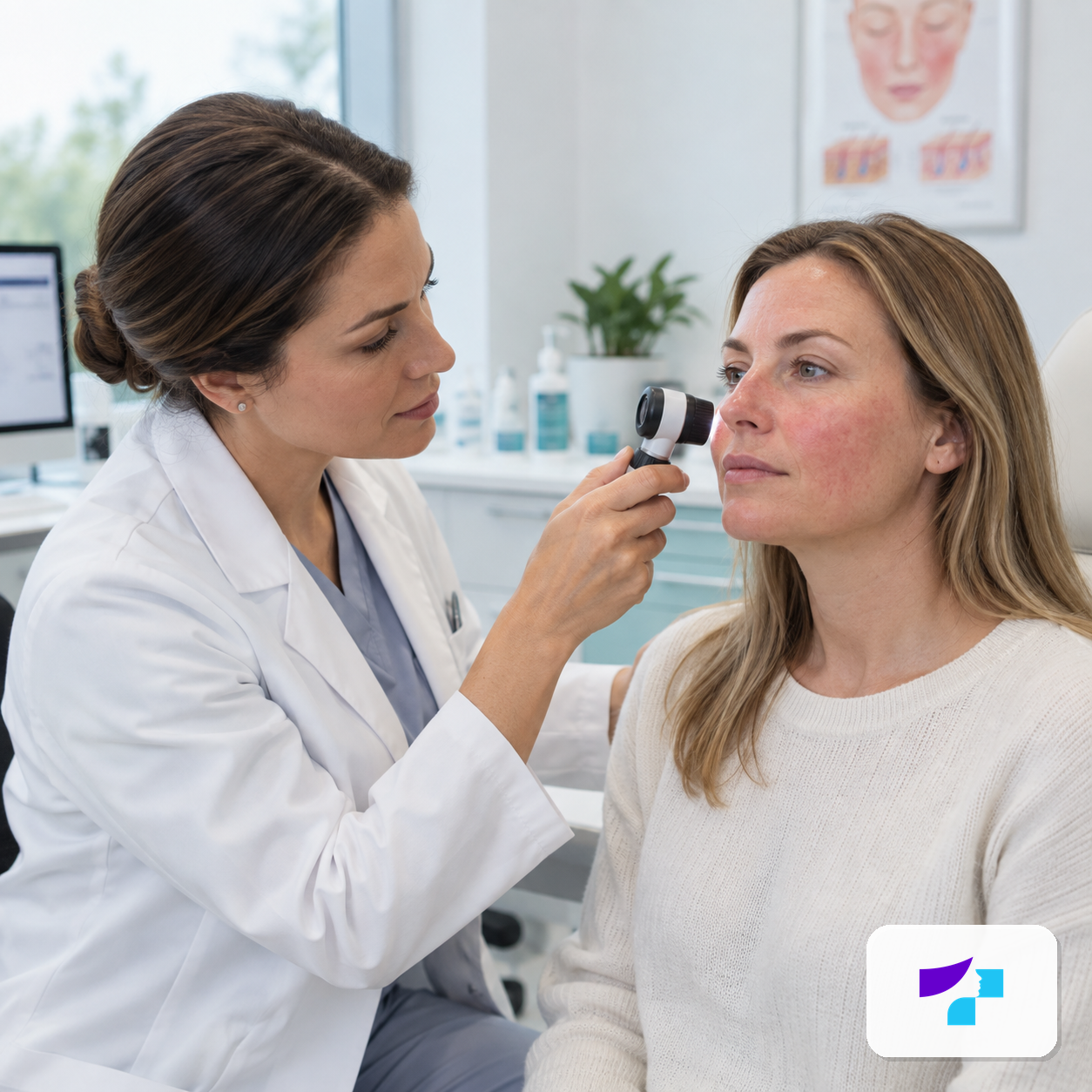
The visual shows a dermatologist consultation, during which the doctor assesses facial redness, visible capillaries, inflammatory signs and the most suitable treatment plan.
During a dermatologist consultation, the doctor may assess:
- whether the redness is temporary or persistent;
- whether papules and pustules are present;
- whether there are comedones, which are more typical of acne;
- whether visible capillaries are present;
- whether there are eye symptoms;
- whether the skin is thickened;
- whether corticosteroid creams have previously been used on the face;
- whether the symptoms may be related to contact dermatitis, perioral dermatitis, seborrheic dermatitis, acne, lupus or another condition.
Dermatoscopy or additional tests may sometimes be used if the diagnosis is unclear. Self-diagnosis based on pictures online can be misleading because several skin conditions may look similar but require different treatment.
Rosacea or acne, couperose, allergy?
| Condition | Typical signs | What helps distinguish it | When to see a dermatologist |
|---|---|---|---|
| Rosacea | Redness, burning, capillaries, papules, pustules | No comedones, symptoms often in the central face, very sensitive skin | If redness becomes persistent or inflammatory eruptions appear |
| Acne | Comedones, inflamed bumps, oilier skin | Blackheads and whiteheads, eruptions also on the back or chest | If acne is inflamed, painful or leaves scars |
| Couperose-prone skin | Visible capillaries and redness without marked inflammation | Fewer papules and pustules, more vascular network | If capillaries become pronounced or rosacea is suspected |
| Contact allergy or irritant dermatitis | Itching, redness, swelling after using a product | Association with a specific product or substance | If the reaction recurs, swelling, blisters or severe itching appear |
| Perioral dermatitis | Small eruptions around the mouth, nose or eyes | Often related to irritating skin care or steroid use | If eruptions persist or worsen |
| Seborrheic dermatitis | Redness and scaling around the nose, eyebrows, scalp | Oilier scales, dandruff, itching | If different anti-inflammatory treatment is needed |
| Lupus or other systemic diseases | Redness may occur on the face, sometimes with other symptoms | Fatigue, joint pain, sun sensitivity or other complaints may be present | If redness is atypical or general symptoms are present |
Rosacea treatment
Rosacea treatment should be chosen according to the dominant symptoms. In one patient, the main problem is persistent redness; in another, inflammatory bumps; in another, capillaries, eye irritation or thickening of the skin on the nose. Therefore, the treatment plan often consists of several parts.
Treatment goals
- reduce redness;
- reduce burning and sensitivity;
- treat papules and pustules;
- reduce visible capillaries;
- prevent or reduce flare-ups;
- improve the skin barrier;
- treat eye symptoms if present;
- prevent disease progression.
Which treatment is suitable for which rosacea symptom?
| Dominant problem | Possible methods | What they may improve | Important note |
|---|---|---|---|
| Temporary flushing | Trigger control, SPF, gentle skin care, certain prescription medicines if prescribed by a doctor | Frequency and intensity of flushing | Not always completely preventable |
| Persistent redness | SPF, brimonidine or oxymetazoline after medical assessment, IPL, vascular laser | Intensity of redness | Some products work temporarily and may cause rebound redness |
| Visible capillaries | IPL/ELOS technologies, vascular laser, Nd:YAG laser | Telangiectasia and vascular network | Creams usually do not fully remove capillaries |
| Papules and pustules | Azelaic acid, metronidazole, ivermectin, doxycycline or another treatment prescribed by a doctor | Inflammatory eruptions | Several weeks are needed to assess the effect |
| Burning and sensitivity | Barrier-repairing skin care, removal of irritants, inflammation control | Skin comfort | Overly active skin care often worsens symptoms |
| Eye symptoms | Eyelid hygiene, artificial tears, warm compresses, medicines if prescribed by a doctor | Dryness, irritation, inflammation | Marked eye symptoms require medical assessment |
| Rhinophyma or skin thickening | Dermatologist assessment, lasers, radiofrequency or surgical methods | Skin surface and thickening | Creams usually do not change marked tissue thickening |
Adapting skin care
Gentle skin care is the foundation of rosacea treatment. It helps reduce irritation, restore the skin barrier and improve treatment tolerability. Sometimes, before more active therapy, the skin barrier first needs to be calmed because very sensitive, burning skin may poorly tolerate even medically appropriate products.
Daily SPF
Sun exposure is one of the most common triggers of rosacea flare-ups. Therefore, broad-spectrum SPF 30-50 should be used every day, even in cloudy weather. Sensitive skin often tolerates mineral filters such as zinc oxide or titanium dioxide better, but the most important thing is to find a product that the patient can use regularly without burning or irritation.
Azelaic acid for rosacea
Azelaic acid may help in papulopustular rosacea by reducing inflammatory bumps and sometimes redness. At first, it may cause tingling, warmth or mild burning, so the frequency and concentration should be adapted to skin sensitivity.
Metronidazole for rosacea
Metronidazole is a topical anti-inflammatory medicine used to reduce rosacea papules and pustules. It is not the main method for removing dilated capillaries, but it may be useful for controlling inflammation.
Ivermectin for rosacea
Ivermectin is a topical medicine used to treat papulopustular rosacea. It may be especially useful in patients where Demodex-related inflammation may play a role. It should not be used independently without a diagnosis, because not every facial redness is rosacea.
Medicines that temporarily reduce redness
In some patients, a dermatologist may prescribe medicines that temporarily narrow skin blood vessels and reduce redness. This group includes, for example, brimonidine or oxymetazoline. They may be useful in persistent redness but should be used carefully because some patients may experience rebound redness or increased sensitivity.
Oral therapy
If papules, pustules or inflammation are pronounced, a dermatologist may prescribe oral anti-inflammatory treatment, for example doxycycline in anti-inflammatory doses or other medicines. In more severe or difficult-to-control cases, other systemic treatment may be considered, but it always requires careful medical assessment.
Rosacea treatment with laser and IPL
Rosacea laser therapy and IPL/ELOS procedures may help reduce persistent redness and visible dilated capillaries on the face. Vascular lasers and intense pulsed light act on superficial blood vessels in the skin, so they are particularly useful for erythema and telangiectasia.
It is important to understand that laser therapy is not a universal rosacea treatment. It may help redness and capillaries well, but it does not always solve papules, pustules, skin burning or eye symptoms. Often, the best result comes from a combined plan: gentle skin care, SPF, medical treatment and procedures when needed.
Treatment of phymatous rosacea and rhinophyma
In long-standing rosacea, some patients may develop skin thickening, most often in the nose area. This is called rhinophyma. It is more common in men. If thickening is related to active inflammation, anti-inflammatory treatment may be needed first. If the tissue is already markedly thickened, procedures such as CO2 laser, Er:YAG laser, radiofrequency or surgical correction may be needed.
Ocular rosacea
Ocular rosacea may occur together with facial skin symptoms or sometimes appear before marked skin symptoms. It may affect the eyelids, the surface of the eye and the tear film.
Possible symptoms
- dry eyes;
- gritty or foreign-body sensation;
- eyelid redness;
- tearing;
- burning;
- recurrent styes or eyelid inflammation;
- light sensitivity;
- blurred vision.
Daily eyelid hygiene, warm compresses and artificial tears may help, but medical assessment is recommended if eye symptoms are present. A doctor should be consulted urgently if there is eye pain, worsening vision, marked light sensitivity or a feeling that the eye is strongly inflamed.
Skin care in rosacea
In rosacea, the aim of skin care is not to “cleanse as strongly as possible” or rapidly transform the skin. The goal is to reduce irritation, restore the skin barrier and help the skin become more stable.
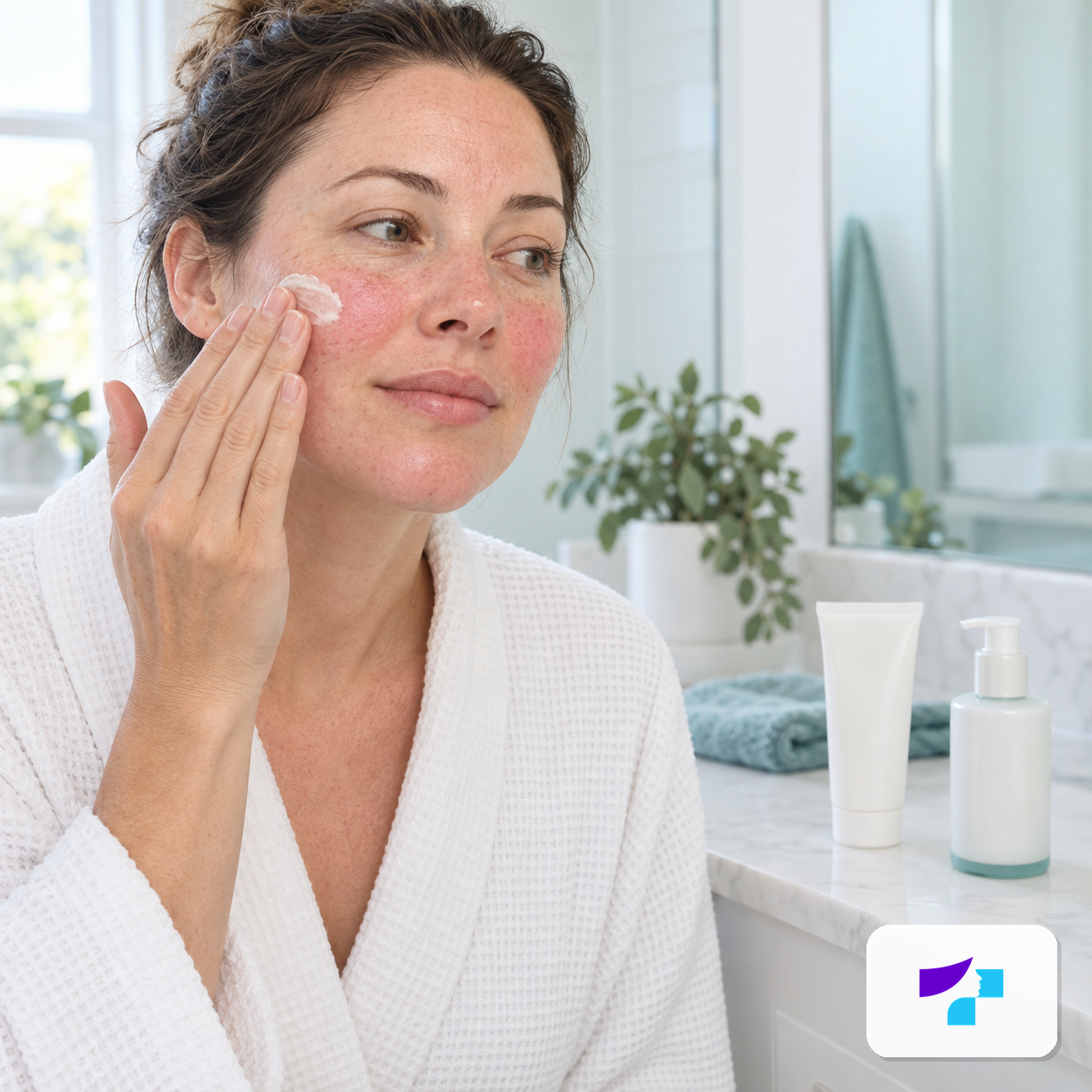
The visual shows gentle daily skin care in rosacea: applying a mild cream or SPF while avoiding aggressive rubbing and irritating products.
Simple daily routine
In the morning:
- Gentle cleansing or rinsing with lukewarm water if the skin is very sensitive.
- Moisturising, barrier-repairing cream.
- SPF 30-50.
- If needed, tinted SPF or a product with green pigments to visually reduce redness.
In the evening:
- Gentle removal of cosmetics and SPF.
- Gentle fragrance-free cleanser.
- Treatment product prescribed by a dermatologist, if planned.
- Moisturising cream for the skin barrier.
What should be avoided in rosacea?
In rosacea, it is important to be careful with products that may irritate the skin. It is especially advisable to avoid:
- mechanical scrubs;
- alcohol-based toners;
- fragrances;
- essential oils;
- abrasive cleansing brushes;
- aggressive at-home peels;
- frequent combining of acids;
- retinoids during an active flare-up without a doctor’s instruction;
- corticosteroid creams on the face without medical supervision;
- introducing several new products at the same time.
If a product causes short-term mild tingling, it does not always mean an allergy. However, if after using a product the skin burns, hurts, becomes markedly red or the reaction persists, the product should be stopped and assessed with a specialist.
How long does rosacea treatment take?
Rosacea treatment requires patience. The effect of topical treatments is usually not visible in one day. Improvement of papules and pustules is often assessed after several weeks, and a more stable result may take 2-3 months. A course of procedures is often needed for correction of redness and capillaries with laser or IPL.
Rosacea should not be judged by one flare-up only. The goal is to reduce the frequency and intensity of symptoms and skin sensitivity in the long term.
How much does rosacea treatment cost?
A specific price cannot be determined without examination. The cost of rosacea treatment depends on:
- the type of rosacea;
- the severity of symptoms;
- the prescription or over-the-counter products needed;
- whether laser therapy or IPL is needed;
- the number of procedures;
- the number of consultations and follow-up visits;
- whether eye symptoms or another skin disease are present;
- whether unsuitable products, such as steroid creams on the face, have previously been used.
More accurate costs should be assessed during a consultation or checked in the clinic price list.
When should rosacea not be ignored?
It is advisable to see a dermatologist if:
- redness becomes persistent;
- papules or pustules appear;
- the skin burns, hurts or is very sensitive;
- visible capillaries become more pronounced;
- there is eye redness, dryness, pain or light sensitivity;
- vision worsens;
- the skin on the nose becomes thicker or rougher;
- corticosteroid creams have been used on the face;
- it is unclear whether it is rosacea, acne, allergy or another skin disease;
- the skin condition affects well-being and daily life.
Common myths about rosacea
Myth: rosacea is only a cosmetic problem
Rosacea is a chronic inflammatory skin disease. It may cause burning, pain, sensitivity, eye symptoms and psychological discomfort.
Myth: rosacea is contagious
Rosacea is not contagious and cannot be passed from person to person.
Myth: rosacea is the same as acne
Papulopustular rosacea may resemble acne, but comedones are usually absent and treatment differs.
Myth: rosacea can be cured with one cream
In some patients, a topical product helps very well, but proper skin care, SPF, trigger control and a long-term plan are often also needed.
Myth: the sun helps rosacea
The sun may temporarily mask the appearance of the skin, but UV radiation often triggers flare-ups and increases redness.
Myth: the more active the skin care, the better the result
In rosacea, excessive skin care, acids, scrubs and frequent product changes often worsen symptoms.
Myth: laser solves everything
Laser and IPL may help redness and capillaries, but they do not replace medical treatment if inflammation is pronounced.
Myth: Demodex is always the only cause
Demodex may be involved in the development of rosacea, but rosacea is a multifactorial disease.
Myth: corticosteroid creams are a good long-term solution for facial redness
Long-term use of steroid creams on the face without medical supervision may worsen rosacea-like symptoms and cause rebound effects.
Summary
Rosacea is a common, chronic and controllable skin disease. It may appear as facial redness, burning, sensitivity, dilated capillaries, papules, pustules and eye symptoms. It is not contagious and is not simply a cosmetic problem.
The best results are usually achieved by combining an accurate diagnosis, gentle skin care, SPF use, control of triggering factors and treatment prescribed by a dermatologist. Because rosacea may resemble acne, allergy, couperose, perioral dermatitis or other conditions, the safest way to choose the most appropriate treatment plan is through a dermatologist consultation.
References and authoritative sources
- American Academy of Dermatology Association: rosacea diagnosis and treatment
- American Academy of Dermatology Association: how to prevent rosacea flare-ups
- DermNet: medical information about rosacea
- DermNet: medical information about ocular rosacea
- Cochrane: evidence review on rosacea treatments
- Mayo Clinic: rosacea diagnosis and treatment
