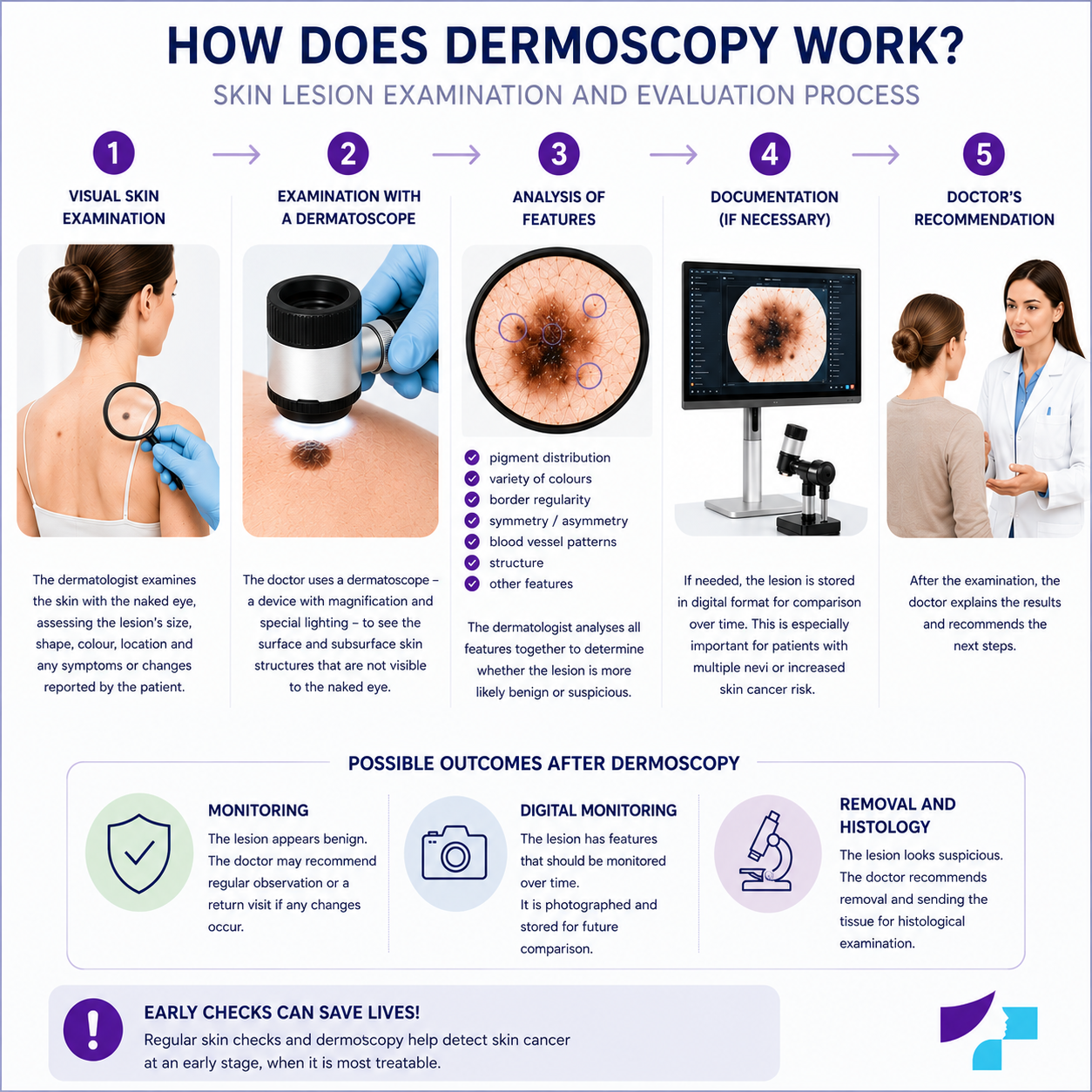
Dermoscopy is a non-invasive skin examination method in which a dermatologist uses a special magnifying optical device — a dermatoscope — to assess the structure, colour, pigment distribution, vascular pattern and other features of skin lesions in detail, including signs that are not sufficiently visible to the naked eye. It helps the doctor distinguish benign skin lesions more accurately from suspicious lesions that require observation, digital monitoring, biopsy or histological examination.
Dermoscopy is one of the most important methods in the diagnosis of skin lesions, because some skin tumours in their early stages may look visually similar to benign lesions. The examination is painless, quick, safe and is usually performed during a dermatologist consultation. During dermoscopy, the skin is not cut, no tissue sample is taken and anaesthesia is not required.
It is important to understand that dermoscopy is not the same as a mole check. A mole check is a broader clinical process during which the dermatologist assesses the patient’s skin, moles, risk factors and the need for further observation or treatment. Dermoscopy, on the other hand, is one of the main methods used by the doctor in this process to examine a specific skin lesion in more detail.
What is a dermatoscope?
A dermatoscope is a medical device that combines magnification and special lighting, allowing the doctor to see the superficial and partly deeper structures of the skin. With a dermatoscope, it is possible to see pigment distribution, vascular patterns, skin surface features and other diagnostically important elements more clearly.
Today, both handheld optical dermatoscopes and digital dermoscopy systems are used. An optical dermatoscope allows the doctor to assess the lesion immediately during the visit. Digital systems also make it possible to capture and store images so that they can later be compared and used to assess whether the lesion changes over time.
Why is dermoscopy important?
With the naked eye, it is not always possible to determine reliably whether a skin lesion is benign, inflammatory, precancerous or malignant. Different lesions may initially look similar, while their biological significance can be very different.
Dermoscopy increases diagnostic accuracy because it allows the doctor to assess not only the external appearance of the lesion, but also its internal structure. This is particularly important in the early recognition of melanoma, basal cell carcinoma, squamous cell carcinoma, actinic keratosis and other skin tumours.
Early diagnosis is essential because many skin tumours are treated much more successfully at an early stage than when they are detected late. Dermoscopy helps determine in time which lesions can be safely monitored and which require active action.
Dermoscopy and mole checks — what is the difference?
Dermoscopy and mole checks are closely related, but they are not completely identical concepts.
A mole check is a broader assessment performed by a dermatologist. It includes examination of the patient’s skin, evaluation of specific moles and other lesions, assessment of risk factors, discussion of the patient’s symptoms and, if necessary, preparation of a further observation or treatment plan.
Dermoscopy is a method by which the doctor examines a specific skin lesion under magnification and with special lighting. It is used during mole checks, but it is not intended only for moles. Dermoscopy can also be used to assess many other skin lesions and diseases.
Therefore, dermoscopy can be understood as a dermatologist’s diagnostic tool, while a mole check is a broader consultation and risk assessment process.
What does the doctor see during dermoscopy?
During dermoscopy, the doctor does not assess only the size or colour of the lesion. The dermatologist analyses a combination of several features that helps determine whether the lesion is more consistent with benign changes, inflammation, a precancerous condition or a malignant process.
During dermoscopy, the doctor may assess:
- pigment distribution;
- pigment network;
- the number of colours and their distribution;
- symmetry or asymmetry of the lesion;
- regularity of the borders;
- dots, globules, lines and other structural elements;
- vascular pattern;
- scaling, crusting or ulceration;
- changes in the skin surface;
- features characteristic of melanocytic or non-melanocytic lesions;
- features that may indicate basal cell carcinoma, squamous cell carcinoma, melanoma or another skin tumour.
The combination of these features helps the doctor decide whether the lesion is benign, should be monitored over time or should be removed and sent for histological examination.
Which skin lesions can be examined with dermoscopy?
Although patients most often associate dermoscopy with moles, the method is used much more widely. Dermoscopy can be used to assess various pigmented and non-pigmented skin lesions, as well as certain skin diseases.
Dermoscopy can be used to assess:
- moles and other melanocytic lesions;
- suspicious pigmented skin patches;
- seborrhoeic keratoses;
- actinic keratoses;
- signs of basal cell carcinoma;
- signs of squamous cell carcinoma;
- haemangiomas and other vascular lesions;
- dermatofibromas;
- warts;
- skin lesions that bleed, crust, itch, hurt or do not heal;
- changes in nail pigmentation;
- scalp and hair diseases in certain cases;
- some inflammatory skin diseases.
For this reason, dermoscopy is not only a “mole method”. It is a widely used dermatological diagnostic method for assessing various skin changes.
Optical dermoscopy
Optical dermoscopy is the classic dermoscopy method in which the dermatologist assesses a skin lesion with a handheld dermatoscope. The doctor places the device on the skin or brings it close to the area being examined and immediately evaluates the structure of the lesion.
Optical dermoscopy is suitable when one or several specific skin lesions that seem suspicious to the patient or doctor need to be assessed. It is quick, practical and often used in everyday dermatology practice.
This method is usually sufficient when a decision needs to be made about a specific lesion: whether it looks benign, should be monitored, photographed for comparison or removed with histological examination.
Digital dermoscopy
Digital dermoscopy means that dermoscopic images of a skin lesion are captured and stored in digital format. This allows them to be compared with future examinations and makes it possible to assess more objectively whether the lesion changes over time.
Digital dermoscopy is particularly useful for patients who have many skin lesions, atypical lesions, an increased risk of melanoma or a need to monitor changes in specific lesions over time.
The advantage of digital dermoscopy is that it does not rely only on the patient’s or doctor’s memory. If images are stored, at the next visit the doctor can compare the specific lesion with the previous image and determine more accurately whether it has changed.
FotoFinder, skin passport and lesion mapping
In some clinics, digital dermoscopy is performed using specialised systems such as FotoFinder or similar digital mapping technologies. These systems allow skin lesions to be documented, images to be stored and compared over a longer period of time.
Patients with many skin lesions or an increased risk of skin cancer may have a so-called “skin passport” created — a digital image database that helps track whether new lesions appear or existing lesions change.
Whole-body mapping is not necessary for every patient. It is particularly valuable when a person has many moles or atypical lesions, a personal or family history of melanoma, significant exposure to ultraviolet radiation or other important risk factors.
Optical and digital dermoscopy — comparison
| Type of dermoscopy | Suitable for | Main advantage |
|---|---|---|
| Optical dermoscopy | Assessing specific skin lesions during the visit | Quick, accessible and suitable for everyday dermatology practice |
| Digital dermoscopy | Documenting lesions and comparing them over time | Allows changes over time to be assessed more objectively |
| Whole-body mapping / FotoFinder | Patients with many lesions or increased risk | Helps create an image database and monitor new or changing lesions |
None of these methods is “the best” for all patients. The most appropriate method is chosen by the dermatologist, taking into account the specific lesion, the patient’s risk factors and the purpose of the examination.
When is dermoscopy needed?
Dermoscopy may be needed if there is a skin lesion that looks unusual, changes or raises uncertainty. It may also be recommended preventively for patients with an increased risk of skin cancer.
It is advisable to see a dermatologist if a skin lesion:
- rapidly increases in size;
- changes colour;
- becomes asymmetrical;
- develops irregular borders;
- becomes multicoloured;
- starts itching, hurting or bleeding;
- crusts or does not heal;
- looks different from other lesions on the skin;
- appears in adulthood and continues to change;
- is located in an area where it is regularly traumatised by clothing, shaving or friction.
These signs do not mean that the lesion is definitely malignant, but they are a sufficient reason for professional assessment.
For whom can dermoscopy be especially important?
Dermoscopy can be particularly important for people with an increased risk of skin cancer. In such cases, the doctor may recommend regular skin checks, digital monitoring or repeat assessment of specific lesions after a certain period of time.
Increased-risk groups may include people who have:
- very fair skin that burns easily in the sun;
- many moles or other skin lesions;
- atypical moles;
- a previous melanoma or another skin cancer;
- a family history of melanoma;
- frequent sunburns during life, especially in childhood;
- regular use of tanning beds;
- long-term exposure to ultraviolet radiation due to work or lifestyle;
- a weakened immune system;
- long-term immunosuppressive therapy.
For these patients, dermoscopy helps not only to assess specific lesions, but also to plan an individual skin monitoring strategy.
How is dermoscopy performed?
Dermoscopy is usually performed during a dermatologist consultation. The doctor first examines the skin visually, listens to the patient’s complaints and asks whether the lesion has changed, bled, itched, hurt or been traumatised previously.
The doctor then uses a dermatoscope. Depending on the device, the examination may be performed with direct contact with the skin or without contact. In some cases, a special fluid or polarised light is used to see the skin structures more clearly.
The examination is painless and usually takes a short time. If only one lesion is being checked, dermoscopy may take a few minutes. If several lesions are assessed or digital documentation is performed, the visit may take longer.
After the examination, the doctor explains the result and recommends further action: observation, repeat check-up, digital monitoring, removal of the lesion or histological examination.
How to prepare for dermoscopy?
Special preparation for dermoscopy is usually not required. However, to make the examination more accurate, it is advisable not to apply make-up, self-tanning products, thick creams or other products to the area being examined before the visit, as they may change the appearance of the skin or lesion.
If changes in nail pigmentation need to be assessed, it is advisable to remove nail polish, gel polish or artificial nails before the visit. If the lesion is located on the scalp, it is useful to tell the doctor when it was first noticed and whether it has changed.
The patient should tell the doctor:
- how long the lesion has been noticed;
- whether it has changed recently;
- whether it has bled, itched, hurt or crusted;
- whether there has been trauma or inflammation;
- whether the lesion has previously been treated or attempts have been made to remove it;
- whether there has been melanoma or skin cancer in the family;
- whether the patient has previously had skin tumours.
If previous photographs or dermoscopy images are available, it is advisable to bring them to the visit.
What does the dermoscopy result mean?
After dermoscopy, the doctor assesses which category the lesion most closely fits and what action is needed. The result may mean several scenarios.
If the lesion looks benign, additional treatment may not be necessary. The doctor may recommend observing it or checking it again only if it changes.
If the lesion is not clearly malignant but has features that should be monitored over time, the doctor may recommend digital documentation and a repeat check after a certain period.
If the lesion looks suspicious, the dermatologist may recommend removing it and sending it for histological examination. This does not mean that the patient definitely has cancer. It means that visual and dermoscopic assessment is not sufficient to safely rule out significant changes.
If the lesion has pronounced signs of malignancy, the doctor may recommend prompt further diagnostics and treatment.
When is dermoscopy not enough?
Dermoscopy is a very valuable diagnostic method, but it does not always replace histological examination. Histology is the microscopic examination of tissue in a laboratory, and in suspicious cases it is what allows malignant changes to be definitively confirmed or excluded.
Dermoscopy may not be sufficient if:
- the lesion is atypical;
- the lesion changes rapidly;
- it bleeds, ulcerates or does not heal;
- the structure of the lesion is unclear;
- the doctor cannot reliably determine its nature;
- there is suspicion of melanoma, basal cell carcinoma, squamous cell carcinoma or another skin tumour;
- there has been previous trauma, self-treatment or incomplete removal of the lesion;
- the clinical picture and dermoscopic picture do not match.
In such cases, the doctor may recommend a biopsy or complete removal of the lesion with histological examination.
Can dermoscopy diagnose melanoma?
Dermoscopy helps the doctor detect signs that may indicate melanoma and determine whether a lesion is suspicious. However, dermoscopy itself is not always the final diagnosis. If the lesion looks suspicious, removal and histological examination are required.
This means that dermoscopy is a very important stage in melanoma diagnostics, but in suspicious cases the final diagnosis is made by laboratory examination of tissue.
It is important for the patient to understand: if the doctor recommends removing a lesion after dermoscopy, this does not necessarily mean that melanoma has been found. It means that the lesion needs to be examined more precisely in order to determine its nature safely.
Is dermoscopy safe?
Dermoscopy is a safe and non-invasive method. It is not associated with radiation, does not damage the skin and does not leave scars. No cuts, injections or tissue sampling are performed during the examination.
Dermoscopy can be performed for patients of different ages, including children, if the dermatologist considers that a specific lesion should be assessed. It can also be performed during pregnancy, because the examination does not affect pregnancy and is not associated with radiation or medication use.
Advantages of dermoscopy
The main advantage of dermoscopy is the ability to examine skin lesions in much greater detail than with the naked eye. It helps the doctor make more accurate decisions about further action.
Advantages of dermoscopy:
- painless and non-invasive method;
- anaesthesia is not required;
- no recovery period;
- suitable for repeated monitoring;
- helps detect suspicious signs early;
- helps distinguish many benign and suspicious lesions;
- may reduce unnecessary removal of benign lesions;
- helps determine when histological examination is needed;
- digital dermoscopy allows lesions to be compared over time.
Limitations of dermoscopy
Although dermoscopy is a very useful method, it also has limitations. The result depends on the doctor’s experience, the type of lesion, its location, image quality and clinical context.
Some skin tumours may be atypical, poorly pigmented or visually similar to benign lesions. Therefore, the doctor may recommend additional examination even if the lesion does not look classically malignant.
Dermoscopy is also not a self-diagnosis method. Phone photographs, mobile apps or artificial intelligence tools cannot replace a dermatologist’s examination, because the diagnosis is based not only on the image, but also on the clinical context, the patient’s risk factors and the doctor’s experience.
Summary
Dermoscopy is a modern, safe and painless skin examination method that allows the dermatologist to assess skin lesions in detail and detect signs that are not visible during a standard visual examination. It is important in the early diagnosis of melanoma, basal cell carcinoma, squamous cell carcinoma and other skin tumours, and it also helps distinguish many benign lesions from those that require further examination.
Dermoscopy is not only a mole check. It is a broader dermatological method used to assess various pigmented and non-pigmented skin lesions, nail changes, vascular lesions and certain skin diseases. However, dermoscopy does not replace histology in cases where a lesion is suspicious or its nature is unclear.
A timely dermatologist consultation and dermoscopy help make an informed decision — whether a lesion can be safely monitored, or whether repeat monitoring, digital documentation, biopsy or removal with histological examination is needed.
The information is for educational and informational purposes only and does not replace a doctor’s consultation, diagnosis or treatment. Self-diagnosis and self-treatment may be incorrect and may delay timely treatment. If you have a suspicious, changing, bleeding, painful or non-healing skin lesion, it is advisable to see a dermatologist. In cases of severe, rapidly worsening or high-risk symptoms, urgent medical attention is required.
References and authoritative sources
- NICE: quality statement on dermoscopy in skin cancer diagnostics
- American Academy of Dermatology Association: melanoma diagnosis and treatment
- DermNet: dermoscopy and pattern analysis
- DermNet: skin cancer and skin self-examination
- NCBI Bookshelf: dermoscopy overview and additional applications
- British Association of Dermatologists: dermoscopy and skin cancer information resources
- European Academy of Dermatology and Venereology: dermatology resources for patients and professionals
- Mayo Clinic: melanoma diagnosis and treatment
