Perioral dermatitis at a glance
Perioral dermatitis is an inflammatory facial skin condition that most often appears as small acne-like bumps around the mouth. The rash may also occur around the nose, eyes or eyelids. Skin in these areas often becomes sensitive, red, dry or flaky and may burn or itch.
Perioral dermatitis is not contagious and is usually not life-threatening, but it can be persistent, recur and significantly affect wellbeing. It is important not to confuse it with acne, rosacea, allergic contact dermatitis or an infection, because the treatment approaches differ.
Especially important: perioral dermatitis should not be self-treated with topical corticosteroid creams on the face. They may temporarily reduce redness but later maintain or worsen the inflammation.
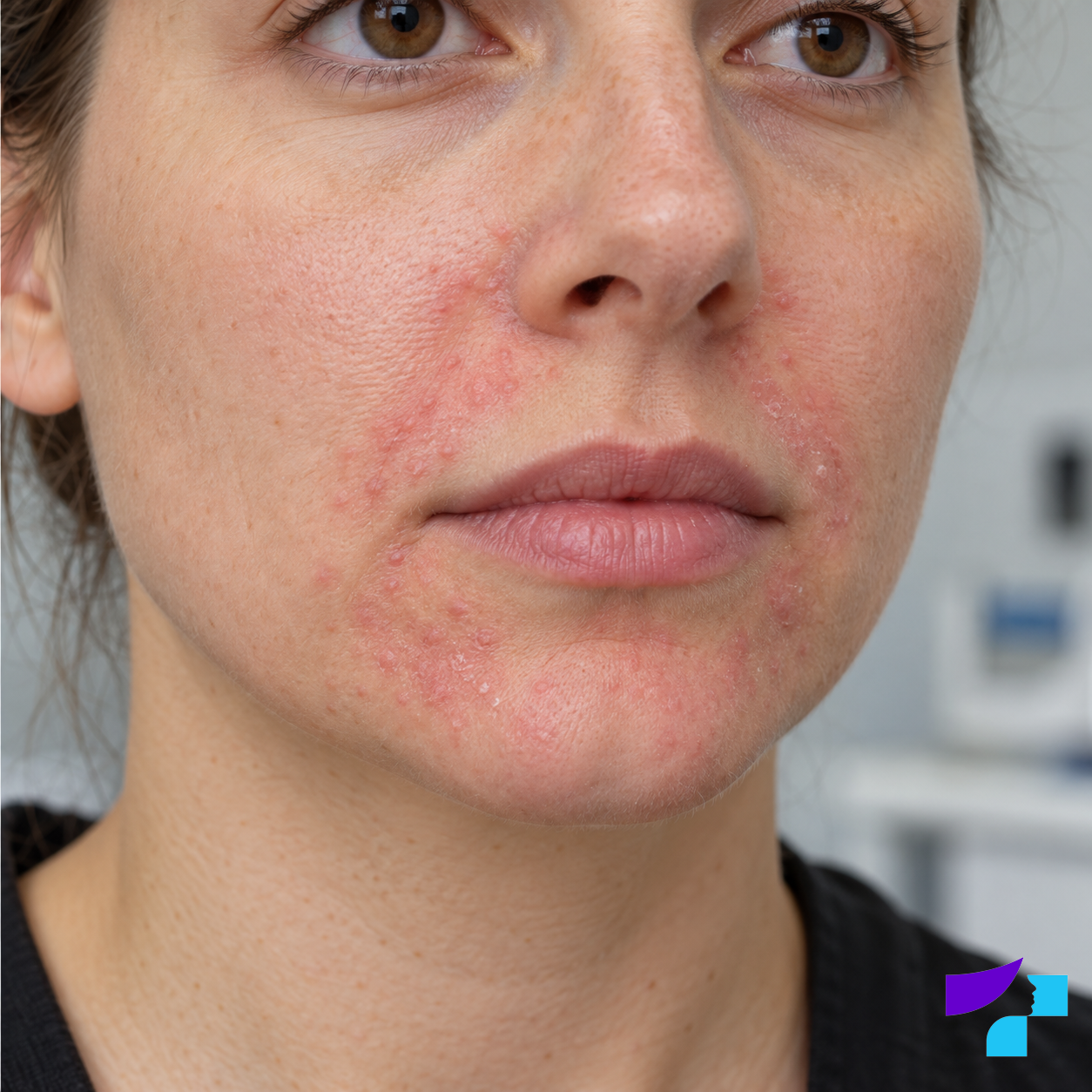
Perioral dermatitis may present with small papules, redness and flaking around the mouth, chin and nose; a narrow band of unaffected skin often remains immediately next to the red part of the lips.
What is perioral dermatitis?
Perioral dermatitis is inflammation of the facial skin that usually develops around the mouth. The word “perioral” means “around the mouth”. A more precise medical term is sometimes “periorificial dermatitis”, because the rash may also appear around other facial openings, such as the nose or eyes.
The condition can resemble acne, but it is not ordinary acne. Perioral dermatitis usually does not cause comedones, or blackheads and whiteheads, which are typical of acne. Small papules, occasional pustules, redness, flaking and burning are more common.
In the broader context of dermatitis, perioral dermatitis is one form of facial dermatitis. You can read about other types in Medart’s article Dermatitis.
Perioral or periorificial dermatitis: what is the difference?
The term “perioral dermatitis” is more commonly used because the classic location is around the mouth. Dermatologists may use the broader term “periorificial dermatitis” when the rash occurs around several facial openings.
| Term | What it means |
|---|---|
| Perioral dermatitis | Rash mainly around the mouth |
| Perinasal dermatitis | Rash around the nose |
| Periocular dermatitis | Rash around the eyes or eyelids |
| Periorificial dermatitis | A broader term for a rash around the mouth, nose, eyes or other openings |
A rash around the eyes or eyelids should not be self-treated with potent creams. The related article Facial and eyelid dermatitis may be useful in this situation.
What does perioral dermatitis look like?
Perioral dermatitis most often looks like small, uniform, acne-like bumps around the mouth. The skin may be red, dry, sensitive or flaky and may feel as though it is burning.
Typical signs include:
- small bumps around the mouth;
- redness around the mouth, chin or nose;
- dry and flaky skin;
- burning, irritation or tightness;
- occasional itching;
- a rash around the nose or eyes;
- a narrow band of unaffected skin immediately next to the red part of the lips.
This unaffected band near the lips is one of the signs that may help a dermatologist distinguish perioral dermatitis from other facial rashes.
What are the symptoms of perioral dermatitis?
Symptoms of perioral dermatitis may be mild or pronounced. Some people have only slight redness and small bumps, while others experience burning, flaking and recurrent flare-ups.
The most common symptoms are:
- small papules or pustules around the mouth;
- redness;
- dryness;
- scaling or flaking;
- burning;
- itching;
- tingling or tightness;
- sensitivity to cosmetics, creams, sunscreen or toothpaste.
Pain is not the most typical symptom. See a doctor if the rash is painful, worsens rapidly, weeps, develops yellowish crusts or is accompanied by fever, because an infection or another diagnosis may need to be ruled out.
Where does perioral dermatitis most commonly occur?
The classic site is around the mouth, especially the chin, corners of the mouth and nasolabial folds, the lines running from the nose to the corners of the mouth.
Perioral dermatitis may appear:
- around the mouth;
- on the chin;
- around the nose;
- in the nasolabial folds;
- around the eyes;
- on the eyelids;
- less commonly on the cheeks or forehead.
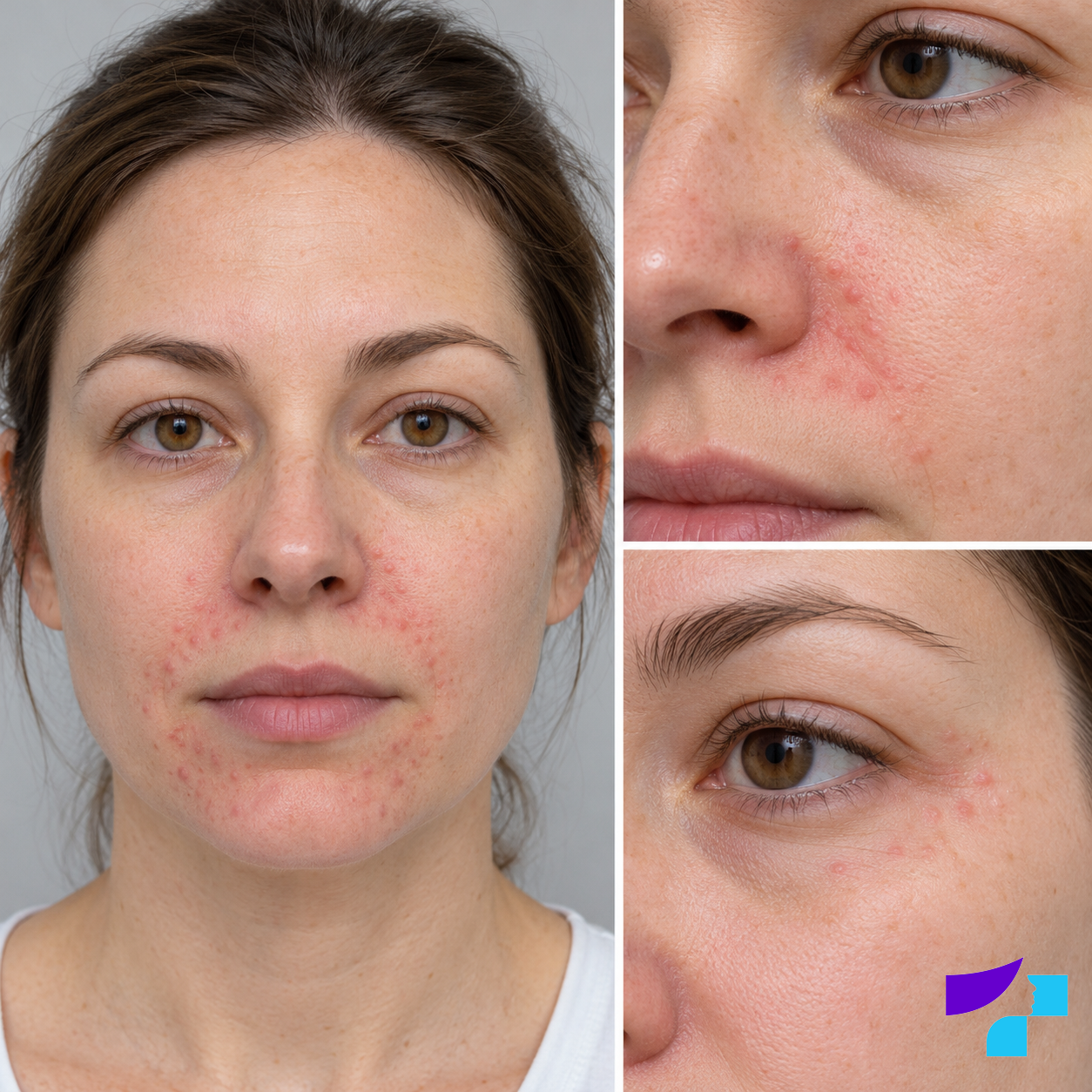
Periorificial dermatitis may affect the skin around the mouth, nose and eyes; the severity and distribution of the rash can vary from person to person.
If the rash mainly affects the scalp, eyebrows and nasal folds and has greasier scaling, seborrheic dermatitis should also be considered.
What causes perioral dermatitis?
The exact cause of perioral dermatitis is not fully understood. It is most often considered to result from a combination of skin barrier disruption, irritation, a local immune response and external triggers.
Common associated factors include:
- use of topical corticosteroid creams on the face;
- inhaled or intranasal corticosteroids that come into contact with facial skin;
- thick, occlusive face creams;
- make-up;
- an excessive skincare routine involving many active products;
- sunscreens that are too irritating or heavy for the individual’s skin;
- toothpaste, including fluoride, cinnamon flavouring or whitening additives in sensitive people;
- fragrances and preservatives in cosmetics;
- wind, heat and ultraviolet radiation;
- masks, scarves, friction and sweating;
- stress;
- hormonal fluctuations, pregnancy or the menstrual cycle;
- an atopic tendency or a sensitive skin barrier.
Important: not every patient has one clear trigger. Perioral dermatitis sometimes develops after several factors coincide, such as a corticosteroid cream, active cosmetics, a heavy sunscreen and a period of stress.
Corticosteroid creams and perioral dermatitis
Topical corticosteroid creams are among the most important triggers of perioral dermatitis. They may temporarily reduce redness, making it seem as though the product is helping. However, the rash may return more severely after treatment is stopped.
This can create a vicious cycle:
| Stage | What happens |
|---|---|
| A corticosteroid cream is applied to the face | Redness temporarily decreases |
| The cream is stopped | The rash returns or worsens |
| The cream is restarted | There is another temporary improvement |
| Use continues | The skin becomes increasingly sensitive and the inflammation persists |
If a corticosteroid cream has been used without medical advice, it should not be continued without a doctor’s assessment. If it was prescribed for another diagnosis, stopping it should be discussed with the doctor, as a gradual approach may sometimes be needed.
Corticosteroid nasal sprays or inhalers may also contribute to a rash around the mouth or nose in some people if the medicine comes into contact with facial skin. Do not stop treatment for asthma, allergy or another condition on your own; discuss correct technique and possible alternatives with your doctor.
Cosmetics, toothpaste and skincare as triggers
In perioral dermatitis, the skin is often “overloaded”. This means it no longer tolerates several creams, serums, active ingredients, make-up or aggressive cleansing well.
Common irritants include:
- thick, greasy or occlusive creams;
- several layers of cosmetics;
- make-up primers and long-wear make-up;
- scrubs;
- acids;
- retinoids;
- alcohol-based toners;
- flavoured products;
- essential oils;
- fragrances;
- some preservatives;
- strongly foaming toothpastes;
- toothpastes with cinnamon flavouring or whitening additives;
- a sunscreen that is too heavy or irritating.
If cosmetics, fragrances, preservatives or toothpaste are suspected of triggering the reaction, allergic contact dermatitis may also need to be assessed. Perioral dermatitis is not the same as an allergy, however; its cause is often more complex than a single allergic reaction.
Masks, friction, sweating and weather
Perioral dermatitis may be worsened by mechanical irritation and the microclimate around the mouth. This particularly applies to people who wear face masks, scarves or tight collars for long periods, or whose face sweats and is rubbed during exercise.
A flare-up may be promoted by:
- prolonged mask use;
- sweating under a mask;
- friction around the mouth and chin;
- friction from a scarf or collar;
- hot water;
- saunas and steam;
- sunbeds;
- intense sun exposure;
- cold wind;
- sudden temperature changes.
This does not mean that masks or weather always cause the condition. They more often act as aggravating factors when the skin barrier is already sensitive or inflamed.
Perioral dermatitis in children, women and men
Perioral dermatitis is more commonly described in young and middle-aged women, but it can also affect men and children.
In women, cosmetics, skincare products, hormonal fluctuations, pregnancy or previous use of topical corticosteroids on the face may play a role.
In children, periorificial dermatitis may appear around the mouth, nose or eyes. In some cases, it is associated with local irritation, inhaled or intranasal medicines, thick creams, sunscreen or lip licking. Facial rashes in children should not be treated for a prolonged period with products intended for adults without medical advice.
Perioral dermatitis is less common in men but can occur. Shaving products, face creams, corticosteroids or other skin irritants may contribute.
Is perioral dermatitis contagious?
No. Perioral dermatitis is not contagious. It cannot be passed to another person by touch, towels, kissing or everyday contact.
It is not a classic bacterial or fungal infection. However, if the rash is unusual, weeps, develops yellowish crusts, becomes painful or spreads rapidly, a doctor may order additional tests to rule out infection or another skin disease.
Could it be “face mites”, a fungal infection or another infection?
Patients often ask whether a rash around the mouth is caused by “face mites”, fungi or bacteria. Perioral dermatitis is generally not simply a fungal infection, bacterial infection or disease caused by Demodex mites. Some diagnoses can look similar, however, and several factors may sometimes overlap.
A doctor may consider additional tests if:
- the rash is atypical;
- there is pus, yellow crusting or marked pain;
- the rash spreads rapidly;
- the eye area is affected;
- previous treatment has not helped;
- a fungal, bacterial or other skin disease is suspected.
It is therefore important not to start antibiotics, antifungal treatments or anti-mite therapy without a diagnosis.
Perioral dermatitis or acne, rosacea and contact dermatitis?
Perioral dermatitis is often confused with other facial skin conditions. This is one reason why self-treatment may fail.
| Condition | Typical features | How it differs from perioral dermatitis |
|---|---|---|
| Perioral dermatitis | Small bumps around the mouth, nose or eyes, burning, dryness and often an unaffected band beside the lips | Usually no comedones; often associated with creams or corticosteroids |
| Acne | Comedones, inflamed spots and sometimes nodules | Blackheads and whiteheads are typical of acne but not of perioral dermatitis |
| Rosacea | Redness in the central face, flushing and visible blood vessels | Rosacea more often affects the cheeks, nose and forehead; perioral dermatitis is concentrated around the mouth |
| Allergic contact dermatitis | Itching, redness and sometimes swelling after contact with an allergen | Itching is often more pronounced and the link to a specific substance may be clearer |
| Seborrheic dermatitis | Scaling on the scalp, eyebrows and nasal folds | Greasy scales and a different distribution are more common |
| Atopic dermatitis | Chronically dry, itchy skin, often with an atopic tendency | Dryness and itching are often more widespread and not limited to the perioral area |
| Lip licker’s dermatitis | Redness exactly where a child or adult repeatedly licks the skin | A clearer link to licking, saliva and irritation is more common |
| Infection | Pain, pus, yellow crusts and rapid worsening | Medical assessment and sometimes tests are needed |
If the skin is chronically dry and itchy or there is an atopic tendency, Medart’s article Atopic dermatitis may also be useful.
Common mistakes that can worsen perioral dermatitis
Perioral dermatitis often persists not because it is dangerous, but because the skin continues to be irritated or is treated as though it were another condition.
Common mistakes include:
- treating the rash as acne with aggressive acne products;
- using a topical corticosteroid cream on the face for a prolonged period;
- trying a new cosmetic product every day;
- applying several serums, creams and layers of make-up at the same time;
- using scrubs, acids or retinoids on inflamed skin;
- squeezing or rubbing the rash;
- washing the face with hot water;
- using saunas or sunbeds during a flare-up;
- self-treating with antibiotics, antifungal medicines or “home remedies”;
- waiting too long before seeing a dermatologist.
With perioral dermatitis, less but more precise care is often better than doing many things without a clear plan.
When should you see a dermatologist?
See a dermatologist if:
- the rash around the mouth does not resolve;
- the rash recurs;
- it spreads around the nose or eyes;
- there is burning, pain or severe irritation;
- the skin weeps, develops crusts or becomes painful;
- the rash affects a child;
- a topical corticosteroid cream has previously been used on the face;
- self-treatment makes the condition worse;
- it is unclear whether the condition is acne, rosacea, an allergy or dermatitis;
- the rash significantly affects confidence, sleep or everyday life.
More urgent assessment is needed if there is rapid deterioration, marked swelling around the eyes, fever, severe pain, visual disturbance or suspected infection.
How is perioral dermatitis diagnosed?
A dermatologist usually diagnoses perioral dermatitis clinically, based on examination of the skin, the distribution of the rash, symptoms and the history of products used.
The doctor may ask:
- how long the rash has been present;
- whether it itches, burns or hurts;
- which facial skincare products are used;
- whether a topical corticosteroid cream has been used;
- whether a nasal spray or inhaler is used;
- which toothpaste is used;
- whether symptoms change with the menstrual cycle, pregnancy, stress or weather;
- whether there is acne, rosacea, atopic dermatitis or allergy.
Additional tests are usually unnecessary, but in selected cases the doctor may consider:
- a skin scraping to rule out a fungal infection;
- a swab if there are signs of infection;
- patch testing if allergic contact dermatitis is suspected;
- a biopsy in very rare or atypical cases.
How is perioral dermatitis treated?
Treatment for perioral dermatitis is individual. It depends on the severity and location of the rash, previously used products, skin sensitivity, age, the possibility of pregnancy and other health considerations.
Treatment may include:
- stopping triggering factors;
- “zero therapy”, or simplifying facial skincare;
- gentle skin cleansing;
- topical anti-inflammatory or antibacterial treatment prescribed by a doctor;
- systemic treatment prescribed by a doctor for moderate or severe cases;
- reviewing cosmetics and toothpaste;
- a plan for stopping topical corticosteroids if they have previously been used.
Important: specific treatment must be selected by a dermatologist. Prescription medicines should not be used for self-treatment, because inappropriate therapy may prolong the condition or alter the appearance of the rash.
What is zero therapy?
Zero therapy means temporarily stopping all unnecessary and potentially irritating products applied to the face. The aim is to reduce the burden on the skin and allow its barrier to settle.
This usually means:
- stopping make-up on the affected area;
- stopping active serums, acids, scrubs and retinoids;
- not using thick, greasy creams;
- not using topical corticosteroid creams without medical advice;
- washing the face with lukewarm water or a very gentle cleanser;
- using only minimal skincare recommended by a dermatologist;
- choosing sunscreen carefully if it is needed and tolerated.
Zero therapy is not simply “doing nothing” without a plan. It is a targeted reduction in the burden placed on the skin. If the rash is pronounced, this alone may not be sufficient and treatment prescribed by a doctor may be needed.
How should the skin be cared for during perioral dermatitis?
During perioral dermatitis, skincare should be simple, gentle and predictable.
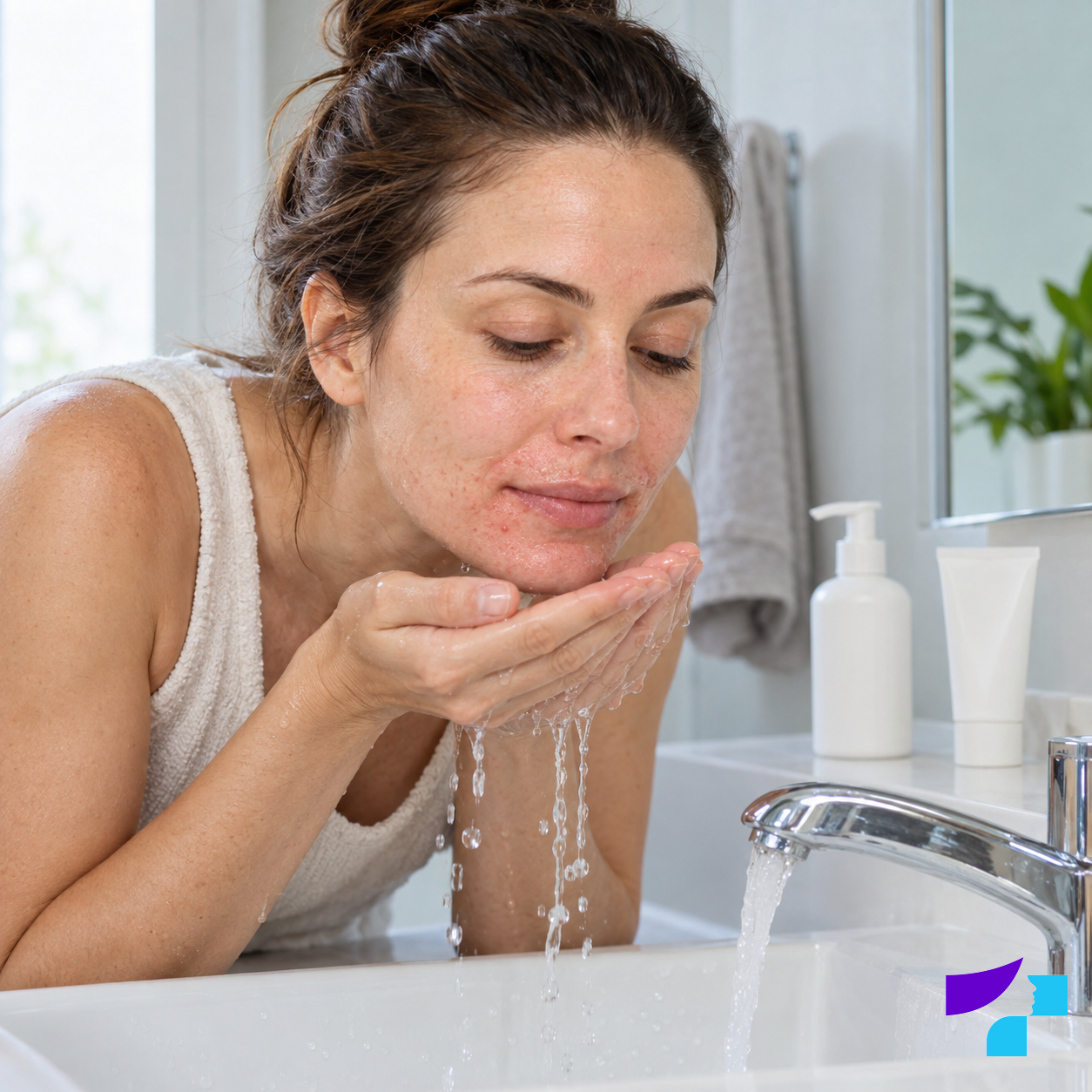
During perioral dermatitis, wash the face with lukewarm water, avoid rubbing and keep the skincare routine simple and guided by a dermatologist.
Practical recommendations:
- wash the face with lukewarm rather than hot water;
- avoid rubbing;
- do not use scrubs;
- do not use alcohol-based toners;
- temporarily stop active products;
- avoid fragrances;
- do not use many products at the same time;
- do not experiment with new cosmetics every day;
- if sunscreen is needed, choose the gentlest possible option and monitor the skin’s response carefully;
- if using an inhaler or nasal spray, discuss with the doctor how to minimise contact between the medicine and facial skin.
If a particular product stings, burns or worsens the rash, do not continue using it simply because it is labelled “for sensitive skin” or “dermatologically tested”. Individual tolerance is very important.
What should be avoided with perioral dermatitis?
With perioral dermatitis, avoid:
- using topical corticosteroid creams on the face without medical advice;
- suddenly stopping corticosteroids prescribed by a doctor without consultation;
- using many active products at the same time;
- using scrubs, acids, retinoids or alcohol-containing products on inflamed skin without medical advice;
- covering the rash with thick creams or several layers of make-up;
- changing cosmetics every day;
- squeezing the bumps;
- using antibiotics or antifungal medicines without a diagnosis;
- deciding on your own that the condition is acne, an allergy, a fungal infection or “face mites”;
- delaying a dermatologist consultation if the rash does not resolve or worsens.
How long does treatment for perioral dermatitis take?
Perioral dermatitis usually does not disappear within one or two days. With the right approach, improvement is often gradual. In some people, the skin begins to settle within a few weeks, but full stabilisation may take several weeks or months.
There may be a temporary flare during the initial period after stopping irritating products or topical corticosteroids. This does not necessarily mean that the condition is worsening permanently, but a dermatologist-guided approach is especially important in such cases.
Can perioral dermatitis recur?
Yes, perioral dermatitis can recur. Recurrence may be promoted by:
- repeated use of topical corticosteroid creams on the face;
- resuming cosmetics that previously caused irritation;
- overly heavy creams;
- excessive skincare;
- stress;
- hormonal fluctuations;
- friction, masks and sweating;
- heat, saunas, sunbeds or intense ultraviolet radiation;
- treatment prescribed by a doctor that was too short or not completed.
To reduce the risk of recurrence, do not immediately return to the previous cosmetic routine once the skin improves.
What should you do after the skin settles?
After the rash improves, the skin may remain sensitive for some time. A common mistake at this stage is immediately restarting the old routine of cosmetics, active products or make-up, which can cause the dermatitis to return.
After the skin settles, it is advisable to:
- reintroduce products gradually rather than all on the same day;
- introduce only one new product at a time;
- observe the skin’s response for at least several days;
- not return to topical corticosteroid creams on the face without medical advice;
- avoid products that previously irritated the skin;
- maintain a simple, well-tolerated skincare routine;
- contact a dermatologist promptly if another flare-up occurs.
The aim is not to use as many “sensitive skin” products as possible, but to find the smallest effective routine that the skin tolerates.
How should you prepare for a dermatologist appointment?
Before the appointment, it is useful to write down:
- when the rash started;
- what makes it better or worse;
- all facial skincare products used;
- make-up products;
- toothpaste;
- sunscreen;
- whether a topical corticosteroid cream has been used;
- whether an inhaler or nasal spray is used;
- whether there has been a pregnancy, hormonal change or link to the menstrual cycle;
- medicines or creams used previously;
- whether there is acne, rosacea, atopic dermatitis or allergy.
If possible, bring the product names or photographs of their ingredient lists. This helps the doctor understand more accurately what may be maintaining the irritation.
Summary
Perioral dermatitis is a common, non-contagious inflammation of facial skin that most often appears as small bumps, redness, dryness and burning around the mouth. It may also spread around the nose and eyes. Although it is not life-threatening, it can be persistent and recur.
The main practical principles are to avoid topical corticosteroid creams on the face unless directed by a doctor, not overload the skin with cosmetics, identify possible triggers and see a dermatologist promptly if the rash does not resolve, recurs or worsens.
Medical disclaimer
The information in this article is for informational purposes and does not replace medical consultation, diagnosis or treatment. Treatment for perioral dermatitis depends on the type, severity and location of the rash, skincare products used, previous corticosteroid use and medical assessment. If a rash around the mouth, nose or eyes does not resolve, recurs, worsens, becomes painful, weeps, develops crusts or affects a child, book a dermatology consultation. Do not use prescription medicines or topical corticosteroid creams for self-treatment.
References and authoritative sources
- American Academy of Dermatology Association: perioral dermatitis symptoms, causes and treatment
- DermNet: causes, clinical features, diagnosis and treatment of periorificial dermatitis
- DermNet: periocular dermatitis, or dermatitis around the eyes
- MSD Manual Professional Edition: perioral dermatitis
- Cleveland Clinic: perioral dermatitis symptoms, causes, diagnosis and treatment
- PubMed: systematic review of pharmacological interventions for periorificial dermatitis in children and adults
- PubMed: perioral dermatitis diagnosis, proposed causes and management
