Inverse psoriasis, also known as flexural psoriasis, is a form of psoriasis that appears in skin folds — places where skin touches skin, such as the groin, armpits, under the breasts, between the buttocks, around the navel or in the genital area. Medically, it may also be called intertriginous psoriasis.
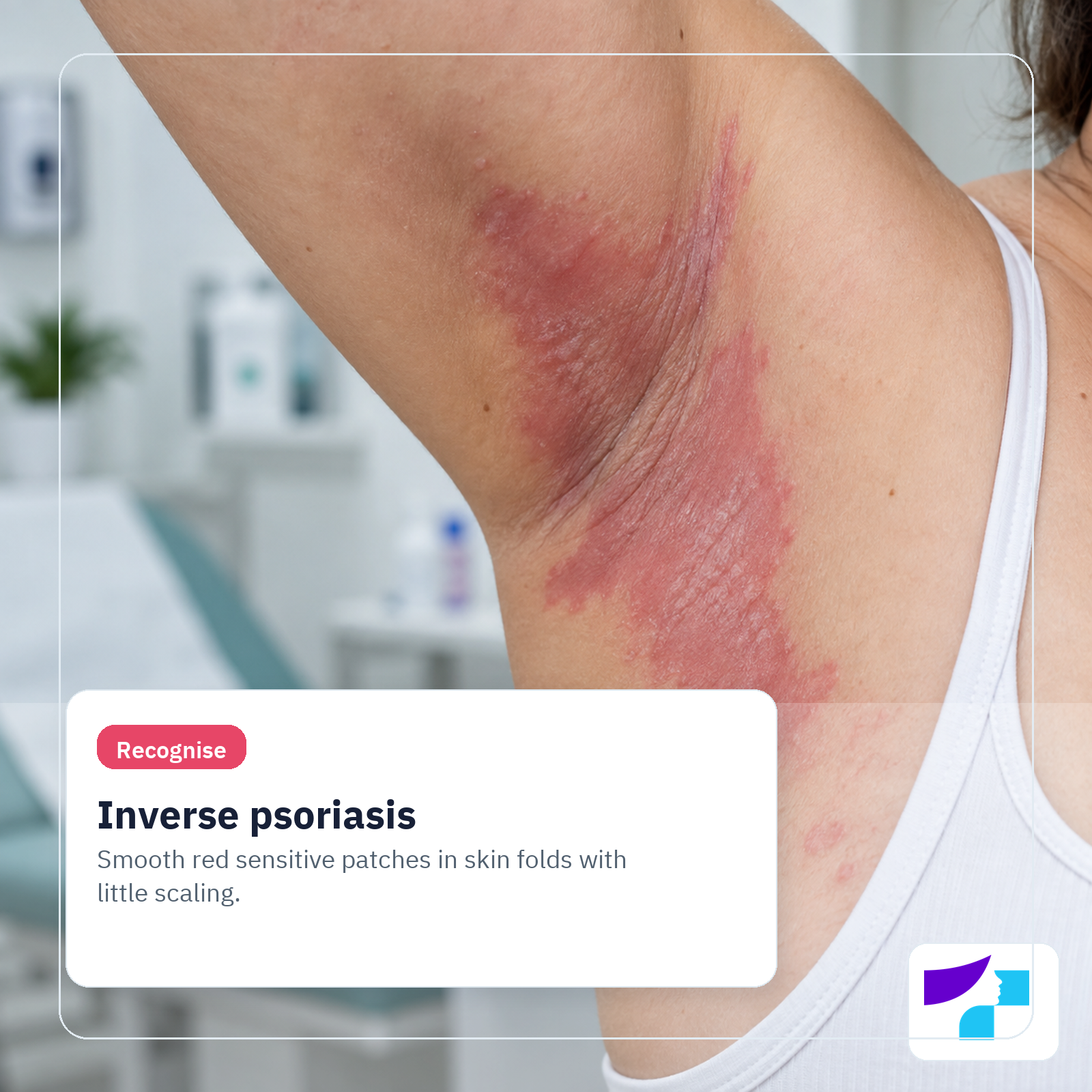
Unlike classic plaque psoriasis, where thick, silvery, scaly plaques are often visible, inverse psoriasis usually appears as smooth, pink or bright red, shiny, sensitive inflammation with stinging, burning, itching or cracks. Because of moisture and friction in skin folds, thick scales often do not form, so this type of psoriasis may look “non-classic”.
Inverse psoriasis often causes confusion because it can resemble a fungal infection, candidiasis, intertrigo, contact dermatitis, irritation or a rash in the intimate area. It is not contagious, not a fungal infection and not a sexually transmitted infection, although similar symptoms can also occur with infections or other skin diseases. For this reason, an accurate diagnosis is best made by a dermatologist.
What is inverse psoriasis?
Inverse psoriasis is a form of chronic inflammatory skin disease — psoriasis — that affects skin folds and friction areas. It may occur as a separate manifestation of psoriasis or together with other forms, such as plaque psoriasis, scalp psoriasis, nail psoriasis or psoriatic arthritis.
In some patients, inverse psoriasis is the first sign that suggests psoriasis, especially if typical scaly plaques on the elbows or knees are not prominent. It may also occur in someone who already has known psoriasis, when inflammation appears in new and more sensitive areas.
This article explains inverse psoriasis in skin folds specifically, rather than repeating all general information about psoriasis.
Are inverse, intertriginous and flexural psoriasis synonyms?
Yes, in practice these terms often describe the same form of psoriasis.
Inverse psoriasis is the main medical term. It is called “inverse” because it often appears in opposite locations compared with classic plaque psoriasis. Plaque psoriasis more often affects elbows, knees and other outer surfaces, while inverse psoriasis affects folds and areas where skin touches skin.
Intertriginous psoriasis means psoriasis in intertriginous areas — places where skin rubs against skin and where warmth, moisture and sweating are common.
Flexural psoriasis is a patient-friendly descriptive term because the condition affects skin folds.
How is inverse psoriasis different from plaque psoriasis?
Classic plaque psoriasis usually appears as clearly defined, red, thickened areas of skin with dry, silvery scales. It often appears on the elbows, knees, scalp or lower back.
Inverse psoriasis looks different. Skin folds contain more moisture, warmth and friction, so thick scales often do not form or are quickly rubbed away. As a result, the affected area may be:
- smooth;
- shiny;
- pink or bright red;
- moister than classic psoriasis;
- sensitive or painful;
- cracked;
- burning or stinging;
- only mildly scaly or not visibly scaly at all.
For this reason, inverse psoriasis is often mistaken for a fungal infection, candidiasis, chafing or allergic irritation.
Is inverse psoriasis contagious?
No. Inverse psoriasis is not contagious. It cannot be caught by touching the skin, living together, sharing a towel or clothing, or being in close contact.
It is not a fungal infection, not a bacterial infection, not a virus and not a sexually transmitted infection. It is an immune-mediated inflammatory disease in which changes in immune system activity cause inflammation in the skin.
It is important to understand, however, that fungal or bacterial infection may sometimes occur at the same time in skin folds. This means that psoriasis itself is not an infection, but a damaged and moist skin fold can become more vulnerable to secondary infection.
What does inverse psoriasis look like?
Inverse psoriasis most often appears as red, smooth, shiny and sensitive patches in skin folds. They may be well defined, but they are not always typically scaly.
Typical signs include:
- red or bright red patches;
- a smooth, shiny surface;
- little scaling or no scaling at all;
- itching;
- stinging;
- burning;
- pain during friction;
- cracks;
- skin sensitivity;
- discomfort when sweating;
- worsening in heat or because of tight clothing.
If the patches are wet, weeping, have an unpleasant odour, pus-like discharge, blisters or ulcers, infection or another skin disease should also be ruled out.
Why does inverse psoriasis often have no thick scaling?
Inverse psoriasis often lacks the classic silvery scales because conditions in skin folds are different from those on the elbows or knees.
Skin folds have:
- more moisture;
- more warmth;
- more sweating;
- constant friction;
- more skin-to-skin contact;
- skin damage that is more easily irritated and cracked.
These conditions prevent scales from building up in the same way as they do on drier parts of the body. Therefore, inverse psoriasis may look “non-psoriatic” — like smooth, red, sensitive inflammation.
3–5 key signs that may suggest inverse psoriasis
A combination of the following signs may suggest inverse psoriasis:
- Red, smooth or shiny patches in skin folds.
- Little scaling or no scaling at all.
- Stinging, burning, itching or pain in areas of friction.
- Repeated symptoms in the same places — the groin, armpits, under the breasts or between the buttocks.
- Psoriasis elsewhere on the body, nail changes or psoriasis in the family.
These signs are not enough for self-diagnosis, but they help show when psoriasis should be considered alongside fungal infection or irritation.
Where does inverse psoriasis most often appear?
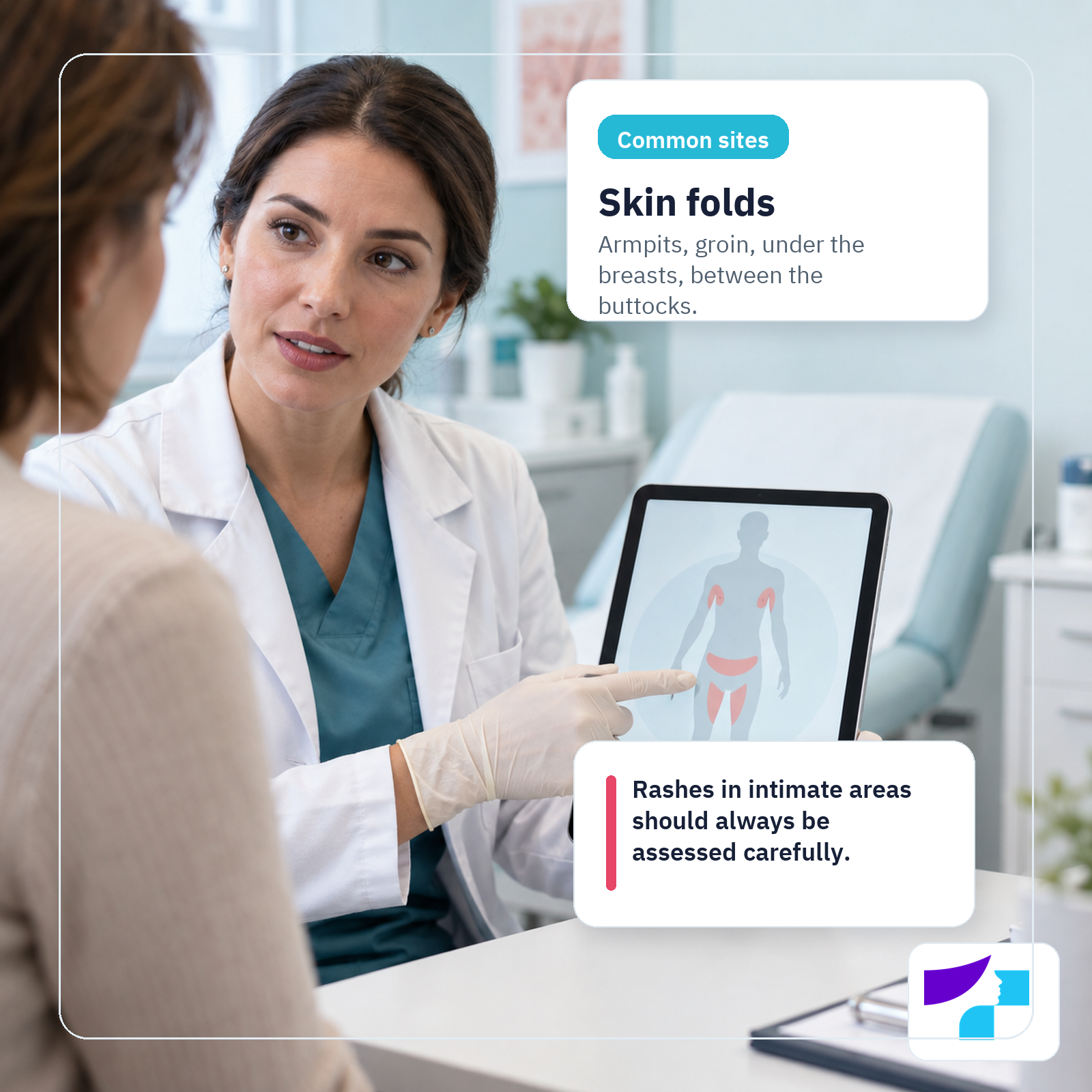
Inverse psoriasis appears in places where skin touches skin or where friction and moisture are increased.
Common locations include:
- armpits;
- groin;
- under the breasts;
- between the buttocks;
- around the anus;
- genital area;
- abdominal folds;
- navel;
- inner thighs;
- behind the ears;
- under skin folds in people with excess weight.
This location is one reason why patients sometimes delay seeing a doctor — the rash is in sensitive or intimate areas that may feel difficult to discuss.
Inverse psoriasis in the intimate area
Inverse psoriasis can affect the genital area — the vulva, penis, groin, perineum or the skin around the anus. In this case, it may also be called genital psoriasis, although genital psoriasis is not exactly the same as all inverse psoriasis, because inverse psoriasis may also affect the armpits, the area under the breasts, abdominal folds or other sites.
Important points:
- genital psoriasis is not a sexually transmitted infection;
- it is not contagious to a partner;
- it does not mean poor hygiene;
- it may cause pain, burning or discomfort during sex;
- it may be associated with shame, anxiety and avoidance of intimacy.
However, rashes in the intimate area should always be assessed carefully. Candidiasis, herpes infection, contact dermatitis, lichen sclerosus, bacterial infections or sexually transmitted infections may look similar. Therefore, if a rash in the intimate area appears for the first time, recurs, hurts, cracks, bleeds or is accompanied by discharge, blisters or ulcers, a doctor should be consulted.
Why does psoriasis in skin folds often look different?
A skin fold is a specific environment. It contains warmth, moisture, friction and sometimes increased growth of microorganisms. Inflammation in these areas can therefore become more painful, moist and irritated than in other parts of the body.
The appearance of inverse psoriasis is affected by:
- sweating;
- tight clothing;
- synthetic underwear;
- friction while walking;
- excess weight and deeper skin folds;
- fragranced hygiene products;
- deodorants or wet wipes;
- shaving or waxing;
- added fungal or bacterial infection.
For this reason, inverse psoriasis may burn, crack and hurt more, even when the affected area is not very large.
Who has a higher risk of inverse psoriasis?
Inverse psoriasis can occur in anyone with psoriasis, but the risk may be higher if there is:
- psoriasis on other parts of the body;
- psoriasis in the family;
- signs of nail psoriasis;
- excess weight;
- deeper skin folds;
- increased sweating;
- frequent skin friction;
- tight or synthetic clothing;
- chronic stress;
- smoking;
- excessive alcohol use;
- skin irritation or trauma;
- recurrent fungal infections or infections in skin folds.
Risk factors do not mean that inverse psoriasis will definitely develop, but they may contribute to its appearance or flare-ups.
How inverse psoriasis develops
Inverse psoriasis, like other forms of psoriasis, is linked to changes in immune system regulation. Inflammatory signals from the immune system speed up skin cell renewal and maintain inflammation in the skin.
In simplified terms, the process can be explained as follows:
- A person has a genetic or immunological tendency to psoriasis.
- The immune system activates inflammatory signals in the skin.
- Skin cells renew faster than usual.
- Moisture and friction in skin folds change the appearance of the lesion.
- Smooth, red, sensitive patches develop, with burning, itching or cracks.
- Irritation, sweating or infection can worsen symptoms.
Psoriasis is not an infection, so people do not become immune after “having it”. The disease is characterised by periods of remission and flare-up.
Symptoms of inverse psoriasis: early, typical and more complicated cases
Early symptoms
At first, there may be:
- mild redness in a skin fold;
- mild itching;
- stinging when sweating;
- discomfort after friction;
- sensitivity after washing or shaving;
- recurrent irritation in the same place.
Typical symptoms
Later, inverse psoriasis may appear as:
- more clearly visible red patches;
- smooth or shiny skin;
- burning;
- pain during friction;
- cracks;
- stinging;
- discomfort during sex if the intimate area is affected;
- flare-ups in hot weather or when sweating.
More complicated cases
In more complicated cases, there may be:
- deeper cracks;
- bleeding;
- weeping;
- an unpleasant odour;
- marked pain;
- added infection;
- spread of the rash;
- a significant impact on quality of life.
In such cases, self-treatment should not be continued. Medical assessment and an accurate diagnosis are needed.
Causes and flare-up factors of inverse psoriasis
Inverse psoriasis does not have one single cause. It develops through the interaction of immune-mediated inflammation, genetic predisposition and external factors.
Flare-ups may be triggered or worsened by:
- sweating;
- skin friction;
- heat;
- tight clothing;
- synthetic underwear;
- excess weight;
- skin irritation;
- shaving or waxing;
- fragranced hygiene products;
- deodorants, lubricants or condom materials if they irritate the skin;
- stress;
- infections;
- alcohol and smoking;
- unsuitable treatment;
- long-term self-treatment without a diagnosis.
It is not always possible to identify one specific reason for a flare-up. However, reducing friction, moisture and irritation may help control symptoms.
Sweating, friction and skin irritation in inverse psoriasis
Sweating and friction are particularly important flare-up factors in inverse psoriasis. Even mild inflammation can become painful if it is located where the skin constantly moves and touches clothing or another skin surface.
Friction can contribute to:
- cracks;
- burning;
- stinging;
- skin sensitivity;
- secondary irritation;
- risk of infection.
For this reason, treatment is not the only important part of care in skin folds. Daily care also matters — gentle washing, careful drying, clothing that does not rub and avoiding irritating products.
What can inverse psoriasis be confused with?
Inverse psoriasis is often confused with other conditions because different skin fold problems may look similar.
It may be confused with:
- fungal infection;
- candidiasis;
- intertrigo;
- contact dermatitis;
- allergic irritation;
- bacterial infection;
- seborrhoeic dermatitis;
- herpes infection;
- sexually transmitted infections;
- lichen sclerosus;
- nappy rash in children;
- other less common skin diseases.
Inverse psoriasis or a fungal infection?
Fungal infection often develops in moist, warm places — in the groin, between the toes, under the breasts or in abdominal folds. It can cause itching, redness, scaling and discomfort.
Inverse psoriasis may be suggested by:
- psoriasis elsewhere on the body;
- nail changes;
- family history;
- repeated lesions in the same places;
- smooth red patches with little or no scaling;
- an incomplete or short-lived response to antifungal treatment.
To distinguish the conditions accurately, a doctor may perform a skin scraping or other tests if fungal infection is suspected.
Inverse psoriasis or candidiasis?
Candidiasis is inflammation caused by yeast, often affecting moist skin folds. It may cause bright redness, moisture, itching, stinging and sometimes small “satellite” lesions around the main affected area.
Psoriasis and candidiasis can also occur at the same time. This means a person may have inverse psoriasis with added candidiasis. In that case, treatment differs from treatment for simple psoriasis or simple fungal infection alone.
Inverse psoriasis or intertrigo?
Intertrigo is inflammation of skin folds caused by friction, moisture and warmth. It is not one specific diagnosis, but an inflammatory condition in skin folds. Fungal or bacterial infection may also be present.
Inverse psoriasis may look similar to intertrigo, but it has the inflammatory mechanism typical of psoriasis and is often associated with other signs of psoriasis.
Inverse psoriasis or contact dermatitis?
Contact dermatitis occurs when the skin reacts to an irritant or allergen. In skin folds, it may be caused by:
- deodorant;
- fragranced wash products;
- laundry detergent;
- synthetic clothing;
- sanitary pads;
- wet wipes;
- condoms or lubricants;
- cosmetics;
- shaving products.
If the rash started after using a new product, contact dermatitis should also be considered. Medart has separate articles on allergic contact dermatitis, allergy and atopic dermatitis, so this article discusses the topic only in the context of differential diagnosis.
Genital psoriasis or a sexually transmitted infection?
Genital psoriasis is not an STI and is not contagious to a partner. However, infections may cause similar symptoms in the intimate area.
STI or another infection may be more likely if there are:
- blisters;
- ulcers;
- discharge;
- pain when urinating;
- enlarged lymph nodes;
- a new sexual contact;
- rapidly developing painful rash;
- fever or feeling unwell.
In such cases, self-diagnosis is not safe — medical assessment and tests are needed.
Inverse psoriasis or another condition?
| Condition | Typical signs | What helps distinguish it |
|---|---|---|
| Inverse psoriasis | Smooth, red, shiny patches in skin folds, stinging, cracks, less scaling | Psoriasis elsewhere on the body, nail changes, family history, recurrence |
| Fungal infection / candidiasis | Red, moist, itchy rash, sometimes satellite lesions | Skin scraping, swab, response to antifungal treatment |
| Intertrigo | Inflammation in areas of friction and moisture | Link with sweating, friction, excess weight, tight clothing |
| Contact dermatitis | Redness, itching or burning after an irritant | New cosmetics, hygiene product, deodorant, laundry detergent or intimate-area product |
| STI / herpes | Pain, ulcers, blisters, discharge or genital symptoms | Sexual history, tests, medical examination |
| Lichen sclerosus or other conditions | White patches, cracks, pain, changes in genital skin | Assessment by a dermatologist, gynaecologist or urologist, sometimes biopsy |
This table helps with orientation, but it does not replace a diagnosis. Several conditions in skin folds and intimate areas can look similar.
How is inverse psoriasis diagnosed?
The diagnosis of inverse psoriasis is usually based on a dermatologist’s examination, medical history and looking for other signs of psoriasis.
The doctor may ask:
- when the rash started;
- whether it recurs;
- whether there is itching, burning, pain or cracking;
- whether symptoms worsen when sweating;
- whether there has been psoriasis elsewhere on the body;
- whether there are nail changes;
- whether psoriasis runs in the family;
- whether new hygiene or cosmetic products have been used;
- whether antifungal products have been used and whether they helped;
- whether there are genital symptoms, discharge or ulcers.
The doctor may also examine:
- the scalp;
- elbows;
- knees;
- lower back;
- nails;
- palms and soles;
- joint symptoms.
Sometimes additional tests are needed:
- skin scraping to rule out fungal infection;
- a swab or culture if infection is suspected;
- STI tests if symptoms or history suggest them;
- skin biopsy if the diagnosis is unclear;
- other tests according to the doctor’s decision.
A photograph may help with initial remote assessment, but it does not always allow inverse psoriasis to be distinguished from fungal infection, contact dermatitis or infection.
Can inverse psoriasis occur together with infection?
Yes. Inverse psoriasis may occur together with fungal, yeast or bacterial infection. Skin folds are warm and moist, so infections can develop more easily there, especially if the skin is inflamed, cracked or rubbed.
Added infection may be suggested by:
- increased pain;
- weeping;
- an unpleasant odour;
- pus-like discharge;
- crusts;
- rapid worsening;
- fever or feeling unwell;
- spread beyond the usual area.
If infection is suspected, treatment needs to be adjusted. A simple “psoriasis ointment” or a simple antifungal product may not be enough.
Treatment of inverse psoriasis
Treatment of inverse psoriasis is determined by a dermatologist, taking into account the location, severity, symptoms, possibility of infection, previous treatment and other manifestations of psoriasis.
The goals of treatment are to:
- reduce inflammation;
- reduce itching, burning and pain;
- restore the skin barrier;
- reduce cracks;
- prevent infections;
- reduce recurrence of flare-ups;
- improve quality of life.
Inverse psoriasis should not be treated long term with prescription products without medical supervision, because medicines may be absorbed more strongly in skin folds and the skin is more vulnerable to side effects.
Topical treatment in skin folds
For mild or moderate inverse psoriasis, topical treatment is often used — products applied directly to the skin. These may include anti-inflammatory treatments, gentler options for sensitive areas, moisturising and skin barrier-supporting products, or other treatment prescribed by a doctor.
This article does not include specific prescription medicine doses or schedules because they must be determined by a doctor.
Why is gentler treatment needed in skin folds?
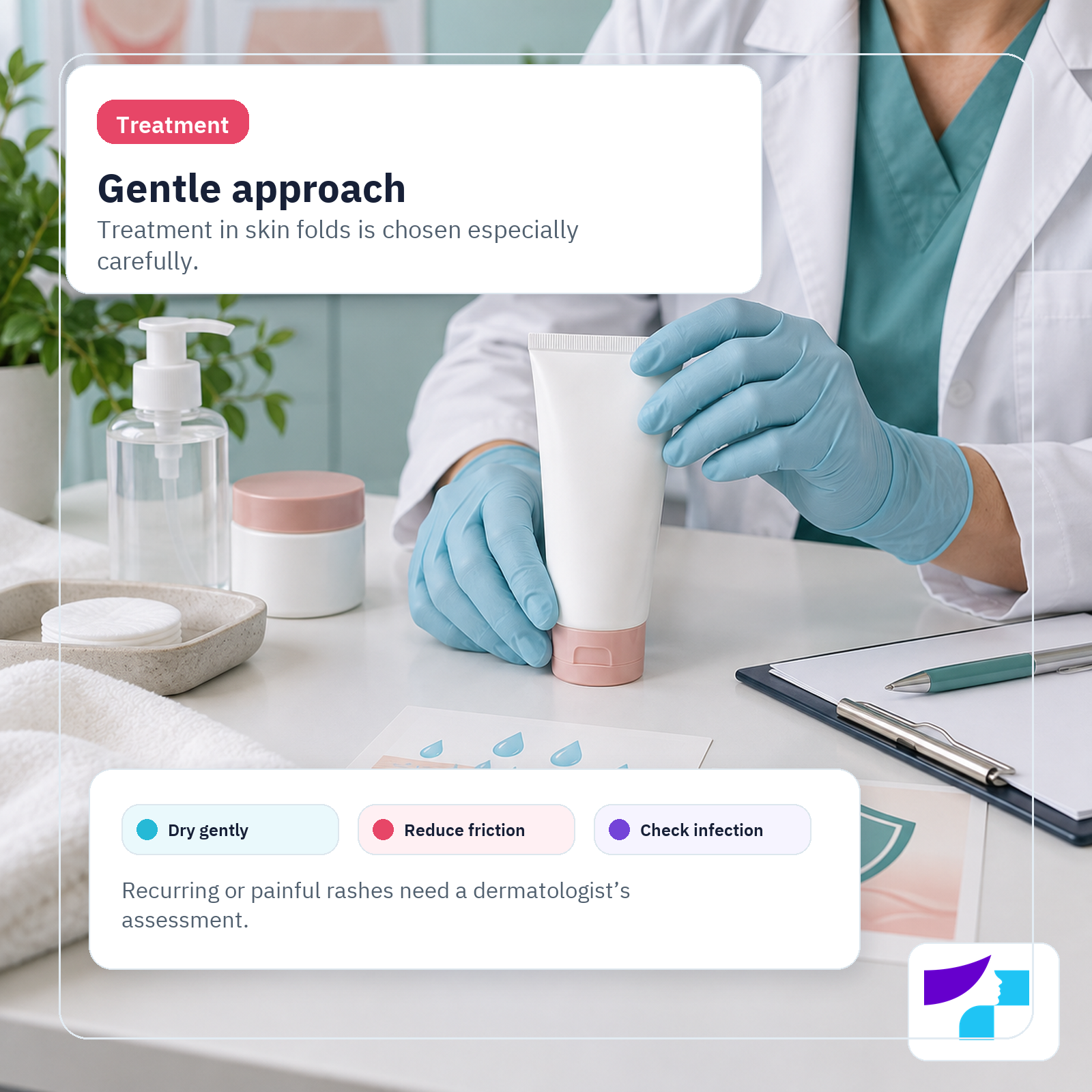
The skin in folds is thinner, moister and more sensitive. There is also more friction and closer skin-to-skin contact, so some topical products may irritate the skin or cause side effects if used for too long or incorrectly.
Long-term use of strong anti-inflammatory ointments in skin folds without medical supervision may increase the risk of skin thinning, irritation, stretch marks or other side effects. Therefore, the strength, duration and most suitable treatment should be chosen by a dermatologist.
Assessment and treatment of infection if it is present
If inverse psoriasis is accompanied by fungal, candidal or bacterial infection, appropriate treatment is needed. In these cases, the doctor may need to perform a scraping, take a swab or assess other symptoms.
It is important not to start long-term antifungal or prescription anti-inflammatory treatment without a diagnosis, because incorrect treatment may delay finding the real problem.
Systemic, biologic and targeted therapy in more severe cases
If inverse psoriasis is part of broader, more severe or difficult-to-control psoriasis, systemic treatment, biologic therapy or targeted therapy may be needed. These treatments act on inflammatory processes in the body, not only on one area of skin.
Treatment is chosen by a doctor, taking into account disease severity, location, impact on quality of life, comorbidities, infection risk and previous treatment.
Skin care in inverse psoriasis
Daily skin care is important because skin folds are easily irritated and inflamed. Skin care does not replace treatment, but it may help reduce flare-ups.
Recommended:
- wash the skin gently;
- avoid fragranced and irritating products;
- dry skin folds carefully after washing;
- do not rub the skin with a towel;
- choose loose, breathable clothing;
- choose cotton or other skin-friendly materials;
- reduce long-lasting moisture in skin folds;
- avoid friction;
- avoid unnecessary new cosmetic or intimate hygiene products during a flare-up;
- ask a doctor which moisturising or protective products are suitable for the specific area.
What should you not do with inverse psoriasis?
With inverse psoriasis, you should not:
- treat a rash as “fungus” for a long time without a diagnosis;
- use strong prescription ointments without medical supervision;
- rub or scratch the affected skin;
- mechanically peel off the skin surface;
- use irritating deodorants, fragranced products or harsh wash products;
- wear tight clothing that rubs;
- ignore cracks, bleeding, pain or weeping;
- ignore rashes in the intimate area;
- assume by yourself that it is definitely psoriasis or definitely a fungal infection.
If symptoms recur, do not go away or worsen, a dermatologist’s assessment is needed.
Lifestyle, clothing, weight and sweating control
Lifestyle does not cure inverse psoriasis, but it may help reduce friction, sweating and irritation.
Helpful measures may include:
- looser clothing;
- breathable underwear;
- changing clothes after sweating;
- carefully drying skin folds;
- weight reduction if there is excess weight and deep skin folds;
- stopping smoking;
- limiting alcohol;
- reducing stress;
- regular dermatology follow-up;
- timely treatment of infections.
Diet alone does not cure inverse psoriasis, but a balanced diet, healthy weight and control of comorbidities may support overall psoriasis management.
Inverse psoriasis in children, during pregnancy and in sensitive areas
Inverse psoriasis can also occur in children, but rashes in skin folds in children should be carefully distinguished from nappy rash, candidiasis, eczema or irritation. Self-treatment with products intended for adults is not appropriate for infants and young children.
During pregnancy and breastfeeding, treatment of inverse psoriasis must be chosen especially carefully. Not all treatments are suitable for pregnant or breastfeeding women. Treatment decisions should therefore be made together with a dermatologist and, if needed, a gynaecologist.
In especially sensitive areas — the genital area, around the anus, under the breasts or in the armpits — treatment should be gentle and medically supervised.
Inverse psoriasis and psoriatic arthritis
Inverse psoriasis by itself does not mean that a person will definitely have psoriatic arthritis. However, psoriasis in general can be associated with joint inflammation in some patients.
A doctor or rheumatologist should be consulted if psoriasis is accompanied by:
- joint pain;
- joint swelling;
- morning stiffness;
- heel or Achilles tendon pain;
- a “sausage-like” finger or toe;
- back pain that is worse in the morning or after rest;
- nail changes together with joint symptoms.
For more on this topic, see the Medart article on psoriatic arthritis.
What is proven, what is still discussed and what medicine is working on?
What is well established
It is well established that psoriasis is a chronic immune-mediated inflammatory disease and that it is not contagious. Inverse psoriasis is one form of psoriasis that affects skin folds and may look different in these areas from classic plaque psoriasis.
It is also well established that topical therapy on the face, in skin folds and in the genital area must be chosen carefully because skin in these areas is more sensitive to irritation and side effects.
Where an individual approach is needed
An individual approach is needed when choosing treatment. For one patient, gentle topical therapy and changes in skin care may be enough, while another may need treatment for infection, a different topical treatment or systemic psoriasis control.
Rashes in the genital area, in children, during pregnancy and in cases where fungal infection, candidiasis, STI or contact dermatitis is suspected should also be assessed individually.
What medicine is working on
Modern dermatology is moving toward personalised psoriasis treatment. This means assessing the disease form, location, impact on quality of life, comorbidities, inflammatory mechanisms and the most suitable treatment for each patient more precisely. In more severe cases, biologic and targeted therapies are becoming increasingly important, while in sensitive areas the focus is on safe, gentle and well-tolerated long-term treatment.
When should you see a dermatologist?
You should see a dermatologist if:
- red patches in skin folds do not go away;
- the rash recurs;
- antifungal treatment does not help;
- there is burning, pain or cracking;
- the rash is in the intimate area;
- there is bleeding, weeping or an unpleasant odour;
- infection is suspected;
- the rash spreads;
- there is psoriasis elsewhere on the body;
- there are nail changes;
- there is joint pain or morning stiffness;
- symptoms significantly affect daily life, sexual life or wellbeing.
Urgent medical help should be sought if there is severe pain, rapidly worsening inflammation, fever, ulcers, blisters, pus-like discharge, marked swelling or feeling generally unwell.
References and authoritative sources
- Latvian Association of Dermatovenerologists: clinical recommendations for the diagnosis and treatment of psoriasis
- Centre for Disease Prevention and Control of Latvia (SPKC): public health information
- National Institute for Health and Care Excellence (NICE): psoriasis assessment and management
- NICE: recommendations on psoriasis assessment, referral and treatment
- American Academy of Dermatology Association (AAD): psoriasis signs and symptoms
- American Academy of Dermatology Association (AAD): psoriasis clinical guidelines
- DermNet: flexural psoriasis
- DermNet: genital psoriasis
- DermNet: psoriasis
- DermNet: treatment of psoriasis
- British Association of Dermatologists (BAD): psoriasis overview
- PubMed: research on inverse psoriasis
- PubMed: research on genital psoriasis
- PubMed: research on treatment of flexural psoriasis
Medical disclaimer
The information in this article is intended for informational and educational purposes and does not replace a dermatologist consultation, diagnosis or treatment. If a person has red, itchy, painful, burning or cracked rashes in skin folds, the groin, armpits, under the breasts, between the buttocks or in the genital area, they should consult a dermatologist or another appropriate specialist. Do not try to treat the rash for a long time as a fungal infection and do not use prescription medicines without a doctor’s advice. If there is rapid worsening, marked pain, ulcers, blisters, pus-like discharge, fever, swelling or feeling generally unwell, urgent medical help should be sought immediately.
