Freckles are small, flat pigmented spots on the skin that usually become more noticeable after sun exposure. They are most often seen on the face, especially on the nose and cheeks, as well as on the shoulders, arms, décolleté and other sun-exposed areas of the body. Freckles are usually benign and are not skin cancer in themselves.
However, not every brown spot on the skin is a freckle. Similar-looking changes may include sunspots, melasma, moles or other pigmented skin lesions. This is why it is important to understand what typical freckles look like, how they differ from other spots and when a dermatologist consultation is needed.
In brief: the most important facts about freckles
- Freckles are usually benign pigmented spots.
- Classic freckles are medically known as ephelides.
- They are related to genetic predisposition, melanin and ultraviolet radiation.
- They often become darker in summer and lighter in winter.
- Freckles are not the same as moles, melasma or sunspots.
- They are usually not dangerous, but changing pigmented lesions should be checked.
- People with freckles often have skin that is more sensitive to the sun.
- SPF and other sun protection measures help reduce the darkening of existing spots and the formation of new ones.
- Freckles may be lightened for aesthetic reasons, but complete and permanent removal cannot be guaranteed.
- Before laser procedures or intensive pigmentation treatment, the diagnosis should be clear.
What are freckles?
Freckles are small, flat, light brown, yellow-brown, reddish-brown or darker spots on the skin. They are usually not raised above the skin surface and most often appear as multiple spots rather than a single lesion.
Classic freckles, or ephelides, develop because ultraviolet radiation stimulates increased melanin production in certain areas of the skin. Melanin is the pigment that gives colour to the skin, hair and eyes and helps protect the skin from UV radiation.
Importantly, in ephelides, the number of melanocytes is usually not increased. Rather, melanocytes in certain areas produce more pigment, which becomes visible as a small spot.
Why do freckles appear?
The development of freckles is influenced by several factors:
- genetic predisposition;
- skin phototype;
- individual melanin production;
- UVA and UVB radiation;
- frequency and intensity of sun exposure;
- the way the skin responds to UV radiation with tanning or uneven pigmentation.
Freckles are more common in people with fair skin, light or red hair and light-coloured eyes. They are also associated with certain genetic traits, including variants of the MC1R gene, which are more common in people with red hair and sun-sensitive skin.
This does not mean that freckles occur only in people with fair skin. They may also appear in other skin types, although they may look different.
Why do freckles become darker in summer?
In summer, the skin is exposed to ultraviolet radiation more often and more intensely. UV radiation stimulates melanin production, and in people predisposed to freckles, pigment forms unevenly in small spots.
This is why freckles may become darker after sunbathing, walking outdoors, outdoor sports or travelling to a sunnier climate. In winter, when UV exposure is lower, classic freckles often become lighter or less visible.
If a brown spot persists throughout the year, becomes more stable over time or first appears in adulthood, it may be a sunspot, also known as solar lentigo, melasma or another type of pigmentation rather than a freckle.
Where do freckles most often appear?
Freckles most often appear on sun-exposed areas:
- on the nose;
- on the cheeks;
- on the forehead;
- on the face in general;
- on the shoulders;
- on the arms and forearms;
- on the upper chest;
- on the décolleté;
- on the upper back.
Freckles on the face are especially common because the face receives sun exposure not only at the beach, but also in everyday life - while walking, driving, exercising or spending time outdoors.
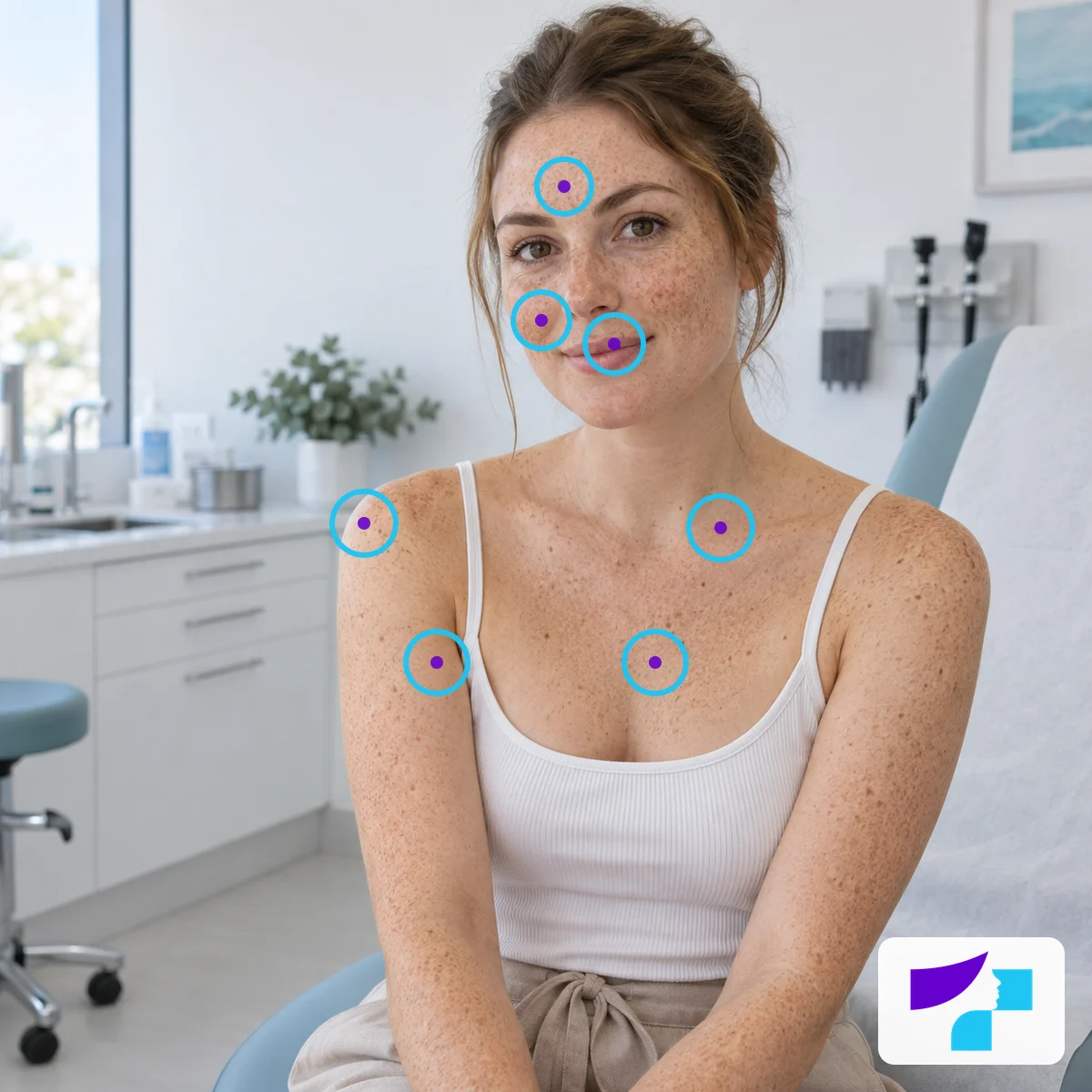
This visualisation shows the most common skin areas where freckles become more noticeable after sun exposure.
Freckles in children
Freckles in children are often a normal and benign skin feature. They may become visible in preschool or school age, especially in children with fair skin and sun sensitivity.
A child’s skin should be carefully protected from UV radiation. Children should not be encouraged to sunbathe in order to “get used to the sun” or to make pigmentation more even. Sunburns in childhood are an important risk factor for skin damage later in life.
If a child develops a new, very dark, rapidly growing, bleeding or unusual pigmented lesion, it should be shown to a doctor. In such cases, a children’s dermatologist may be appropriate.
Are freckles dangerous?
Freckles are usually not dangerous. Classic freckles are not melanoma and are not a precancerous condition.
However, people with many freckles often have fairer skin that is more sensitive to UV radiation. This means that sun protection, prevention of sunburn and regular self-checking of the skin are especially important.
Sometimes a person may call another pigmented lesion a “freckle”. Therefore, attention should be paid not only to the name, but to the behaviour of the spot - whether it changes, grows, bleeds, becomes asymmetrical or looks different from the others. In such cases, a mole and skin lesion examination is recommended.
Are freckles sun damage?
The answer is nuanced. Classic freckles are not the same as chronic sun damage spots. They mainly reflect genetic predisposition and the skin’s response to UV radiation.
Sunspots, or solar lentigines, are more likely to appear in adulthood and are more closely related to cumulative UV exposure over a lifetime. They are often larger, more persistent and do not fade in winter as much as classic freckles.
In both cases, photoprotection is important because UV radiation contributes both to the darkening of freckles and to the development of other pigmented spots.
Freckles or pigmented spots?
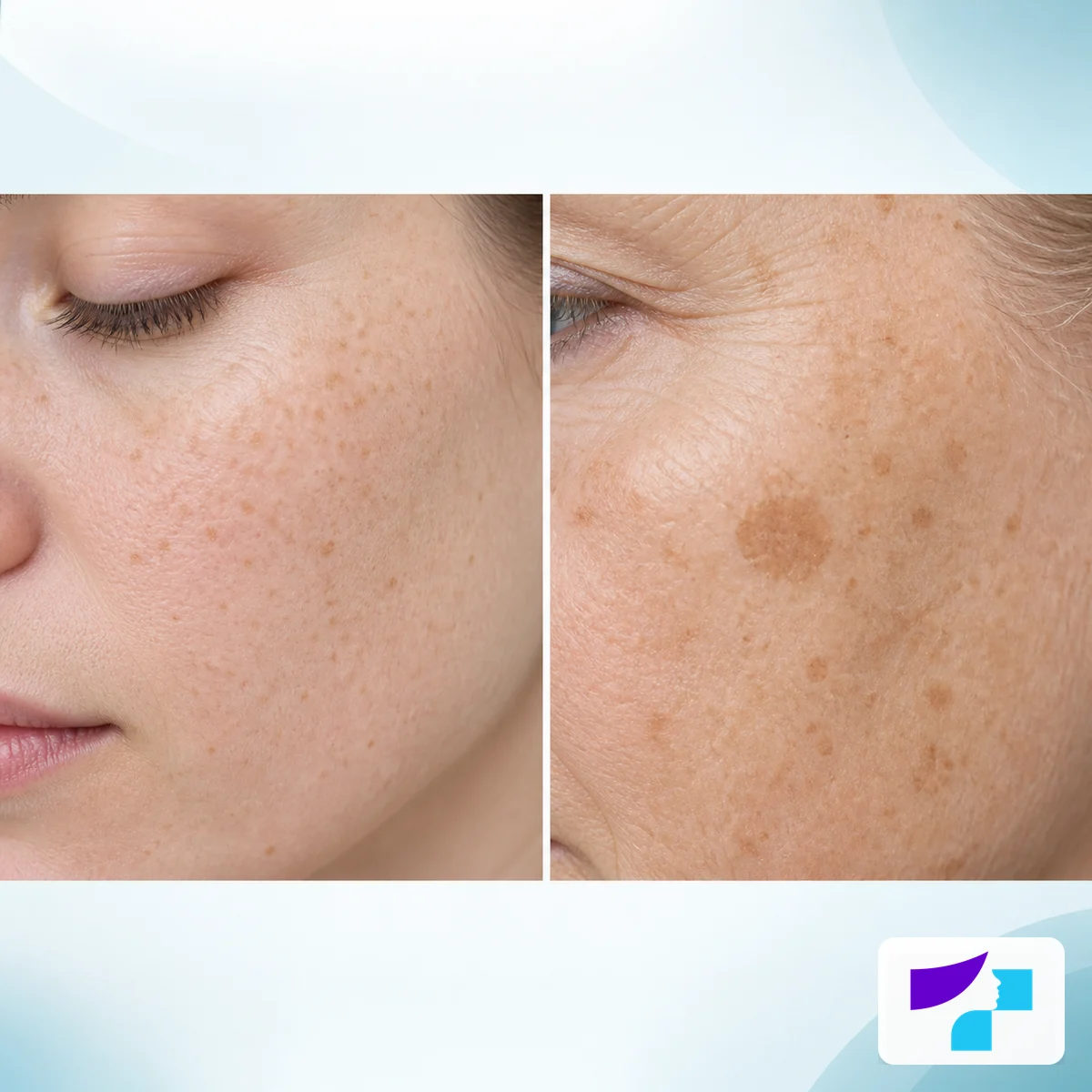
This visualisation shows the difference between small, seasonal freckles and larger, more persistent pigmented spots.
| Feature | Freckles | Pigmented spots / sunspots |
|---|---|---|
| Common onset | Childhood or young age | More often in adulthood |
| Appearance | Small, flat, multiple spots | May be larger and more clearly defined |
| Relation to the sun | Darken after UV exposure | Related to long-term UV exposure |
| Seasonality | May become lighter in winter | Often persist all year round |
| Location | Face, shoulders, arms, décolleté | Face, backs of the hands, shoulders, décolleté |
| Risk | Usually benign | Usually benign, but changes should be assessed |
This table is only a general guide. It is not always possible to determine from a description alone whether a spot is a freckle, sunspot, mole or another skin lesion.
Freckles or moles?
Freckles and moles are not the same. Moles, or melanocytic naevi, are skin lesions involving melanocytic cells. They may be flat or raised, light brown, dark brown, pink, skin-coloured or bluish. Moles may also occur in areas that are not regularly exposed to the sun.
Freckles are usually small, flat, multiple and more often located on sun-exposed areas. However, different pigmented lesions are not always easy to distinguish visually. In such cases, a dermatologist may use dermoscopy.
The ABCDE principle may help patients notice suspicious changes at home:
- A - asymmetry: one half looks different from the other;
- B - border: the edges are irregular, blurred or ragged;
- C - colour: several colours appear in one lesion or the colour changes;
- D - diameter: the lesion increases in size;
- E - evolution: the lesion changes over time in size, shape, colour, surface or sensation.
The ABCDE principle does not replace a dermatologist’s examination. If a pigmented lesion changes or seems unusual, it should be checked.
Freckles, melasma and sunspots
Freckles
Freckles are usually small, flat pigmented spots that often begin in childhood or young age. They become more prominent after sun exposure and may become lighter in winter.
Melasma
Melasma is another type of hyperpigmentation. It more often appears as broader, irregular brownish or grey-brown patches on the face, for example on the cheeks, forehead, upper lip or chin. Melasma is influenced by the sun, hormonal factors and individual predisposition. It is not the same as freckles.
Sunspots or solar lentigines
Sunspots more often appear in adulthood, especially on the face, backs of the hands, forearms, shoulders and décolleté. They are related to cumulative UV exposure and often persist throughout the year. They may be larger and more persistent than classic freckles.
Can freckles disappear on their own?
Classic freckles may become lighter in winter or when the skin is carefully protected from UV radiation. In some people, they become less noticeable with age.
However, complete spontaneous disappearance cannot be guaranteed. If the spots are solar lentigines, melasma or another type of hyperpigmentation, they are usually more persistent and do not fade as easily.
How can freckles be reduced?
Medical treatment for freckles is usually not necessary. They are benign and often represent a normal skin feature.
If a person wishes to reduce their appearance for aesthetic reasons, several approaches may be considered:
- regular photoprotection;
- pigmentation-reducing skincare products;
- topical treatments prescribed by a dermatologist;
- chemical peels;
- laser procedures or other light-based technologies.
Expectations should be realistic: freckles may be lightened, but complete and permanent removal is not always possible. Without sun protection, pigmentation may return or become darker in the next sunny season.
Creams and active ingredients for freckles
A cream for freckles usually means a product that helps reduce hyperpigmentation or even out skin tone. Such products may be useful, but they do not work the same way for everyone and are not an immediate solution.
Ingredients used in dermatology to reduce pigmentation include:
- vitamin C;
- niacinamide;
- azelaic acid;
- retinoids;
- AHA acids;
- kojic acid;
- arbutin;
- other pigmentation-modulating ingredients.
Results usually develop gradually over several weeks or months. If the skin becomes irritated, pigmentation may become more pronounced, especially in people prone to hyperpigmentation. Prescription products should be used only as directed by a doctor.
Why should aggressive home remedies not be used to bleach freckles?
Lemon juice, hydrogen peroxide, salt scrubs, onion, acidic products and other home remedies are still often mentioned online for bleaching freckles. These methods may seem harmless, but they can irritate the skin, damage the skin barrier and in some cases make pigmentation more pronounced.
Particular caution is needed with lemon juice and other acidic or photosensitising substances if the skin is then exposed to the sun. Irritation, redness or inflammation may lead to post-inflammatory hyperpigmentation - new or darker pigmented spots.
A safer approach is regular sun protection and dermatologically tested products suitable for the specific skin type.
Can freckles be removed with laser?
Laser procedures and other light-based technologies can reduce certain pigmented spots, including freckles or sunspots. However, the most suitable method depends on the type of spot, skin phototype, depth of pigmentation and diagnosis.
Before laser or intensive pigmentation treatment, it is important to make sure that the lesion is benign. Suspicious or changing pigmented lesions should not be treated cosmetically without medical assessment.
Possible risks include irritation, redness, post-inflammatory hyperpigmentation, hypopigmentation, incomplete results and recurrence of pigmentation. Careful sun protection is especially important after procedures.
How does a dermatologist assess freckles and pigmented spots?
A dermatologist evaluates not only the spot itself, but also the broader context:
- when the spots appeared;
- whether they are changing;
- whether they darken after sun exposure;
- whether there have been sunburns;
- the patient’s skin phototype;
- whether there is a family history of skin cancer;
- whether the patient has many moles;
- which medicines and skincare products are used;
- whether pregnancy, hormonal therapy or other melasma-related factors are relevant;
- how the spot looks clinically and, if needed, under dermoscopy.
Typical freckles can often be recognised clinically. If a lesion looks atypical, the dermatologist may recommend monitoring, digital dermoscopy, biopsy or removal with histological examination.
When should you see a dermatologist?
You should see a dermatologist if:
- a spot rapidly changes in size, shape or colour;
- a spot becomes asymmetrical;
- the borders become irregular;
- several colours appear within one lesion;
- the spot bleeds, hurts, itches, crusts or ulcerates;
- the lesion becomes raised or starts to look different from the others;
- a new dark spot appears in adulthood;
- there are many moles;
- there is a family history of melanoma or another skin cancer;
- the skin is very fair and there have been repeated sunburns;
- it is unclear whether the spot is a freckle, mole, melasma or another lesion.
If there is doubt, it is safer to have the lesion checked rather than wait until the changes become more obvious.
How can new freckles and pigmented spots be prevented?
The main basis of prevention is photoprotection - protecting the skin from UV radiation. This does not mean sunscreen alone.

This visualisation summarises the main photoprotection measures that help reduce freckle darkening and the formation of new pigmented spots.
Important measures include:
- avoiding the strongest midday sun;
- staying in the shade;
- wearing a wide-brimmed hat;
- using sunglasses;
- choosing clothing that covers the shoulders, arms and décolleté;
- using a broad-spectrum sunscreen;
- applying enough product;
- reapplying SPF after sweating, swimming or prolonged time outdoors;
- paying particular attention to the face, nose, cheeks, shoulders, arms and décolleté.
Sunscreen is only one part of photoprotection. It works best together with shade, clothing and avoiding excessive UV exposure.
Which SPF should be used if you have freckles?
People with freckles should choose broad-spectrum sun protection against both UVA and UVB radiation. The SPF number mainly describes protection against UVB, which is more closely related to sunburn, but UVA protection is also important in pigmentation.
It is important not only to choose an adequate SPF, but also to apply it generously and reapply it regularly. Even a very high SPF does not guarantee that freckles will not appear at all, but it helps reduce the darkening of existing spots and the formation of new pigmented spots.
Common myths about freckles
Myth: freckles are always dangerous
In reality, freckles are usually benign. What may be dangerous is a changing pigmented lesion that only looks like a freckle.
Myth: freckles and moles are the same
They are different types of pigmentation and skin lesions. Moles may be raised, larger and structurally different.
Myth: freckles turn into melanoma
Classic freckles do not themselves turn into melanoma. However, melanoma may look like a pigmented spot, so changing lesions should be checked.
Myth: if you use SPF, freckles will never appear
SPF reduces the effect of UV radiation, but it does not guarantee complete prevention of pigmentation.
Myth: any bleaching cream can completely remove freckles
Creams may help reduce pigmentation, but results are gradual and not always complete.
Myth: freckles occur only in children
They often begin in childhood, but may also be visible in adults, especially after sun exposure.
Myth: freckles are only cosmetic, so the skin does not need protection
Freckles may indicate sun-sensitive skin, so sun protection is important.
Myth: all brown spots on the face are freckles
Brown spots may be freckles, sunspots, melasma, moles or other skin lesions.
Summary
Freckles are common, usually benign pigmented spots. Their visibility is influenced by genetics, skin type and UV radiation. They often become darker in summer and lighter in winter.
Freckles are not the same as moles, melanoma, melasma or sunspots. Therefore, changing, bleeding, painful, itchy or atypical pigmented lesions should be checked by a dermatologist. The main basis of prevention is regular photoprotection - shade, clothing, a hat, sunglasses and broad-spectrum SPF.
References and authoritative sources
- DermNet: brown spots, lentigines and freckles
- DermNet: solar lentigo and sunspots
- DermNet: dermoscopy of benign melanocytic lesions
- American Academy of Dermatology Association: ABCDE signs of melanoma
- American Academy of Dermatology Association: signs and symptoms of moles
- Cleveland Clinic: freckles, causes and treatment options
