Melasma is an acquired skin pigmentation disorder that most often appears as symmetrical brownish, grey-brown or darker patches on the face. It is not skin cancer, an infection or an allergy, but melasma can be long-lasting, recurrent and can significantly affect a person’s wellbeing. The aim of melasma treatment is usually not a one-time “complete cure”, but control of pigmentation, reduction of patches and lowering the risk of recurrence.
What is melasma?
Melasma is a chronic form of hyperpigmentation in which the pigment-producing cells of the skin — melanocytes — become overly active and produce more melanin in certain areas of the skin. Melanin is the pigment that gives skin its colour and helps protect it from ultraviolet radiation.
In melasma, pigment accumulates unevenly. This is why brown, grey-brown or darker patches appear on the skin. Melasma most often develops on the face: the forehead, cheeks, nose, chin, jawline and the area above the upper lip.
Melasma itself is not a malignant skin tumour. However, not every brown patch on the face is melasma. If a pigmented patch changes, becomes asymmetrical, bleeds, ulcerates, itches, hurts or looks different from other skin lesions, it should be examined by a dermatologist.
Why is melasma also called chloasma or the mask of pregnancy?
Melasma is sometimes called chloasma. When pigmentation appears during pregnancy, it is often referred to as the “mask of pregnancy” because the patches often appear symmetrically in the central part of the face.
During pregnancy, oestrogen and progesterone levels change, and these hormonal changes can increase melanocyte activity. If sun exposure, visible light or genetic predisposition are also present, melasma may become more pronounced.
In some women, melasma improves after childbirth, while in others it persists for longer or recurs. During pregnancy and breastfeeding, treatment must be chosen especially carefully, as several pigment-reducing treatments are not suitable during this period.
What does melasma look like on the face?
Melasma usually appears as flat, irregularly shaped but often symmetrical areas of pigmentation. They may be light brown, dark brown, grey-brown or bluish-grey.
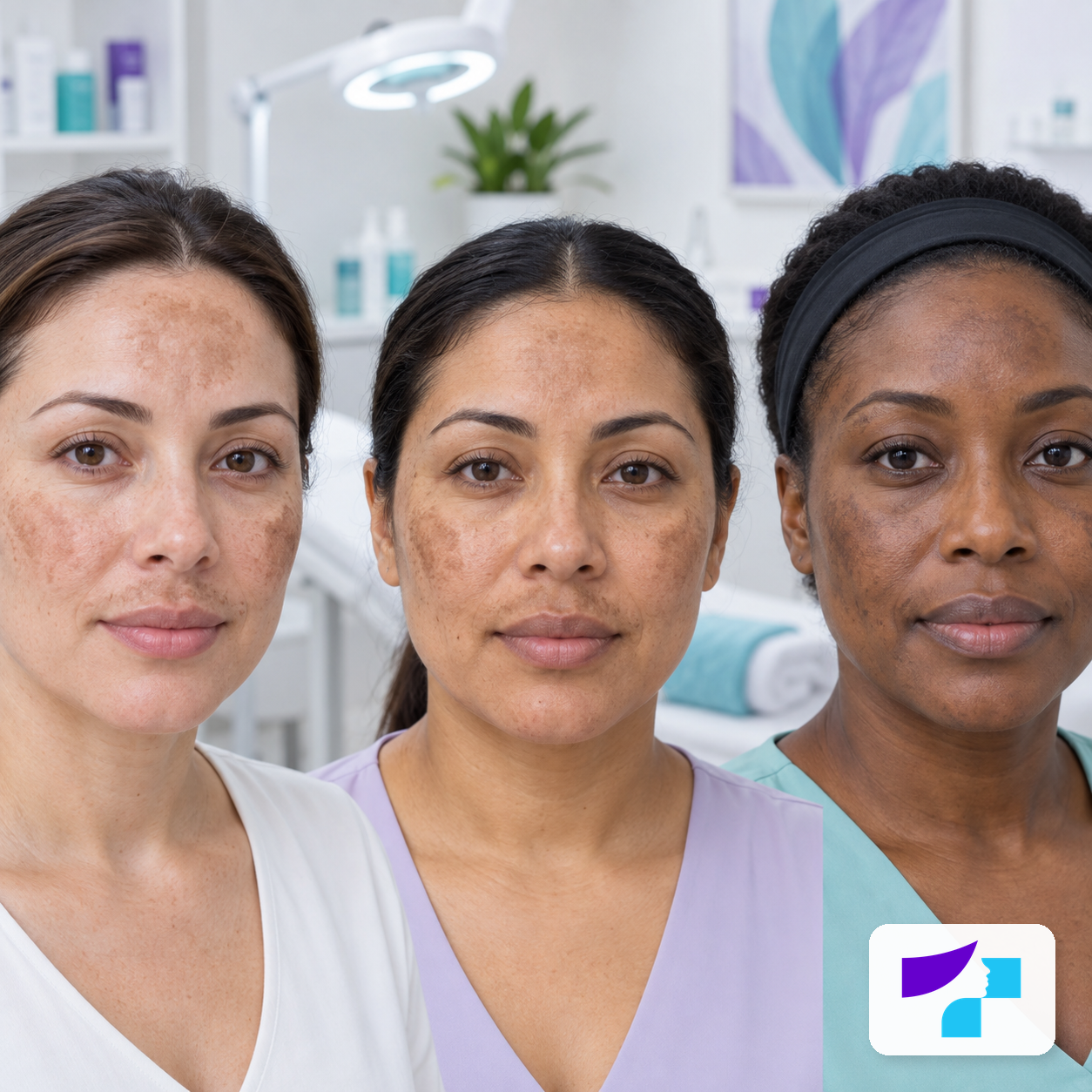
The image shows that melasma can look different depending on skin tone: on lighter skin it is often light to medium brown, while on darker skin the pigmentation may appear more pronounced, darker or greyish.
Common locations include:
- cheeks;
- forehead;
- area above the upper lip;
- bridge of the nose;
- chin;
- jawline.
On lighter skin, melasma is more often seen as light to medium brown patches. On darker skin, it may be dark brown, greyish or more contrasting. Melasma usually does not itch, hurt, bleed or form crusts.
Why does melasma develop?
Several factors usually contribute to the development of melasma at the same time. It is not a sign of poor hygiene, an infection or an allergy. The most common triggers are sun exposure, visible light, hormones, genetic predisposition, skin phototype, irritation and sometimes medicines or cosmetic products.
| Factor | How it can affect melasma |
|---|---|
| UV radiation | Activates melanocytes and increases pigment production. |
| Visible light | May worsen hyperpigmentation, especially in darker skin phototypes. |
| Hormones | Pregnancy, hormonal contraception or hormone therapy may contribute to melasma. |
| Genetics | Melasma is more common in people with a family history of similar pigmentation. |
| Skin phototype | More common in medium to darker skin tones. |
| Inflammation and irritation | Aggressive skincare or procedures may worsen pigmentation. |
| Heat | In some people, heat may intensify facial pigmentation. |
The role of the sun, visible light and tanning beds
The sun is one of the most important factors that worsens melasma. UVA and UVB radiation stimulate melanin production, which is why melasma often becomes darker in summer, after sunbathing or after prolonged time outdoors.
Visible light is also important, especially visible sunlight and short-wavelength blue light. In people with darker skin phototypes, it may contribute to more persistent pigmentation. This is why tinted sunscreen with iron oxides is often recommended for melasma, as it can provide better protection against visible light than transparent SPF.
There is no convincing evidence that everyday phone or computer screens by themselves significantly worsen melasma. The main practical focus remains protection from the sun, avoiding tanning beds and using daily photoprotection.
Tanning beds are not a safe alternative to sunlight. They can intensify pigmentation and interfere with melasma treatment results.
Is melasma dangerous?
Typical melasma is not dangerous and does not turn into skin cancer. It is not infectious and is not contagious. However, pigmented patches may resemble other skin diseases and lesions, including conditions that require dermatological assessment.
A dermatologist consultation is needed if a patch:
- grows quickly;
- changes colour;
- becomes asymmetrical;
- has irregular borders;
- becomes multicoloured;
- bleeds or ulcerates;
- itches, hurts or becomes tender;
- becomes raised;
- looks different from other skin lesions;
- appears as a new atypical patch in adulthood.
In these cases, it is important not to rely on self-diagnosis.
How to distinguish melasma from other pigmentation patches?
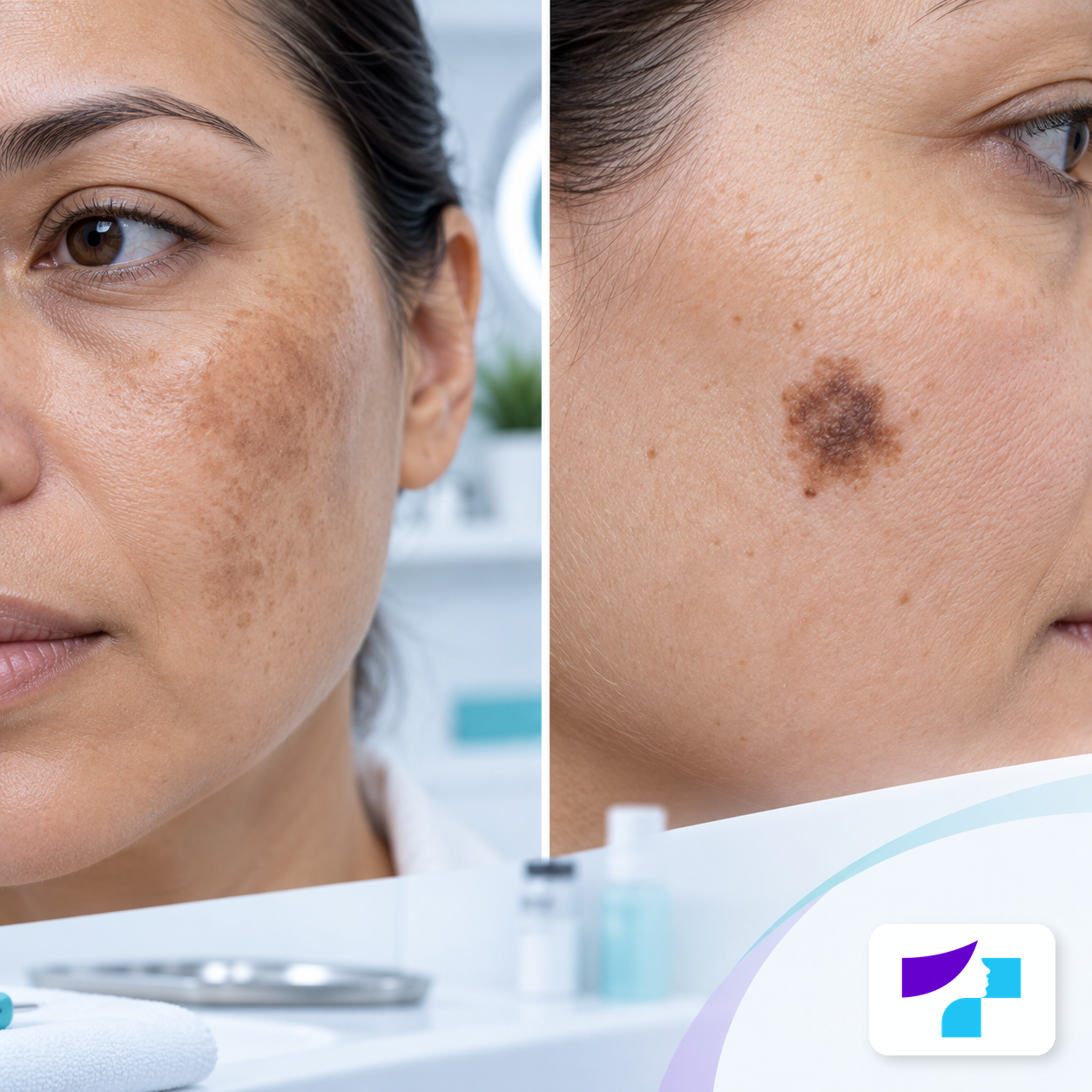
The image compares typical diffuse facial pigmentation that may be consistent with melasma with a darker and more irregular pigmented lesion. If a patch changes, becomes asymmetrical, multicoloured, bleeds, ulcerates, hurts or itches, it should be shown to a dermatologist.
| Condition | Typical feature | How it differs from melasma |
|---|---|---|
| Melasma | Symmetrical brownish patches on the face. | Often linked to hormones, UV radiation and visible light. |
| Solar lentigo or sunspots | Separate sun-induced pigmentation spots. | Usually more clearly defined and related to chronic sun damage. |
| Freckles | Small spots that become more visible in summer. | Often begin in childhood and may fade in winter. |
| Post-inflammatory hyperpigmentation | Pigment after acne, trauma, inflammation or a procedure. | Related to previous skin injury or inflammation. |
| Mole | A pigmented lesion that may be flat or raised. | Must be assessed by shape, borders, colour and change over time. |
| Seborrhoeic keratosis | Often rough, raised and “stuck-on” in appearance. | Usually has a textured surface. |
| Actinic keratosis | Rough, scaly sun-damaged lesion. | May be a precancerous lesion. |
| Lentigo maligna or melanoma | Changing, atypical pigmented lesion. | Requires assessment by a dermatologist. |
| Pigmented contact dermatitis | Pigmentation after irritation or an allergen. | Related to an inflammatory skin reaction. |
| Drug-induced hyperpigmentation | Pigmentation after the use of certain medicines. | Requires assessment of medication history. |
It is especially important to distinguish melasma from lentigo maligna and melanoma, as these conditions may look like an uneven pigmented patch.
How does a doctor diagnose melasma?
A dermatologist can often recognise melasma based on its clinical appearance, location and medical history. During the visit, the doctor assesses:
- the symmetry of pigmentation;
- colour and borders;
- whether the patch is flat or raised;
- sun exposure habits;
- pregnancy or hormone therapy;
- use of contraception;
- previous creams and procedures;
- possible skin irritation.
Dermoscopy helps examine pigmentation under magnification. A Wood’s lamp may sometimes help assess pigment depth, but it is not always necessary and does not always provide a completely reliable answer. A biopsy is usually not needed in melasma, but it may be performed if the diagnosis is unclear or another skin disease is suspected.
Can melasma go away on its own?
In some cases, melasma may improve on its own, especially if it appeared during pregnancy or after a specific hormonal trigger. However, melasma is often chronic and recurrent.
It may become lighter in winter and darker in summer. Even after successful treatment, pigmentation may return if the skin is exposed again to sunlight, visible light, tanning beds or irritating procedures.
How is melasma treated?
Melasma treatment is usually gradual. The first step is daily photoprotection. Without it, creams and procedures often produce incomplete or short-lived results.
Treatment goals include:
- reducing excessive pigment production;
- evening out skin tone;
- protecting the skin from repeated pigmentation;
- reducing the risk of recurrence;
- avoiding irritation and post-inflammatory hyperpigmentation.
| Method | Who it may help | Limitations and risks |
|---|---|---|
| Broad-spectrum SPF 30/50 | All patients with melasma. | Must be used daily and in sufficient quantity. |
| Tinted SPF with iron oxides | Especially melasma affected by visible light. | A suitable shade and texture need to be found. |
| Azelaic acid | To reduce pigmentation, including in more sensitive skin. | May irritate; results are usually gradual. |
| Vitamin C, niacinamide | As additional agents for skin tone. | Usually not enough as the only treatment. |
| Retinoids | To regulate skin cell renewal. | Not suitable during pregnancy; may irritate. |
| Hydroquinone | One of the most effective agents in selected patients. | Only under medical supervision and for a limited time. |
| Triple combination therapy | Some patients with more pronounced melasma. | Prescription treatment; medical monitoring is required. |
| Tranexamic acid | Selected patients. | Thrombosis risks and contraindications must be assessed. |
| Chemical peel | Some patients as an adjunct treatment. | May irritate and cause post-inflammatory hyperpigmentation. |
| Laser/IPL | Selected cases. | May worsen melasma, especially in darker skin. |
Creams and active ingredients for melasma
Topical treatments can help reduce pigmentation, but results usually appear gradually over several weeks or months.
Commonly used active ingredients include:
- azelaic acid;
- hydroquinone;
- retinoids, such as tretinoin;
- vitamin C;
- niacinamide;
- cysteamine;
- topical forms of tranexamic acid;
- combined formulas prescribed by a dermatologist.
Hydroquinone can be effective, but it should only be used according to a doctor’s instructions and for a limited time. Incorrect or prolonged use may cause irritation, post-inflammatory hyperpigmentation and, rarely, exogenous ochronosis — persistent bluish-grey pigmentation.
Unknown “bleaching” creams should be avoided, especially if purchased from unreliable sources. They may contain inappropriate doses of hydroquinone, strong corticosteroids or other substances that can damage the skin.
Tranexamic acid in melasma treatment
Tranexamic acid is used in melasma treatment in different forms — topically, in combination with procedures or, in selected cases, orally. It may help some patients, but it is not suitable for everyone.
Oral tranexamic acid should only be considered under medical supervision. Before use, the risk of thrombosis, blood clotting disorders, cardiovascular disease, pregnancy, breastfeeding, smoking and the use of oestrogen-containing contraception must be assessed.
Laser therapy, IPL and chemical peels
Procedures must be chosen carefully in melasma. Unlike separate sunspots, melasma is chronic and prone to recurrence. An overly aggressive procedure may cause inflammation and worsen pigmentation.
Possible risks include:
- skin irritation;
- burns;
- post-inflammatory hyperpigmentation;
- hypopigmentation;
- uneven results;
- recurrence;
- risk of scarring if the procedure is performed incorrectly.
In darker skin phototypes, the risk of procedures is higher, so treatment should preferably be planned with a specialist experienced in treating pigmentation disorders.
SPF and tinted sunscreen in melasma
Sun protection is the foundation of melasma control. A broad-spectrum SPF 30 or SPF 50 that protects against UVA and UVB radiation is recommended. In melasma, SPF 50 is often preferred.
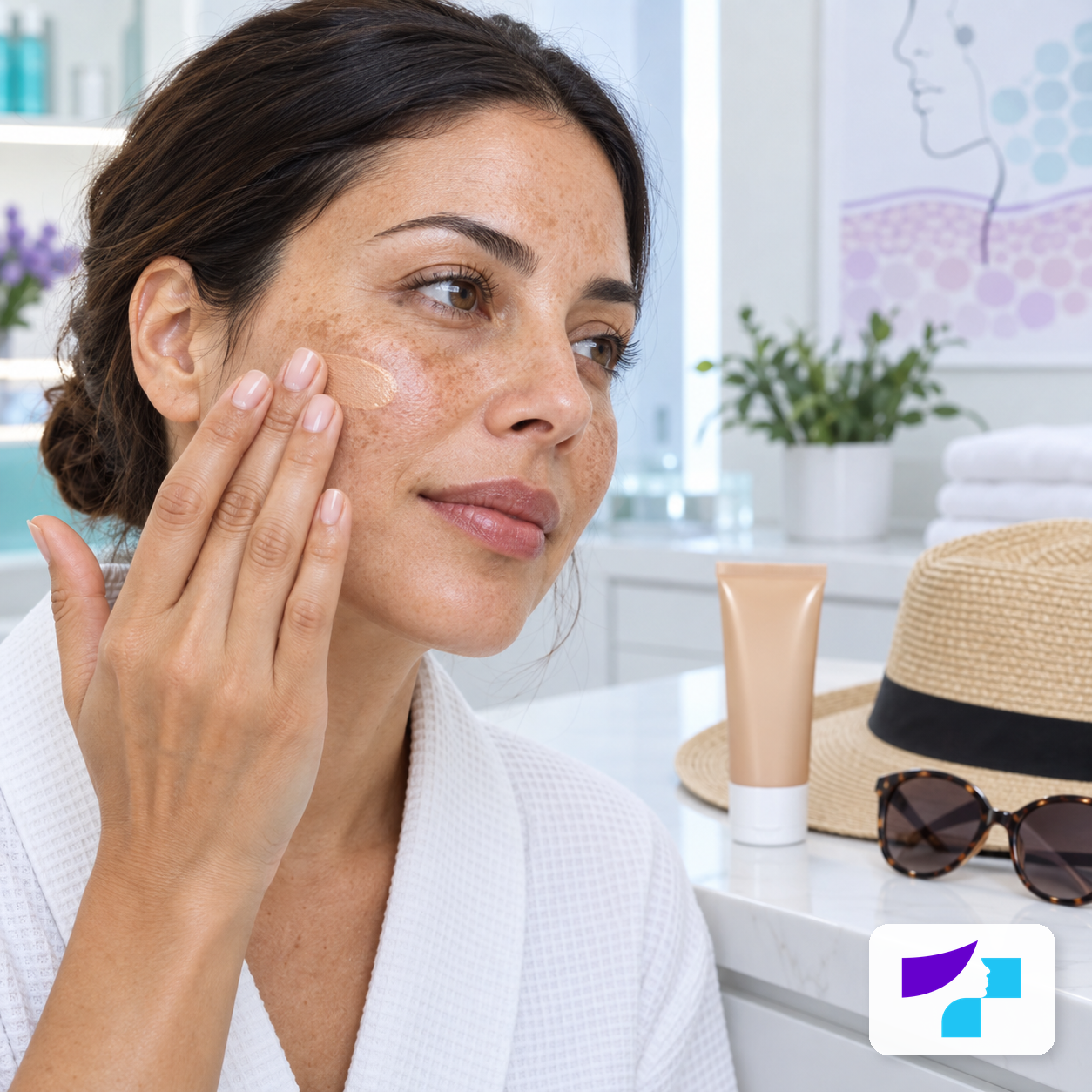
The image shows daily photoprotection in melasma: applying tinted sunscreen, together with additional protection such as a hat and sunglasses.
Practical recommendations:
- use SPF every day, including on cloudy days;
- apply a sufficient amount;
- reapply every 2–3 hours when outdoors;
- reapply after sweating, swimming or wiping the face;
- choose tinted SPF with iron oxides if you have melasma;
- wear a broad-brimmed hat;
- avoid direct midday sun;
- do not use tanning beds.
SPF can help prevent melasma from worsening and reduce the formation of new pigmentation patches. SPF alone does not always fade existing patches, but without it treatment is usually less effective.
Psychological impact and quality of life
Melasma is not life-threatening, but it can be emotionally difficult. Facial pigmentation is visible in daily life, and people may experience reduced self-confidence, anxiety, a desire to hide the skin with makeup or avoidance of social situations.
This impact is real and should not be dismissed as “only cosmetic”. The role of the dermatologist is not only to rule out dangerous skin lesions, but also to help choose a safe, realistic and sustainable long-term treatment plan.
What should you not do if you have melasma?
In melasma, you should avoid:
- bleaching the skin with lemon, baking soda, acids or other home remedies;
- using prescription medicines without medical advice;
- buying unknown bleaching creams;
- overusing scrubs, peels or acids;
- undergoing aggressive procedures without a diagnosis;
- using tanning beds;
- relying only on makeup without SPF;
- continuing products that burn, sting or irritate the skin for a long time.
Skin irritation can worsen hyperpigmentation. In melasma care, a gentle, consistent and long-term approach often works best.
How to reduce the risk of melasma recurrence?
Melasma recurrence cannot always be completely prevented, but the risk can be reduced.
Important steps include:
- using broad-spectrum SPF every day;
- choosing tinted SPF with iron oxides;
- avoiding tanning beds;
- using gentle skincare;
- reducing skin irritation;
- agreeing on maintenance treatment with a dermatologist;
- strengthening photoprotection in summer;
- photographing pigmentation to monitor changes;
- checking atypical patches in good time.
How to prepare for a dermatologist visit?
Before the visit, it is useful to prepare:
- when the pigmentation appeared;
- whether it changes in summer and winter;
- whether there has been pregnancy;
- whether you use hormonal contraception or hormone therapy;
- which creams and procedures you have tried;
- which SPF you use;
- whether the patches itch, hurt, bleed or change;
- whether similar pigmentation problems run in the family.
If possible, bring earlier photographs. They help assess changes in pigmentation over time.
Common myths about melasma
Is melasma only a pregnancy-related problem?
No. Pregnancy is a common trigger, but melasma can also occur without pregnancy.
Does melasma mean skin cancer?
No. Melasma is not skin cancer, but atypical pigmented lesions should be checked.
Can melasma turn into melanoma?
Typical melasma does not turn into melanoma. However, melanoma may resemble a pigmented patch.
Does melasma always disappear after childbirth?
No. In some women it improves, while in others it persists.
Is ordinary SPF enough?
Not always. In melasma, tinted SPF with iron oxides is often useful.
Is hydroquinone safe for everyone?
No. It should only be used under medical supervision.
Can vitamin C alone cure melasma?
No. It may help as an additional ingredient, but it is usually not enough on its own.
Does laser always help melasma?
No. Laser may help some patients, but it may also worsen pigmentation.
Is treatment riskier for darker skin?
For some procedures, yes, because the risk of post-inflammatory hyperpigmentation is higher.
Is SPF needed in winter too?
Yes. UVA and visible light may be relevant throughout the year.
Summary
Melasma is a common, usually benign but chronic pigmentation disorder. It most often affects the face and is linked to UV radiation, visible light, hormones, pregnancy, genetics and skin phototype. Melasma is not cancer, an infection or an allergy, but not every brown patch is melasma. A safe approach starts with an accurate diagnosis. Treatment usually requires patience, daily SPF, tinted photoprotection and a dermatologist-tailored plan.
Medical disclaimer
This information is for educational purposes and does not replace a dermatologist consultation, diagnosis or treatment. Any new, changing, bleeding, ulcerating, painful, itchy, asymmetrical or multicoloured pigmented lesion should be shown to a dermatologist. Do not try to bleach or treat pigmentation patches yourself with unverified remedies, prescription medicines without medical advice or aggressive procedures.
References and authoritative sources
- DermNet: medical information about melasma, its causes, diagnosis and treatment
- NCBI Bookshelf, StatPearls: overview of melasma diagnosis, risk factors and treatment
- British Association of Dermatologists: patient information about melasma
- Primary Care Dermatology Society: patient information about melasma and self-care
- American Academy of Dermatology: melasma overview for patients
- American Academy of Dermatology: causes and risk factors of melasma
- American Academy of Dermatology: melasma diagnosis and treatment
- American Academy of Dermatology: melasma self-care and sun protection
- Cleveland Clinic: patient information about melasma
- American College of Obstetricians and Gynecologists: skin changes during pregnancy
