Allergic contact rashes are signs of skin inflammation that may appear after contact with cosmetics, jewellery, hair or nail products, adhesives, gloves or other substances. The skin may become itchy, swollen, dry, scaly or covered with small blisters, and the reaction may begin only after several hours or days.
Similar rashes may also be caused by skin irritation, atopic dermatitis, hives, infection or another skin condition. This is why the appearance of a rash alone cannot reliably prove that its cause is allergy.
What are allergic contact rashes?
“Allergic contact rashes” is a patient-friendly descriptive term for rashes that appear after the skin has come into contact with a particular substance or product. Medically, such symptoms may be related to allergic contact dermatitis — a delayed inflammatory skin reaction to a substance to which the body has previously become sensitised.
However, not every rash that appears at a contact site is allergic. It may also be caused by:
- direct skin irritation
- frequent washing
- disinfectants and cleaning products
- friction or pressure
- sweat and prolonged moisture
- a flare of atopic dermatitis
- hives
- fungal, bacterial or viral infection
- a medicine applied to the skin
- another inflammatory skin condition.
Allergic and irritant contact dermatitis can look very similar and may sometimes occur at the same time. Contact dermatitis is not contagious and is not passed from one person to another.
For more detail on how contact allergy develops, common contact allergens, diagnosis and patch testing, see the Medart article Allergic contact dermatitis.
What do allergic contact rashes look like?
The appearance of a contact rash can vary considerably. It depends on the severity of the reaction, duration of contact, body site, the specific substance and the condition of the skin barrier.
Possible signs include:
- itching
- changes in skin colour
- swelling
- burning or stinging
- small fluid-filled blisters
- weeping
- crusting
- dry and rough skin
- scaling or peeling
- painful cracks
- skin thickening in long-lasting inflammation.
Contact rashes are often most prominent where the skin touched the product or object. However, inflammation may extend beyond the direct contact area, and a substance can be transferred to another body site by hands, hair, clothing or cosmetic tools.
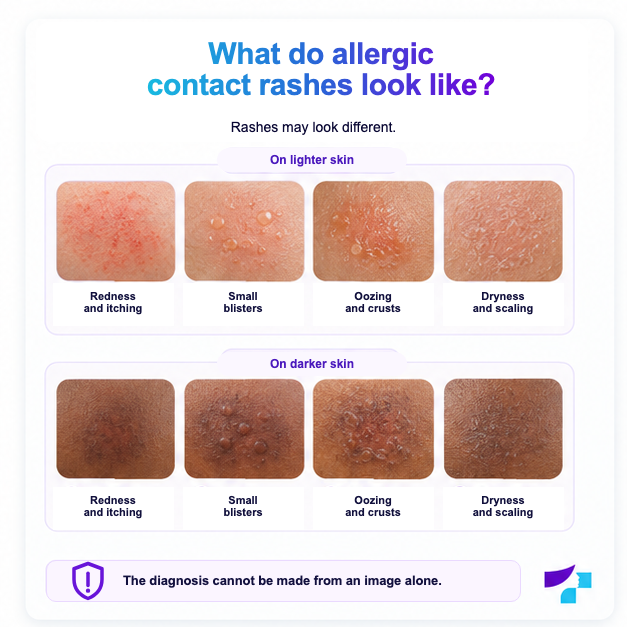
What does the rash look like on different skin tones?
On lighter skin, inflammation often looks pink or red. On darker skin, it may look violet, greyish, dark brown or simply darker than the surrounding skin. Redness may be less visible on darker skin, so it is important to assess itching, swelling, surface changes, blisters, scaling and cracks as well.
After inflammation improves, the affected area may remain darker or lighter than the surrounding skin for some time.
Signs of an acute contact rash
In an acute reaction, the skin may become markedly itchy, swollen and inflamed. Possible signs include:
- small blisters
- weeping
- crusting
- burning
- skin tenderness or soreness.
Signs of long-lasting or recurrent contact rashes
If contact with the trigger continues or inflammation keeps recurring, the skin may become:
- dry
- rough
- scaly
- thickened
- cracked
- painful.
Long-lasting inflammation and scratching damage the skin barrier, so the skin may also become more sensitive to water, soaps and other everyday irritants.
How quickly can a rash appear after contact?
Allergic contact dermatitis is usually a delayed reaction. A rash may appear after several hours, the next day or several days after contact. This means the possible trigger is not always the last product applied to the skin.
An irritant reaction may start immediately after exposure to a strong chemical or develop gradually after repeated contact with weaker irritants such as soap, water or disinfectants.
Contact urticaria and other immediate allergic reactions usually begin within minutes or hours. They may cause raised, changing hives and rapid swelling.
The timing of the reaction helps the doctor assess the possible cause, but timing alone does not confirm the diagnosis.
Where do contact rashes appear?
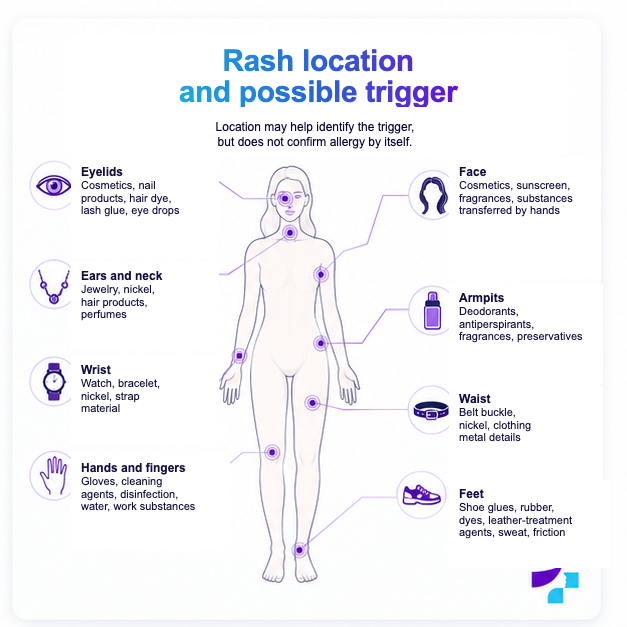
The location of the rash may provide clues about products, objects or workplace substances that regularly touch that area of skin. However, location alone cannot reliably identify the trigger.
Face
Facial rashes may be caused by:
- face creams
- make-up
- sunscreens
- cleansers
- fragrances
- hair-care products
- adhesives
- substances transferred by hands.
Not every reaction to cosmetics is allergic. Products containing acids, retinoids, scrubs, alcohol-based solutions or several active products used at the same time may cause direct irritation.
Eyelids and the area around the eyes
Eyelid skin is thin and sensitive. Rashes may be caused by:
- eye cosmetics
- facial skin-care products
- sunscreens
- eyelash glue
- eye drops or contact lens solutions
- hair dye
- nail polish, gel nails or acrylates
- fragrances
- airborne dust, sprays or plant particles.
The trigger is not always applied directly to the eye area. Residues from nail products, hair dye, fragrances or metals may be transferred to the eyelids by the fingers. Substances may also reach the face through hair or spread through the air.
Ears and neck
Rashes on the earlobes, behind the ears or on the neck may be related to:
- earrings
- necklaces
- nickel or other metals
- hair dye
- shampoos and conditioners
- hair styling products
- perfumes
- clothing details.
After hair colouring, the reaction may be more pronounced along the hairline, on the forehead, behind the ears, on the neck or on the eyelids.
Hands and fingers
Hand rashes are often related to:
- water
- soaps
- disinfectants
- cleaning products
- foods
- gloves
- metals
- cosmetics
- nail products
- chemicals used at work.
Hand dermatitis is very often caused or worsened by irritation rather than allergy. Frequent washing, wet work, sweating in gloves and insufficient drying damage the skin barrier. Damaged skin also becomes more vulnerable to irritants and possible contact allergens.
Wrists, fingers and waist
Rashes under a watch, bracelet, ring or belt buckle may be related to:
- nickel
- another metal
- watch strap material
- rubber
- leather
- sweat
- moisture
- friction
- soap or cosmetic residue trapped under the object.
For this reason, a rash under a ring or watch does not always mean a metal allergy.
Armpits
Armpit rashes may be caused by:
- deodorants
- antiperspirants
- fragrances
- preservatives
- shaving products
- textiles
- laundry detergent residues
- sweat and friction.
The armpit is a warm and moist skin area, so infection or another condition unrelated to contact allergy is also possible.
Feet
Rashes on the feet may be related to:
- shoe adhesives
- rubber
- textile dyes
- metal parts
- leather treatment chemicals
- chromium compounds
- sweat
- tight shoes
- friction and prolonged moisture.
Itchy, scaly foot rashes may also be caused by a fungal infection.
Rash under a plaster or medical device
The reaction may be caused by:
- plaster adhesive
- a preparation applied to the skin
- the material of a medical device
- moisture
- friction
- a prolonged occluded environment.
The shape of the rash may match the area of the plaster or adhesive, but this does not show whether the reaction is allergic or irritant.
Common triggers of contact rashes
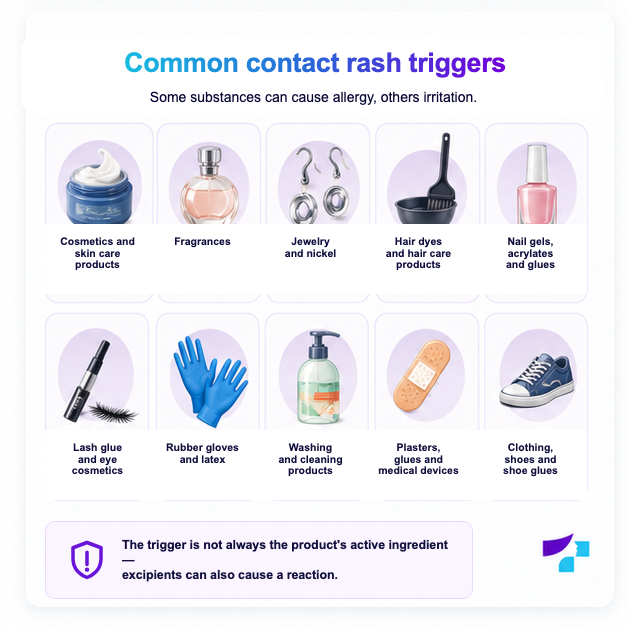
Cosmetics and skin-care products
Cosmetic products may cause both allergic and irritant reactions. Possible triggers include:
- fragrances
- preservatives
- colourants
- plant extracts
- essential oils
- sunscreen ingredients
- adhesives
- base ingredients and other excipients.
The reaction may be caused not by the advertised active ingredient, but by a preservative, fragrance, colourant or another excipient.
Labels such as “natural”, “for sensitive skin”, “dermatologically tested” or “hypoallergenic” do not guarantee that the product is free from a substance to which a particular person is sensitive.
Jewellery and metals
Nickel is one of the most common metal contact allergens. It may be present in:
- earrings
- necklaces
- rings
- watches
- bracelets
- belt buckles
- clothing fasteners
- metal parts of phones and other objects.
Cobalt, chromium compounds, metal coatings or other materials may also cause reactions.
Hair dyes and hair-care products
Rashes caused by hair dyes and hair-care products may appear:
- on the scalp
- along the hairline
- on the forehead
- on the ears
- on the eyelids
- on the face
- on the neck.
The rash may begin only the next day or later. If the face, lips or throat swell rapidly after hair colouring, or breathing problems occur, emergency medical help is needed.
Gel nails, acrylates and adhesives
Acrylates and methacrylates used in nail modelling may cause rashes:
- around the nails
- on the fingers
- on the palms
- on the eyelids
- on the face
- on the neck.
Residues can be transferred to other body sites by the fingers. Nail technicians have a higher occupational risk because they regularly come into contact with uncured nail materials.
Eyelash glue and eye cosmetics
Eyelash glue, mascara, eye shadows, eye creams and make-up removers can cause allergic or irritant dermatitis.
If there has been a marked reaction after eyelash extensions or glue use, the product should not be tried again at home.
Rubber gloves and latex
Rashes after glove use may have several causes:
- irritation from sweating, moisture and prolonged glove wearing
- delayed contact allergy to rubber additives
- an immediate allergic reaction to natural latex proteins.
Immediate latex allergy may cause hives, swelling of the eyes or face, runny nose, wheezing or breathing problems. This is different from delayed contact dermatitis.
Washing and cleaning products
Soaps, dishwashing liquids, surface cleaners, solvents and disinfectants most often cause direct skin irritation.
Some fragrances, preservatives or other ingredients in these products may also cause contact allergy.
Plasters, adhesives and medical devices
Rashes may be caused by adhesives, topical preparations, device materials or a moist, occluded environment.
If a medical device is needed for monitoring or treatment, it should not be stopped without advice. A healthcare professional can help choose an alternative fixation method or another solution.
Topical medicines
A medicine applied to the skin may also cause irritation or contact allergy to the active substance, preservative, fragrance or another excipient.
If the skin worsens after using a prescribed product, contact a doctor or pharmacist. Medicines should not be stopped without medical advice unless a severe or rapidly worsening reaction has started.
Clothing and shoes
Rashes may be promoted by:
- textile dyes
- metal details in clothing
- rubber
- shoe adhesives
- leather treatment chemicals
- sweat
- friction
- tight and damp clothing.
Workplace substances
Contact rashes are more common in professions with regular exposure to:
- water
- soaps and disinfectants
- gloves
- hair dyes
- nail products
- metals
- cement
- adhesives
- paints
- solvents
- food products.
Higher risk may occur in healthcare, cleaning, beauty work, hairdressing, nail care, construction, metalworking and food production.
A rash that appears in a work setting is not automatically an occupational disease. Its relationship with work is assessed by a doctor.
Why can a reaction start to a product that was previously well tolerated?
Contact allergy can develop gradually. A person may use the same product for months or years without a visible reaction and later become sensitive to one of its ingredients.
Other explanations are also possible:
- the manufacturer has changed the product formula
- the product is used more often or in a larger amount
- the skin has become drier or damaged
- another product has been added at the same time
- the reaction is caused by a preservative, fragrance, colourant or adhesive
- several products together irritate the skin excessively
- another skin condition has coincided with product use.
A previously well-tolerated product therefore does not necessarily remain safe for life.
Allergic contact rash or skin irritation?
| Feature | Possible allergic reaction | Possible skin irritation |
|---|---|---|
| Mechanism | Immune reaction to a specific substance | Direct damage to the skin barrier |
| Who can develop it? | A person who has become sensitised to that substance | Anyone, if exposure is strong, frequent or prolonged enough |
| Is previous contact needed? | Usually yes | No; a strong irritant may damage the skin on first exposure |
| Onset | Often after several hours or days | Immediately or gradually after repeated exposure |
| Common triggers | Nickel, fragrances, preservatives, hair dyes, acrylates, rubber additives and adhesives | Water, soaps, cleaning products, disinfectants, solvents, sweat and friction |
| Typical sensations | Often marked itching | More often burning, stinging, dryness or soreness, although itching may also occur |
| Rash borders | May extend beyond the direct contact area | Usually most pronounced exactly where exposure occurred |
| Diagnosis | Symptoms and contact history; patch tests may sometimes be needed | Assessment of symptoms and irritant exposure |
| Initial action | Stop using the suspected substance | Reduce irritant exposure and protect the skin |
In practice, the two conditions cannot always be distinguished by appearance. Allergic and irritant contact dermatitis may also occur together.
How to distinguish contact rashes from other rashes
Contact rash or hives?
Hives usually cause raised, itchy wheals that can quickly change shape and location. A single hive usually disappears relatively quickly, although a new one may appear elsewhere.
Inflammation caused by contact dermatitis usually remains in one place longer. Blisters, weeping, dryness, scaling and cracks may occur.
Sudden hives together with swelling of the face, tongue or throat and breathing problems may indicate a severe immediate allergic reaction.
For more information about types of allergy, hives, immediate reactions and allergy testing, see the Medart article Allergy.
Contact rash or atopic dermatitis?
Atopic dermatitis is a chronic inflammatory skin disease related to skin barrier problems and individual predisposition. Contact rashes may begin after contact with a specific external substance.
The two conditions can look similar and may occur at the same time. Atopic and dry skin is often more vulnerable to irritation.
For more detail about the symptoms, course and treatment of this disease, see the Medart article Atopic dermatitis.
Contact rash or fungal infection?
Fungal rashes may sometimes have a more clearly defined scaly edge, but their appearance can vary greatly. Infection often affects the feet, groin, skin folds or nails.
Using an unsuitable anti-inflammatory product can change the appearance of an infection and make diagnosis more difficult.
Contact rash or bacterial infection?
Possible bacterial infection may be suggested by:
- increasing pain
- warm skin
- pus
- yellowish crusts
- rapidly increasing redness or swelling
- fever
- worsening general wellbeing.
Scratching, weeping and cracks damage the skin barrier and increase the risk of secondary infection.
Contact rash or medication-related reaction?
Rashes caused by medicines taken by mouth or injection are often more widespread and not limited to a single contact site. A medicine applied to the skin, however, can cause local irritation or contact allergy.
Medicines should not be stopped without medical advice. A widespread, rapidly worsening reaction or mucosal involvement requires urgent medical assessment.
Contact rashes in children
Children can also develop allergic or irritant contact rashes. Possible contact sources include:
- wet wipes
- sunscreens
- skin-care products
- plasters and adhesives
- buttons and metal fasteners on clothing
- jewellery
- shoes
- cosmetics or fragrances transferred from an adult’s skin.
In children, similar symptoms may also be caused by atopic dermatitis, nappy-area irritation, fungal infection and other skin conditions. A child should be examined by a doctor if the rash is recurrent, widespread, weeping or unclear.
What to do if a rash appears after contact with a product
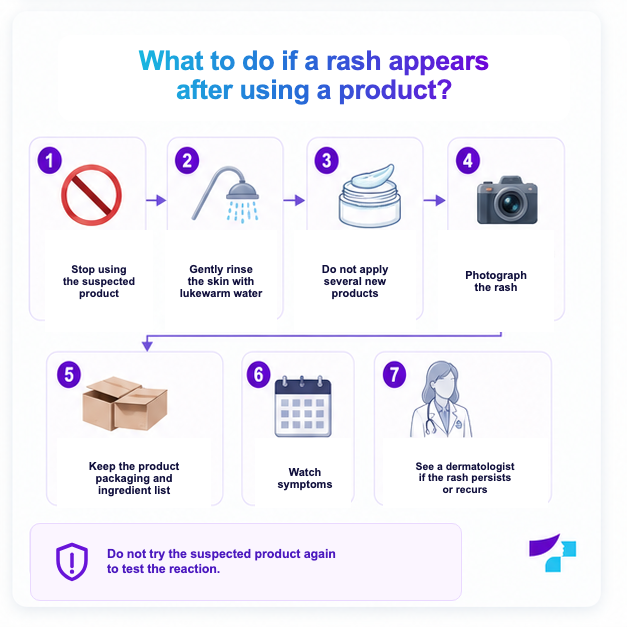
Stop using the suspected product
If a specific cosmetic product, piece of jewellery, hair or nail product, adhesive or other substance is suspected, stop using it.
Do not use the product again just to check whether the reaction returns.
Gently rinse the skin
If the product or substance may still be on the skin, rinse it gently with lukewarm water. Do not rub, scrub or wash the skin with harsh cleansers.
After exposure to a hazardous chemical, follow the product safety instructions and seek medical help immediately if needed.
Do not use several new products
Several new creams, serums, oils, essential oils or home remedies should not be applied to inflamed skin at the same time. This can worsen irritation and make it harder to identify the trigger.
Keep the product packaging
Keep:
- the product name
- the packaging
- the ingredient list
- the date of use
- information about when the reaction started.
This information may be important during a dermatologist consultation.
Photograph the rash
The rash may change before the doctor sees it. Photograph the skin in good light:
- at the start of the reaction
- after one or two days
- if the rash spreads or changes.
Protect the skin
While the skin is inflamed, it is advisable to avoid:
- hot water
- scrubs and peels
- products containing fragrances
- alcohol-based products
- tight clothing
- friction
- scratching
- prolonged moisture
- repeated contact with the suspected substance.
A cool compress may temporarily reduce itching and discomfort.
When can an emollient help?
A simple fragrance-free emollient can help reduce dryness and support skin barrier repair.
Moisturisers may also contain fragrances, preservatives or other ingredients that cause irritation or contact allergy in some people. If burning, itching or swelling worsens after applying a product, stop using it.
Do antihistamines help?
Antihistamines may reduce itching in some people, especially if there are also signs of hives. However, they do not remove contact with the trigger and do not always significantly reduce the skin inflammation caused by contact dermatitis.
Ask a doctor or pharmacist about the most appropriate treatment.
What should not be done with contact rashes?
- Do not reuse a product that caused a marked reaction.
- Do not perform uncontrolled challenge tests at home.
- Do not apply undiluted chemicals to the skin.
- Do not try several new products on damaged skin.
- Do not use essential oils as a universal “natural treatment”.
- Do not rub or scrub inflamed skin.
- Do not pierce blisters.
- Do not use prescription anti-inflammatory medicines for a long time without medical instructions.
- Do not use strong medicated products on the face or eyelids without consultation.
- Do not stop prescribed medicines without medical advice.
- Do not diagnose the rash only from an image found online.
- Do not assume that “natural” or “hypoallergenic” guarantees safety.
- Do not throw away the product packaging before saving the ingredient list.
When can a contact rash be watched at home for a short time?
A mild, localised reaction may be watched at home for a short time if:
- use of the suspected product has been stopped
- the rash is not spreading
- there is no marked swelling of the face or eyelids
- there is no pus, fever or increasing pain
- there are no breathing problems
- there are no large blisters or extensive weeping
- general wellbeing is good.
Home observation does not replace a dermatologist consultation if symptoms do not improve, recur regularly or the possible trigger is unclear.
When should a rash not be treated only at home?
See a doctor if:
- the rash is widespread or spreading quickly
- the face or eyelids swell markedly
- large blisters form
- there is marked weeping
- deep or painful cracks appear
- pus or yellowish crusts appear
- pain or skin warmth increases
- fever appears
- the rash affects the eyes, mouth or genital area
- symptoms significantly disturb sleep, work or everyday activities
- the reaction does not improve after removing the possible trigger
- the rash keeps recurring
- the possible cause cannot be identified
- the rash may be related to work.
Contact dermatitis can significantly affect sleep, hand function, everyday activities, work, emotional wellbeing and social life.
When is urgent or emergency help needed?
Allergic contact dermatitis is usually a delayed skin reaction. However, emergency medical help should be sought immediately if any of the following occur:
- difficulty breathing
- wheezing
- rapid swelling of the lips, tongue or throat
- rapidly increasing facial swelling
- fainting
- confusion
- marked weakness
- severe eye injury or vision problems
- a widespread reaction after exposure to a hazardous chemical
- rapid worsening of general condition.
These signs may indicate an immediate allergic reaction, chemical injury or another emergency, not only localised contact dermatitis.
When should you see a dermatologist?
A dermatologist consultation is recommended if:
- the rash recurs
- inflammation does not clear or keeps returning
- the possible trigger is unclear
- the rash is widespread
- the rash affects the face or eyelids
- blisters, weeping or painful cracks appear
- infection is suspected
- the rash interferes with work, sleep or everyday activities
- the reaction may be related to the workplace
- there is suspicion of allergy to cosmetics, hair dye, acrylates, adhesives or rubber additives
- more detailed contact allergy diagnosis may be needed.
A dermatologist assesses the appearance and location of the rash, the timing of symptoms, products used, workplace exposures and other possible skin disease causes. If allergic contact dermatitis is suspected, the doctor may consider patch testing.
For more detail about patch tests, interpretation of results and the clinical relevance of a confirmed contact allergen, see the Medart article Allergic contact dermatitis.
How to prepare for a dermatologist consultation
- Write down when the rash started.
- Recall which products were used one to several days before the reaction.
- Photograph the rash at different stages.
- Keep the suspected product packaging.
- Prepare complete ingredient lists.
- List cosmetics, hair and nail products used.
- Note cleaning and washing products.
- Tell the doctor about gloves and work materials.
- Note whether symptoms improve on days off or during holidays.
- Tell the doctor about all medicines used.
- Mention previous allergic reactions.
- Do not stop prescribed treatment without medical advice.
How to reduce the risk of recurrent contact rashes
- Do not use a product that has repeatedly caused a marked reaction.
- Check product ingredients if a specific contact allergen has been identified.
- Keep packaging of suspected products.
- Choose simpler, fragrance-free skin-care products.
- Introduce only one new cosmetic product at a time.
- Wash hands gently and dry them thoroughly.
- Change damp gloves in good time.
- Choose protective gloves suitable for the task.
- Clean cosmetic tools regularly.
- Do not perform uncontrolled allergy tests at home.
- See a dermatologist if reactions recur.
Medical disclaimer
The information in this article is intended for informational and educational purposes only and does not replace a dermatologist consultation, diagnosis or treatment. Rashes that appear at a contact site may be related to an allergic reaction, skin irritation, atopic dermatitis, infection or another skin condition, so the diagnosis cannot be made reliably from a symptom description or image alone. If the rash is widespread, recurrent, persistent, affects the face or eyes, is painful, weeping, purulent or associated with breathing problems and swelling of the face or throat, medical or emergency assessment is needed.
References and authoritative sources
- European Academy of Dermatology and Venereology — patient guide to contact dermatitis, its signs, causes and diagnosis.
- British Association of Dermatologists — information about allergic and irritant contact dermatitis.
- American Academy of Dermatology — signs and symptoms of contact dermatitis.
- American Academy of Dermatology — diagnosis and treatment principles for contact dermatitis.
- DermNet — medical overview of allergic contact dermatitis.
- DermNet — possible causes of eyelid contact dermatitis and indirect allergen transfer.
- DermNet — contact allergy to acrylates.
- DermNet — allergic contact dermatitis in children.
- Children’s Clinical University Hospital portal “Vesela pasaule” — allergic contact dermatitis.
Content author:
