Impetigo is a common, highly contagious bacterial skin infection. It most often affects children, especially preschool-aged children, but babies, teenagers and adults can also develop impetigo. A typical sign is small sores, blisters or weeping skin lesions that quickly become covered with yellow-brown or honey-coloured crusts. Impetigo is most often seen on the face, around the nose and mouth, but it may also appear on the hands, legs and other areas of the body.
Although impetigo is usually not dangerous, it can spread quickly to other areas of the skin and to other people. Early recognition, proper skin care, hygiene and treatment prescribed by a doctor are therefore important. Extra caution is needed in babies, people with weakened immunity, patients with diabetes, widespread infection, lesions near the eyes or recurrent impetigo.
In Brief: Key Facts About Impetigo
- Impetigo is a bacterial skin infection, not an allergy or simple skin irritation.
- The most common causes are Staphylococcus aureus and Streptococcus pyogenes.
- Impetigo is highly contagious and spreads easily through hands, skin contact, towels, clothing, bedding and toys.
- A typical sign is weeping sores or blisters that become covered with yellowish, honey-coloured crusts.
- In children, impetigo often starts around the nose and mouth, especially after a runny nose, scratching, eczema or insect bites.
- The first signs may appear a few days after contact with the infection; the timing depends on the bacteria involved and the condition of the skin.
- In mild cases, a doctor may prescribe topical treatment, while more widespread or severe infection may require oral antibiotics.
- Antibiotic creams or tablets should not be used without medical advice.
- A child with impetigo should stay at home until the infection is no longer contagious.
- The lesions should not be scratched, squeezed or picked, as this encourages spread and may increase the risk of scarring.
- A dermatologist consultation helps distinguish impetigo from herpes, eczema, allergic rashes, chickenpox, cellulitis and other skin conditions.
What Is Impetigo?
Impetigo is a superficial skin infection caused by bacteria. Most often, these are staphylococcal or streptococcal bacteria. The infection affects the upper layers of the skin, so early lesions may look small: red patches, blisters or sores. However, impetigo can spread very quickly because bacteria easily get onto hands, clothing, towels and surfaces.
The skin normally protects the body well against bacteria. Impetigo is more likely to occur when the skin barrier is damaged. This may happen after scratches, abrasions, insect bites, eczema flare-ups, chickenpox, irritation around the nose from a runny nose or other minor skin injuries. Such damage is particularly common in children, which is why impetigo is more common in children than in adults.
Sometimes impetigo can also develop on skin that appears healthy. This is one reason why the infection may appear suddenly in childcare settings and affect several children within a short time.
When staphylococcal or streptococcal bacteria infect already inflamed skin, such as areas affected by eczema, scabies, chickenpox, insect bites or wounds, this is sometimes called impetiginisation. In practice, this means that the original problem may be another skin condition, but a bacterial infection with signs of impetigo has been added.
What Does Impetigo Look Like?
At first, impetigo may look like mild redness, a small blister, a tiny sore or a skin abrasion. The lesion may then begin to weep, the blister may burst, and a yellow-brown, golden or honey-coloured crust forms on the skin. In some patients, the crust looks like a dry yellowish layer stuck to the skin.
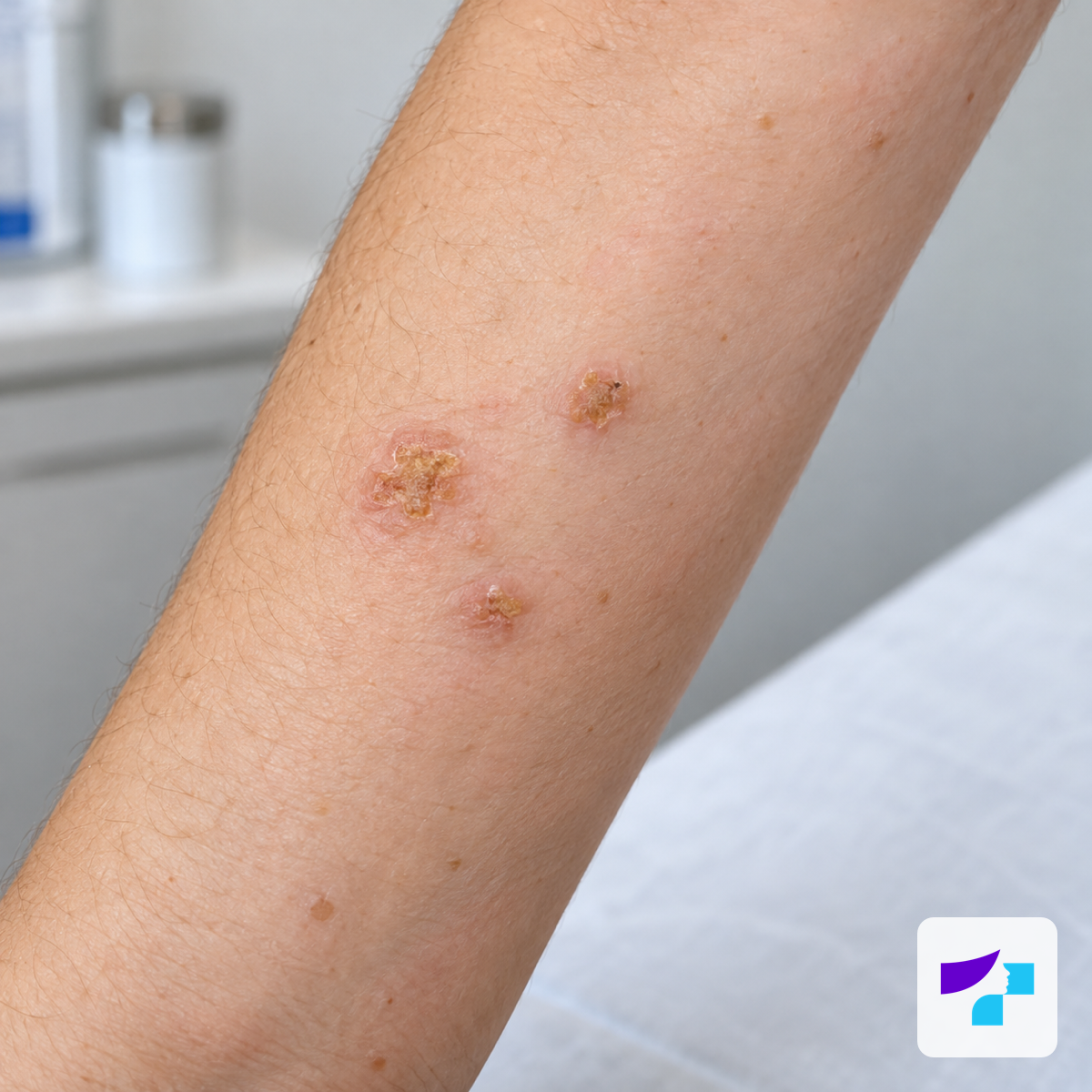
Illustrative visualisation: superficial skin lesions on the forearm with the yellow-brown, honey-coloured crusts characteristic of impetigo.
Common sites of impetigo include:
- around the nose;
- around the mouth;
- on the chin;
- on the cheeks;
- on the hands;
- on the legs;
- areas where eczema, insect bites or abrasions have been scratched.
Itching and soreness are usually mild to moderate, but a child may scratch the lesions and transfer bacteria to other areas of the skin. Nearby lymph nodes may sometimes be slightly enlarged or tender.
On darker skin, redness may be less noticeable. Therefore, more important signs may include blisters, weeping, crusting, changes in the skin surface, itching or rapid spread of lesions.
Types of Impetigo
| Type | Appearance | Who Is More Commonly Affected | Key Treatment Point |
|---|---|---|---|
| Non-bullous impetigo | Small sores, weeping and yellow-brown or honey-coloured crusts. | Children, often on the face, around the nose and mouth, and on damaged skin. | Limited cases often respond to doctor-prescribed topical treatment and hygiene measures. |
| Bullous impetigo | Larger, thin-walled blisters with clear, cloudy or yellowish fluid; after rupture, moist erosions remain. | More common in babies and young children; may appear on the face, trunk, buttocks, arms or legs. | Requires medical assessment; oral antibiotics may be needed more often. |
| Ecthyma | Deeper, more painful ulcers with thick crusts. | May develop if the infection is untreated or if risk factors are present. | Should be assessed by a doctor because healing is slower and scarring may occur. |
How Does Impetigo Spread?
Impetigo is a contagious skin infection. It spreads when bacteria from infected skin reach another area of skin or another person.
Ways impetigo spreads include:
- direct skin contact with a person who has impetigo;
- touching sores, blisters, crusts or discharge;
- sharing towels, clothing, bedding or pillowcases;
- toys, sports equipment or other surfaces touched by an infected person;
- scratching, when bacteria are transferred under the nails to other parts of the body.
In childcare settings, impetigo can spread especially easily because children often touch their faces, share toys, have close contact and do not always wash their hands thoroughly. Sports settings may also carry a higher risk if there is close skin contact or shared equipment.
What Is the Incubation Period for Impetigo?
The incubation period is the time between contact with bacteria and the first visible signs of disease. In impetigo, this can vary. Signs of impetigo caused by group A streptococcus often appear about 4-10 days after contact, while staphylococcal infection may sometimes begin earlier. In practice, patients or parents cannot always determine exactly when or where infection occurred, because bacteria may be transferred by hands, objects or contact in a childcare setting.
How Long Is Impetigo Contagious?
Impetigo is contagious while there are active, weeping lesions on the skin or until the infection is controlled with appropriate treatment. After antibiotic treatment prescribed by a doctor is started, contagiousness usually decreases significantly within 24-48 hours. The exact timing may vary depending on the severity of infection, type of treatment, whether lesions can be covered and local kindergarten or school requirements.
If treatment has not been started, a person may remain contagious until the lesions are dry, crusted, no longer weeping and no new lesions are forming. During this time, hygiene and avoiding close contact with others are especially important.
When Can a Child Return to Kindergarten or School?
A child with impetigo should not attend kindergarten or school while the infection is contagious. In practice, this usually means that the child stays at home at least until doctor-prescribed treatment has started, the lesions are controlled, they can be covered and the child feels well. Many recommendations state that returning to a group setting may be possible 24-48 hours after appropriate treatment is started, provided the lesions are covered and there are no new actively weeping areas.
If treatment is not given, the child should wait until the lesions are dry, no longer spreading and no new sores or blisters are forming. The doctor’s advice, the child’s general condition and the infection-control rules of the specific childcare or school setting should always be followed.
While impetigo is contagious, children and adults should also avoid contact sports, swimming pools, gyms and close contact with newborns, people with diabetes or weakened immunity. If an adult works with food, in healthcare, social care or childcare, returning to work should be discussed with a doctor or the workplace infection-control lead.
Impetigo Treatment
The aim of impetigo treatment is to cure the infection, reduce contagiousness, prevent spread to other areas of the skin and lower the risk of complications. The choice of treatment depends on the number of lesions, their location, the patient’s age, general health and whether the infection is recurrent.
A doctor can usually diagnose impetigo by examining the skin. In some cases, especially recurrent, widespread or unusual impetigo, a swab or discharge sample may be needed to identify the bacteria and choose the most appropriate treatment.
Diagnosis
In most cases, impetigo is a clinical diagnosis: the doctor recognises it by the typical appearance, location and course of the rash. During the visit, the doctor may ask about contact with other children or family members, recent runny nose, skin injuries, insect bites, eczema, scabies, chickenpox, previous antibiotics and recurrent infections.

Illustrative visualisation: a dermatologist examines the skin on a patient’s forearm to assess the lesions and determine the most appropriate next steps.
A swab from a skin lesion or the nose is usually not needed for every patient, but it may be useful if impetigo is widespread, recurrent, does not respond to treatment, MRSA is suspected or an outbreak is possible in a group setting. Such testing helps identify the bacteria and its sensitivity to antibacterial medicines.
Skin Care and Hygiene
Skin care is important whether a cream or oral antibiotics are used.
Recommendations:
- gently wash the affected skin with water and mild soap;
- wash hands thoroughly before and after touching lesions;
- use a separate clean towel;
- do not rub the skin or pick crusts;
- if possible, cover lesions with a clean dressing or clothing;
- keep the child’s nails short to reduce spread caused by scratching;
- change and wash towels, pillowcases, bedding and clothing frequently;
- clean toys and surfaces that the child often touches.
Crusts should not be aggressively removed. If the doctor recommends it, they may be softened gently during washing so that the treatment can reach the lesion surface better. However, the skin should not be traumatised.
Topical Treatment
In mild and limited cases, a doctor may prescribe a topical antibacterial medicine or antiseptic treatment. Topical treatments are applied directly to the affected skin. Medical sources mention mupirocin, retapamulin, fusidic acid or antiseptic agents as examples, but the specific choice should be made by a doctor, taking into account the patient’s age, infection site, possible bacterial resistance and local treatment guidelines.
In some countries, guidelines also mention a specific hydrogen peroxide cream for mild impetigo. This is not the same as applying ordinary hydrogen peroxide solution to the skin at home. Self-use of irritating disinfectants may damage the skin and make healing more difficult, so the appropriate topical treatment should be chosen by a doctor.
Important points:
- prescription creams should be used only as directed by a doctor;
- the medicine should be used as often and for as long as prescribed;
- treatment should not be stopped early just because the skin looks better;
- hands should be washed after applying the cream;
- do not use antibiotic cream left over from previous treatment or prescribed for another person.
Incorrect antibiotic use may contribute to bacterial resistance and make future treatment more difficult.
Oral Antibiotics
Oral antibiotics may be needed if:
- impetigo is widespread;
- there are many lesions;
- the infection is spreading quickly;
- bullous impetigo is present;
- the patient is a baby;
- there is fever or feeling unwell;
- immunity is weakened;
- diabetes or other risk factors for complications are present;
- topical treatment has not helped;
- the infection is recurrent.
The specific antibiotic, dose and treatment duration are determined by the doctor. In impetigo, it is not safe to use doses or treatment schemes found online, because treatment must be adapted to the patient’s age, infection extent, possible allergies and local bacterial resistance. If antibiotics are prescribed, the full course should be completed even if the rash starts improving after a few days.
What Should Not Be Done in Impetigo?
In impetigo, you should avoid:
- scratching sores, blisters or crusts;
- picking crusts so that the skin “heals faster”;
- squeezing blisters;
- sharing towels, clothing, pillowcases or face cloths;
- taking a child to kindergarten or school while the infection is contagious;
- using someone else’s or old antibiotic creams;
- using corticosteroid creams without a doctor’s advice;
- applying aggressive disinfectants, cologne, concentrated hydrogen peroxide solution or brilliant green without medical advice;
- putting powders on weeping lesions, as they may dry onto discharge, interfere with care and hide spread of infection;
- ignoring worsening, fever, pain, swelling or spreading redness.
If it is unclear whether the rash is impetigo, herpes, infected eczema, an allergic reaction or another condition, it is safer to consult a doctor rather than start treatment based on images online.
When Should You See a Doctor?
A dermatologist can help confirm the diagnosis, distinguish impetigo from similar skin conditions and choose appropriate treatment.
You should see a doctor or dermatologist if:
- impetigo occurs in a baby;
- lesions are widespread or spreading quickly;
- the rash is near the eyes;
- there is fever, feeling unwell or significant pain;
- the skin becomes hot, swollen or redness spreads rapidly;
- a deeper skin infection, such as cellulitis, is suspected;
- the person has diabetes, weakened immunity or severe eczema;
- impetigo is recurrent;
- treatment is not helping or symptoms are worsening;
- the diagnosis is unclear.
Special care is needed if a child appears very tired, refuses food or fluids, has a high temperature, severe pain or rapidly worsening redness. In such cases, more urgent medical assessment is required.
How to Tell Impetigo Apart From Other Skin Conditions?
Impetigo may resemble several other skin conditions. The exact diagnosis is made by a doctor, but the comparison below may help in practice.
| Condition | What Is Similar | What Helps Tell It Apart | When to See a Doctor |
|---|---|---|---|
| Herpes | Blisters and crusts around the mouth. | Often causes burning, tingling, grouped blisters and recurrence in the same place. | If the diagnosis is unclear, the rash is widespread or the patient is a child. |
| Eczema | Itching, redness and scratching. | Usually lacks typical honey-coloured crusts, but scratched eczema may become infected. | If weeping, pus, crusting or worsening appears. |
| Allergic rashes | Redness and itching. | Usually no purulent sores, honey-coloured crusts or contagious spread. | If there is facial swelling, breathing difficulty, rapid progression or an unclear cause. |
| Chickenpox | Blisters on the skin. | Usually lesions are in different stages across the body, often with fever. | If there are complications, weakened immunity or unclear diagnosis. |
| Cellulitis | Redness, pain and skin inflammation. | A deeper infection with hot, swollen, painful skin and more extensive redness. | Medical care is needed urgently. |
Impetigo and Eczema
Children with atopic dermatitis or eczema have a higher risk of impetigo. During eczema, the skin is drier, inflamed and often itchy. Scratching damages the skin barrier and makes it easier for bacteria to enter the skin. If an eczema patch suddenly starts to weep, becomes more painful, develops yellow crusts or worsens quickly, a bacterial infection may have developed.
In this situation, usual eczema treatment should not simply be continued without consulting a doctor, especially if corticosteroid creams or wet wraps are being used. The doctor will assess whether antibacterial treatment is needed and when it is safe to restart or adjust eczema therapy.
Can Impetigo Come Back?
Yes, impetigo can recur. This is more likely if:
- the child has eczema or persistent itchy skin;
- there are frequent scratches, abrasions or insect bites;
- another infected person is present in the family or child group;
- towels, bedding or clothing are not changed;
- bacteria remain in the nose or on the skin;
- the treatment course was not completed;
- immunity is weakened or other risk factors are present.
In recurrent impetigo, the doctor may recommend additional testing, such as a swab from a skin lesion or the nose, to understand whether the person carries the bacteria and how recurrence can be prevented.
What to Do if Impetigo Appears in Kindergarten, School or the Family?
If impetigo appears in a child group or in several family members, the main aim is to stop transmission quickly. The sick child should stay at home until no longer contagious, lesions should be covered where possible and handwashing should be reinforced. Toys, frequently touched surfaces, towels, bedding and clothing should be cleaned or washed more often.
If several children become ill within a short time, the kindergarten or school should be informed so that hygiene measures can be strengthened. Family members should not share towels, pillowcases, water bottles, cutlery or sports equipment. If impetigo recurs several times, a doctor may assess whether additional diagnostics or bacterial carriage control is needed.
Complications
In most cases, impetigo heals without serious consequences if treated promptly and correctly. However, complications are possible.
Possible complications include:
- spread of infection to other skin areas;
- deeper skin infection;
- cellulitis;
- lymphangitis, or inflammation of the lymph vessels;
- ecthyma, which may heal more slowly and leave scars;
- recurrent infections;
- post-inflammatory pigmentation changes, especially after inflammation or scratching;
- rarely, kidney inflammation after streptococcal infection.
Very rarely, a bacterial skin infection may also be associated with more serious systemic complications, such as scarlet fever, staphylococcal scalded skin syndrome or infection entering the bloodstream. These situations are not typical of mild impetigo, but they are a reason to take fever, apathy, severe pain, rapidly worsening skin or widespread redness seriously.
The risk of complications is higher in babies, people with weakened immunity, diabetes, widespread infection or untreated impetigo. This does not mean that every case of impetigo is dangerous, but it does mean that rapid worsening should not be ignored.
Impetigo Prevention
The goal of prevention is to reduce bacterial transmission and protect the skin from damage.

Illustrative visualisation: washing hands with soap and water helps reduce bacterial transmission and the spread of impetigo.
Recommendations:
- wash hands regularly with soap and water;
- keep children’s nails short;
- do not share towels, face cloths, pillowcases or clothing;
- wash towels, bedding and clothing at a higher temperature if someone at home has impetigo;
- clean toys and frequently touched surfaces;
- cover lesions if possible;
- wash and cover scratches, abrasions and insect bites promptly;
- treat eczema and reduce itching so the child scratches less;
- shower after sports and use a clean towel;
- observe family members if someone at home has impetigo.
Common Myths About Impetigo
Myth: Impetigo happens only because of poor hygiene.
In reality, impetigo can occur even in a child with good hygiene if bacteria enter damaged skin. Hygiene helps reduce spread, but it is not the only factor.
Myth: Impetigo is not contagious if the child feels well.
A child may feel well, but the skin lesions may still be contagious.
Myth: Yellow crusts are always just an allergy.
Yellow-brown or honey-coloured crusts are one of the typical signs of impetigo, especially if lesions are weeping and spreading.
Myth: Any antibiotic cream at home can be used.
Antibiotics should be used only as directed by a doctor. Incorrect use may not help recovery and may increase the risk of resistance.
Myth: Crusts should be picked off so the skin heals faster.
Picking crusts injures the skin, may spread infection and increases the risk of scarring.
Myth: Impetigo affects only children.
Impetigo is more common in children, but adults can also get it.
Myth: Treatment can be stopped as soon as the rash starts to disappear.
If a doctor has prescribed a treatment course, it should be completed even if the skin looks better.
Myth: Impetigo always leaves scars.
Superficial impetigo usually heals without scarring if the skin is not scratched and the infection does not become deeper. The risk of scarring is higher with ecthyma or deeper lesions.
Summary
Impetigo is a common, contagious and usually treatable bacterial skin infection. It affects children more often, but adults can also develop it. The most typical sign is weeping sores, blisters and yellow-brown or honey-coloured crusts, especially around the nose and mouth.
Treatment depends on the extent of infection, the patient’s age and risk factors. In some cases, topical treatment and careful hygiene are enough, while in others oral antibiotics are needed. Hygiene is just as important as medication because it helps protect family members, classmates and others from infection and prevents spread to other areas of the skin.
If lesions are widespread, near the eyes, occur in a baby, spread rapidly, recur or it is unclear whether this is impetigo, a doctor or dermatologist consultation is needed.
References and Authoritative Sources
- Centers for Disease Control and Prevention (CDC): clinical guidance for group A streptococcal impetigo
- Centers for Disease Control and Prevention (CDC): patient information about impetigo
- National Health Service (NHS): impetigo symptoms, treatment and contagiousness
- National Institute for Health and Care Excellence (NICE): antimicrobial prescribing guidance for impetigo
- Mayo Clinic: impetigo symptoms and causes
- DermNet: dermatological overview of impetigo
- American Academy of Dermatology: impetigo signs and symptoms
- HealthyChildren.org by the American Academy of Pediatrics: impetigo in children
