Corns are localised, well-defined areas of thickened skin that most often develop on the feet and toes where the skin is exposed to long-term pressure or friction. They are not an infection, are not contagious, and are not the same as warts. A corn most often develops because of poorly fitting shoes, foot deformity, toe pressure, or uneven weight distribution on the foot.
What does a corn look like? A corn is usually a small, round or oval area of hard thickened skin with a denser centre or core. It may be skin-coloured, yellowish, greyish, or whitish. It often hurts when pressed directly from above or when the area is compressed while walking.
An accurate diagnosis is important because patients often confuse a corn with a plantar wart, blister, broader callus, or another skin lesion. These conditions have different causes and require different treatment approaches.
In Brief: Key Points About Corns
- A corn develops because of long-term pressure or friction.
- Corns are not contagious.
- A corn is not a wart; a plantar wart is caused by human papillomavirus.
- Corns most often form on the toes, between the toes, or on the sole of the foot.
- A common cause is narrow, hard, or poorly fitting footwear.
- Corns are more common in people with foot or toe deformities.
- A painful corn can make walking and wearing shoes difficult.
- A corn should not be cut at home.
- Corn plasters and salicylic acid products should be used with caution.
- Self-treatment can be dangerous in diabetes, poor circulation, or reduced sensation in the feet.
- If the pressure is not corrected, the corn often comes back.
What Is a Corn?
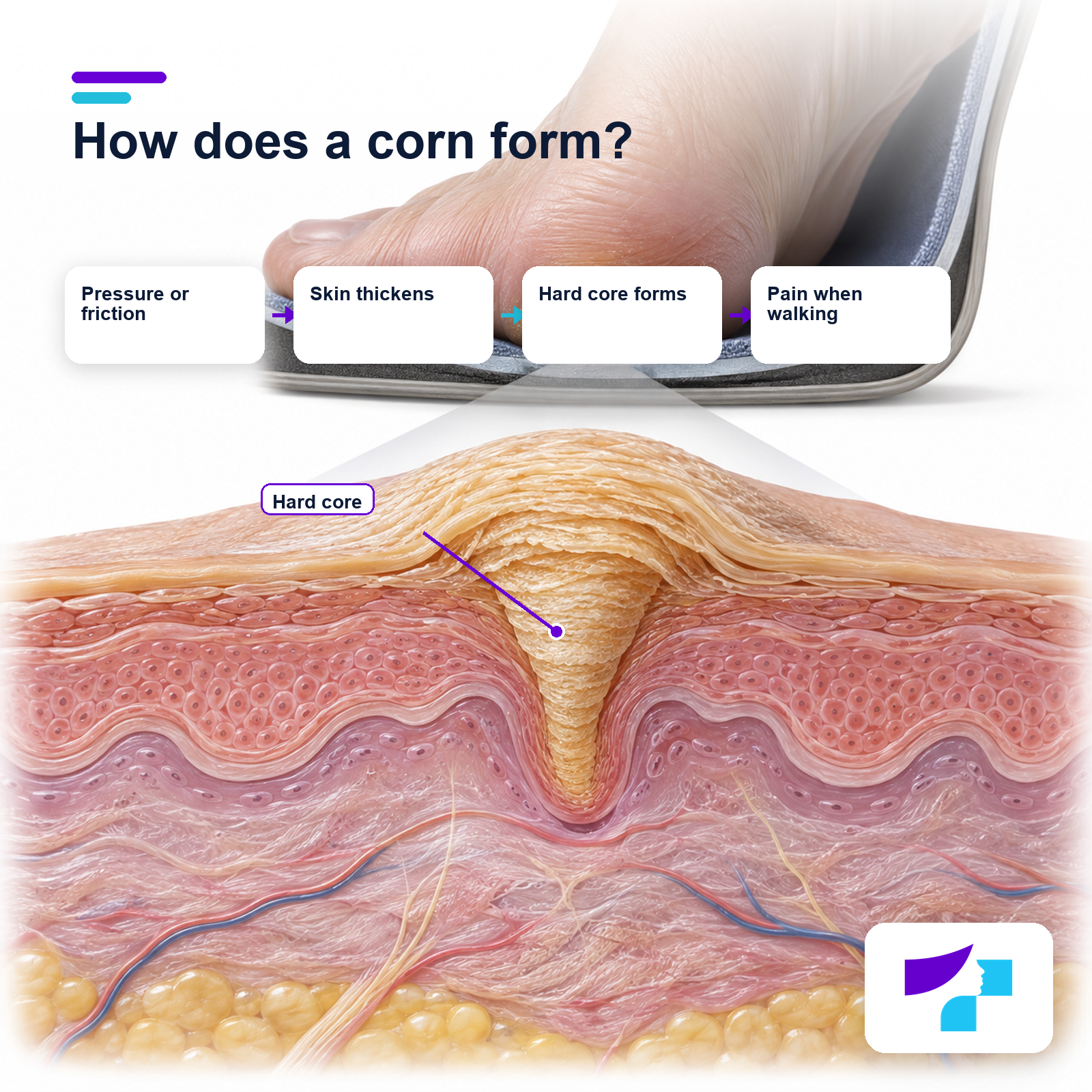
A corn is a localised thickening of the outer horny layer of the skin. The skin thickens as a protective response to repeated mechanical irritation: pressure, friction, or overload in a specific area of the foot.
Medically, a corn may also be called clavus or heloma. It is a form of hyperkeratosis, meaning thickening of the outer skin layer in a defined area. Compared with a broader callus, a corn is usually smaller, deeper, more clearly defined, and more often painful.
A dense keratin core may form in the centre of the corn. Patients often describe this as the “root” of the corn. It is not a true root, but a hard, deeper-pointing thickening of the skin’s horny layer that presses into the tissues and can irritate nerve endings. This is why even a small corn can cause significant pain.
Why Do Corns Develop?
Corns develop where the skin is repeatedly exposed to pressure or friction. This is especially common on the feet because they carry body weight and spend much of the day inside shoes.
Common causes of corns include:
- narrow shoes;
- hard shoes;
- shoes with a narrow toe box;
- high-heeled shoes;
- shoes that rub a specific part of the foot or toe;
- socks that fold, bunch up, or press on the skin;
- prolonged walking or standing;
- foot overload during sport or work;
- uneven distribution of pressure on the foot;
- flat feet;
- a high foot arch;
- hammer toes;
- bunion deformity, or hallux valgus;
- bony prominences or other foot deformities;
- reduced soft tissue padding under the sole.
A corn is not only a superficial skin problem. It often has a mechanical cause. If that cause remains, the skin continues to protect itself, thickens again, and the corn may recur.
Where Do Corns Most Often Form?
Corns most often appear in places where the skin is compressed between bone and footwear or between two toes.
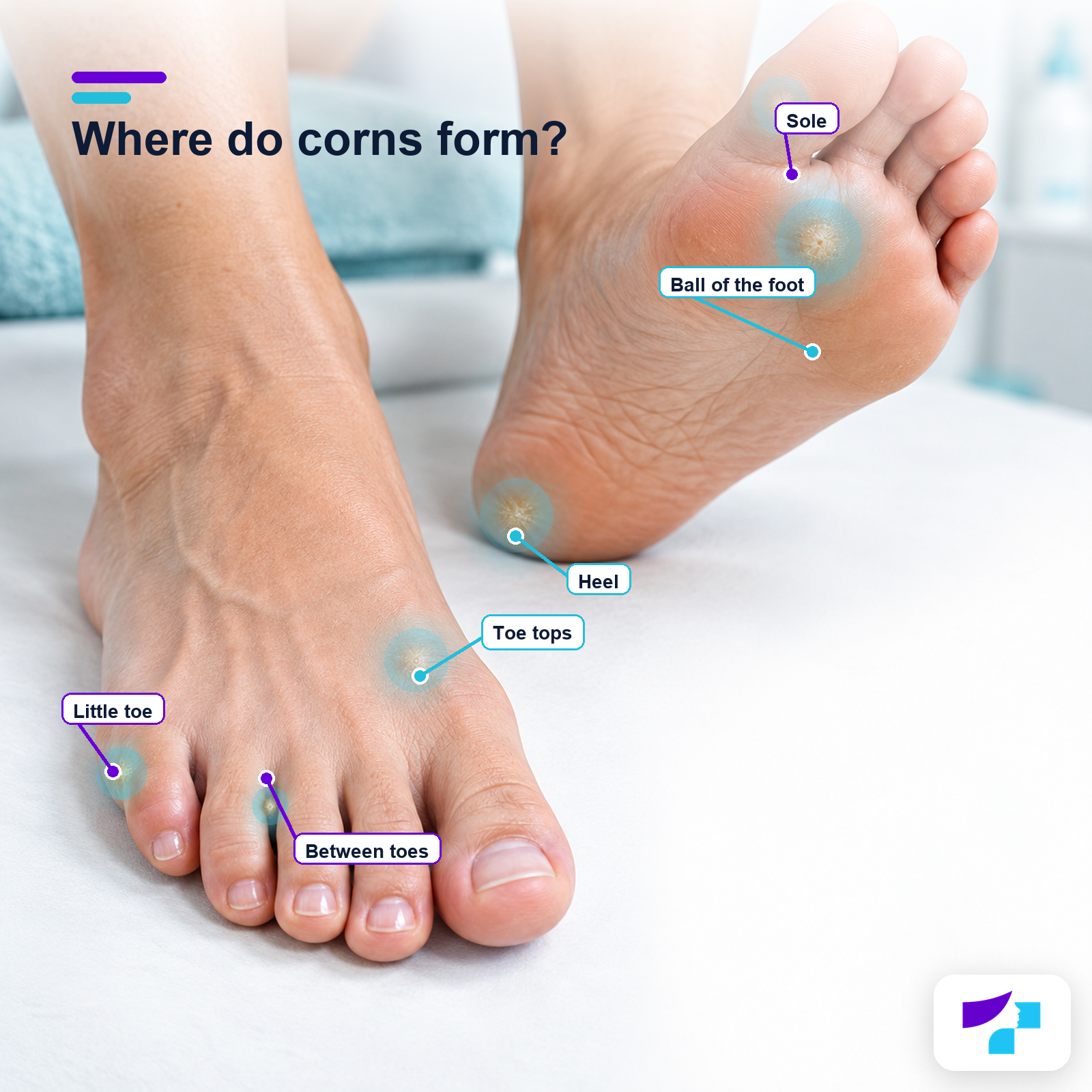
Common locations include:
- the outer side of the little toe;
- the tops of the toes;
- the tips of the toes;
- between the toes;
- especially between the fourth and fifth toes;
- the forefoot;
- the sole of the foot;
- the heel or side of the foot if there is increased load there.
The location of a corn often helps identify its cause. For example, a corn on the little toe is often related to pressure from footwear, while a corn between the toes can develop because of tight toe compression and moisture.
Types of Corns
Corns can differ in appearance, texture, and location.
Hard Corn
A hard corn usually forms on dry pressure points, such as the tops of the toes, the side of the little toe, or the sole of the foot. It is dense, clearly defined, and often painful with direct pressure.
Soft Corn
A soft corn more often develops between the toes. In this area, the skin is more moist, so the thickening may be whitish, softer, and macerated. A soft corn can be very painful, and moisture between the toes may contribute to irritation, cracks, or infection.
Corn With a Core
Patients often use this term for a corn with a distinct central core. This dense centre can cause a sharp, stabbing pain while walking.
Seed Corns
Sometimes several small, hard keratin plugs may appear on the sole. They are usually superficial and not always painful, but they may be difficult to distinguish from other foot skin lesions.
What Are the Symptoms of a Corn?
Corn symptoms may be mild or very disruptive. For some people, a corn is only a small area of thickened skin, while for others it causes sharp pain with every step.
Typical signs include:
- a hard, well-defined area of thickened skin;
- a visible denser centre;
- pain with direct pressure;
- pain when walking;
- pain when wearing certain shoes;
- a stabbing or burning sensation;
- tenderness in one specific point;
- discomfort between the toes;
- whitish, moist skin in the case of a soft corn.
If redness, swelling, bleeding, pus, severe pain, or a wound appears, this may indicate inflammation, infection, or another problem. In such cases, assessment by a doctor or podologist is needed.
Corn or Wart?
A corn and a wart can look similar, so they are often confused. However, they are different skin lesions.
A corn develops because of pressure and friction. A wart is caused by human papillomavirus and may be contagious. If a wart is mistakenly treated as a corn, treatment may not be effective and the problem may persist. If wart treatment is needed, more information is available in the article on wart removal.
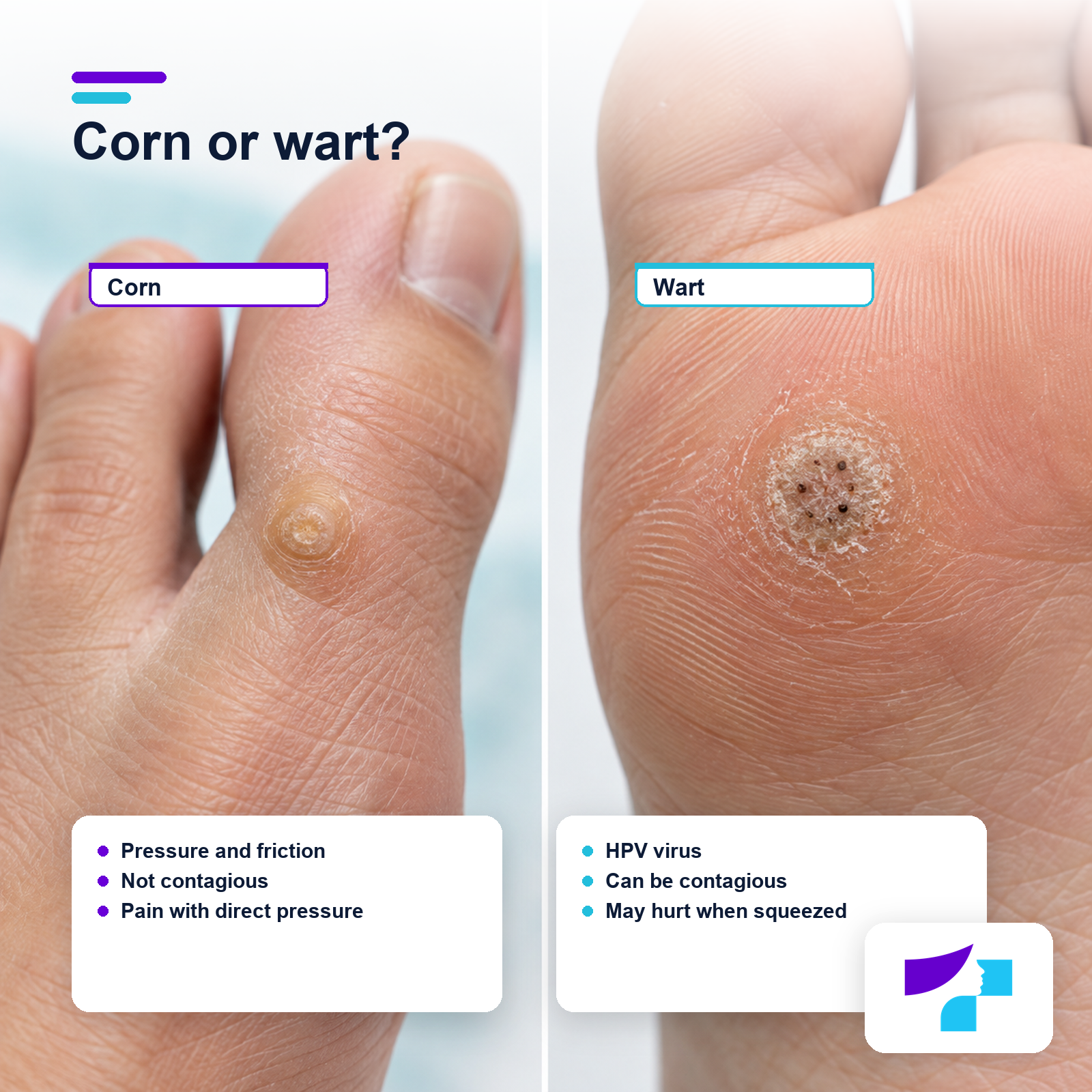
| Feature | Corn | Wart |
|---|---|---|
| Cause | Pressure and friction | Human papillomavirus |
| Contagiousness | Not contagious | May be contagious |
| Appearance | Hard thickening with a centre | Rougher lesion, sometimes with small dark dots |
| Skin lines | Often preserved | May be interrupted |
| Pain | More often with direct pressure from above | Often also painful when squeezed from the sides |
| Common location | Pressure points, toes, between toes | Sole of the foot, toes |
| Treatment | Reducing pressure and treating thickened skin | Wart treatment after diagnosis |
This table is for general guidance only. A diagnosis cannot always be made from appearance alone. If the lesion is painful, bleeds, changes, spreads, or does not go away, it should be assessed by a specialist.
Corn or Blister?
A blister usually develops after acute friction. It is a fluid-filled skin bubble that may appear after new shoes, a long walk, or intense activity.
A corn develops gradually. It is not a fluid-filled blister, but hardened, thickened skin. A blister should not be burst, and a corn should not be cut at home.
If blisters or corns repeatedly appear in the same place, footwear, socks, and foot load should be assessed.
Corn or Callus?
Not every area of thickened skin on the foot is a corn. A broader, less defined thickening is called a callus. It usually forms over larger pressure areas, such as the heels or forefoot.
A corn is usually smaller, deeper, and more painful. It often has a dense central point that causes a feeling of pressure or stabbing pain.
In both cases, the key is to understand why the skin is being overloaded.
What Else Can Be Mistaken for a Corn?
Sometimes other foot skin or soft tissue conditions are mistaken for corns. They may require different treatment.
A corn may be confused with:
- a plantar wart;
- a broad callus;
- a blister;
- a skin fissure;
- irritation caused by a foreign body;
- macerated skin between the toes;
- a skin change caused by a fungal infection;
- knuckle pads or other benign soft tissue lesions;
- palmoplantar keratoderma;
- less commonly, another type of skin lesion.
If the lesion is not typical, changes quickly, bleeds, becomes dark, forms a wound, or does not go away, the diagnosis should be clarified by a dermatologist. In some cases, the doctor may use dermoscopy to assess the features of the skin lesion more accurately.
Are Corns Contagious?
No, corns are not contagious. They do not develop because of infection and cannot “spread” from one person to another.
Plantar warts, however, may be contagious because they are caused by a virus. If it is unclear whether the lesion is a corn or a wart, it is better not to start aggressive self-treatment and to have the diagnosis checked by a specialist.
How Are Corns Treated?
Corn treatment depends on its location, depth, pain, and the patient’s overall health. The goal is not only to remove thickened skin but also to reduce the pressure that caused it.
Main treatment principles include:
- reducing pressure and friction;
- choosing more comfortable footwear;
- using protective pads or silicone inserts;
- using toe separators if the corn is between the toes;
- orthopaedic insoles if foot pressure is uneven;
- professional foot care by a podologist;
- safe removal or reduction of thickened skin;
- keratolytic products, such as salicylic acid or urea, if suitable for the patient;
- assessment of foot deformity if corns keep recurring.
If the cause remains, the corn may return even after successful removal. If the corn causes pain or interferes with walking, foot corn removal by a specialist may be appropriate.
How Can a Corn Be Treated at Home?
If the person is otherwise healthy, the corn is not inflamed, and the diagnosis is clear, safe self-care may be tried initially.
Practical steps:
- reduce pressure on the painful area;
- choose comfortable shoes with enough room;
- use a protective pad or non-medicated corn protector to reduce friction;
- after soaking the feet in warm water, gently reduce only the superficial thickening with a clean foot file or pumice stone;
- moisturise the feet regularly;
- use pharmacy products only according to the instructions;
- if pain does not improve, the lesion changes, or it is unclear whether it is a corn, see a specialist.
People with diabetes, poor circulation, reduced sensation in the feet, or immune system disorders should not treat corns themselves at home. In these situations, even a small wound can become serious.
What to Do During the First 7 Days if a Corn Appears?
If the lesion looks like a corn and there are no signs of inflammation, the main aim during the first days is to offload the painful area.
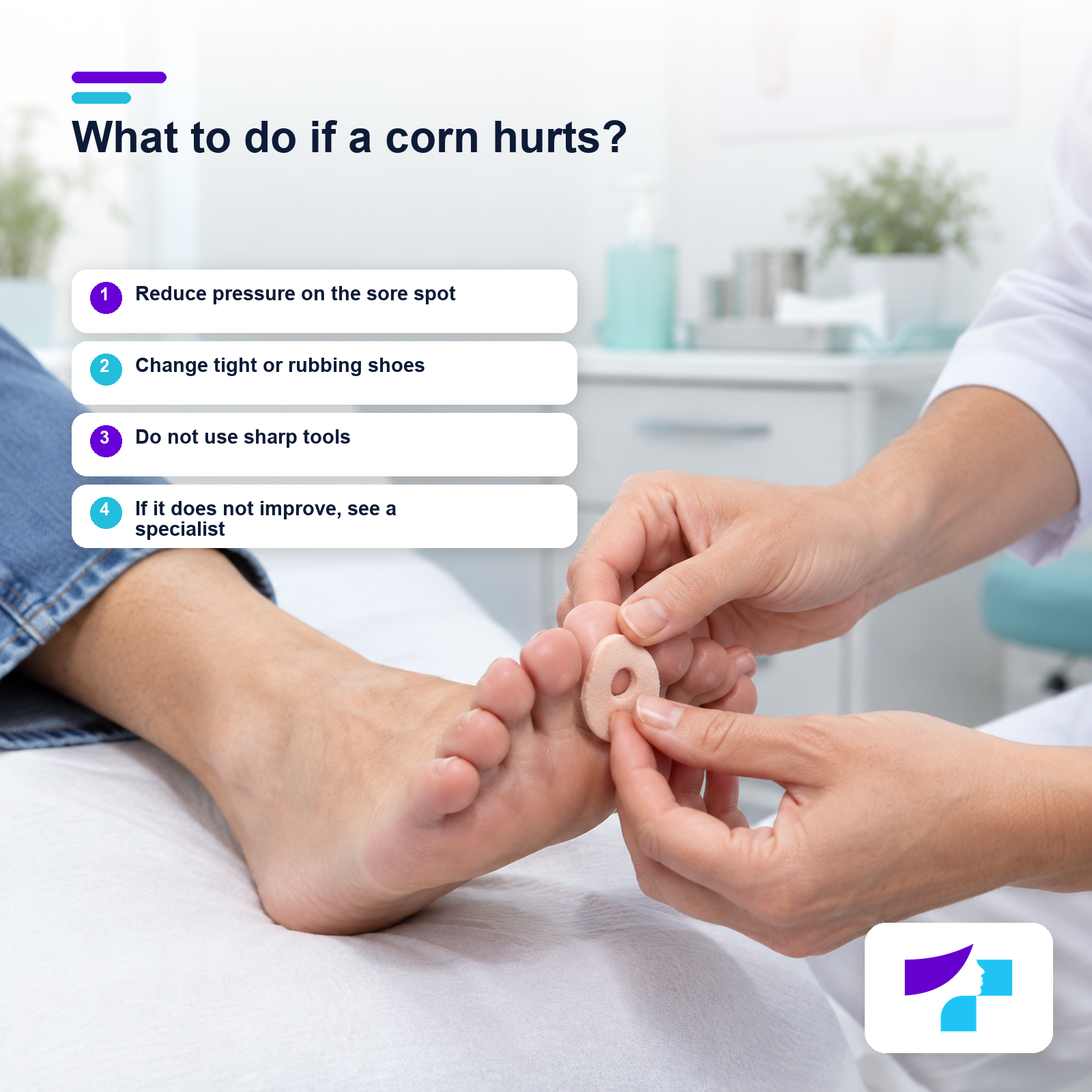
- Day 1: stop wearing shoes that press or rub the specific area.
- Day 2: use a soft protective pad to reduce pressure.
- Day 3: after a warm foot soak, very gently reduce only the surface thickening.
- Day 4: moisturise the feet regularly, but do not apply aggressive products to damaged skin.
- Day 5: assess whether the pain is improving. If it is increasing, stop self-care.
- Day 6: review your everyday footwear and load habits.
- Day 7: if there is no clear improvement or the diagnosis is uncertain, book an appointment with a podologist or doctor.
If redness, swelling, bleeding, discharge, a wound, or severe pain appears at any time, do not wait until the end of the week.
Can You Cut a Corn?
A corn should not be cut at home with scissors, a knife, a razor blade, or any other sharp instrument.
This can:
- injure healthy skin;
- cause bleeding;
- increase the risk of infection;
- worsen pain;
- encourage further thickening of the skin;
- be especially dangerous in diabetes or circulatory disorders.
Safer options include gentle foot care and, if needed, professional treatment by a podologist.
Do Corn Plasters Help?
Corn plasters may help reduce friction or soften thickened skin. Some contain salicylic acid, which breaks down the thickened outer skin layer.
However, they must be used with caution. The active ingredient should not come into contact with surrounding healthy skin because it may cause irritation or a chemical burn. A plaster should be used only according to the instructions.
Salicylic acid products are not suitable for everyone, especially people with:
- diabetes;
- poor circulation in the feet;
- reduced sensation in the feet;
- open wounds;
- inflamed skin;
- very sensitive or fragile skin.
It is important to understand that a plaster does not remove the mechanical cause. If shoes or foot load continue to create pressure, the corn may return.
Why Is a Plaster Alone Often Not Enough?
A corn plaster may temporarily reduce pain, protect the skin, or help soften the thickening. However, a corn develops because a specific area of skin is repeatedly compressed or rubbed.
If footwear is not changed, the foot area is not offloaded, or toe deformity is not addressed, the plaster treats only the consequence, not the cause. This is why recurrent corns require not only skin care but also assessment of foot loading.
Home Remedies for Corns: Why Caution Is Needed
Various home remedies are sometimes used for corns, such as vinegar, garlic, onion, celandine, soda baths, or other irritating mixtures. Some may temporarily soften the skin or reduce discomfort, but they do not remove the cause of the corn.
Aggressive home remedies may cause:
- skin irritation;
- chemical burns;
- wounds;
- infection;
- damage to healthy skin;
- delayed diagnosis if the lesion is not actually a corn.
Caustic products should be avoided especially in children, people with diabetes, poor circulation, reduced sensation, or inflamed skin.
When Should Self-Treatment Be Stopped?
Self-care should not be continued if:
- pain increases;
- redness or swelling appears;
- bleeding develops;
- there is pus or wet discharge;
- a wound forms;
- the lesion becomes dark or changes quickly;
- there is no improvement after a few weeks;
- there is no confidence that it is truly a corn;
- the patient has diabetes, poor circulation, or reduced sensation in the feet.
In these situations, a consultation with a podologist, dermatologist, or doctor is needed.
When Should You See a Podologist, Dermatologist, or Doctor?
A specialist consultation is needed if:
- the corn is very painful;
- pain interferes with walking;
- the lesion recurs;
- it is unclear whether it is a corn or a wart;
- there is redness, swelling, bleeding, or discharge;
- the lesion changes quickly;
- home care does not help;
- the lesion is in a child and the diagnosis is uncertain;
- the patient has diabetes;
- there is poor circulation;
- there is reduced sensation in the feet;
- there is an immune system disorder.
A podologist can safely treat the thickened skin, offload the painful area, and recommend suitable aids. More information about medical foot and nail care is available in the section on medical foot care and in the article on medical pedicure. A dermatologist helps if the diagnosis is unclear or if there is suspicion of a wart, another skin disease, or an atypical lesion.
Urgent medical assessment is needed if a wound develops on the foot, pain increases rapidly, fever appears, there are signs of infection, or a person with diabetes develops any non-healing skin injury.
Why Do Corns Come Back?
Corns come back when pressure or friction remains. If only the surface thickening is removed but the shoes still press or the foot is overloaded in the same place, the skin thickens again.
In recurrent corns, the following should be assessed:
- shoe size and shape;
- toe position inside shoes;
- foot arch;
- walking pattern;
- foot deformities;
- work or sport load;
- need for orthopaedic insoles;
- need for toe separators or offloading aids.
How Can Corns Be Prevented?
Corn prevention is based on reducing pressure and friction.
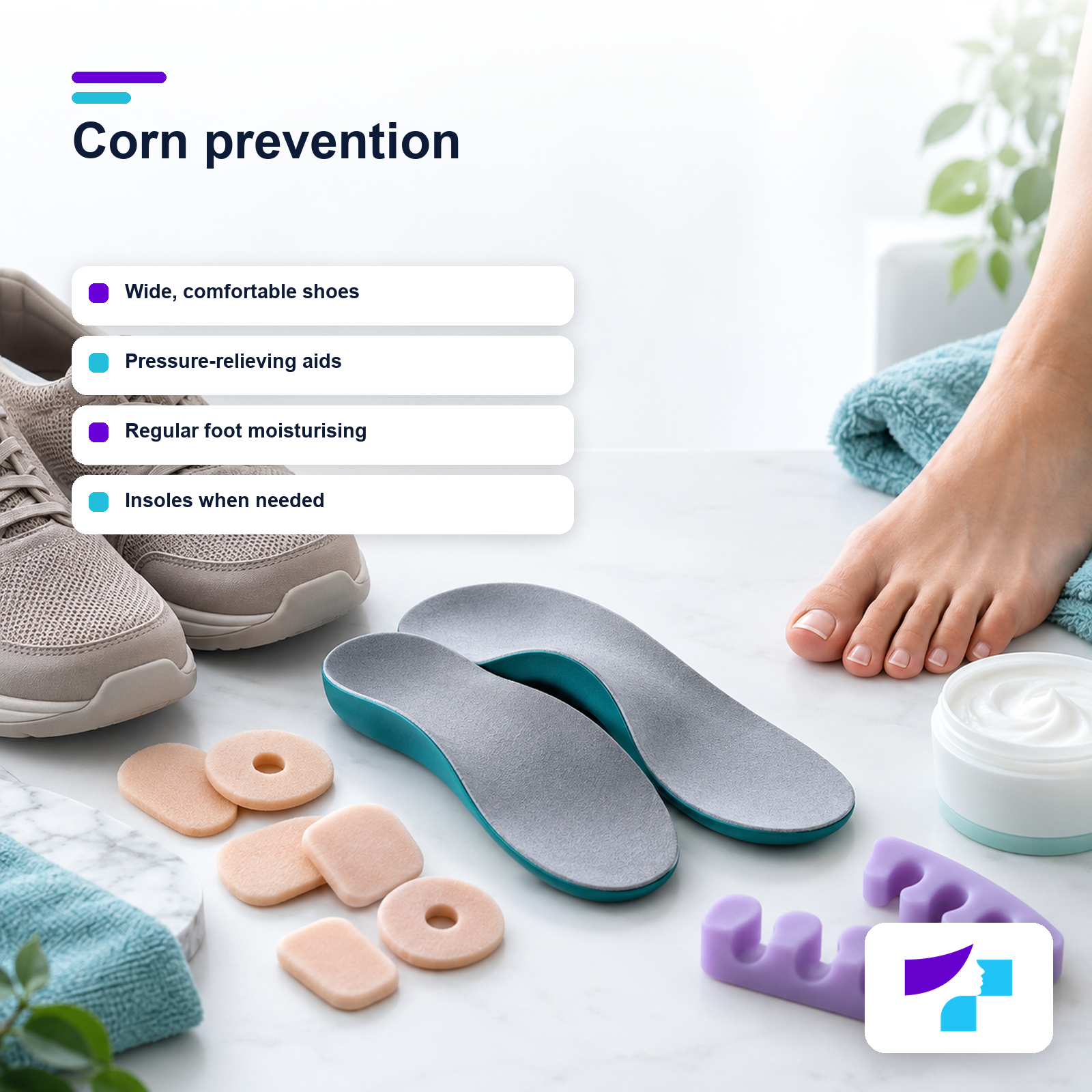
Recommendations:
- choose shoes with enough room in the toe box;
- avoid shoes that are too narrow or too hard;
- do not continue wearing shoes that repeatedly rub the same area;
- choose soft, suitable socks;
- avoid socks that bunch up inside shoes;
- use protective pads in pressure areas;
- use suitable toe separators between the toes if recommended by a specialist;
- moisturise the feet regularly;
- care for thickened skin gently before it becomes painful;
- in the case of foot deformity, consider consultation with a podologist, orthopaedic specialist, or technical orthopaedic specialist;
- use custom orthopaedic insoles if needed.
Corns in Children
In children, painful lesions on the feet are often plantar warts rather than corns. However, a corn can also develop in a child, especially if shoes rub or a specific area of the foot is repeatedly compressed.
A child’s foot should not be cut, treated with caustic products, or aggressively treated at home. If the lesion hurts, grows, changes, or it is unclear what it is, consultation with a doctor, dermatologist, or podologist is needed.
Corns in Diabetes
Corns should be taken especially seriously in people with diabetes. Diabetes may be associated with reduced sensation in the feet, poorer circulation, and impaired wound healing. This means that a small skin injury may not be noticed in time and may develop into an ulcer or infection.
In diabetes, you should not:
- cut a corn yourself;
- use aggressive caustic products without specialist advice;
- use salicylic acid corn plasters without medical advice;
- ignore pain, redness, or a wound;
- continue wearing shoes that create pressure.
The safest approach is professional foot care and medical assessment.
Common Myths About Corns
Myth: Corns Are Contagious
In reality, corns are not an infection. They develop because of pressure and friction.
Myth: A Corn and a Wart Are the Same Thing
No. A wart is caused by a virus, while a corn is caused by mechanical irritation.
Myth: It Is Best to Cut a Corn Out at Home
Cutting a corn at home may cause a wound, bleeding, and infection.
Myth: A Corn Will Go Away if You Ignore It
If pressure continues, a corn often becomes more painful or comes back.
Myth: Corn Plasters Are Suitable for Everyone
They are not suitable for everyone, especially in diabetes, poor circulation, or reduced sensation.
Myth: Once a Corn Is Removed, It Will Never Return
If the cause is not corrected, a corn can form again.
Myth: Corns Only Affect Older People
They can occur at any age if there is repeated pressure or friction.
Myth: Pedicure Always Solves Corns
Skin treatment may reduce symptoms, but recurrent corns require correction of the mechanical cause.
Myth: Home Remedies Are Safer Than Pharmacy Products
Not always. Caustic or irritating products can damage healthy skin and cause burns.
Summary
Corns are localised areas of thickened skin caused by pressure and friction. They most often form on the feet and toes, especially where shoes press or foot loading has changed.
Corns are not contagious and are not the same as warts. Treatment should focus not only on removing the thickened skin but also on correcting the pressure that caused it. If a corn is painful, recurrent, bleeding, inflamed, or the diagnosis is unclear, specialist assessment is needed. Self-treatment is not recommended for people with diabetes, poor circulation, or reduced sensation in the feet.
Medical Disclaimer
This article is intended for educational purposes and does not replace consultation with a doctor, podologist, or dermatologist. If a lesion on the foot is painful, bleeding, changing, persistent, inflamed, or it is unclear whether it is a corn, wart, or another skin lesion, specialist assessment is needed. Self-treatment may be dangerous for people with diabetes, reduced sensation in the feet, poor circulation, or immune system disorders.
References and Authoritative Sources
- DermNet: patient and clinician information on corns and calluses
- DermNet: patient and clinician information on viral warts
- National Health Service (NHS): corns and calluses
- Mayo Clinic: symptoms and causes of corns and calluses
- American Academy of Dermatology: diabetes and skin health
- Merck Manual Professional Edition: calluses and corns
- NCBI Bookshelf / StatPearls: medical overview of corns
