Vitiligo is a chronic skin pigmentation disorder in which light or white patches appear on the skin. These patches develop because melanin - the pigment that gives colour to the skin, hair and eyes - is reduced or lost in certain areas. Melanin is produced by melanocytes, and in vitiligo these cells are damaged or stop functioning properly.
Vitiligo is not contagious, is not an infection and is not related to poor hygiene. However, white spots on the skin do not always mean vitiligo. Similar changes may be caused by skin fungus, post-inflammatory changes, pityriasis alba, inherited pigmentation disorders or other skin conditions. An accurate diagnosis is best made by a dermatologist.
Vitiligo treatment is individual. It depends on the type of vitiligo, the location and extent of the patches, disease activity, the patient’s age, skin phototype and associated conditions. Treatment does not always fully restore skin colour, but it may help stabilise the condition, support repigmentation and improve the appearance of the skin.
In Brief: Key Facts About Vitiligo
- Vitiligo causes loss of pigment in the skin.
- Vitiligo is not contagious and cannot be passed to another person.
- It is often associated with autoimmune processes.
- It can begin at any age, including childhood.
- Vitiligo is often visible on the face, hands, feet, around the eyes and mouth, elbows, knees and genital area.
- The course may be stable, slowly progressive or rapidly progressive.
- Not all white skin patches are vitiligo, so dermatological diagnosis is important.
- Treatment may help restore pigment, but complete cure cannot be guaranteed.
- Sun protection is very important because depigmented skin burns more easily.
- Visible vitiligo may affect self-confidence and quality of life, so psychological support can also be part of care.
What Is Vitiligo?
Vitiligo is an acquired skin depigmentation condition. This means that the skin loses pigment in certain areas and becomes lighter, white or sometimes slightly pink. These areas are usually flat, without scaling or thickening.
The loss of pigment is caused by damage to melanocytes. Today, vitiligo is most often explained as an autoimmune condition: the immune system mistakenly targets melanocytes. However, vitiligo is multifactorial - genetic predisposition, oxidative stress, skin trauma, sunburn, chemical exposure and other triggers may all play a role.
Vitiligo is not only a cosmetic concern. For some patients it causes little discomfort, while for others visible patches on the face, hands or body can affect wellbeing, relationships, work and social life.
How Does Vitiligo Start?
Vitiligo often begins with one or several small light patches. At first they may be only slightly lighter than the surrounding skin, but later they can become clearly white. Sometimes the borders are sharp, while in other cases the transition is more gradual.
Common first locations include:
- the face, especially around the eyes and mouth;
- the backs of the hands and fingers;
- the feet;
- the elbows and knees;
- the armpits or groin;
- the genital area;
- areas exposed to friction or previous skin trauma.
In some people, vitiligo patches become more noticeable in summer because the surrounding skin tans while depigmented skin does not. Sunbathing is not a safe way to even out skin colour - it can increase contrast and cause sunburn.
Symptoms of Vitiligo
The main symptom of vitiligo is light or white patches on the skin. They may vary in size and shape, and their number may change over time.
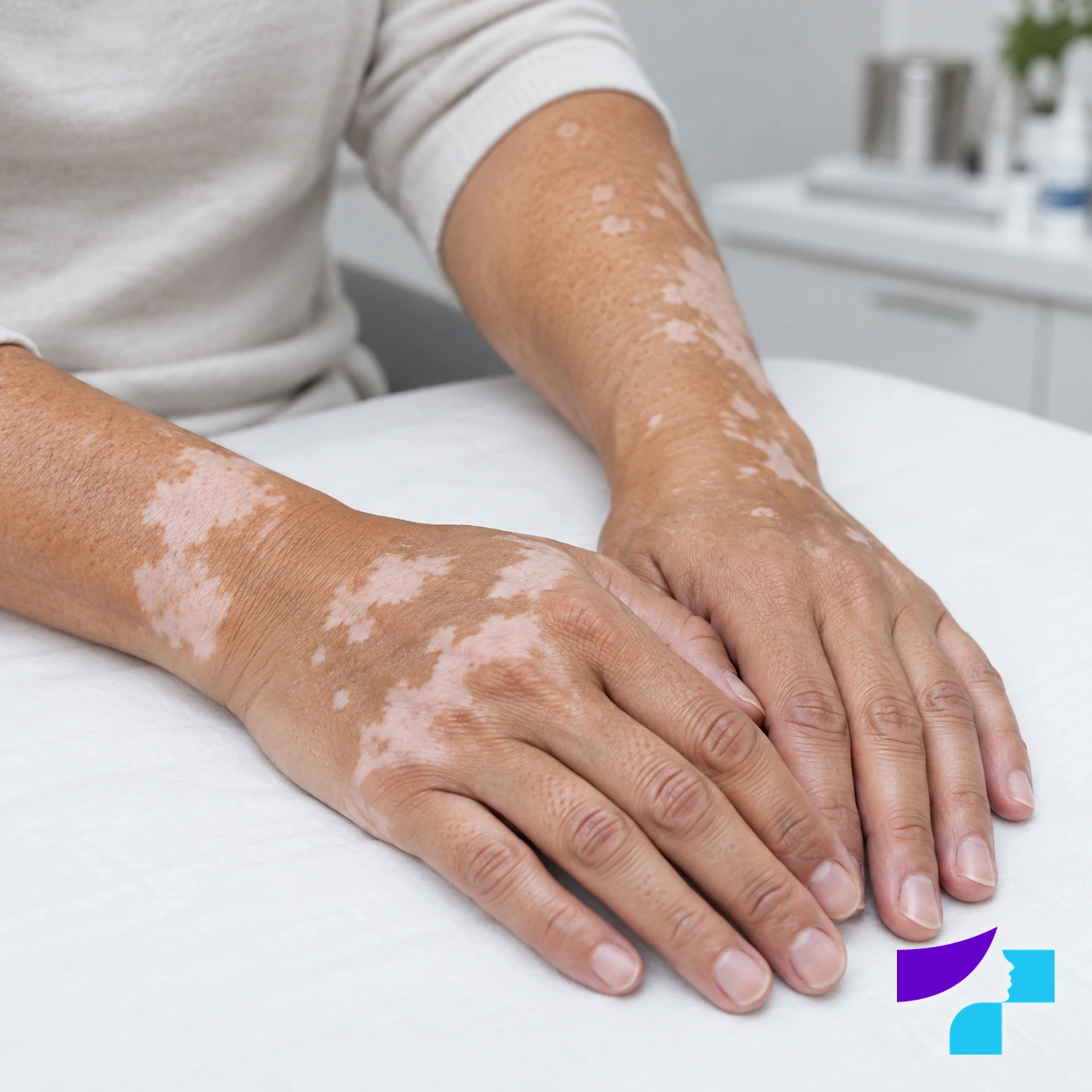
The illustration shows light and white patches characteristic of vitiligo on the hands and forearms. The shape and distribution of patches can vary from person to person.
Possible signs of vitiligo include:
- white patches on the skin;
- loss of pigment on the face, hands, feet, elbows, knees or around body openings;
- patches on both sides of the body, especially in non-segmental vitiligo;
- one localised patch or patches on one side of the body in segmental vitiligo;
- whitening of hair, eyebrows, eyelashes or beard hair in the affected area;
- light patches inside the mouth or nose;
- occasionally mild itching or sensitivity before a new patch appears;
- emotional discomfort due to visible skin changes.
If patches are scaly, red, very itchy, improve with antifungal treatment or appear after eczema, the diagnosis may not be vitiligo. In such cases, a dermatologist’s examination is especially important.
Types of Vitiligo
| Type of vitiligo | Appearance | Typical course | Common treatment options |
|---|---|---|---|
| Non-segmental vitiligo | Patches often appear on both sides of the body | The most common type; may progress in waves | Topical therapy, phototherapy, JAK inhibitors in selected cases, combined treatment |
| Segmental vitiligo | Patches on one side of the body or in one area | Often starts in childhood or adolescence and may stabilise after an active period | Topical therapy, targeted light therapy, sometimes surgical options in stable cases |
| Focal vitiligo | One or a few separate patches | May remain limited or change over time | Observation, topical therapy, targeted therapy |
| Generalised vitiligo | Multiple patches in different body areas | May spread gradually | Phototherapy, topical therapy, combined plan |
| Acrofacial vitiligo | Patches on the face, hands, feet, around the mouth or eyes | Hands and feet often respond less well to treatment | Topical therapy, phototherapy, camouflage |
| Universal vitiligo | Loss of pigment over a very large area of skin | Rare form | Individual plan, sun protection, camouflage, depigmentation therapy in selected cases |
Active or Stable Vitiligo: Why Does It Matter?
When choosing treatment, it is important to understand whether vitiligo is active or stable.
Active vitiligo may be suggested by:
- regular appearance of new patches;
- enlargement of existing patches;
- blurred or inflamed patch borders;
- new patches developing at sites of trauma, scratching, friction or sunburn;
- a rapid increase in the affected skin area.
When depigmentation appears at a site of skin trauma, this is called the Koebner phenomenon. It is an important sign because during active disease, aggressive procedures, tattooing or micropigmentation may trigger new patches.
Stable vitiligo means there have been no new patches and existing patches have not changed significantly for a certain period. Some treatment options, especially surgical methods and micropigmentation, are usually considered only when the disease is stable.
Why Does Vitiligo Develop?
The exact cause of vitiligo cannot always be identified. Most often, it is explained by an autoimmune mechanism in which the immune system damages melanocytes.
Factors that may contribute to vitiligo include:
- genetic predisposition;
- autoimmune conditions in the patient or family;
- thyroid disease;
- skin trauma, friction or surgical scars;
- sunburn;
- chemical exposure, such as phenol-containing substances;
- oxidative stress;
- significant emotional or physical stress.
This does not mean that stress or trauma always causes vitiligo. More often, they act as possible triggers in a person who already has a predisposition.
Is Vitiligo Dangerous?
Vitiligo is usually not physically dangerous and is not contagious. However, it can be medically and emotionally significant.
Important risks and related aspects include:
- depigmented skin burns more easily in the sun;
- sunburn can irritate the skin and may trigger new patches in some patients;
- vitiligo can be associated with other autoimmune conditions;
- visible patches can affect self-confidence and quality of life.
Patients often ask whether vitiligo increases the risk of skin cancer. There is no proven increased risk of skin cancer specifically in depigmented vitiligo patches. However, skin without pigment burns more easily, and anyone can still develop skin cancer due to other risk factors. Therefore, SPF, protective clothing and regular skin checks remain important.
Vitiligo or Another Condition?
White patches on the skin may look similar, but their causes can be different. Self-diagnosis based on internet images is not reliable.
| Condition | Typical appearance | What helps distinguish it |
|---|---|---|
| Vitiligo | Clearly light or white patches, usually without scaling | Under Wood’s lamp the patches appear more clearly depigmented; usually no scaling |
| Tinea versicolor / skin fungus | Lighter or darker patches, more often on the trunk, sometimes with fine scaling | Fungal test may be positive; treatment is antifungal, not vitiligo therapy |
| Pityriasis alba | Light, poorly defined patches, often on the face in children | Often related to dry skin or atopic dermatitis; borders are less sharp |
| Post-inflammatory hypopigmentation | Lighter areas after eczema, psoriasis, trauma or inflammation | Appears after inflammation; pigment often returns gradually |
| Idiopathic guttate hypomelanosis | Small white spots on sun-exposed areas, more common in older adults | Usually small, round spots on forearms or legs |
| Halo nevus | A mole with a pale ring around it | The mole and surrounding skin should be evaluated |
| Chemical leukoderma | Pigment loss in areas exposed to chemicals | Link with work environment, cosmetics or chemical products |
How Is Vitiligo Diagnosed?
Vitiligo diagnosis starts with a dermatologist’s examination and a discussion about onset, progression, family history, other diseases, medications and possible triggers.
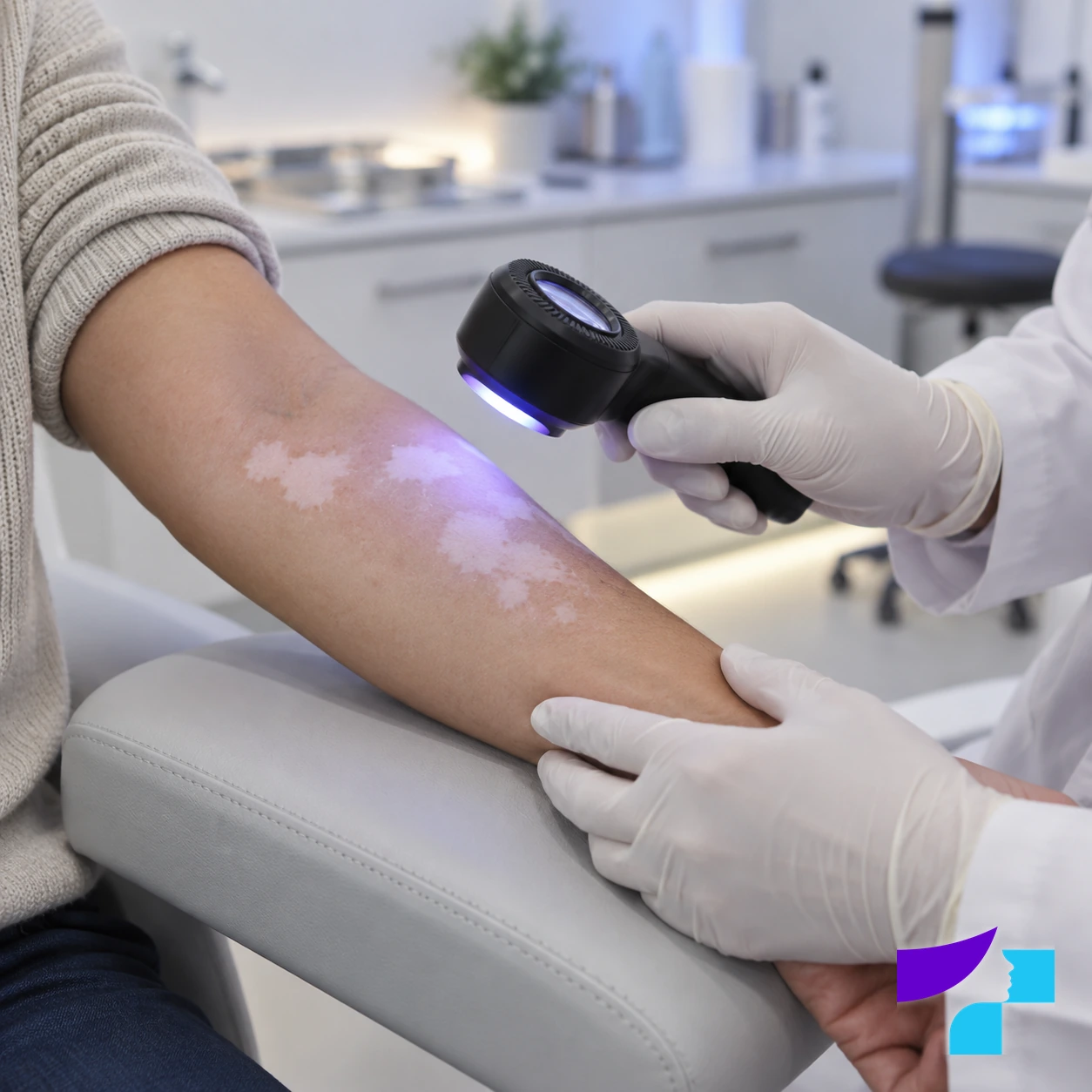
The illustration shows an examination of forearm skin using diagnostic lighting. A dermatologist assesses pigmentation changes to distinguish vitiligo from other causes of light skin patches.
A dermatologist may use:
- skin examination in daylight;
- Wood’s lamp examination to see depigmented areas more clearly;
- dermoscopy;
- clinical photography to compare changes over time;
- blood tests if associated autoimmune disease is suspected;
- rarely, a skin biopsy if the diagnosis is unclear.
In some cases, the doctor may also assess the affected skin area and the impact on quality of life. Tools such as VASI or DLQI may be used medically, but for the patient the key questions are whether the disease is active, how extensive it is and how it affects daily life.
Vitiligo and Other Autoimmune Diseases
Vitiligo can be associated with other autoimmune diseases. The most commonly discussed association is with thyroid disease, but links are also possible with alopecia areata, psoriasis, type 1 diabetes, rheumatoid arthritis, pernicious anaemia and other autoimmune conditions.
This does not mean that every patient with vitiligo has another disease. However, a doctor may recommend checking thyroid function, especially if vitiligo is extensive, autoimmune diseases run in the family or the patient has symptoms such as:
- fatigue;
- weight changes;
- palpitations;
- increased sensitivity to cold or heat intolerance;
- hair loss;
- menstrual changes;
- excessive thirst or frequent urination.
The scope of tests is determined by the doctor after examination and discussion with the patient.
Vitiligo Treatment
Vitiligo treatment should be individual. For one patient, observation, SPF and camouflage may be enough; another may need topical medication, phototherapy or a combined plan.
Treatment goals may include:
- slowing or stopping disease progression;
- supporting repigmentation;
- reducing contrast between patches and surrounding skin;
- protecting the skin from sunburn;
- improving wellbeing and quality of life.
Important: no method guarantees complete and permanent pigment restoration. Results vary depending on location, disease duration, activity and individual response.
Sun Protection and Skin Care
Sun protection is a basic part of daily vitiligo care. Depigmented skin cannot tan like surrounding skin and burns more easily.
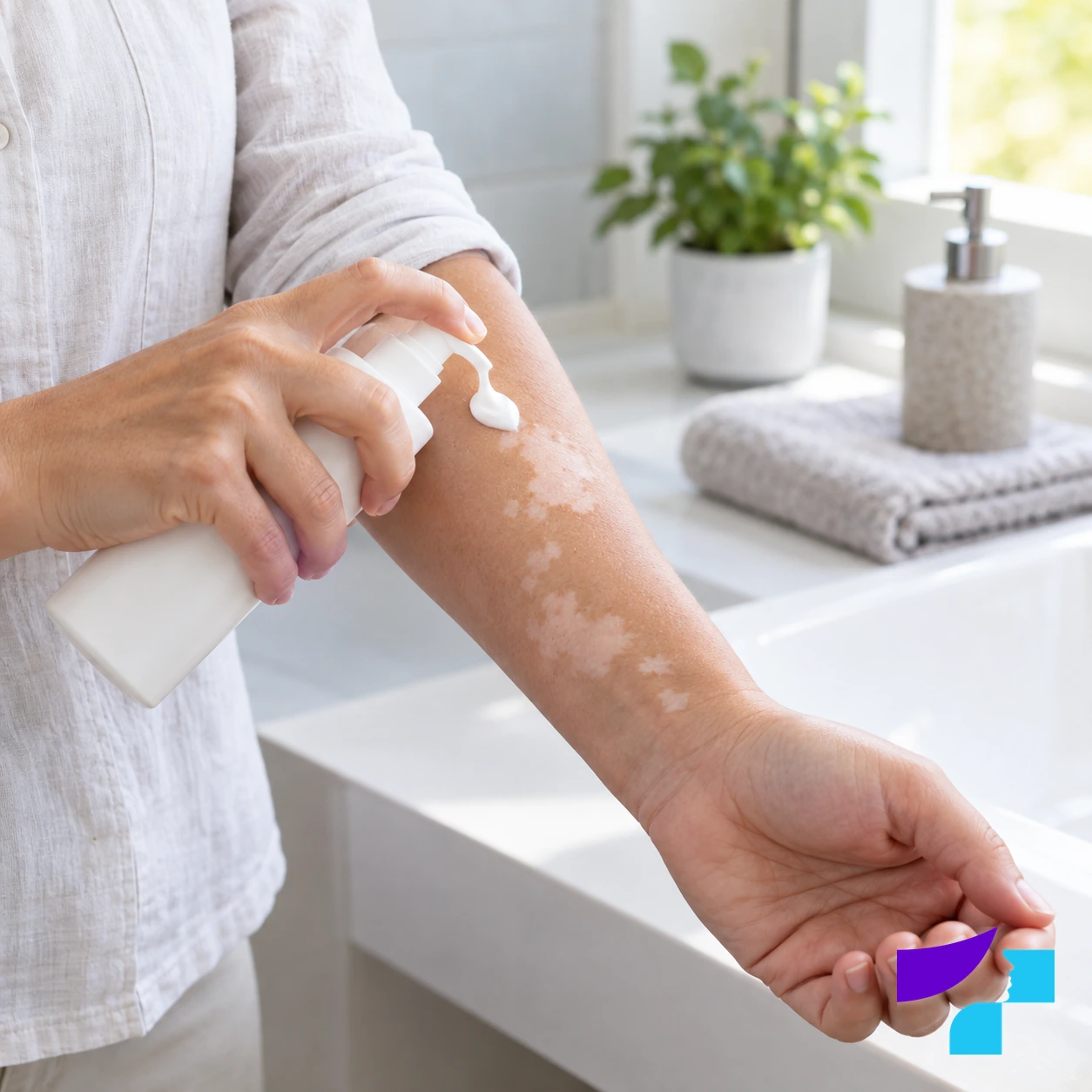
The illustration shows sunscreen being applied to a forearm with vitiligo patches. Sunscreen should be applied to both depigmented areas and the surrounding skin.
Recommended measures include:
- using broad-spectrum SPF 50 or high-protection sunscreen;
- reapplying SPF when spending a long time outdoors, sweating or swimming;
- wearing a hat, sunglasses and protective clothing;
- avoiding sunburn;
- avoiding irritation and trauma to affected skin.
If a person avoids the sun extensively, vitamin D levels and supplementation can be discussed with a doctor.
Topical Corticosteroids
Topical corticosteroids may help reduce inflammatory activity and support repigmentation, especially in newer patches. They should only be used according to a doctor’s instructions.
Possible risks of incorrect or prolonged use include:
- skin thinning;
- visible small blood vessels;
- stretch marks;
- irritation;
- pigmentation changes.
Special caution is needed on the face, eyelids, skin folds and in children.
Calcineurin Inhibitors
Products containing tacrolimus or pimecrolimus may be suitable for vitiligo on the face, neck and more sensitive areas. They do not cause skin atrophy in the same way as corticosteroids, so in selected cases a doctor may use them as part of a longer treatment plan.
The effect develops gradually. Some patients may initially experience burning, warmth or mild irritation at the application site.
JAK Inhibitors
JAK inhibitors are a newer treatment group in vitiligo therapy. In the European Union, ruxolitinib cream is approved for the treatment of non-segmental vitiligo in adults and adolescents from 12 years of age when the face is affected. It is a prescription medicine, and treatment should be started and supervised by a doctor experienced in vitiligo diagnosis and treatment.
This therapy is not suitable for all patients. The doctor assesses:
- the type of vitiligo;
- the affected skin area;
- facial involvement;
- the patient’s age;
- associated conditions;
- medicine availability and safety considerations.
Results usually take several months. If improvement is insufficient, the doctor may review the treatment plan.
Phototherapy
Phototherapy, especially narrowband UVB therapy, is one of the important methods for more extensive vitiligo. It uses a controlled dose of ultraviolet light to influence immune activity in the skin and stimulate repigmentation.
Phototherapy usually requires regular sessions over several months. It is not the same as uncontrolled sunbathing or using a tanning bed. Dose, frequency and duration must be medically determined.
Areas that often respond better include:
- the face;
- the neck;
- the trunk.
Areas that often respond less well include:
- fingertips;
- palms;
- feet;
- areas with white hairs.
Possible side effects include redness, itching, dryness or burns if the dose is not appropriate. Sunburn in vitiligo is especially undesirable.
Excimer Laser and Targeted Light Therapy
Excimer laser or targeted UVB therapy may be suitable for smaller, localised vitiligo patches. It allows treatment of a specific area while affecting less surrounding skin.
This method may be considered, for example, for individual patches on the face or body. Several procedures are usually needed, and results vary depending on location and disease activity.
Surgical Methods
Surgical methods, such as skin grafting or melanocyte transfer, may be suitable for carefully selected patients with stable vitiligo. They are generally not used when vitiligo is actively progressing.
Before such methods, it is important to assess:
- how long the disease has been stable;
- whether the patient tends to form scars or keloids;
- the location of the patches;
- realistic expected results;
- possible risks, including uneven pigmentation or scarring.
Camouflage, Tinted Products and Medical Makeup
Camouflage is a safe and practical option to reduce the contrast between vitiligo patches and surrounding skin. It can be used whether or not the patient chooses medical treatment.
Options include:
- medical makeup;
- water-resistant camouflage products;
- self-tanning products;
- skin tone evening products.
Camouflage does not treat the cause of vitiligo, but it can be very important for quality of life, especially when patches are visible.
Micropigmentation and Vitiligo Camouflage
Micropigmentation, or implanting pigment into the skin, may be considered only in selected stable vitiligo cases. It is not vitiligo treatment but a cosmetic camouflage method.
Before micropigmentation, it is important to assess:
- whether vitiligo is inactive;
- whether there is a risk of Koebner phenomenon;
- whether there is skin inflammation, infection or sunburn;
- whether the patient understands that pigment may change colour over time;
- whether the result may fail to match the skin tone after tanning or seasonal skin colour changes.
In active, progressive vitiligo, micropigmentation may not be recommended because skin trauma can trigger new patches.
Depigmentation Therapy
In very extensive vitiligo, when a large part of the skin has lost pigment, depigmentation of remaining pigmented skin may be considered in selected situations to even out skin tone. This is a serious, long-term and usually irreversible approach that should only be considered under specialist supervision.
Psychological Support
Vitiligo can affect self-confidence, relationships, work, clothing choices and social life. This is especially important for children, teenagers and people with visible patches on the face or hands.
Psychological support, discussion with a doctor, support groups and reliable information can be as important as topical therapy or phototherapy. It is important for the patient to know: vitiligo is not their fault.
Which Treatment Is Suitable for Which Situation?
| Situation | Possible methods | What may improve | Important caution |
|---|---|---|---|
| Vitiligo on the face | Calcineurin inhibitors, JAK inhibitors in selected cases, targeted light therapy | Repigmentation, contrast | Strong medicines should not be used on facial skin without medical advice |
| Vitiligo on the hands | Topical therapy, phototherapy, camouflage | Partial pigmentation, visual contrast | Palms and fingers often respond less well |
| Vitiligo in children | Gentle topical therapy, SPF, dermatologist follow-up | Disease control, skin protection | Do not use adult medicines without a doctor |
| Rapidly progressing vitiligo | Prompt dermatologist consultation, active treatment plan | Slowing spread | Do not delay consultation or perform traumatic procedures |
| Stable vitiligo | Topical therapy, phototherapy, camouflage, surgery in selected cases | Repigmentation or camouflage | Surgery and micropigmentation only after assessment |
| Extensive vitiligo | Phototherapy, topical therapy, SPF, psychological support | Disease control, skin tone, quality of life | A longer plan is needed |
| Small isolated patches | Topical therapy, excimer laser, observation | Local repigmentation | Diagnosis should be confirmed |
| Vitiligo after trauma or burn | Gentle skin care, SPF, dermatologist follow-up | Reducing risk of new patches | Avoid repeated trauma |
| Vitiligo with strong emotional impact | Dermatological care, camouflage, psychological support | Wellbeing and daily comfort | Do not judge the problem only by affected skin area |
How Long Does Vitiligo Treatment Take?
Vitiligo treatment is usually long-term. The first changes may appear only after several months. Pigment often returns gradually - as small pigment dots inside a patch or as colour returning from the edges.
Treatment duration is influenced by:
- disease activity;
- age of the patches;
- location;
- chosen therapy;
- patient adherence;
- skin phototype;
- hair colour in the affected area.
The face and neck usually respond better than the palms, feet and fingertips. If the hair in a patch has turned white, repigmentation may be more difficult because hair follicles are one of the sources of pigment recovery.
Can Vitiligo Stop on Its Own?
The course of vitiligo is unpredictable. In some patients, patches remain unchanged for a long time; in others, they gradually enlarge or appear in new places. In rare cases, some pigment may return spontaneously, but complete spontaneous recovery is uncommon.
If patches spread quickly, appear in a child or are located in visible areas, it is not advisable to wait for years. Early dermatologist consultation helps confirm the diagnosis and choose the most suitable approach.
Vitiligo in Children
Vitiligo can begin in childhood. In children, accurate diagnosis, gentle treatment and emotional support are especially important.
Parents should not:
- use strong prescription creams without medical advice;
- treat a child with products intended for adults;
- rub or irritate the patches;
- rely on unproven products;
- sunbathe the patches with the aim of “bringing pigment back”.
A child should be helped to understand that vitiligo is not contagious and is not their fault. At school or kindergarten, it may be important to reduce stigma and explain that vitiligo is not an infection.
What Should You Avoid With Vitiligo?
- Do not sunbathe without protection.
- Do not use tanning beds as vitiligo treatment.
- Do not use strong creams without a dermatologist’s advice.
- Do not irritate or traumatise the skin.
- Do not use aggressive peels or scrubbing on affected areas.
- Do not start micropigmentation if vitiligo is active.
- Do not rely on “miracle cures” promising complete cure.
- Do not consider vitiligo an infection.
- Do not delay consultation if patches enlarge quickly.
- Do not treat a child with adult medicines without a doctor.
When Should You See a Dermatologist?
It is advisable to see a dermatologist if:
- new white patches appear on the skin;
- patches enlarge or become more numerous;
- patches are on the face, hands, feet or genital area;
- patches appear in a child;
- there is itching, scaling or redness;
- skin fungus or another condition is suspected;
- there is a family history of autoimmune disease;
- there are symptoms of thyroid dysfunction;
- vitiligo significantly affects wellbeing or self-confidence.
Common Myths About Vitiligo
Myth: Vitiligo Is Contagious
In reality, vitiligo is not contagious and cannot be caught from another person.
Myth: Vitiligo Is Caused by Poor Hygiene
Vitiligo is not related to dirt or inadequate skin care.
Myth: All White Skin Patches Are Vitiligo
White patches can also occur due to fungal infection, eczema, post-inflammatory changes or other pigmentation disorders.
Myth: Vitiligo Always Spreads Over the Whole Body
In some patients the disease progresses, while in others patches remain stable for years.
Myth: Vitiligo Cannot Be Treated
Treatment options exist, but results are individual and take time.
Myth: Sunbathing Helps Even Out Skin Colour
Sunbathing often increases contrast and can cause burns.
Myth: One Cream Is Enough to Treat Vitiligo
Topical therapy helps some patients, but a longer or combined plan is often needed.
Myth: Micropigmentation Is Suitable for All Patients With Vitiligo
It may be suitable only in selected stable vitiligo cases after careful assessment.
Summary
Vitiligo is a chronic skin pigmentation disorder in which light or white patches appear on the skin. It is not contagious and is not an infection, but it is often associated with autoimmune processes.
Not all white skin patches are vitiligo, so dermatological diagnosis is important. A doctor can distinguish vitiligo from skin fungus, post-inflammatory changes and other pigmentation disorders.
Vitiligo treatment should be individual. For some patients, observation, SPF and camouflage are suitable; others may need topical therapy, phototherapy, JAK inhibitors or combined treatment. The best approach is chosen by a dermatologist, taking into account disease activity, patch location and the patient’s needs.
References and Authoritative Sources
- American Academy of Dermatology (AAD): overview of vitiligo
- American Academy of Dermatology (AAD): vitiligo diagnosis and treatment
- National Institute of Arthritis and Musculoskeletal and Skin Diseases (NIAMS): vitiligo
- MedlinePlus: patient information about vitiligo
- DermNet: vitiligo signs, causes and treatment
- National Health Service (NHS): vitiligo
- British Association of Dermatologists: patient information about vitiligo
- NCBI Bookshelf: medical overview of vitiligo
- European Medicines Agency (EMA): information about ruxolitinib cream for vitiligo
