Dandruff
Dandruff is excessive flaking of the scalp: dead cells from the outermost layer of skin become visible as white or greyish flakes in the hair and on clothing. Mild itching may also occur. Dandruff is not contagious and is not a sign of poor hygiene. Scalp oils, yeasts that form part of the normal skin microbiota, and individual skin susceptibility all play a role in its development.
Mild dandruff can often be controlled with appropriate scalp care and topical treatments. However, not all scalp flaking is dandruff. Marked redness, pain, oozing or patches of hair loss may indicate another condition and warrant medical assessment.
Key facts about dandruff
- Dandruff can also occur on an oily scalp; it is not the same as dry skin.
- Dandruff is often considered a mild manifestation within the spectrum of seborrheic dermatitis, without marked visible inflammation.
- Treatment is chosen according to the cause of flaking, not just the appearance of the flakes.
- The effectiveness of a medicated shampoo also depends on applying it correctly to the scalp.
- If there is no improvement after about four weeks, medical advice is needed. There is no need to wait a month if inflammation or hair loss is present.
- Symptoms may recur; some people need maintenance treatment.
What is dandruff and what does it look like?
The outermost layer of skin is continually renewed. Old cells are shed, and this process normally goes unnoticed. When cell renewal and shedding change, cells may clump together into visible scales.
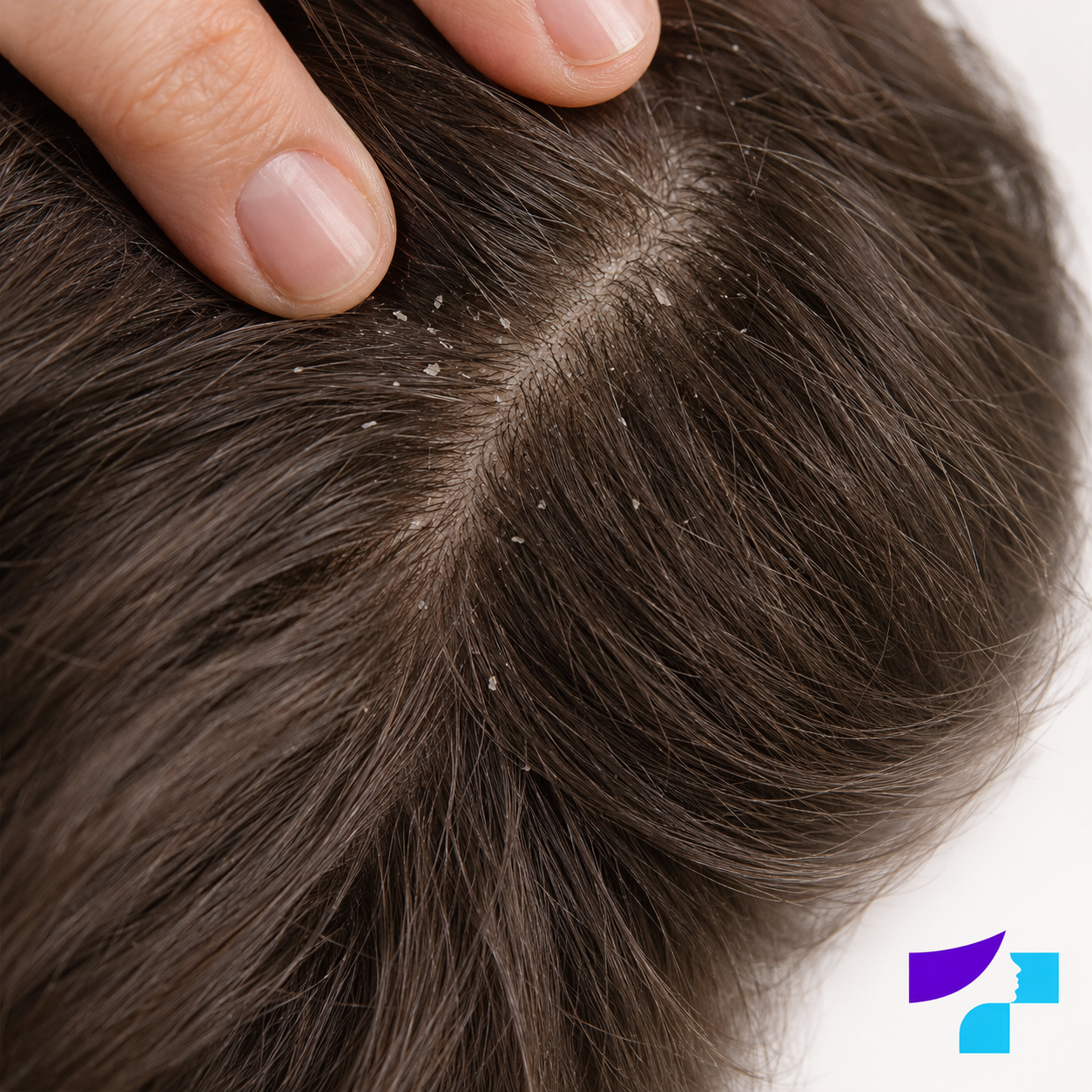
Dandruff typically causes fine, widespread flaking within the hair-bearing scalp. Flakes may fall easily onto the shoulders or remain among the hairs. Itching sometimes occurs, but marked inflammation, pain and pustules are not typical of uncomplicated dandruff.
The everyday terms “dry dandruff” and “oily dandruff” describe appearance: scales may be fine and loose, or more adherent and greasy. These descriptions are not sufficient to establish a diagnosis. A yellowish colour alone does not confirm a particular condition either.
What causes dandruff?
Dandruff cannot be explained by a single cause. The interaction of three factors is important:
- Sebum — oily substances produced by the sebaceous glands that coat the skin and hair.
- Malassezia yeasts — microorganisms that may form part of the normal skin microbiota.
- Individual skin susceptibility — characteristics of the skin barrier and its response to irritants and substances produced by microorganisms.
Malassezia uses skin lipids, or fats. The products of their breakdown may promote irritation and flaking in susceptible skin. This does not mean that the person has acquired an infection or that the yeast must be eliminated completely. The amount of yeast alone does not explain all symptoms.
Stress and cold weather may make dandruff worse in some people. Infrequent washing allows sebum and scales to accumulate, while harsh degreasing or an irritating product may worsen scalp discomfort. Care therefore needs to be adapted to the individual situation.
Is dandruff contagious?
Ordinary dandruff and seborrheic dermatitis are not contagious. They cannot be acquired simply by being near another person.
A dermatophyte infection of the scalp, or tinea capitis, is different. It is a separate condition that may spread through contact with an infected person, animal or object. Its treatment differs from dandruff management.
Dandruff or a dry scalp?
A dry scalp may flake, itch and feel tight. Moisture loss, dry air, irritating hair care products or excessive washing with degreasing products may contribute to dryness.
Dandruff, by contrast, is associated with the interaction between sebum, the skin microbiota and skin susceptibility. It can also affect people whose scalp becomes oily quickly. Both conditions may produce fine white flakes, so flake size alone cannot reliably establish the cause.
Dry hair does not necessarily mean a dry scalp. The ends may be dry or chemically damaged while the skin at the roots is oily. Scalp treatment and care of the hair lengths may therefore require different approaches: applying the treatment to the skin and using a suitable conditioner or other gentle care on the hair lengths.
How is dandruff related to seborrheic dermatitis?
Dandruff is often described as the mildest manifestation within the spectrum of seborrheic dermatitis, confined to the hair-bearing scalp and occurring without marked clinically visible inflammation.
In more pronounced seborrheic dermatitis, flaking is accompanied by redness and more noticeable itching. Changes may also affect the eyebrows, creases beside the nose, beard area and skin behind the ears. Flaking in these areas should not automatically be labelled dandruff — a doctor needs to assess the possible cause.
Read more about the symptoms and treatment in the article on seborrheic dermatitis.
What other conditions can look like dandruff?
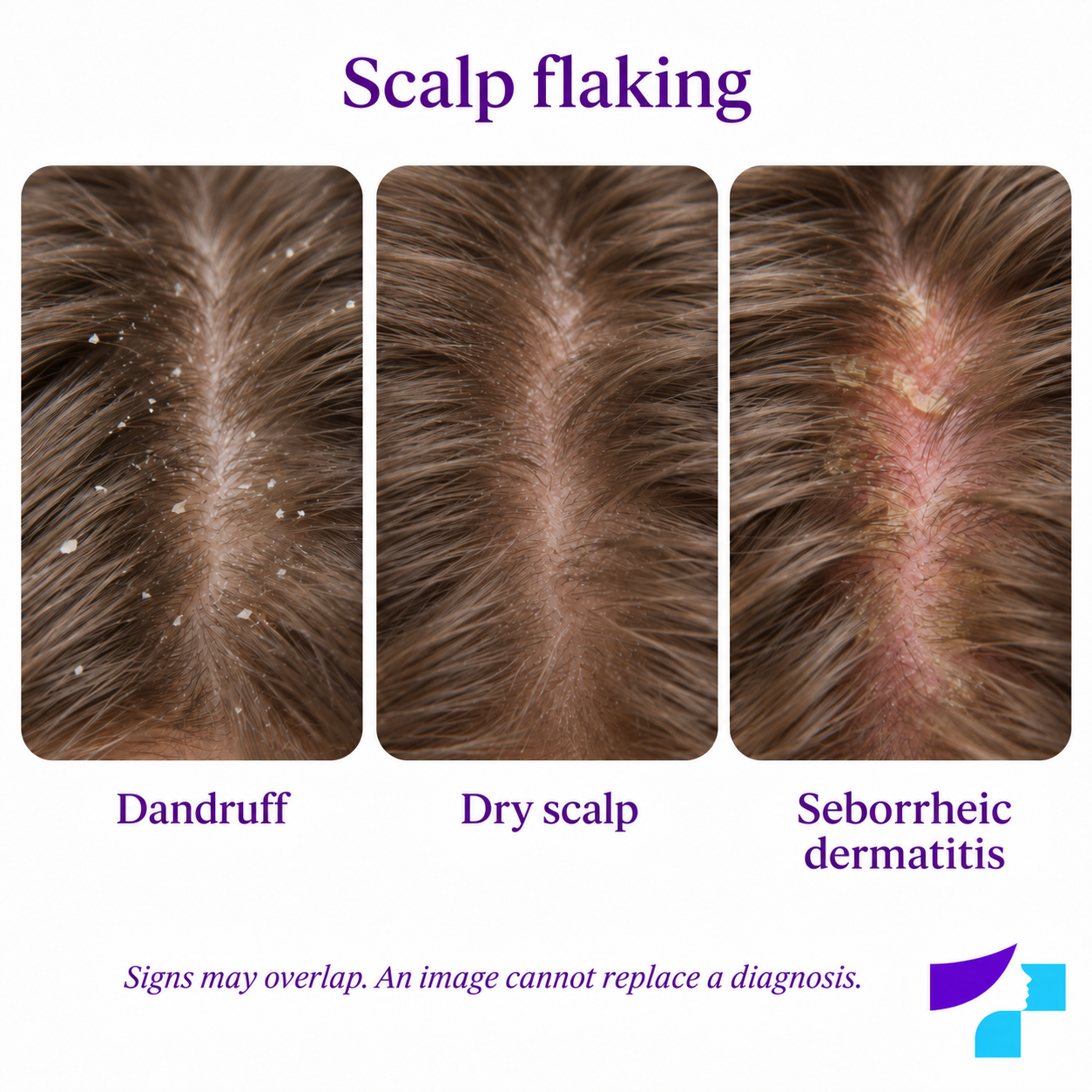
Several different conditions can cause scalp flaking. Distinguishing between them matters because treatment is not the same.
| Condition | Typical signs | When medical assessment is needed |
|---|---|---|
| Dandruff | Fine, widespread scales; mild itching may occur without marked inflammation | If symptoms persist or the cause is unclear |
| Dry scalp | Fine flaking, tightness and sensitivity | If symptoms persist despite gentler care |
| Seborrheic dermatitis | Flaking with redness; may also affect the eyebrows, face and skin behind the ears | If inflammation is pronounced, widespread or recurrent |
| Scalp psoriasis | Thicker, well-defined scaly patches that may extend beyond the hairline | To establish the diagnosis and choose treatment |
| Contact dermatitis | Itching, burning, redness or blisters after contact with an irritant or allergen | If the reaction is pronounced, persistent or recurrent |
| Tinea capitis | Flaking with broken hairs, patches of hair loss or painful swelling | Promptly, particularly in a child |
| Head lice and nits | Itching, scratch marks, nits attached to hairs or live lice | If the findings are unclear or treatment is not helping |
| Hair care product residue | Particles on the scalp or hair after product use | If itching or inflammation persists after washing |
These signs can help with orientation but do not replace a diagnosis. More than one condition may be present at the same time, such as seborrheic dermatitis and psoriasis.
Flaking after hair colouring
If symptoms begin after colouring the hair or using a new hair care product, irritant or allergic contact dermatitis should be considered. Burning, swelling and a rash along the hairline, on the ears or neck are particularly relevant. The reaction may also be delayed.
Dandruff or nits?
Dandruff flakes are usually easier to remove, whereas nits are firmly attached to the hair shaft. However, this feature alone does not reliably confirm head lice. Finding live lice is important when establishing an active infestation.
How does a doctor identify the cause of scalp flaking?
Typical mild dandruff can usually be assessed through a symptom history and scalp examination. The doctor asks about symptom onset, duration, recurrence, itching, signs of inflammation and changes in the hair.
Information about products used, washing habits, recent hair colouring and previous treatment is important during the consultation. Photographs of ingredient lists or packaging and a record of how long products have been used can be helpful.
In unclear cases, trichoscopy — examination of the hair and scalp under magnification — may help assess hair shafts and signs of inflammation. It is not required for every patient.
If a dermatophyte infection is suspected, scales or hairs are examined. Patch testing may be performed if contact allergy is suspected, while a biopsy is needed only in selected unclear cases.
Ordinary dandruff alone is not an indication for a broad panel of blood, hormone, vitamin or microbiome tests. Detecting Malassezia does not confirm disease either, because it is also found on healthy skin.
How is dandruff treated?
The aims of treatment are to reduce flaking and itching, protect the skin barrier and, when necessary, control inflammation. If another condition is causing the flaking, treatment needs to address that condition.
How topical treatments work
Regular scalp cleansing that is well tolerated is important in mild dandruff. If this is not enough, treatments with a specific purpose are used.
| Approach | Purpose | Main limitation |
|---|---|---|
| Antifungal action, for example ketoconazole | Reduce the Malassezia-associated process when appropriately indicated | Does not treat every cause of scalp flaking |
| Scale-loosening action, for example salicylic acid | Help reduce the build-up of scales | May irritate; does not replace treatment of inflammation or infection |
| Gentle cleansing and care | Reduce irritation and provide well-tolerated daily care | May not be sufficient on its own for active dandruff or inflammation |
| Doctor-prescribed anti-inflammatory treatment | Control the manifestations of a diagnosed inflammatory condition | Used for specific indications, rather than long-term treatment of any flaking |
The suitability of a particular treatment depends on its indications, ingredients, the patient's age and scalp condition. Follow the instructions for the preparation available in Latvia; recommendations from other countries cannot automatically be applied to all locally available products.
Why does correct shampoo use matter?
Medicated shampoo needs to be applied to the scalp, where the flaking occurs. If it mainly reaches the hair lengths or is rinsed off too quickly, its effect may be insufficient.
Follow the specific product instructions for application, contact time and frequency. There is no single treatment course for all preparations. More frequent use or leaving a product on longer does not guarantee better results and may increase irritation.
How often should hair be washed?
One answer does not suit everyone. Washing frequency is adapted to scalp oiliness, hair texture, physical activity and treatment.
An oily scalp may need more frequent washing. With dry or tightly curled hair, the risk of drying out the hair needs to be considered. The frequency of medicated shampoo use and overall hair washing may differ; gentle cleansing can be used between treatments when needed.
When are anti-inflammatory medicines needed?
In pronounced seborrheic dermatitis or another diagnosed inflammatory condition, a doctor may prescribe topical anti-inflammatory treatment. Corticosteroids are not a universal everyday remedy for dandruff, and a doctor determines how long they should be used.
Oral antifungal medicines are not a self-treatment for ordinary dandruff. In tinea capitis, however, shampoo alone is not sufficient because the infection also affects the hair and requires doctor-prescribed systemic treatment.
What if treatment is not helping?
If there is no improvement, both the diagnosis and the way treatment is being used need to be reviewed, rather than only the choice of product.
Important questions include:
- whether the flaking is actually dandruff;
- whether the treatment is being applied to the scalp;
- whether the contact time and frequency are being followed;
- whether treatment has continued for long enough;
- whether irritation has developed;
- whether another skin condition is also present.
Frequently switching between several products makes it harder to assess the outcome. If a correctly used approach does not improve symptoms within about four weeks, medical advice is needed. Seek help sooner if the condition worsens or inflammation develops.
Does the scalp get used to a medicated shampoo?
A reduced effect does not in itself prove that the scalp has become used to the shampoo. Disease activity, the way the product is used or scalp tolerance may have changed. Another diagnosis is also possible.
Sometimes the active ingredient or treatment approach needs to be changed, but there is no universal rule that everyone should regularly switch shampoos regardless of the outcome.
What does burning after application mean?
Burning, new redness or increasing itching may indicate an adverse reaction. They are not signs that the treatment is working more strongly.
Rinse the product off and stop using it. If the reaction is pronounced or does not settle, consult a doctor or pharmacist.
Daily care and scalp exfoliation
Care should reduce irritation rather than aim to remove all oils or mechanically scrub the skin clean. Comfortably warm water, gentle washing with the fingertips and thorough rinsing are recommended.
Avoid scratching with fingernails, vigorous rubbing and excessively hot hairdryers. Dry shampoo does not replace scalp washing. If a particular styling or care product repeatedly causes symptoms, its use should be reviewed.
Scalp exfoliation is not an essential step in dandruff treatment. A scale-loosening active ingredient and a mechanical scrub are not the same. A doctor may recommend an approach to soften thick scales, but inflamed skin should not be vigorously rubbed and crusts should not be picked off.
Do pillowcases and combs matter?
Keeping personal items reasonably clean is part of everyday hygiene, but changing a pillowcase or choosing a particular fabric does not replace dandruff treatment. There is no basis for explaining ordinary dandruff as continuous reinfection from a pillow.
If a reaction to laundry detergent or another substance in contact with the skin is suspected, contact dermatitis should be considered. For a confirmed contagious infection, a doctor provides separate advice about shared items.
Home remedies and nutrition
Vinegar, lemon juice, baking soda and undiluted essential oils are not standard treatments for dandruff. These substances may irritate the skin, particularly if it is already inflamed or scratched.
There are individual studies of tea tree oil in specific formulations, but these do not justify using undiluted oil or homemade mixtures. Applying oils is not a universal solution either: softening scales and controlling the condition are different objectives.
A balanced diet is important for general health. However, dandruff alone is not a reason to prescribe vitamins, biotin, zinc, probiotics or a restrictive diet. An identified nutrient deficiency is corrected when medically indicated. It is not justified to explain every case of dandruff by sweets, toxins or changes in the gut microbiome.
Does dandruff cause hair loss?
Ordinary dandruff alone does not mean baldness or irreversible damage to hair follicles.
However, marked inflammation, vigorous scratching and other scalp conditions may be associated with hair breakage or shedding. For example, a dermatophyte infection damages hairs, while severe scalp psoriasis can sometimes be associated with hair loss.
Bald patches, hairs breaking close to the scalp or pronounced hair loss should not be attributed to dandruff alone. The cause needs to be assessed.
Dandruff in children and teenagers
Dandruff may develop during adolescence as the sebaceous glands become more active. Scalp flaking in children needs careful assessment, especially when accompanied by changes in the hair.
Broken hairs, patches of hair loss or painful swelling may indicate tinea capitis. In this situation, a medical examination is needed rather than prolonged trials of different shampoos.
If a topical treatment is prescribed for a child, parents should check that it is age-appropriate and used correctly. Preparations intended for adults should not automatically be assumed suitable.
Cradle cap is a manifestation of infantile seborrheic dermatitis. It often causes greasy scales and improves over time. Care differs from adult treatment; crusts should not be picked off.
When should you see a doctor?
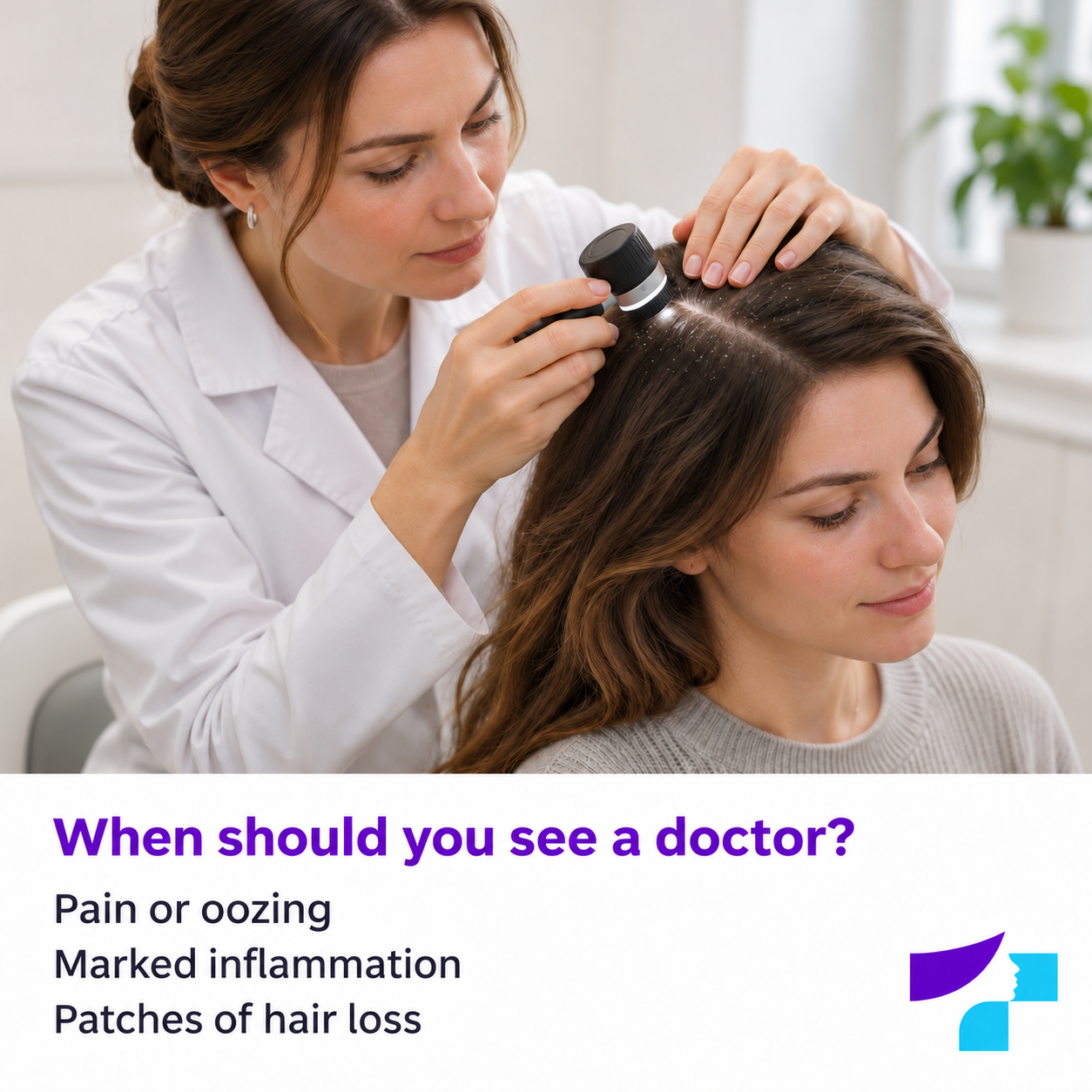
A dermatology consultation is appropriate if:
- there is no improvement after about four weeks;
- itching is pronounced or disrupts sleep;
- there is persistent redness, thick scaling or extensive patches;
- flaking also affects the face or other body areas;
- symptoms recur after hair colouring or use of a particular product;
- it is unclear whether the problem is dandruff.
Prompt assessment is needed for pain, burning, oozing, pustules, pronounced crusting, broken hairs or patches of hair loss. Rapidly increasing painful swelling, especially with fever, requires urgent assessment.
Difficulty breathing or swelling of the tongue or throat after using hair dye or another product requires emergency medical assistance.
Why does dandruff come back?
Treatment can reduce symptoms, but individual skin susceptibility may remain. Some patients therefore need less frequent maintenance treatment after improvement, following the instructions or their doctor's advice.
Recurrence does not mean that a person has poor hygiene or was previously treated incorrectly. However, if symptoms change or become harder to control, the diagnosis should be reviewed. A single course cannot be guaranteed to remove dandruff permanently.
Dandruff and emotional wellbeing
Visible flakes, itching and worries about other people's reactions can affect self-esteem and daily life. Dandruff is not something to be ashamed of. If symptoms cause discomfort or persistent worry, seeking professional help is reasonable.
Medical disclaimer
This information is for educational purposes and does not replace an individual medical consultation, diagnosis or treatment. See a doctor if scalp flaking is accompanied by marked redness, pain, swelling, oozing, pustules or patches of hair loss, or if symptoms do not improve with appropriate self-care. Use medicinal treatments according to the instructions and the advice of a doctor or pharmacist.
References and authoritative sources
- UK National Health Service (NHS): dandruff
- DermNet: seborrheic dermatitis
- American Academy of Dermatology (AAD): how to treat dandruff
- American Academy of Dermatology (AAD): diagnosis and treatment of seborrheic dermatitis
- American Academy of Dermatology (AAD): self-care for seborrheic dermatitis
- British Association of Dermatologists (BAD): seborrhoeic dermatitis
- Borda LJ, Wikramanayake TC: a comprehensive review of seborrheic dermatitis and dandruff (2015)
- Cleveland Clinic: dry scalp — causes, treatment and prevention
- DermNet: scalp dermatophyte infection (tinea capitis)
- DermNet: scalp psoriasis
- UK National Health Service (NHS): hair dye reactions
- UK National Health Service (NHS): head lice and nits
- UK National Health Service (NHS): side effects of ketoconazole
- UK National Health Service (NHS): common questions about ketoconazole
- UK National Health Service (NHS): cradle cap
- Satchell AC and colleagues: treatment of dandruff with 5% tea tree oil shampoo — a clinical study (2002)
Content author
Frequently Asked Questions
Consultation fee
| Specialists | Clients of the clinic | First visit |
|---|---|---|
| Trichologist Ivanna Buvan | 57.00 € | 60.00 € |
| Dermatologist Dr. Med. assistant professor Māra Rone-Kupfere | 76.00 € | 80.00 € |
| Dermatologist Dace Buile | 66.50 € | 70.00 € |
| Dermatologist Gunita Buiksa | 57.00 € | 60.00 € |
| Dermatologist Ilona Zablocka | 57.00 € | 60.00 € |
| Dermatologist Zanda Bogdanova | 57.00 € | 60.00 € |



 +1
 +1
 +1 242
 +1 246
 +1 268
 +1 441
 +20
 +212
 +213
 +216
 +218
 +220
 +221
 +222
 +223
 +223
 +224
 +225
 +226
 +227
 +228
 +229
 +230
 +231
 +232
 +234
 +235
 +236
 +237
 +238
 +239
 +239
 +240
 +241
 +242
 +243
 +244
 +245
 +248
 +249
 +250
 +251
 +252
 +253
 +254
 +255
 +256
 +257
 +258
 +260
 +261
 +262
 +263
 +264
 +265
 +266
 +267
 +268
 +269
 +269
 +27
 +284
 +290
 +291
 +297
 +298
 +299
 +30
 +31
 +32
 +33
 +34
 +340
 +345
 +350
 +351
 +352
 +353
 +354
 +355
 +356
 +358
 +359
 +36
 +370
 +371
 +372
 +373
 +374
 +375
 +376
 +377
 +378
 +380
 +385
 +386
 +387
 +389
 +39
 +39
 +40
 +41
 +41
 +420
 +421
 +43
 +45
 +46
 +47
 +473
 +48
 +49
 +500
 +501
 +502
 +503
 +504
 +505
 +506
 +507
 +509
 +51
 +52
 +53
 +54
 +55
 +56
 +57
 +58
 +590
 +591
 +593
 +594
 +594
 +595
 +596
 +597
 +598
 +60
 +61
 +62
 +63
 +64
 +649
 +65
 +66
 +664
 +671
 +672
 +672
 +672
 +673
 +674
 +675
 +676
 +677
 +678
 +679
 +680
 +681
 +682
 +683
 +684
 +686
 +687
 +688
 +689
 +690
 +691
 +692
 +6982
 +7
 +7
 +7
 +7
 +758
 +767
 +784
 +809
 +809
 +81
 +82
 +84
 +850
 +852
 +853
 +856
 +86
 +868
 +869
 +876
 +880
 +885
 +886
 +90
 +91
 +92
 +93
 +94
 +95
 +960
 +961
 +962
 +963
 +964
 +965
 +967
 +968
 +971
 +972
 +973
 +974
 +975
 +976
 +977
 +98
 +993
 +994
 +995
 +996
 +996