Alopecia Areata
Alopecia areata is an autoimmune condition in which the immune system mistakenly targets hair follicles and causes hair loss. Most people first notice one or more round or oval bald patches. The condition can also affect the beard, eyebrows, eyelashes and body hair.
Alopecia areata is not contagious, and hair regrowth is possible. However, its course varies: some people regrow hair without treatment, while others develop new patches or more extensive hair loss. A sudden bald patch should be assessed by a doctor because other conditions can look similar.
At a glance: key facts about alopecia areata
- It is a specific autoimmune condition that can develop in both children and adults.
- The typical sign is clearly defined bald patches with largely normal-looking skin.
- Hair follicles are generally not replaced by scar tissue, so the potential for regrowth remains.
- Diagnosis is usually based on examination and trichoscopy; not everyone needs the same set of blood tests.
- Treatment depends on the extent and activity of the condition, age and its impact on quality of life.
- Hair regrowth does not mean that the condition will never return.
What is alopecia areata?
Alopecia is a general medical term for hair loss. Alopecia areata is one specific type. You can find a broader overview of the different causes of hair loss in our article on alopecia.
A hair follicle is a structure in the skin from which a hair grows. In alopecia areata, inflammation caused by the immune system disrupts follicle function and normal hair growth. It is a non-scarring form of alopecia: the follicle may retain the ability to produce a new hair even after prolonged hair loss. However, this does not guarantee complete regrowth.
Unlike androgenetic alopecia, which more often causes gradual thinning in characteristic areas of the scalp, alopecia areata usually starts with suddenly noticeable patches. The mechanisms and treatment approaches differ.
What causes alopecia areata?
The condition involves an immune response that is mistakenly directed against hair follicles. This does not simply mean a “weak immune system”, and nonspecific “immune boosting” is not a treatment. It is not always possible to establish why this response begins in a particular person at a particular time.
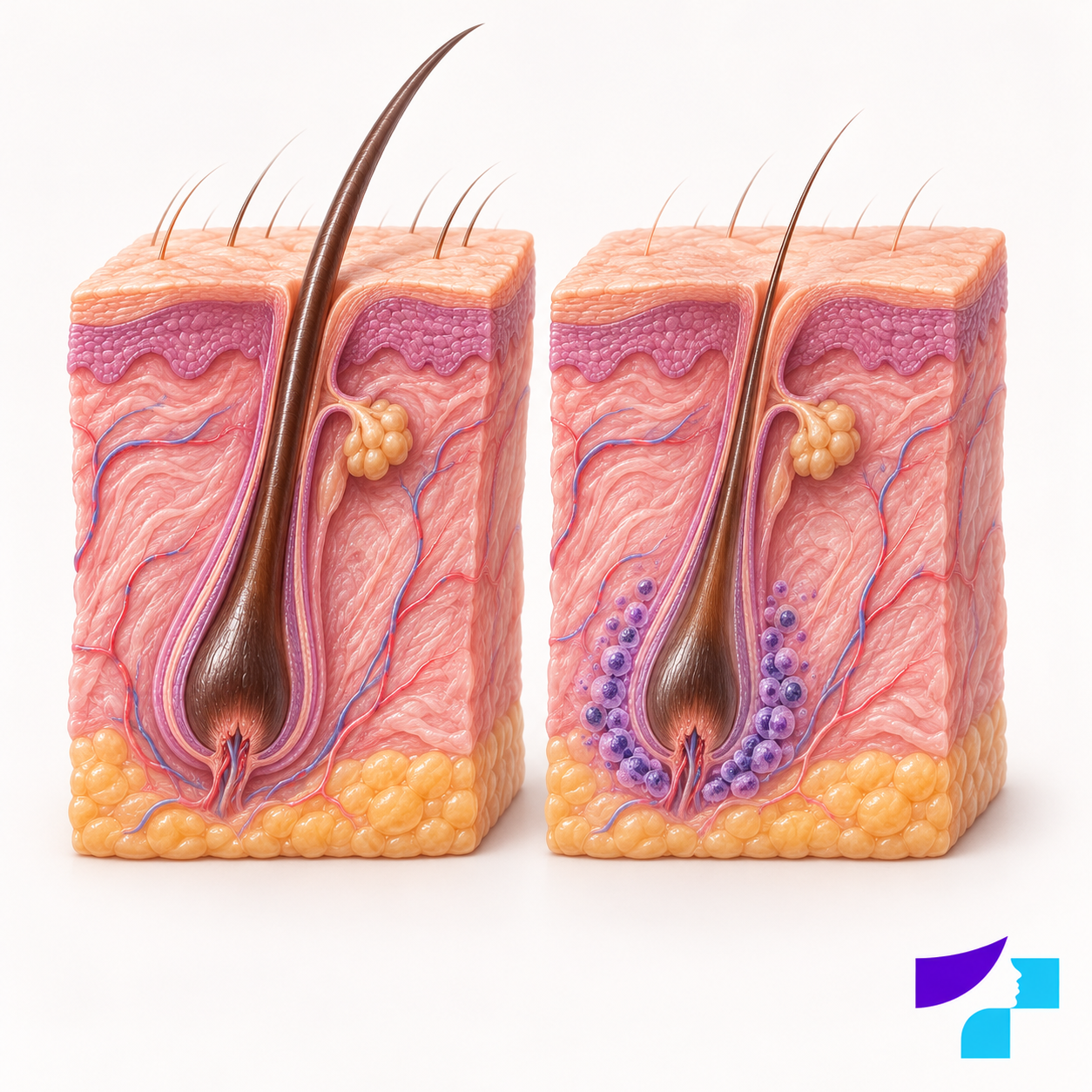
Simplified medical illustration: a normally functioning hair follicle is shown on the left, and immune cells around the hair bulb on the right. In alopecia areata, the immune response disrupts hair growth, but the potential for regrowth may remain.
Genetic predisposition
Several genetic factors contribute to the condition. Having a close relative with alopecia areata may increase the likelihood of developing it, but inheritance does not follow a simple, single pattern. Many people have no family history of the condition.
Stress and previous illness
Some people notice their first patch after an emotionally difficult period or an infection. These events may be possible triggers, but occurring around the same time does not prove causation. Many people have no identifiable trigger.
The patient is not to blame for developing the condition. Stress management may improve well-being, but it is not a guaranteed way to regrow hair.
Associated conditions and nutritional factors
Alopecia areata occurs more often alongside certain other conditions, including autoimmune thyroid disease, vitiligo and atopic dermatitis. This does not mean that everyone with alopecia areata has, or will develop, these conditions.
Iron, vitamin D or other nutritional deficiencies may need separate assessment, but they should not automatically be considered the cause of a round bald patch. Correcting a deficiency and treating an autoimmune condition are different tasks.
What are the early signs and symptoms?
Scalp hair
A clearly defined round or oval bald patch typically appears. It may be noticed by chance while brushing or washing the hair, or during a visit to a hairdresser. There may be a single patch, several separate patches or areas that merge.
The skin usually looks smooth, without marked scaling or scarring. Some people experience itching, tingling or burning before or during hair loss. Significant pain, pus-filled spots and crusting are not typical of an uncomplicated patch and warrant assessment for an additional or different cause.
At the edge of a patch, the doctor may see short, broken hairs that are narrower near the skin than at the free end. These are called exclamation mark hairs. They are one possible diagnostic sign, rather than a reliable way to diagnose the condition at home.
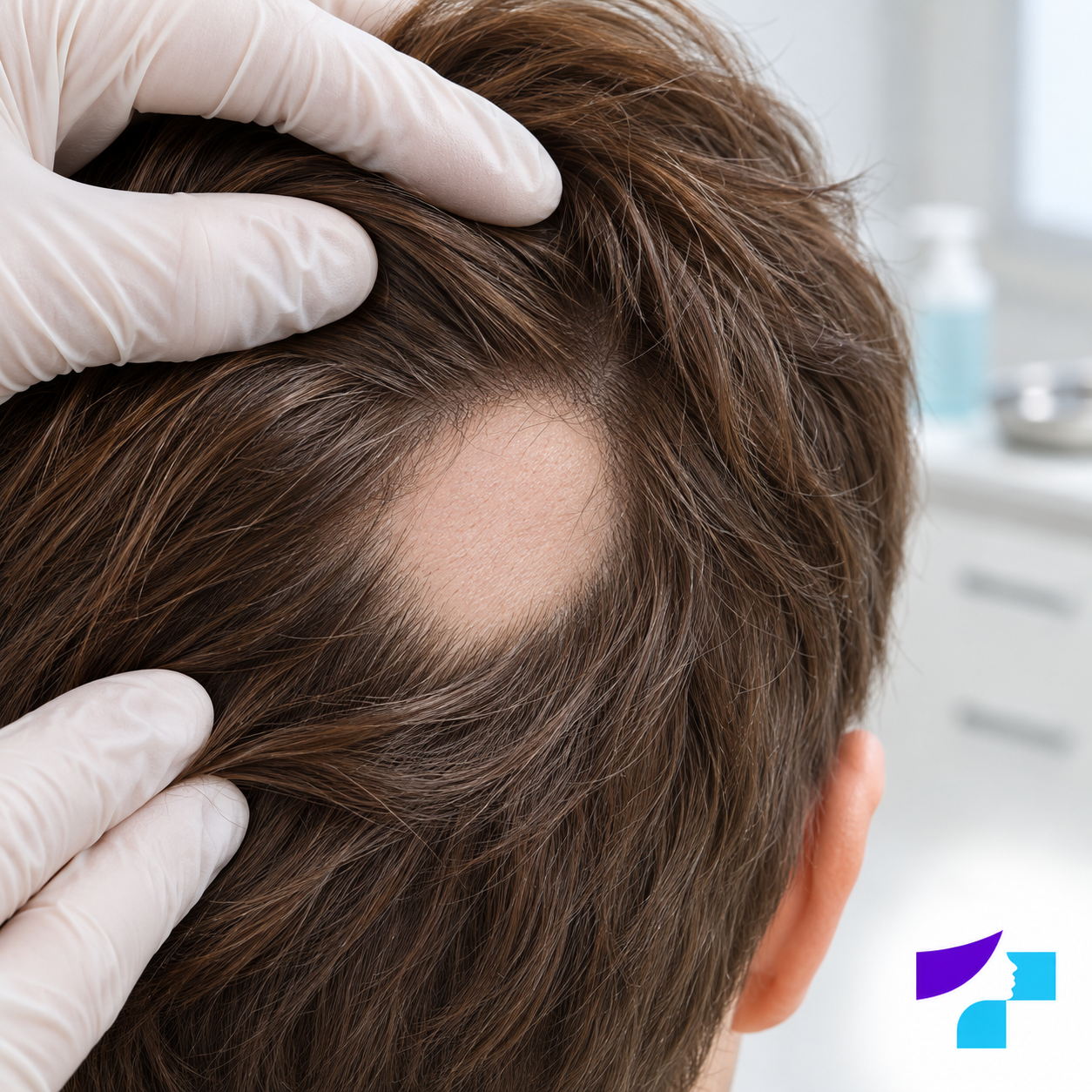
Illustrative depiction of alopecia areata: a clearly defined round bald patch with largely normal-looking skin. Other conditions can cause similar changes, so a doctor must establish the diagnosis.
Beard, eyebrows, eyelashes and body hair
Round or oval bald patches can appear in the beard; this location is sometimes referred to as alopecia barbae. Some eyebrow, eyelash or other body hair may also be lost.
Loss of eyebrows and eyelashes can be particularly troublesome because of both appearance and their role in protecting the eyes. Tell your doctor if your eyes become dry or irritated.
Nail changes
Some people develop small pits, ridges or roughness on the surface of their nails. These changes are not specific to alopecia areata, so the nails are assessed together with the other findings.
What forms can alopecia areata take?
| Form | Typical presentation |
|---|---|
| Patchy alopecia areata | One or more clearly defined bald patches |
| Ophiasis | A band of hair loss mainly along the hairline at the back and sides of the scalp |
| Alopecia totalis | Complete or almost complete loss of scalp hair |
| Alopecia universalis | Complete or almost complete loss of scalp, facial and body hair |
| Diffuse presentation | More widespread hair loss without the classic clearly defined patches |
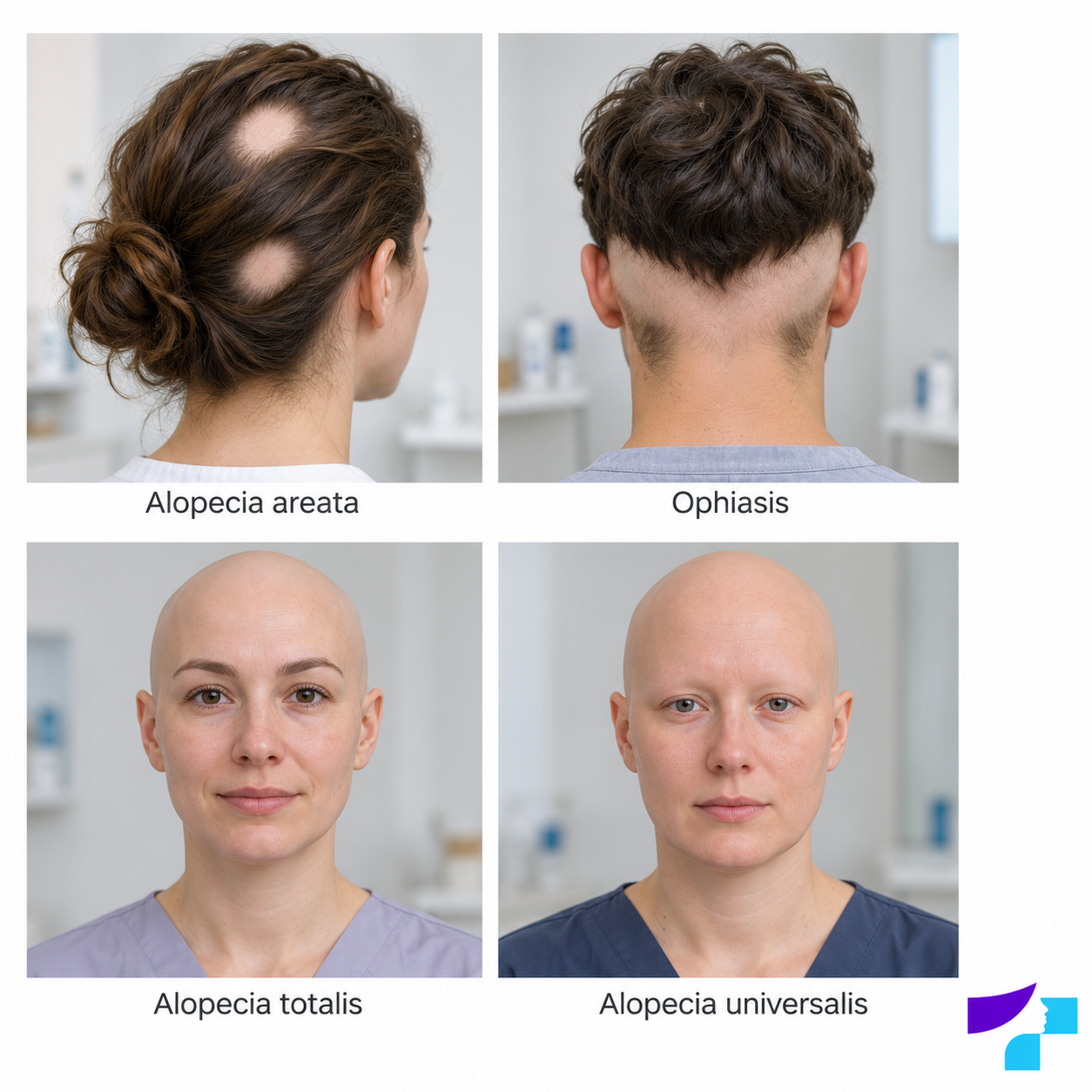
Illustrative comparison of disease patterns: patchy alopecia areata at the top left, ophiasis at the top right, alopecia totalis at the bottom left and alopecia universalis with loss of facial hair at the bottom right. These are not necessarily consecutive stages.
These forms are not necessarily consecutive stages. A single small patch does not, by itself, mean that someone will lose all their hair.
How is it distinguished from other causes of hair loss?
A round bald patch is not a diagnosis on its own. It is particularly important to rule out scalp ringworm in children. When inflammation or scarring is present, conditions that can permanently damage follicles must also be considered.
| Possible cause | Features that help a doctor distinguish it |
|---|---|
| Alopecia areata | Clearly defined patches, usually without marked scaling, with preserved follicular openings |
| Scalp ringworm | Scaling, broken hairs and sometimes redness or marked inflammation; fungal testing is needed |
| Trichotillomania | Irregular areas caused by hair pulling, with hairs of different lengths; a sensitive discussion is important |
| Traction alopecia | Hair loss in areas exposed to prolonged pulling, for example from tight hairstyles or extensions |
| Scarring alopecia | Loss of follicular openings, with possible redness, scaling, pain or other skin changes |
| Androgenetic alopecia | More often gradual thinning with a receding hairline or widening parting |
| Telogen effluvium | More often increased shedding across the scalp rather than separate smooth bald patches |
The table provides orientation, but individual features can overlap. More than one type of hair loss can also occur in the same person.
When should you see a specialist?
A new bald patch should be assessed by a dermatologist or trichologist. Timely assessment is particularly important for children, rapidly increasing hair loss and loss of eyebrows or eyelashes.
Seek an earlier assessment if there is pain, swelling, marked redness, scaling, pustules, crusting or possible scarring. These signs may indicate an infection or another inflammatory condition. Alopecia areata itself is usually not a medical emergency.
Before the appointment, it is helpful to note when the changes began, whether they are progressing, which medicines and supplements have been used, and whether similar conditions occur in the family. Dated photographs can help track changes. There is no need to repeatedly pull out hairs or order an extensive panel of blood tests before the consultation.
How is alopecia areata diagnosed?
The doctor asks about the onset and course of symptoms, general health, family history and previous treatment. They examine the affected areas and scalp and, where appropriate, the eyebrows, eyelashes, beard and nails.
Trichoscopy is a non-invasive examination of the hair and scalp under magnification. It allows the doctor to assess hair shafts, follicular openings and a combination of signs. Findings in alopecia areata may include exclamation mark hairs, broken hairs, black or yellow dots, and signs of regrowth. No single finding should be interpreted in isolation.
The doctor may also perform a hair pull test: gently pulling a small group of hairs to assess whether they detach more easily than expected. This can help identify active shedding, but a positive test is not specific to alopecia areata. There is no need to repeat this test yourself.
Are blood tests or a biopsy needed?
When the presentation is typical, the diagnosis can often be made without extensive laboratory testing. Tests are selected according to specific clinical concerns.
For example, a doctor may consider thyroid testing based on symptoms, family history and other risk factors. A full blood count, ferritin or other nutritional markers may be useful when there are relevant signs, dietary restrictions or accompanying diffuse shedding. An abnormal blood test result does not, by itself, explain all the hair loss.
If a fungal infection is suspected, hair and skin samples are tested. A scalp biopsy — examination of a small skin sample — is used when the diagnosis is uncertain or another process, including scarring alopecia, is suspected.
Tests to establish a diagnosis and checks before treatment are not the same thing. Even when the diagnosis is clear after examination, certain treatments may require blood tests or infection screening before they can be started safely. The extent of these checks depends on the treatment and the patient's health.
How is severity assessed?
The doctor assesses the extent of hair loss, new patches, the speed of shedding, the areas affected and the impact on daily life. The SALT score (Severity of Alopecia Tool) may be used to document the extent of scalp hair loss.
SALT measures scalp hair loss but does not fully reflect the significance of eyebrow or eyelash loss or emotional distress. A small patch in a highly visible area can be very troubling even when overall hair loss is limited.
How is alopecia areata treated?
Treatment aims to reduce the effects of the condition and promote hair regrowth. The choice depends on age, the areas affected, extent, activity, previous treatment results and the patient's preferences. No single treatment guarantees complete and permanent regrowth for everyone.
| Approach | When it may be considered | Main limitation |
|---|---|---|
| Observation | Selected cases of limited, recently developed disease | Regrowth is not guaranteed; an agreed follow-up plan is needed |
| Topical corticosteroids | Various cases of limited disease, including in children | The preparation and treatment duration must be individualised; skin thinning is possible |
| Corticosteroid injections | Particularly small patches in adults | Discomfort and risk of local tissue thinning; treating large areas may be impractical |
| Contact immunotherapy | Selected cases of more extensive or persistent disease | Specialist supervision is needed; dermatitis and pigment changes can occur |
| Systemic treatment, including JAK inhibitors | Severe or otherwise significant disease, in accordance with the relevant indications | Individual benefit–risk assessment, blood tests and ongoing monitoring |
This is not a mandatory treatment sequence. Not every patient needs to try every method, and the choice of medication cannot be based solely on the number of patches.
When is observation an option?
After the diagnosis has been confirmed, observation may be considered for a single, recently developed, limited patch. This means agreeing a follow-up plan with the doctor and knowing which changes should prompt another appointment.
This approach is not suitable for everyone. Progression, extensive hair loss or substantial emotional distress may be reasons to choose active treatment.
Topical corticosteroids and injections
Corticosteroids applied to the skin reduce inflammation. They are one treatment option, including for children. The doctor selects the preparation, strength, treatment area and duration. Incorrect or prolonged use can cause skin thinning and other side effects.
For limited patches, particularly in adults, corticosteroids may be injected directly into the affected skin. Possible effects include discomfort, thinning of the skin or underlying tissue with a small indentation, more visible blood vessels and pigment changes. Procedures around the eyebrows require particular care.
Contact immunotherapy
Contact immunotherapy involves applying a specific substance, such as diphencyprone (DPCP), to the affected skin under medical supervision to produce a controlled allergic contact reaction. The aim is to influence the local immune process and promote regrowth.
Treatment has several stages. First, initial sensitisation makes the skin responsive to the chosen substance. The specialist then adjusts its application to the individual's reaction, aiming to maintain mild, controlled inflammation. Before treatment, the expected benefits, risks, necessary tests and skin care after procedures are discussed. Patient information and consent are important parts of treatment.
This is not the same as irritating the skin with household products. Marked eczema, itching, blisters, enlarged lymph nodes or pigment changes can occur. The method requires supervision by an experienced specialist, and availability must be checked with the individual healthcare provider.
Systemic treatment and JAK inhibitors
For extensive, active or severe disease, medicines that act throughout the body may be considered. In selected situations, systemic corticosteroids or other medicines that affect the immune response, such as methotrexate or ciclosporin, are used. Some of these treatments may be outside the approved indications for the particular medicine. Long-term systemic corticosteroid use is limited by side effects, and relapse can occur after withdrawal.
JAK inhibitors affect specific inflammatory signalling pathways. Baricitinib and ritlecitinib are approved in the EU for severe alopecia areata in adults and adolescents aged 12 years and older. They are prescription medicines whose suitability and use must be assessed and monitored by a doctor.
Important safety considerations include infections, changes in blood counts and other laboratory results, and warnings about blood clots, serious cardiovascular events and malignancy. Particular assessment is needed for older patients, long-term smokers and people with relevant risk factors.
Before treatment, the doctor reviews general health, infection risks, vaccination status and the laboratory tests required for the chosen medicine. Ongoing monitoring is needed during treatment. Pregnancy, plans to conceive and breastfeeding must be discussed beforehand: these JAK inhibitors must not be used during pregnancy and are not used while breastfeeding. Contraception requirements and the timing of treatment withdrawal depend on the specific medicine.
EU authorisation does not automatically mean that a medicine is available or publicly reimbursed in Latvia. These matters should be clarified before treatment begins.
Minoxidil and other additional approaches
A doctor may sometimes use minoxidil as an additional treatment to support hair growth. It does not replace treatment directed at the autoimmune process. Skin irritation and unwanted hair growth are possible; scalp products should not be applied to the eyebrows or eyelashes without medical advice.
Evidence for PRP, mesotherapy and microneedling specifically in alopecia areata is insufficient to present them as standard treatments with predictable results. Studies of androgenetic alopecia cannot automatically be applied to alopecia areata.
Hair transplantation is generally unsuitable: it does not address the autoimmune process, and the condition may also affect transplanted hairs.
How is the response to treatment assessed?
Regrowth is not the only important measure during treatment. The doctor compares patch size, the appearance of new areas, shedding activity, eyebrow and eyelash involvement, side effects and the impact on well-being. Sometimes the initial benefit is stabilisation before substantial regrowth becomes visible.
Photographs taken from a similar angle and in similar lighting, repeat trichoscopy and, where appropriate, the SALT score can help comparisons. It is better to take photographs at reasonable intervals than to look for changes every day.
When is the response assessed?
Regrowth is a slow process, and results are usually assessed over months rather than days. The timing depends on the treatment and the course of the condition. For example, the product information for ritlecitinib advises considering discontinuation if there is no evidence of therapeutic benefit after 36 weeks.
If new patches appear or the expected regrowth does not occur, the doctor should reassess disease activity, the diagnosis and the treatment plan. Do not change doses or medicines yourself. Some people need maintenance treatment after a successful response; hair loss may return when treatment stops.
Alopecia areata in children and adolescents
A new bald patch in a child should first be assessed by a doctor. Scalp ringworm can look similar and, unlike alopecia areata, is contagious. It is particularly important to investigate this possibility if there is scaling, broken hair, painful swelling or inflammation.
Treatment is adapted to the child's age and ability to cooperate. Topical treatment is often considered; discomfort may limit injections. In severe disease, adolescents may also be eligible for certain systemic treatments approved for their age. Adult treatment regimens must not simply be transferred to children.
Confirmed alopecia areata is not, in itself, a reason to stay away from school, nursery or a swimming pool. If the diagnosis remains uncertain and an infection is suspected, the doctor will advise on the next steps.
Explain simply that the condition is not the child's fault and cannot be passed to others. Discuss how to answer questions from other children and what support the child would like. Involving teachers and responding promptly to teasing can be as important as medical care.
Will the hair grow back, and can the condition return?
Hair may regrow spontaneously or with treatment, but an individual's outcome cannot be reliably predicted. Limited, recent hair loss generally has a more favourable chance of regrowth than longstanding, extensive disease. Early onset, ophiasis and nail involvement may be associated with a more difficult course.
The first hairs to regrow may be fine, pale or white. Their thickness and pigment may change later. A single fine hair does not confirm complete recovery, just as a lack of regrowth in the first few weeks does not mean regrowth will be impossible.
Some people develop new patches after improvement, even much later. There is currently no treatment that guarantees the condition will never return. Even with extensive hair loss, it is worth discussing further treatment and support with a specialist.
Daily care and emotional support
Wash your hair as needed using gentle products. Normal washing does not cause an autoimmune patch or wash out the follicles. Avoid tight hairstyles, vigorous rubbing and irritating products on the affected skin.
Hair colouring is not automatically prohibited, but discuss its suitability with your doctor if the skin is irritated or being treated. Hair dye and other cosmetic products can cause additional irritation or contact allergy.
Protect bald skin from the sun with a hat and an appropriate broad-spectrum sunscreen, and wear comfortable headwear in cold weather. Glasses can help protect the eyes if eyebrows or eyelashes have been lost; persistent irritation should be assessed by a doctor.
No universal diet has been proven to cure alopecia areata. Supplements should be selected for a justified need. There is no convincing evidence of a safe, predictable benefit from castor oil, onion juice, essential oils or similar remedies, and they may cause dermatitis.
Hair loss can affect self-esteem, relationships and willingness to take part in everyday activities. The significance of this distress cannot be measured solely by the size of a patch. Psychological support, psychotherapy, a support group, a wig, a hair system or cosmetic camouflage may form part of care. The choice to cover hair loss or leave it visible belongs to the individual.
Can alopecia areata be prevented?
There is no reliably proven method to prevent the first episode or guarantee protection against recurrence. Gentle care, a balanced diet, sleep and stress management may support general health and well-being, but they are not guaranteed prevention for this autoimmune condition.
Skin protection reduces the risk of sunburn and irritation rather than preventing alopecia areata itself. Following treatment carefully also does not guarantee that the condition will never return; a relapse does not mean the patient has done something wrong.
Myths and facts
“You can pass the condition to other people.”
Alopecia areata is not an infection. However, before confirming the diagnosis, it is important to rule out causes such as a fungal infection.
“Stress is always to blame.”
Stress may be one possible factor, but in many cases no specific trigger can be identified.
“The hair fell out because it was not washed enough.”
Hygiene habits do not explain the autoimmune mechanism.
“Vitamins or an oil will be enough.”
A deficiency may need correction, but this does not replace assessment and treatment of the condition itself.
“One patch means all the hair will fall out.”
The course varies, and such progression is not inevitable.
“Once the hair has regrown, the condition is gone forever.”
Regrowth is a positive sign, but another episode is possible.
Medical disclaimer. This information is educational and does not replace an individual consultation, diagnosis or treatment. Seek specialist advice if hair loss is sudden, patchy, rapidly progressing or accompanied by signs of scalp inflammation. Do not start prescription medicines on your own.
References and authoritative sources
- British Association of Dermatologists (BAD): living guideline for managing alopecia areata, 2025 update
- British Association of Dermatologists (BAD): patient information on alopecia areata
- American Academy of Dermatology (AAD): alopecia areata diagnosis and treatment
- American Academy of Dermatology (AAD): signs and symptoms of alopecia areata
- American Academy of Dermatology (AAD): self-care for alopecia areata
- National Institute of Arthritis and Musculoskeletal and Skin Diseases (NIAMS): alopecia areata overview, symptoms and causes
- National Institute of Arthritis and Musculoskeletal and Skin Diseases (NIAMS): alopecia areata diagnosis, treatment and steps to take
- DermNet: causes, diagnosis and treatment of alopecia areata
- DermNet: scalp ringworm (tinea capitis)
- DermNet: trichotillomania
- DermNet: traction alopecia
- British Association of Dermatologists (BAD): intralesional steroid therapy
- British Association of Dermatologists (BAD): patient information on ritlecitinib
- State Agency of Medicines of Latvia (ZVA): medical technology for topical immunotherapy in alopecia areata
- European Medicines Agency (EMA): baricitinib indications, effectiveness and safety
- European Medicines Agency (EMA): ritlecitinib indications, effectiveness and safety
- European Medicines Agency (EMA): ritlecitinib summary of product characteristics and package leaflet
- European Medicines Agency (EMA): updated ritlecitinib safety information for healthcare professionals
Content author
Frequently Asked Questions
Consultation fee
| Specialists | Clients of the clinic | First visit |
|---|---|---|
| Trichologist Ivanna Buvan | 57.00 € | 60.00 € |
| Dermatologist Dr. Med. assistant professor Māra Rone-Kupfere | 76.00 € | 80.00 € |
| Dermatologist Dace Buile | 66.50 € | 70.00 € |
| Dermatologist Gunita Buiksa | 57.00 € | 60.00 € |
| Dermatologist Ilona Zablocka | 57.00 € | 60.00 € |
| Dermatologist Zanda Bogdanova | 57.00 € | 60.00 € |



 +1
 +1
 +1 242
 +1 246
 +1 268
 +1 441
 +20
 +212
 +213
 +216
 +218
 +220
 +221
 +222
 +223
 +223
 +224
 +225
 +226
 +227
 +228
 +229
 +230
 +231
 +232
 +234
 +235
 +236
 +237
 +238
 +239
 +239
 +240
 +241
 +242
 +243
 +244
 +245
 +248
 +249
 +250
 +251
 +252
 +253
 +254
 +255
 +256
 +257
 +258
 +260
 +261
 +262
 +263
 +264
 +265
 +266
 +267
 +268
 +269
 +269
 +27
 +284
 +290
 +291
 +297
 +298
 +299
 +30
 +31
 +32
 +33
 +34
 +340
 +345
 +350
 +351
 +352
 +353
 +354
 +355
 +356
 +358
 +359
 +36
 +370
 +371
 +372
 +373
 +374
 +375
 +376
 +377
 +378
 +380
 +385
 +386
 +387
 +389
 +39
 +39
 +40
 +41
 +41
 +420
 +421
 +43
 +45
 +46
 +47
 +473
 +48
 +49
 +500
 +501
 +502
 +503
 +504
 +505
 +506
 +507
 +509
 +51
 +52
 +53
 +54
 +55
 +56
 +57
 +58
 +590
 +591
 +593
 +594
 +594
 +595
 +596
 +597
 +598
 +60
 +61
 +62
 +63
 +64
 +649
 +65
 +66
 +664
 +671
 +672
 +672
 +672
 +673
 +674
 +675
 +676
 +677
 +678
 +679
 +680
 +681
 +682
 +683
 +684
 +686
 +687
 +688
 +689
 +690
 +691
 +692
 +6982
 +7
 +7
 +7
 +7
 +758
 +767
 +784
 +809
 +809
 +81
 +82
 +84
 +850
 +852
 +853
 +856
 +86
 +868
 +869
 +876
 +880
 +885
 +886
 +90
 +91
 +92
 +93
 +94
 +95
 +960
 +961
 +962
 +963
 +964
 +965
 +967
 +968
 +971
 +972
 +973
 +974
 +975
 +976
 +977
 +98
 +993
 +994
 +995
 +996
 +996