Alopecia is the medical term for hair loss. It is not one single disease, but a broad group of signs and conditions that may appear as temporary excessive shedding, gradual hair thinning, round bald patches, or permanent hair loss caused by scarring.
Hair loss may be related to genetics, hormones, autoimmune inflammation, stress, infections, nutrient deficiencies, medications, scalp diseases, or mechanical hair damage. In some cases, hair grows back on its own, while in others an early dermatologist consultation is important to help prevent permanent hair loss.
In brief: the key points about alopecia
- Alopecia means hair loss or loss of hair density.
- It may affect the scalp, beard, eyebrows, eyelashes, or other parts of the body.
- The most common types include androgenetic alopecia, alopecia areata, telogen effluvium, and scarring alopecia.
- Not all hair loss is dangerous, but sudden, patchy, painful, or scarring hair loss should be assessed by a doctor.
- Effective treatment depends on an accurate diagnosis.
What is alopecia?
Alopecia is hair loss that exceeds a person’s usual hair shedding or causes visible thinning. It may be localised, when hair is lost in one or more patches, or diffuse, when hair becomes thinner across the whole scalp.
Alopecia may be temporary or long-lasting. If the hair follicles, from which hair grows, have not been permanently damaged, regrowth is often possible. If follicles are destroyed and replaced by scar tissue, hair loss may become permanent.
When is hair loss normal?
A small amount of daily hair shedding is normal because hair grows in cycles. Some hairs are in the active growth phase, some move into the resting phase, and some shed. People usually do not notice every shed hair, but more hair may become visible during washing, brushing, or seasonal changes.
Hair loss may be medically significant if:
- hair falls out in clumps;
- the shedding starts suddenly;
- round or oval bald patches appear;
- the parting becomes wider;
- the hairline recedes;
- eyebrows, eyelashes, or beard hair fall out;
- the scalp itches, hurts, flakes, becomes red, or scars.
Main types of alopecia
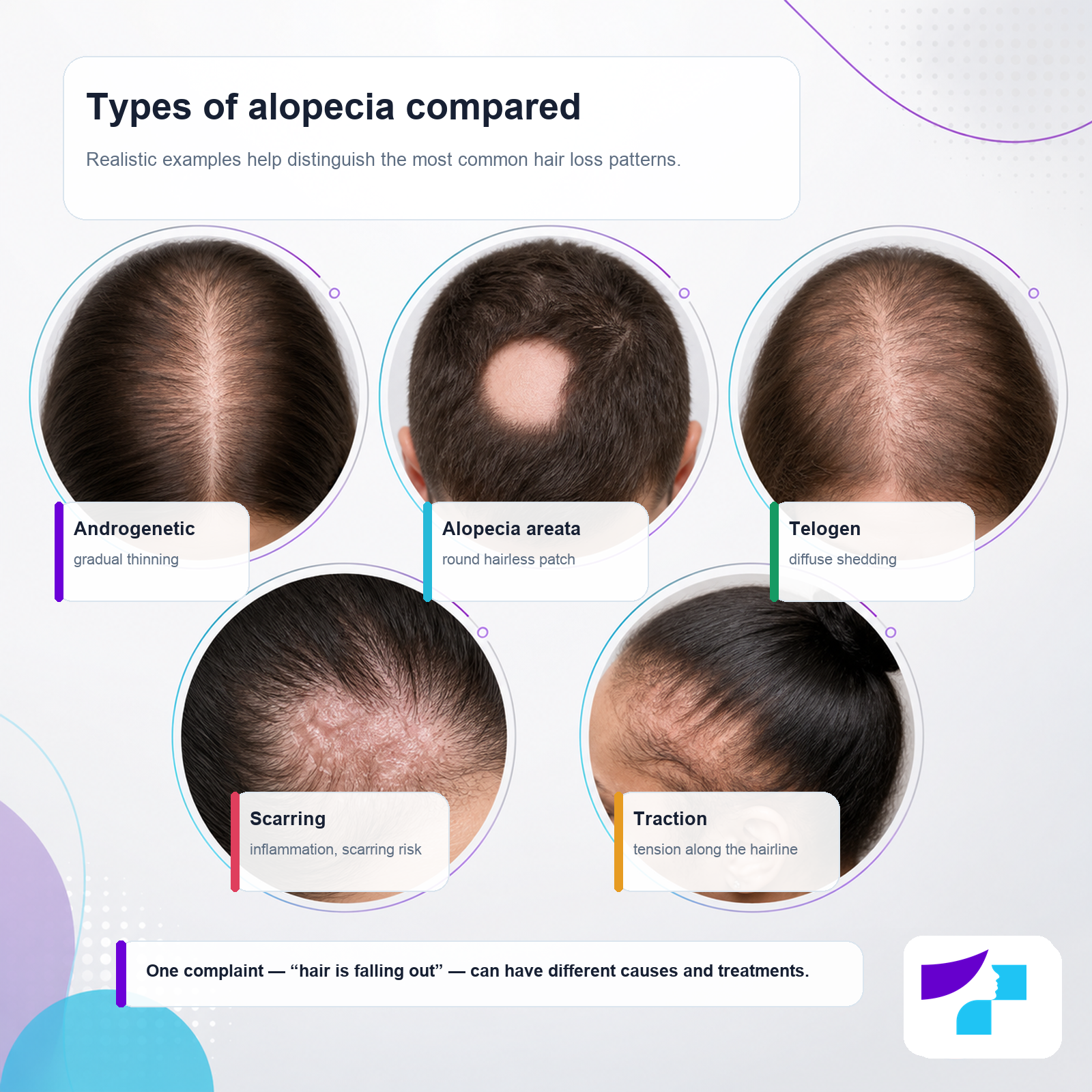
| Type of alopecia | How it appears | Most common mechanism | Can hair grow back? |
|---|---|---|---|
| Androgenetic alopecia | Gradual hair thinning; in men the hairline often recedes, while in women the parting often becomes wider | Genetic and hormonal sensitivity of hair follicles | Progression can be slowed, and partial improvement is sometimes possible |
| Alopecia areata | Round or oval bald patches | Autoimmune process affecting the hair follicle | Regrowth is often possible, but the condition may recur |
| Telogen effluvium | Diffuse, increased shedding across the scalp | Stress, illness, childbirth, deficiencies, medications | Usually possible if the trigger is corrected |
| Anagen effluvium | Rapid hair loss during the growth phase | Chemotherapy, toxic exposure, severe illness | Often grows back after the cause ends |
| Scarring alopecia | Hair loss with skin changes, inflammation, or scarring | Permanent damage to hair follicles | Limited; stopping progression is essential |
| Traction alopecia | Hair loss along the hairline or in areas where hair is pulled | Tight hairstyles, extensions, long-term tension | Early cases may regrow; late cases may be permanent |
| Hair loss caused by infection | Scaly, red patches and broken hairs | Fungal or other infection | Usually possible after treating the cause |
Scarring and non-scarring alopecia
An important distinction is between scarring and non-scarring alopecia.
| Feature | Non-scarring alopecia | Scarring alopecia |
|---|---|---|
| Hair follicles | Usually preserved | Damaged or destroyed |
| Hair regrowth | Often possible | Often limited or impossible |
| Skin appearance | Skin may look normal, smooth, and without scarring | Skin may be smooth, shiny, scarred, red, or scaly |
| Common examples | Androgenetic alopecia, telogen effluvium, alopecia areata | Lichen planopilaris, frontal fibrosing alopecia, discoid lupus erythematosus, folliculitis decalvans |
| Why recognition matters | Treatment often aims to restore or stabilise hair growth | Treatment aims to stop irreversible damage as early as possible |
If the skin in the area of hair loss becomes shiny, smooth, painful, red, scaly, crusted, or develops pus-filled lesions, a dermatologist should assess it.
How alopecia develops: the role of hair follicles, hormones, and the immune system
Hair grows from a hair follicle. The follicle is not a passive structure; it responds to hormones, inflammation, nutrient availability, immune system activity, and the overall condition of the body.
The hair growth cycle has several phases:
- anagen phase - the active growth phase;
- catagen phase - the transition phase;
- telogen phase - the resting phase;
- shedding phase - the hair detaches and falls out.
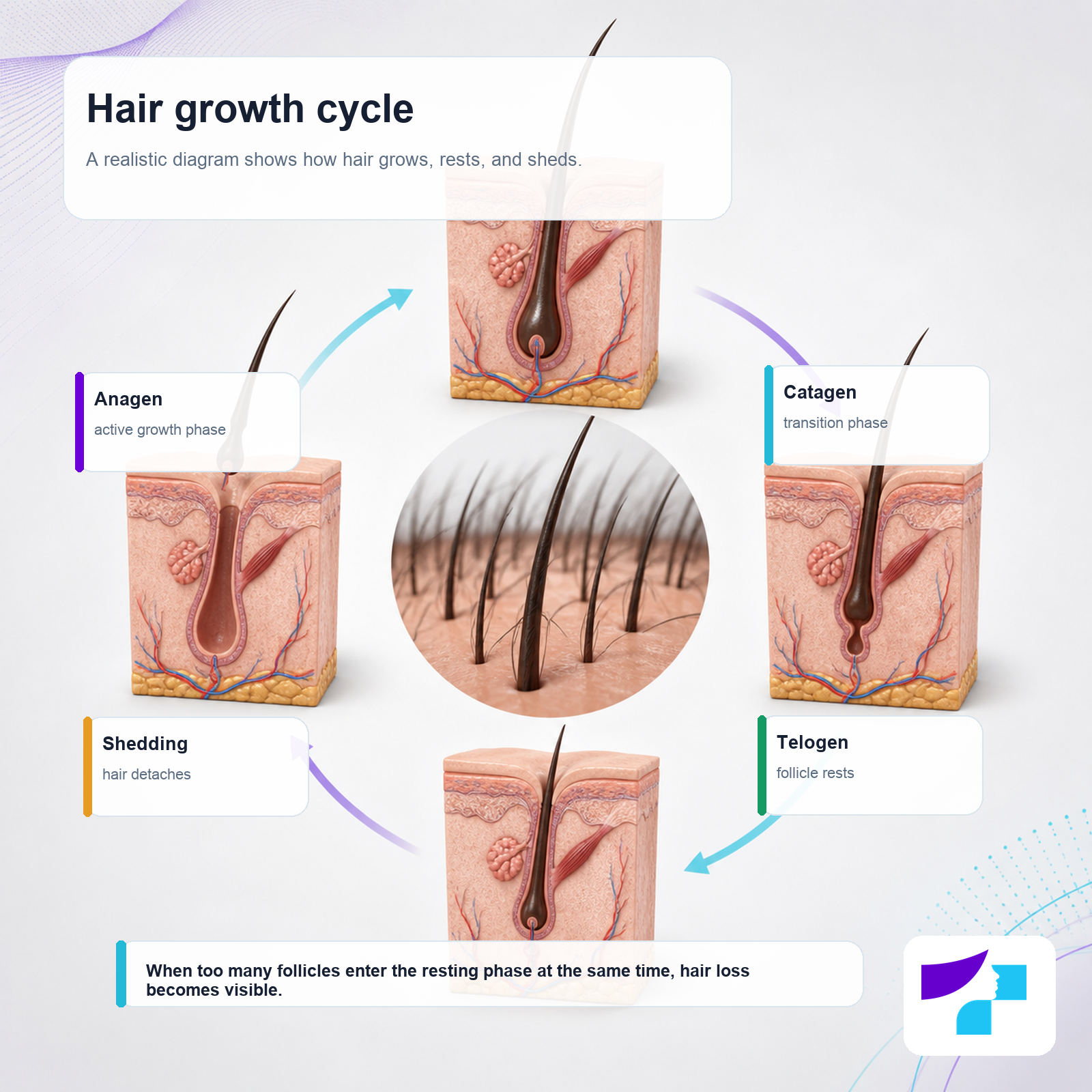
Different types of alopecia disturb different parts of this cycle. In androgenetic alopecia, follicles gradually become smaller and produce thinner hairs. In alopecia areata, the immune system mistakenly attacks the hair follicle area. In telogen effluvium, too many hairs enter the resting phase at the same time. In scarring alopecia, inflammation may permanently damage the follicle.
Hair loss development timeline
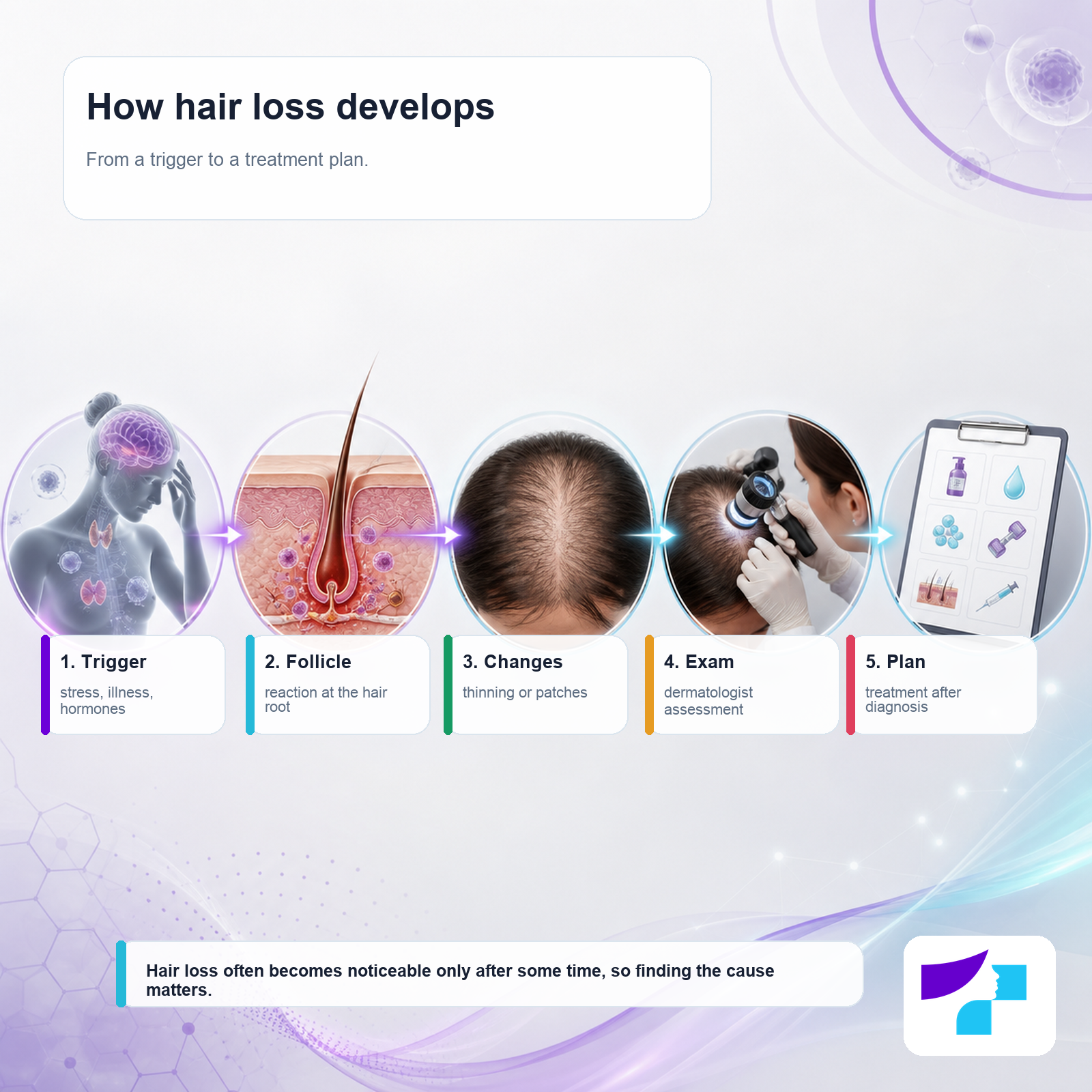
Triggering factor or long-term process
Stress, illness, childbirth, hormonal changes, genetic predisposition, autoimmune inflammation, medications, nutrient deficiency, or scalp disease.
Follicle response
The hair follicle reduces growth, enters the resting phase, becomes smaller, or is damaged by inflammation.
Visible changes
Hair becomes thinner, shedding increases, patches appear, the hairline recedes, or the scalp becomes more visible.
Diagnosis
A dermatologist assesses the pattern of hair loss, scalp, hair roots, medical history, and, when needed, orders blood tests or a biopsy.
Treatment plan
The cause is treated, inflammation is reduced, hair growth is supported, or disease progression is stopped.
Symptoms of alopecia
The symptoms of alopecia vary depending on the type.
Early symptoms
- more hair on the brush, in the shower, or on the pillow;
- loss of hair volume;
- widening of the hair parting;
- a small bald patch appears;
- the scalp becomes sensitive, itchy, or flaky.
Later symptoms
- visible scalp in several areas;
- markedly receding hairline;
- multiple bald patches;
- loss of eyebrow, eyelash, or beard hair;
- smooth, shiny, or scarred skin in areas where hair no longer grows.
5 signs that may suggest alopecia
- A round or oval bald patch appears suddenly.
- Hair sheds much more than usual and continues for several weeks.
- The parting gradually widens or the hairline recedes.
- The scalp becomes inflamed, painful, scaly, or scarred.
- Eyebrows, eyelashes, or beard hair also fall out.
Risk factors and who is more likely to develop alopecia
Alopecia can affect people of any age. Risk factors differ depending on the type of hair loss.
Risk may be higher if:
- androgenetic alopecia or alopecia areata runs in the family;
- there are autoimmune diseases, such as thyroid disease or vitiligo;
- there is atopic dermatitis, asthma, or allergic rhinitis;
- there has recently been serious illness, surgery, high fever, or major stress;
- there has been childbirth or marked hormonal change;
- there is iron, ferritin, vitamin D, vitamin B12, or other nutrient deficiency;
- medications that may affect hair growth are being used;
- hair is worn in tight hairstyles for long periods;
- there is chronic inflammation, scaling, or infection of the scalp.
Is alopecia contagious?
Alopecia itself is not contagious. Androgenetic alopecia, alopecia areata, or telogen effluvium cannot be caught from another person.
However, some conditions that cause hair loss can be contagious. For example, a fungal scalp infection can cause scaly, red patches and broken hairs. In such cases, medical assessment and specific treatment are needed.
When should you see a dermatologist?
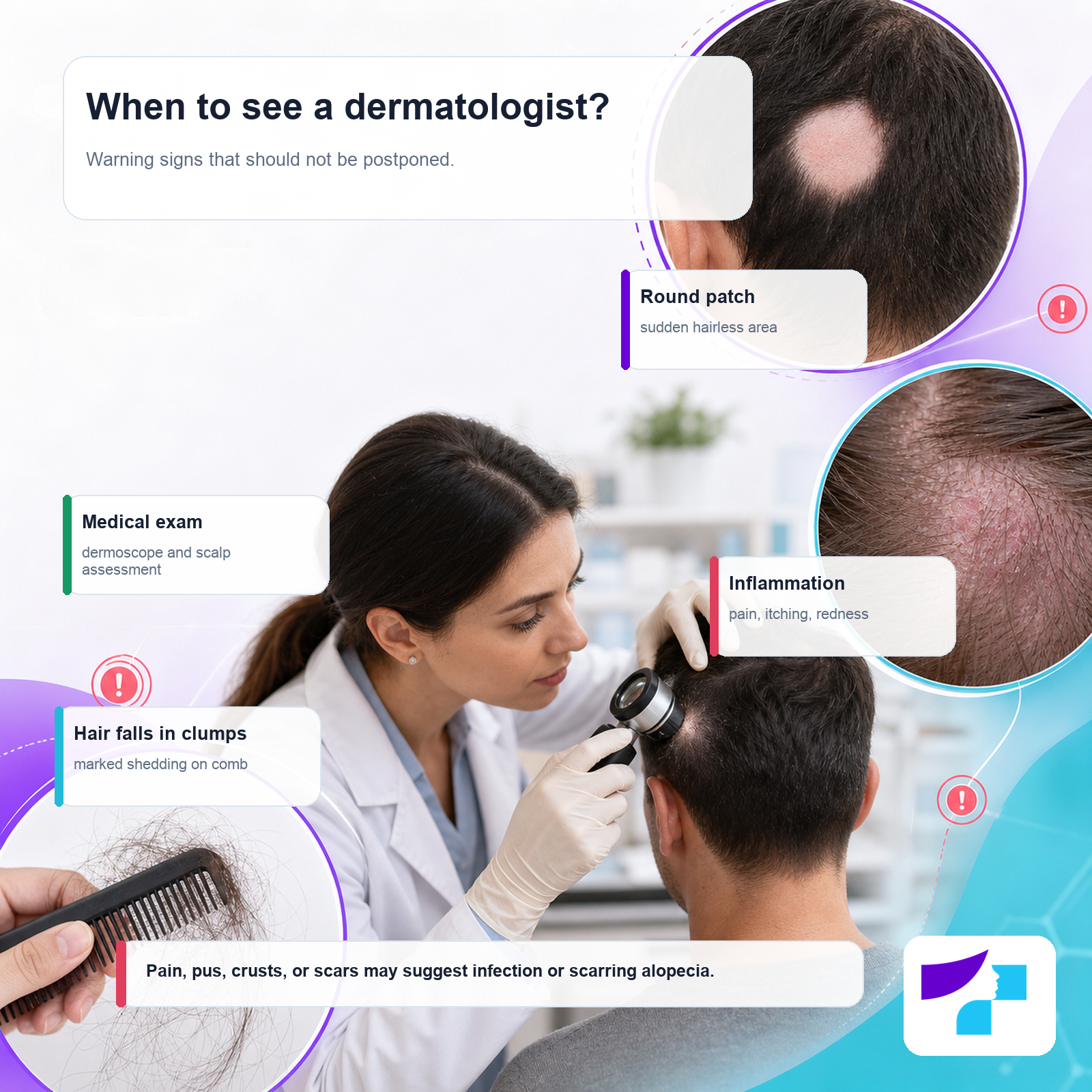
A dermatologist consultation is recommended if:
- hair loss starts suddenly;
- there are round bald patches;
- hair falls out in clumps;
- hair loss lasts longer than several weeks and worsens;
- there is scalp pain, itching, redness, scaling, crusting, or pus;
- scars are visible or areas of skin become smooth and shiny;
- eyebrows, eyelashes, or beard hair fall out;
- hair loss begins in a child;
- hair loss significantly affects wellbeing or self-esteem.
When can hair loss require urgent assessment?
A more urgent medical consultation is needed if hair loss is accompanied by pain, rapid progression, pus-filled lesions, crusting, scarring, marked scalp redness, or general symptoms such as fever or feeling unwell. These signs may indicate infection, inflammatory scalp disease, or scarring alopecia.
How is alopecia diagnosed?
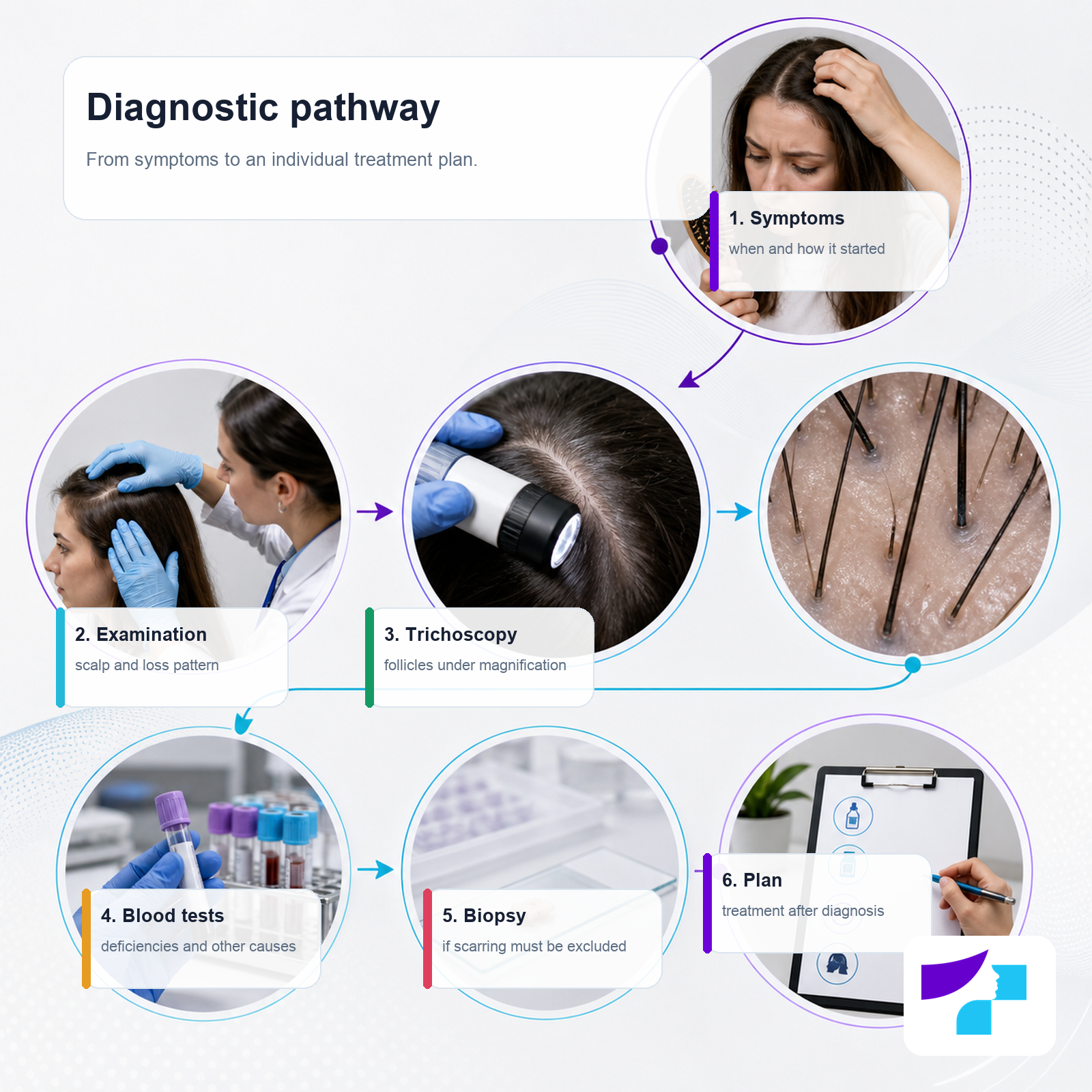
A dermatologist usually starts with a discussion and examination. It is important to know when the hair loss started, whether it was sudden or gradual, and whether there has been stress, illness, childbirth, new medications, weight loss, dietary restriction, or similar problems in the family.
Diagnostic methods may include:
| Examination | Why it is used |
|---|---|
| Scalp and hair examination | To assess the pattern of hair loss, skin condition, and visible signs of inflammation |
| Dermoscopy or trichoscopy | To examine hair follicles, hair shafts, and scalp under magnification |
| Hair pull test | To assess whether shedding is increased |
| Blood tests | To look for deficiencies, thyroid changes, inflammation, or other possible causes |
| Fungal tests | If infection is suspected |
| Scalp biopsy | If scarring alopecia or an unclear inflammatory process needs to be excluded |
Blood tests may include a complete blood count, ferritin, thyroid markers, vitamin D, vitamin B12, inflammatory markers, or hormone tests, but they should be chosen individually. There is no single universal test that diagnoses all types of alopecia.
What may the doctor ask during the visit?
Before seeing a dermatologist, it may help to write down:
- when the hair loss started;
- whether it started suddenly or gradually;
- whether hair is falling out across the whole scalp or in specific patches;
- whether there is itching, pain, scaling, or redness;
- whether there has been stress, illness, surgery, fever, or childbirth;
- which medications and supplements are being used;
- whether there are thyroid, autoimmune, or hormonal conditions;
- whether hair loss runs in the family;
- which hair care products, colouring, or hairstyles are used.
How is alopecia treated?
Treatment depends on the cause. Effective management starts with a diagnosis, not with trying random products.
Androgenetic alopecia
In androgenetic alopecia, the goal is to slow follicle miniaturisation and preserve existing hair. A doctor may recommend topical hair growth stimulants, certain prescription treatment groups, procedures, or hair transplantation if appropriate. Treatment is usually planned long-term.
Alopecia areata
In mild alopecia areata, hair may regrow without treatment. If therapy is needed, a dermatologist may use topical or injected anti-inflammatory therapy, immunomodulating treatment, or, in more severe cases, systemic treatment groups including JAK inhibitor-type medicines. Such treatment must be supervised by a doctor.
Telogen effluvium
In telogen effluvium, the most important step is to identify and correct the trigger: illness, stress, iron deficiency, nutritional deficiency, medication effect, or hormonal change. Hair often recovers gradually, but it takes time.
Scarring alopecia
In scarring alopecia, treatment aims to stop inflammation and protect the follicles that remain. Hair usually does not regrow in already scarred areas, which makes early diagnosis especially important.
Traction alopecia
In traction alopecia, it is important to stop mechanical pulling: tight ponytails, braids, extensions, or hairstyles that create long-term tension. Early cases may regrow, but long-term damage may become permanent.
Do minoxidil, vitamins, and procedures help?
Minoxidil-type topical products may help in certain types of hair loss, especially androgenetic alopecia, and are sometimes used as part of combined treatment. They do not work for everyone and usually require long-term, regular use.
Vitamins and supplements help when hair loss is driven by a specific deficiency. If there is no iron, vitamin D, vitamin B12, or other nutrient deficiency, hair supplements may not improve the situation.
Procedures such as injection therapies, laser therapy, scalp procedures, or hair transplantation may be suitable only in specific situations. They are not a universal solution for all types of alopecia.
What can be done at home?
Home care cannot replace diagnosis, but it can reduce additional damage:
- wash hair gently, according to scalp type;
- avoid tight hairstyles and pulling the hair;
- reduce aggressive bleaching, heat tools, and chemical treatments;
- choose a gentle brush and avoid forceful brushing of wet hair;
- ensure adequate intake of protein, iron, and micronutrients;
- treat dandruff, seborrhoeic dermatitis, or other scalp problems;
- track changes with comparable photos every few weeks.
What should not be done if hair is falling out?
Avoid:
- starting prescription medicines without a doctor;
- using several aggressive products at the same time;
- irritating the scalp with unproven methods;
- delaying consultation if there is scarring, pain, or inflammation;
- relying only on vitamins without a diagnosis;
- stopping doctor-prescribed treatment immediately after the first improvement;
- comparing your course of hair loss with other people’s experiences online.
Alopecia in women, men, and children
In women, hair loss often appears as diffuse thinning or widening of the parting. It may be influenced by genetics, hormones, childbirth, menopause, thyroid disease, iron deficiency, or chronic stress.
In men, androgenetic alopecia is more common - recession of the hairline and thinning on the top of the scalp. The earlier treatment begins, the better the chance of preserving existing hair.
In children, hair loss may be caused by alopecia areata, fungal infection, hair-pulling behaviour, nutrient deficiency, or other conditions. Hair loss in a child should always be assessed carefully, especially if there is itching, scaling, redness, or broken hairs.
Alopecia and emotional health
For many people, hair is part of identity, so alopecia can be emotionally difficult. It may affect self-esteem, social life, work, and relationships. It is not only a cosmetic issue.
If hair loss causes anxiety, low mood, or avoidance of social situations, it should be discussed with a doctor. Medical treatment, psychological support, support groups, cosmetic camouflage, hairstyle adjustment, wigs, or scalp micropigmentation may help.
Common myths about alopecia
Myth: alopecia is caused by a dirty scalp
Most types of alopecia are not related to poor hygiene. Causes more often include genetics, the immune system, hormones, illness, or inflammation.
Myth: frequent hair washing causes hair loss
During washing, hairs that were already in the shedding phase become visible. Gentle washing itself does not cause alopecia.
Myth: hats cause baldness
Normal hat wearing does not cause androgenetic alopecia.
Myth: vitamins always stop hair loss
Vitamins help only when there is a deficiency. If the cause is autoimmune or genetic, vitamins alone are not enough.
Myth: all hair will grow back on its own
Hair regrows in some cases, but in scarring alopecia or long-term follicle miniaturisation, hair loss may become permanent.
Summary
Alopecia is a broad term that includes many types of hair loss. Some cases are temporary and reversible, while others may progress and cause permanent hair loss. The key is to identify the cause: genetic, hormonal, autoimmune, inflammatory, infectious, mechanical, or related to general health. The earlier the diagnosis is made, the better the chances of stopping the process and choosing appropriate treatment.
Medical disclaimer
The information in this article is intended for educational and informational purposes only. It does not replace medical consultation, diagnosis, or treatment. If you notice sudden, rapid, patchy, or progressive hair loss, scalp pain, itching, redness, scaling, scarring, eyebrow or eyelash loss, or if hair loss affects a child, consult a dermatologist or another qualified healthcare professional. Do not use prescription medicines or undergo aggressive procedures without medical assessment.
References and authoritative sources
- American Academy of Dermatology Association: hair loss resource center and patient information
- American Academy of Dermatology Association: alopecia areata diagnosis and treatment
- National Institute of Arthritis and Musculoskeletal and Skin Diseases (NIAMS): alopecia areata
- National Health Service (NHS): hair loss symptoms, causes, and what to do
- NHS Inform: alopecia overview, types, and treatment options
- DermNet: hair loss, alopecia types, causes, diagnosis, and treatment
- DermNet: clinical information on alopecia areata
- DermNet: diffuse alopecia and common causes
- Mayo Clinic: hair loss diagnosis and treatment
- Centre for Disease Prevention and Control of Latvia (SPKC): national health information resource
