Shingles, also called herpes zoster, is a viral infection caused by reactivation of the Varicella zoster virus. This is the same virus that causes chickenpox. After a person has had chickenpox, the virus does not disappear completely. It remains inactive in nerve ganglia and may reactivate years later.
Shingles is not just a skin rash. It affects both the skin and the nerves, which is why the illness often begins with burning, stabbing or shooting pain before any visible rash appears. At this stage, shingles may be mistaken for intercostal neuralgia, back pain, muscle strain or even pain coming from internal organs.
Typically, the rash appears on one side of the body and follows the course of a nerve. Shingles on the face, near the eye or ear, and shingles in people with weakened immunity should always be taken seriously. In these situations, medical help should be sought promptly.
Key points about shingles
- Shingles is caused by reactivation of the Varicella zoster virus.
- It is the same virus that causes chickenpox.
- The illness usually affects one side of the body.
- Pain, burning, tingling or skin sensitivity may begin before the rash appears.
- Typical shingles causes painful blisters on red skin.
- Shingles can be contagious to people who have never had chickenpox or have not been vaccinated against it.
- Treatment should ideally be started as early as possible, especially within the first 72 hours after the rash appears.
- Shingles near the eye is an urgent situation because of the risk of vision damage.
- The most common long-term complication is postherpetic neuralgia, or persistent nerve pain.
- Vaccination against shingles can reduce the risk of illness and complications.
What is shingles?
Shingles, or herpes zoster, develops when the Varicella zoster virus present in the body becomes active again and travels along a nerve to the skin. The first encounter with this virus usually causes chickenpox. After recovery, the virus remains dormant in the nervous system.
When the immune system no longer controls the virus as effectively, it may reactivate. This causes inflammation in the affected nerve area, followed by painful skin changes in the area supplied by that nerve. This is why shingles often looks like a stripe or band on one side of the body.
Although the name includes the word “herpes”, shingles is not the same as cold sores or genital herpes. Cold sores and genital herpes are usually caused by the herpes simplex virus, while shingles is caused by Varicella zoster virus.
Why does shingles occur?
Shingles can develop in a person whose body already contains the Varicella zoster virus. Most often, this means the person has previously had chickenpox. Less commonly, latent virus may also be related to chickenpox vaccination, although the risk of shingles after vaccination is generally lower than after natural chickenpox infection.
The risk of shingles increases when the immune system becomes weaker or the body is under greater strain.
Common risk factors
- Age over 50 years.
- Weakened immunity.
- Cancer or cancer treatment.
- Immunosuppressive medication.
- HIV infection or other conditions affecting immunity.
- Chronic diseases such as diabetes, chronic lung, kidney or cardiovascular disease.
- Recent severe illness, trauma or surgery.
- Long-term stress, overwork or lack of sleep.
Stress alone is not the only cause of shingles, but it may be one of the factors that affects immune function. Some patients notice shingles after prolonged stress, exhaustion or another illness.
What are the symptoms of shingles?
Shingles symptoms may develop gradually. At first, a person may feel pain or burning while the rash is not yet visible. This is why the early stage of shingles is not always easy to recognise.
Early stage before the rash
The first symptoms of shingles may include:
- burning skin pain;
- tingling or prickling;
- increased sensitivity to touch;
- itching in a specific skin area;
- pain on one side of the body;
- fatigue;
- headache;
- mild fever or general malaise.
At this stage, the patient may think it is a “trapped nerve”, strained back or pain from the ribs, heart, lungs, stomach, kidneys or gallbladder. If a rash appears in the same area a few days later, shingles becomes more likely.

Illustrative visualisation: a woman indicates the location of pain in her side. Shingles may begin with one-sided pain, burning or skin sensitivity before a rash appears.
Rash stage
After pain or tingling, redness usually appears, followed by small grouped fluid-filled blisters. The shingles rash often follows the course of a nerve in a band-like pattern.
Typical features include:
- the rash is on one side of the body;
- it usually does not cross the midline;
- blisters are grouped together;
- the skin is painful, sensitive or burning;
- touch, clothing or movement may worsen the pain.
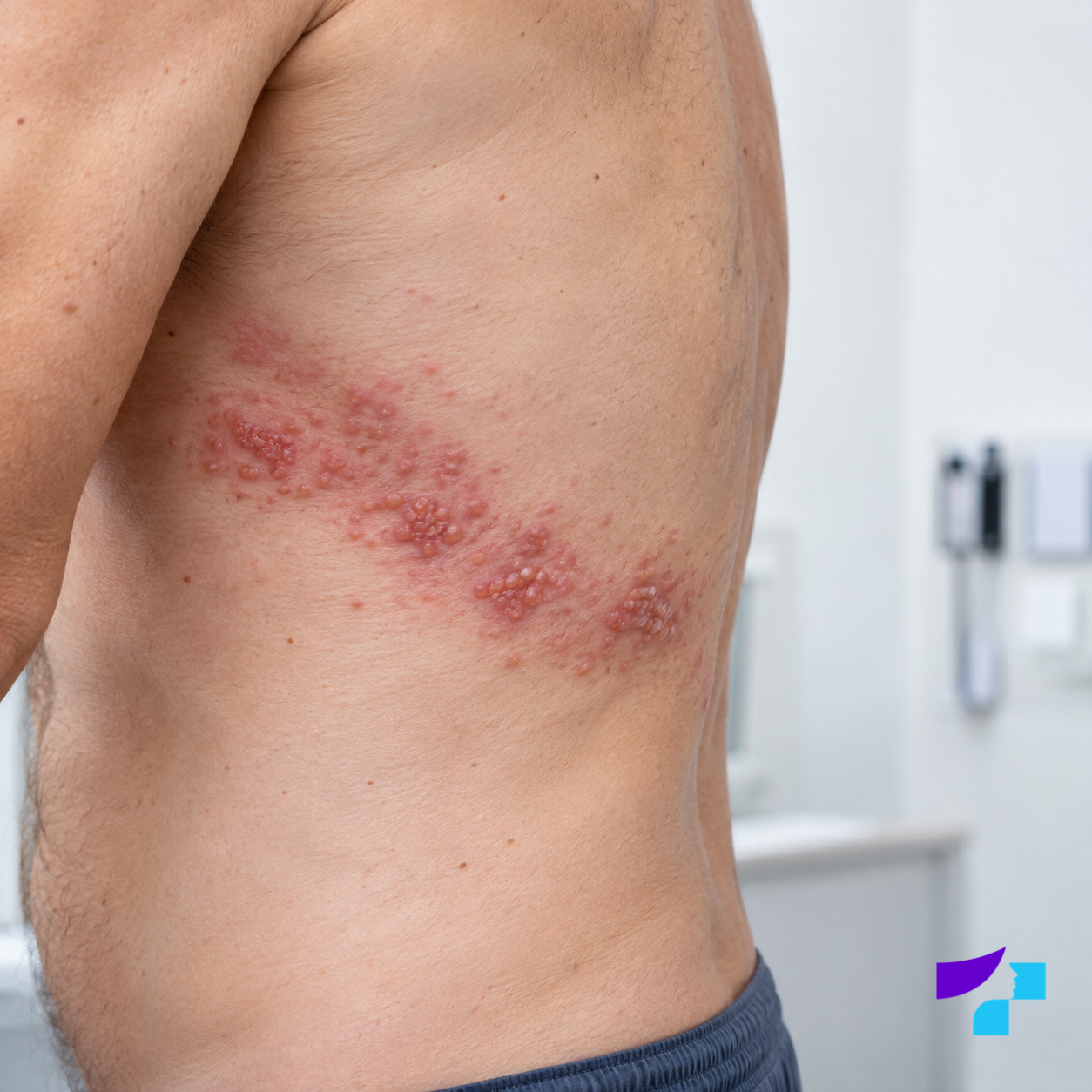
Illustrative visualisation: grouped blisters and redness form a band along the side of the body. This pattern on one side of the body is characteristic of shingles.
Crusting and healing stage
Within a few days, the blisters may break, dry out and form crusts. The rash usually heals within 2-4 weeks, but the skin may remain sensitive for some time. Some patients develop pigment changes or small scars, especially if the blisters were scratched, injured or became secondarily infected.
Pain after the rash has healed
In some patients, pain continues even after the rash has healed. This condition is called postherpetic neuralgia. It is one of the most common complications of shingles, especially in people over 50 years of age.
What does shingles look like at the beginning?
At first, shingles may look like a small red or sensitive patch of skin. Sometimes there are no visible skin changes yet, but the skin hurts, burns or tingles. Later, red patches, small raised spots and blisters may appear.
Typical shingles:
- appears on one side of the body;
- has a band-like or segmental distribution;
- is painful, not only itchy;
- forms grouped blisters;
- most often appears on the chest, side, back, abdomen, neck or face.
A diagnosis should not be made only from internet images. Shingles may resemble allergy, contact dermatitis, herpes simplex infection, impetigo, insect bites or other skin conditions. If there is pain and a blistering rash on one side of the body, a dermatologist consultation or family doctor consultation is recommended.
Where on the body can shingles appear?
| Location | How it may appear | Why it matters |
|---|---|---|
| Chest and side | Painful band on one side, blisters, burning | One of the most typical shingles locations |
| Back | Burning or stabbing pain, later rash | May initially resemble back or muscle pain |
| Abdomen | Band-like pain, sensitivity, blisters | May be confused with abdominal organ pain |
| Neck | Pain, itching, one-sided blisters | Can be a very sensitive area |
| Face | Rash on one side of the face | Requires prompt medical assessment |
| Eye area | Pain, redness, blisters, blurred vision | Urgent situation because of vision risk |
| Ear area | Pain, rash, hearing or balance symptoms, facial weakness | May be related to Ramsay Hunt syndrome |
Pain before rash: nerve inflammation or shingles?
One of the most common reasons shingles is missed at the beginning is pain before the rash. If the pain is in the chest or back, a person may think of intercostal neuralgia, muscle tension or spine problems. If the pain is in the abdomen, it may resemble stomach, gallbladder or kidney pain.
Shingles is more likely if:
- the pain is on one side of the body;
- the skin is unusually sensitive to touch;
- there is burning, tingling or shooting pain;
- redness or blisters appear after 1-3 days;
- pain and rash follow a band-like pattern.
If the pain is severe, located on one side and accompanied by skin sensitivity or a rash, it is better not to wait. Early medical assessment helps start treatment sooner and reduce the risk of complications.
Is shingles contagious?
Shingles is not contagious in the sense that another person would immediately develop shingles after contact. However, a person with active shingles can transmit the Varicella zoster virus to someone who has no immunity to chickenpox. In that case, the other person may develop chickenpox, not shingles.
Contagiousness is mainly related to direct contact with fresh blisters and the fluid inside them. Once all blisters have crusted over, the risk of transmission is significantly lower.
During the illness, close contact should be avoided with:
- pregnant women who have not had chickenpox or vaccination;
- newborns;
- people with weakened immunity;
- people who have never had chickenpox and have not been vaccinated against it.
When should you see a doctor?
A doctor should be contacted as soon as possible if shingles is suspected. Early treatment is especially important because antiviral medicines work best when started within the first 72 hours after the rash appears. In some situations, treatment may also be started later, especially if new lesions are still appearing, the illness is severe or the patient is at higher risk.
Seek urgent medical help if:
- the rash or pain is near the eye;
- there is blurred vision, eye pain or eye redness;
- the rash is on the face or near the ear;
- there is facial weakness, hearing or balance disturbance;
- the patient has weakened immunity;
- the patient is over 50 years old;
- the rash is widespread or very painful;
- there is high fever or marked weakness;
- the patient is pregnant;
- the rash is pus-filled or bacterial infection is suspected.
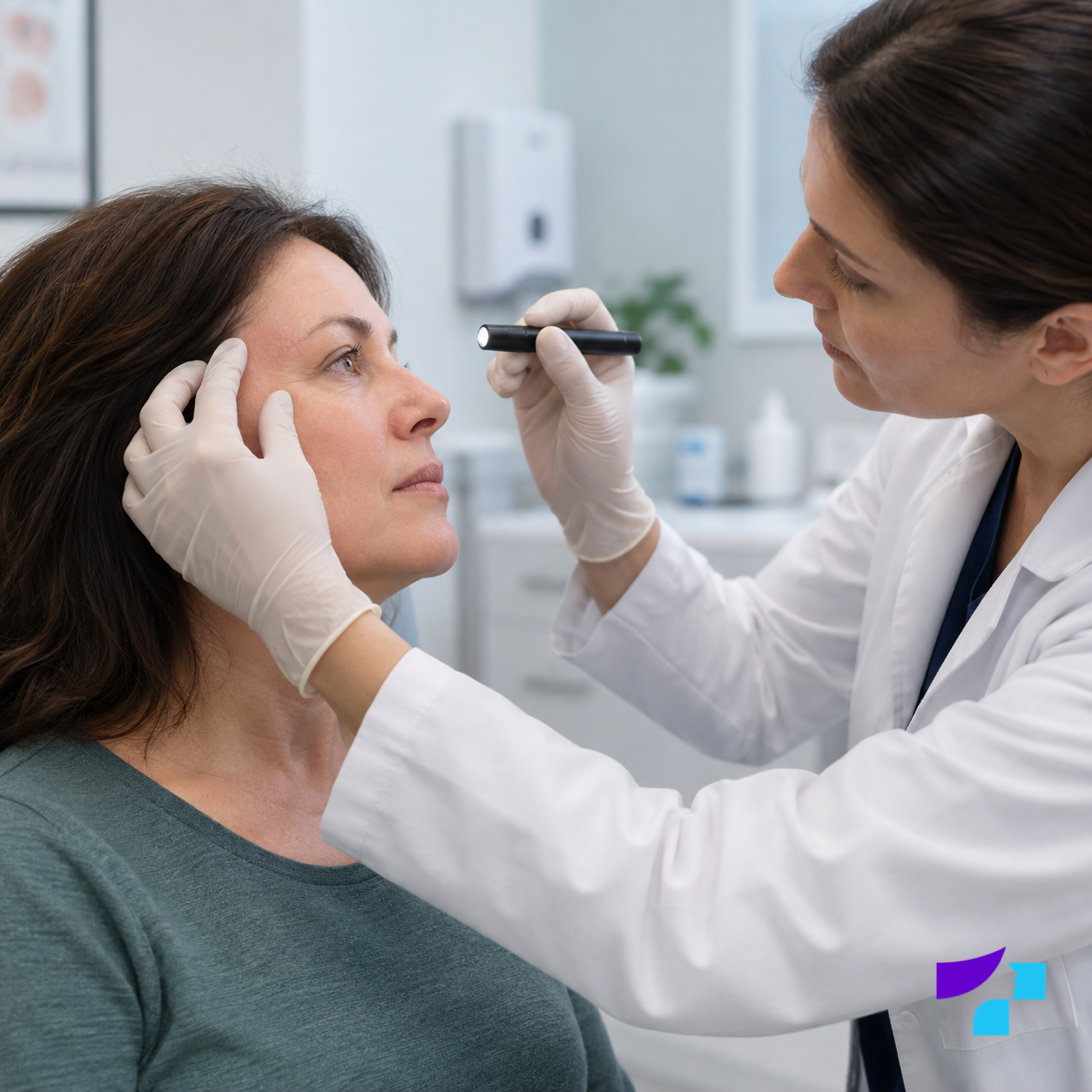
Illustrative visualisation: a doctor examines a patient's eye and facial area. Shingles rash or pain near the eye requires urgent medical assessment because of the risk of vision damage.
How is shingles diagnosed?
Most often, a doctor diagnoses shingles based on symptoms and the typical appearance of the rash. A typical picture is one-sided pain, burning or tingling followed by grouped blisters along a nerve pathway.
Additional tests may be needed if:
- the rash is atypical;
- the illness occurs without a rash;
- the patient has weakened immunity;
- the eye area is affected;
- shingles must be distinguished from herpes simplex, impetigo or other infections.
How is shingles treated?
Shingles treatment depends on the patient’s age, general health, rash location, symptom severity and risk of complications.
The goals of treatment are to:
- reduce viral activity;
- shorten the course of illness;
- relieve pain;
- support skin healing;
- reduce new rash formation;
- reduce the risk of postherpetic neuralgia and other complications.
Antiviral medicines
A doctor may prescribe antiviral medicines such as aciclovir, valaciclovir or famciclovir. These medicines help limit viral replication. They should not be started or used without medical advice, because the doctor must assess indications, other diseases, kidney function, possible drug interactions and the most appropriate treatment regimen.
Pain treatment
Shingles pain can be very intense. Some patients improve with doctor-recommended pain relievers, while others need targeted treatment for nerve pain. If the pain is severe, burning, disrupts sleep or continues after the rash has healed, the doctor should be informed.
Skin care
Skin care aims to reduce irritation and the risk of secondary infection.
- Keep the affected area clean and dry.
- Do not pick blisters or crusts.
- Wear loose, soft clothing.
- Avoid friction.
- Wash hands after touching the rash.
- Cover the rash with a non-stick dressing if needed.
What can be done at home?
Home care does not replace treatment prescribed by a doctor, but it may help reduce discomfort.
Helpful measures may include:
- cool, damp compresses for short-term comfort;
- loose clothing;
- adequate fluid intake;
- rest;
- covering the rash if contact with others is possible;
- careful hand hygiene;
- doctor-recommended pain relief.
Avoid:
- scratching or picking blisters;
- sauna, swimming pool or hot baths while the rash is active;
- aggressive disinfectants;
- starting prescription medicines on your own;
- waiting if the rash is near the eye or on the face.
Complications of shingles
Most people recover without serious consequences, but shingles can cause complications. The risk is higher in older adults, people with weakened immunity and cases affecting the face, eye area or large skin areas.
- Postherpetic neuralgia.
- Secondary bacterial skin infection.
- Pigment changes or scars after the rash.
- Eye damage and impaired vision.
- Hearing or balance problems.
- Facial nerve involvement.
- Rarely, pneumonia, meningitis, encephalitis or other severe complications in people with marked immunosuppression.
How to distinguish shingles from other conditions?
| Condition | What may look similar | What is more typical of shingles |
|---|---|---|
| Allergy | Redness, itching, rash | One-sided pain and blisters along a nerve pathway |
| Contact dermatitis | Rash after contact with an irritant | Burning, tingling and segmental distribution |
| Herpes simplex | Blisters | Shingles usually affects a wider nerve area and is very painful |
| Impetigo | Blisters, crusts | Shingles is usually one-sided and associated with nerve pain |
| Insect bites | Itchy rash | Shingles often begins with burning or shooting pain |
| Eczema | Redness, itching, irritation | Shingles is more often sudden, painful and one-sided |
Vaccination against shingles
Vaccination against shingles is a preventive measure. It does not treat shingles that has already started, but it can reduce the risk of shingles and complications in the future.
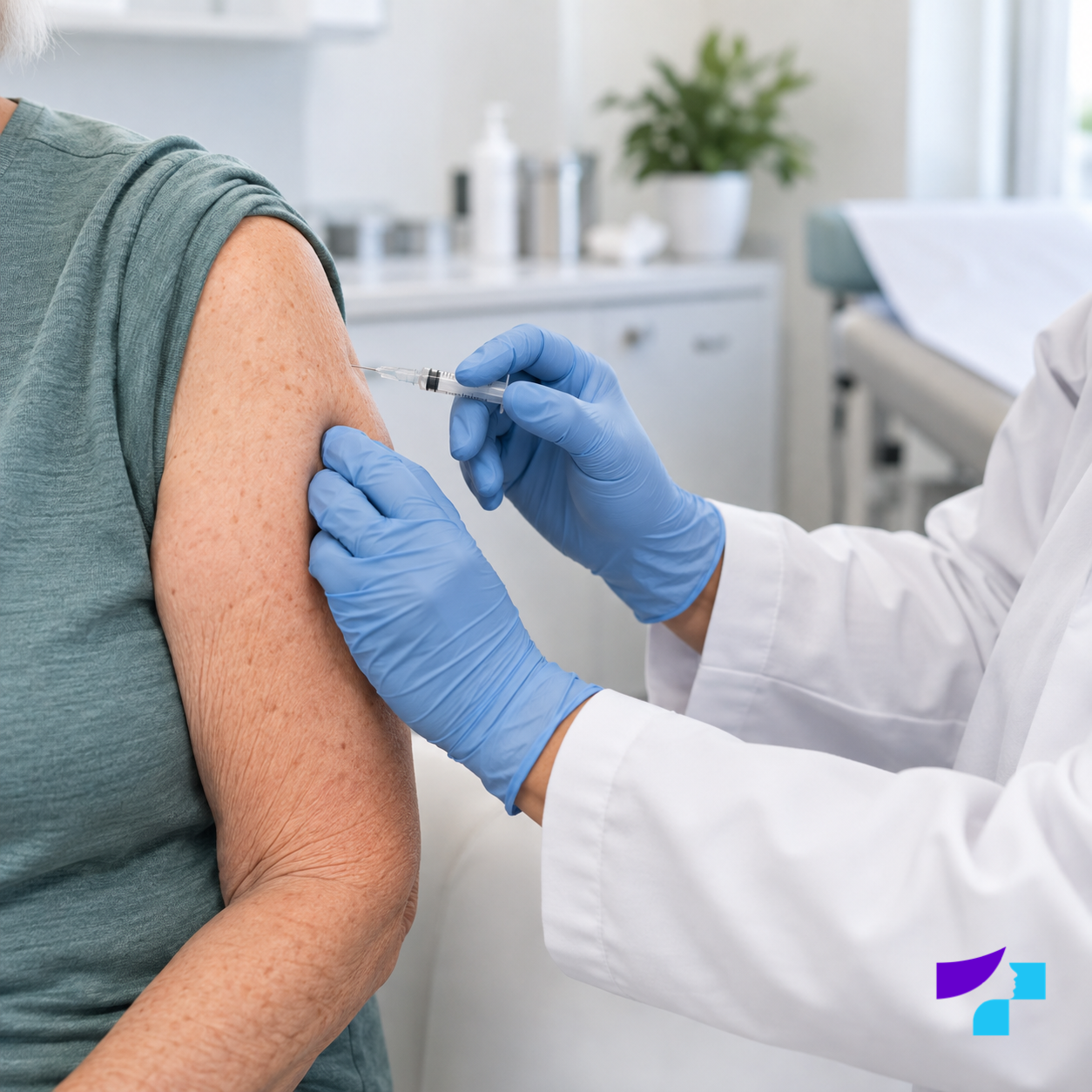
Illustrative visualisation: a vaccine is administered into an adult patient's upper arm. The image illustrates the vaccination procedure; suitability and timing of shingles vaccination should be discussed with a doctor.
International recommendations support recombinant herpes zoster vaccination for adults over 50 years of age, as well as certain immunocompromised groups from a younger age. The vaccine is usually given in two doses. Suitability, dose interval and timing should be discussed with a doctor.
Vaccination may be considered for:
- people over 50 years of age;
- patients with weakened immunity;
- patients with chronic diseases;
- people who have already had shingles;
- patients planned for immunosuppressive therapy, if the doctor considers it appropriate.
Can shingles occur without a rash?
Rarely, shingles may cause pain without visible skin changes. This is called herpes zoster sine herpete. It is harder to diagnose because there are no typical blisters. If one-sided burning or shooting pain occurs in a specific skin area, especially in a higher-risk patient, a doctor may consider this diagnosis.
Summary
Shingles, or herpes zoster, is caused by reactivation of the Varicella zoster virus and affects both skin and nerves. It often begins with burning or stabbing pain on one side of the body, followed by a painful blistering rash.
Recognising shingles early is important because timely treatment can shorten the course of illness and reduce the risk of complications. Special attention is needed if the rash is near the eye, on the face or ear area, or if the patient has weakened immunity.
A dermatologist consultation or family doctor consultation can help confirm the diagnosis, choose treatment and reduce the risk of persistent nerve pain.
References and authoritative sources
- U.S. Centers for Disease Control and Prevention (CDC): clinical overview of shingles
- U.S. Centers for Disease Control and Prevention (CDC): shingles vaccination recommendations
- DermNet: herpes zoster
- DermNet: postherpetic neuralgia after shingles
- Mayo Clinic: shingles symptoms and causes
- National Health Service (NHS): patient information about shingles
- European Vaccination Information Portal: shingles and vaccination
