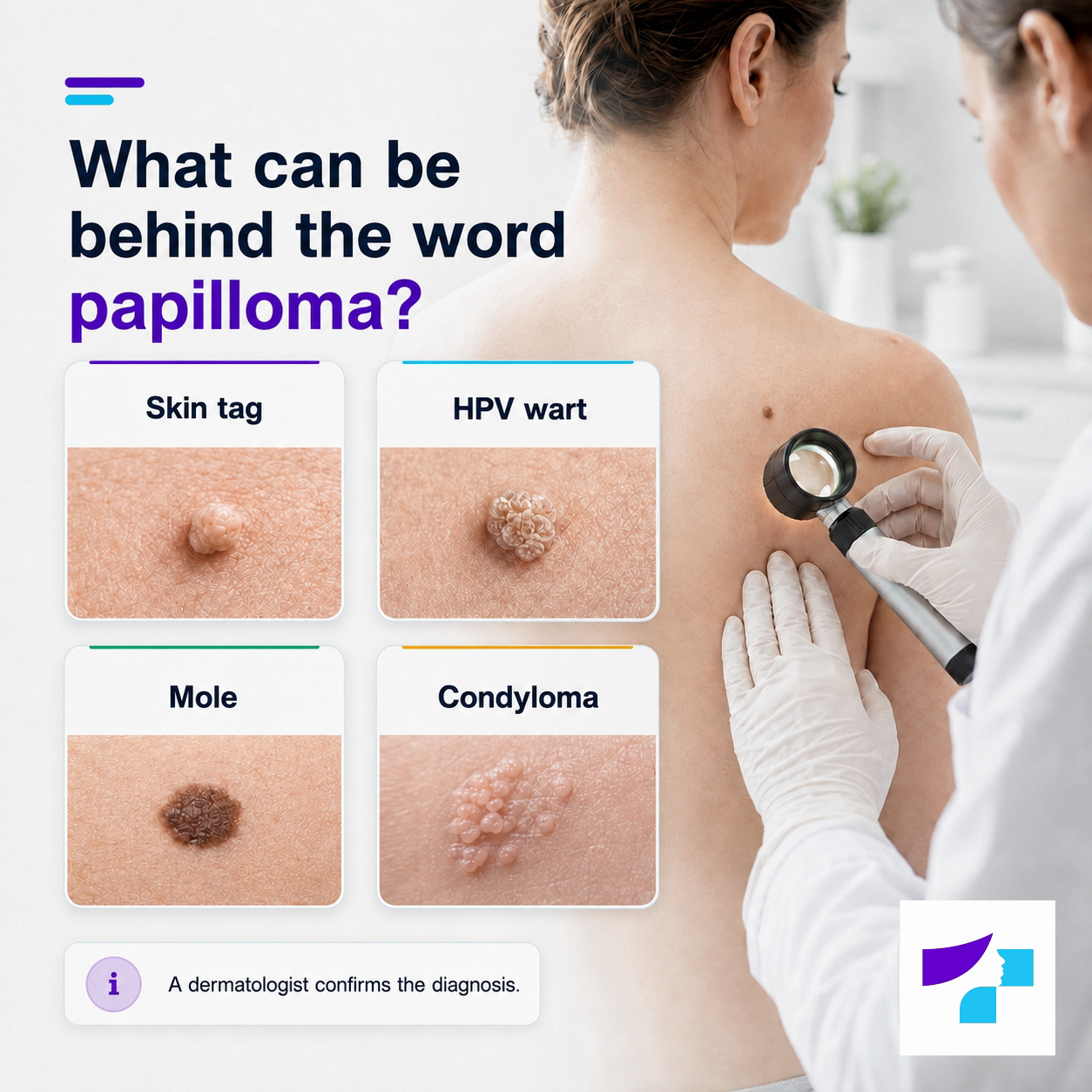
Papillomas are a common reason for visiting a dermatologist. People usually use the word “papillomas” to describe small skin growths on the neck, in the armpits, under the breasts, in the groin, on the eyelids or in the intimate area. Medically, however, the word “papilloma” is often used too broadly in everyday language: it may refer to skin tags, also called acrochordons, HPV-related warts, genital warts or condylomas, seborrheic keratoses, moles or other skin lesions.
Most of these lesions are benign, but self-diagnosis can be misleading. The most important step is not simply to “remove a papilloma”, but first to understand what the lesion actually is. If a skin lesion grows, bleeds, hurts, itches, changes color or shape, ulcerates or looks different than before, it should be shown to a dermatologist.
What are papillomas?
In medicine, a papilloma means a growth that forms a papillary or wart-like structure on the skin or mucous membrane. In patient language, however, “papilloma” most often means a soft, small skin growth on a stalk. In dermatology, such lesions are often called skin tags, acrochordons, fibroepithelial polyps or soft fibromas.
Skin papillomas or acrochordons are usually:
- soft;
- skin-colored, pinkish or slightly brownish;
- a few millimeters in size, less often larger;
- on a narrow stalk or slightly raised above the skin;
- more common in skin folds and areas of friction.
They are usually not dangerous and not contagious. However, other skin lesions may look similar, so in unclear cases a dermatologist’s assessment is necessary.
Why can the term “papilloma” be misleading?
The word “papilloma” itself does not tell whether the lesion is caused by a virus, is contagious, benign, cosmetic or needs further examination. Two visually similar growths can be completely different.
| What the patient says | Possible medical explanation | Usually related to HPV? |
|---|---|---|
| Papilloma on the neck | Skin tag or acrochordon | Usually no |
| Papilloma in the armpit | Skin tag, irritated lesion | Usually no |
| Hard papilloma on a finger | Viral wart | Yes |
| Papilloma on the foot | Plantar wart | Yes |
| Papilloma in the intimate area | Condyloma or another lesion | Often HPV, but it must be assessed |
| Brown papilloma | Seborrheic keratosis, mole or another lesion | Not always |
| Bleeding papilloma | Traumatized or suspicious lesion | Needs examination |
Therefore, the correct medical approach is to distinguish skin papillomas or acrochordons from HPV-related warts and other skin lesions.
Papillomas, skin tags, warts and condylomas: what is the difference?
| Lesion | Typical appearance | Common locations | Contagious? | When should it be checked? |
|---|---|---|---|---|
| Skin tag or acrochordon | Soft growth, often on a stalk | Neck, armpits, groin, under the breasts, eyelids | Usually no | If it grows, bleeds, hurts, causes discomfort or is unclear |
| Common wart | Firm, rough lesion | Fingers, palms, knees | Yes | If it hurts, spreads, bleeds or does not go away |
| Plantar wart | Thickened area on the sole, may hurt while walking | Feet | Yes | If it interferes with walking or spreads |
| Condyloma | Soft or cauliflower-like growths | Genitals, anal area | Yes | Always requires specialist assessment |
| Mole | Pigmented spot or raised lesion | Anywhere on the skin | No | If it changes according to ABCDE warning signs |
| Seborrheic keratosis | “Stuck-on”, brownish, rough lesion | Face, back, chest | No | If it changes quickly or bleeds |
Why do skin papillomas or acrochordons appear?
The exact cause is not always known. The development of skin tags is associated with a combination of factors:
- skin rubbing against skin, clothing or jewelry;
- skin folds and moisture;
- excess body weight;
- pregnancy and hormonal changes;
- insulin resistance and type 2 diabetes;
- age;
- genetic predisposition.
They are more often seen on the neck, in the armpits, in the groin, under the breasts and on the eyelids, because these areas are more prone to friction and irritation.
Are papillomas related to HPV?
Not always. This is one of the most important clarifications.
HPV, or human papillomavirus, causes warts and condylomas, but not all soft skin papillomas or skin tags. Some people use the word “papilloma” to mean an HPV wart, while others mean an acrochordon, where the role of the virus is unclear or not the main factor.
In short:
- skin tags are usually not contagious and are not always related to HPV;
- common warts are caused by HPV;
- genital warts or condylomas are usually caused by HPV types 6 and 11;
- high-risk HPV types, such as HPV 16 and 18, are associated with precancerous changes and certain cancers, but they often do not cause visible warts.
What is human papillomavirus or HPV?
HPV is a very common group of viruses. There are more than 200 HPV types. Some infect the skin and cause common warts, while others infect mucous membranes in the genital, anal or mouth and throat areas.
HPV can be:
- low-risk - more often causes genital warts, but rarely causes cancer;
- high-risk - with persistent infection, it may cause cell changes and certain types of cancer.
HPV infection often causes no symptoms. A person may not know that they are infected, and in many cases the infection clears on its own. However, in high-risk HPV cases, prevention, HPV vaccination and cervical cancer screening are important.
Where do papillomas most often appear?
Skin papillomas or acrochordons most often appear:
- on the neck;
- in the armpits;
- under the breasts;
- in the groin;
- on the eyelids;
- in abdominal folds;
- in areas where clothing, necklaces or underwear rub the skin.
If the lesions are on the fingers, feet or around the nails, they may more often be HPV-related warts. If the lesions are in the genital or anal area, they should be treated as a separate sexual health issue.
Papillomas in the intimate area and condylomas
Lesions in the intimate area should not be diagnosed or treated at home. They may be condylomas, skin tags, moles, molluscum contagiosum, inflammatory changes, precancerous changes or other lesions.
Condylomas are genital warts most commonly caused by low-risk HPV types. They may be small, soft, skin-colored, pinkish or cauliflower-like. They may appear on the genitals, around the anus, in the perineal area or, less commonly, on other mucosal surfaces.
For genital lesions, the most appropriate specialist may be a dermatovenerologist, gynecologist, urologist or proctologist.
Are papillomas contagious?
It depends on the type of lesion.
Skin tags or acrochordons are usually not contagious. They cannot “spread” to another person through everyday contact.
HPV warts are contagious. They can spread through direct contact, small skin microtraumas, shaving, shared towels or shoes, and moist public places such as swimming pools and showers.
Condylomas are contagious and spread through intimate skin-to-skin contact. A condom reduces the risk of HPV transmission, but does not eliminate it completely, because the virus may be present on skin areas not covered by a condom.
Are papillomas dangerous?
Common skin papillomas or acrochordons are usually not dangerous. They more often cause cosmetic discomfort or mechanical irritation if they rub against clothing, jewelry or are traumatized during shaving.
However, it is risky to automatically assume that any growth is a “harmless papilloma”. A mole, seborrheic keratosis, basal cell carcinoma, squamous cell carcinoma, melanoma or another skin disease may be mistaken for a papilloma.
A lesion should be checked especially if it:
- grows quickly;
- changes color, shape or surface;
- bleeds or ulcerates;
- hurts, burns or itches;
- becomes inflamed;
- is asymmetrical or has irregular borders;
- is located on the eyelid, face, genitals or anal area;
- appears in large numbers over a short period of time;
- appears in a person with a weakened immune system.
How can a papilloma be distinguished from a mole, wart or another lesion?
A dermatologist can do this safely. At home, some features may be noticed, but they do not replace a medical examination.
A skin tag is usually soft, flexible and often on a stalk. A wart is more often firmer, rougher and has a thickened surface. A mole is often pigmented, but may also be raised and skin-colored. Seborrheic keratosis often looks like a “stuck-on” brownish or rough lesion.
If a lesion is pigmented, changing or bleeding, it should not be considered an ordinary papilloma until it has been examined by a doctor.
How does a doctor check papillomas?
A dermatologist performs a skin examination and, if necessary, dermoscopy. Dermoscopy is the examination of a skin lesion using magnification and special lighting. It helps assess structure, pigment, blood vessels and other features that may not be visible to the naked eye.
If the diagnosis is unclear or the lesion is suspicious, the doctor may recommend a biopsy or complete removal of the lesion with histological examination. Histology means that the removed tissue is examined under a microscope in a laboratory.
How are papillomas removed?
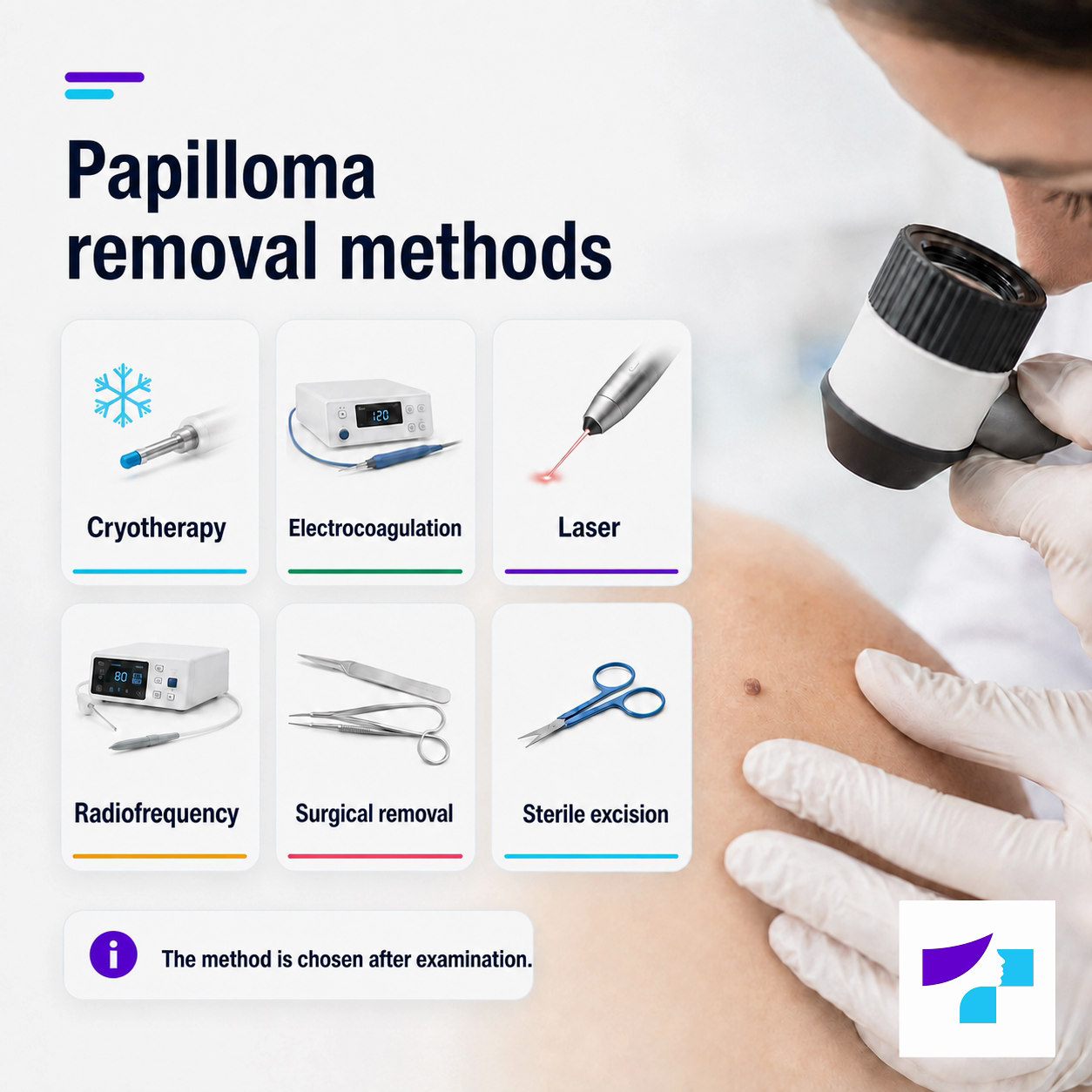
The method of papilloma removal depends on the type, size, number and location of the lesion, the patient’s skin characteristics and whether histology is needed.
| Method | When it is used | Advantages | What to consider |
|---|---|---|---|
| Cryotherapy with liquid nitrogen | For warts and some benign lesions | Quick method, often without cutting | A blister or scab may form; repeated sessions may be needed |
| Electrocoagulation | For small skin growths | Stops bleeding at the same time | A scab may form; small risk of scarring |
| Laser therapy | For precise removal, including cosmetically sensitive areas | Precise tissue treatment | Not always suitable if histology is needed |
| Radiofrequency method | For delicate removal of benign lesions | Precise method with local anesthesia | Must be assessed individually |
| Surgical removal | For suspicious or larger lesions | Allows histological examination | A stitch and scar may be possible |
| Sterile removal with medical scissors | For individual skin tags | Quick and suitable for small lesions | Must be performed in sterile medical conditions |
The procedure is usually performed on an outpatient basis. For small lesions, local anesthesia or a short procedure without complex preparation is often sufficient. After the procedure, the doctor’s wound care instructions should be followed.
Is papilloma removal painful?
Pain is usually mild or short-lived. If needed, local anesthesia is used. The sensation depends on the method, the location of the lesion and the patient’s sensitivity. The eyelids, face and intimate area are more sensitive, so in these areas the doctor’s experience is especially important.
What to expect after papilloma removal?
After the procedure, there may be redness, a small wound, scab or tenderness at the removal site. Healing time depends on the method, the size of the lesion and the body area.
It is usually important to:
- keep the area clean;
- not scratch or pick off the scab;
- avoid aggressive products;
- avoid sun exposure on the healing area;
- follow the wound care instructions given by the doctor.
Any removal method may leave a small scar or pigmentation change, especially if the area is traumatized or exposed to the sun during healing.
Can papillomas grow back?
If a specific lesion has been completely removed, it usually does not return in the same place. However, new papillomas or warts may appear elsewhere.
In the case of skin tags, new lesions may develop if friction, excess body weight, irritation of skin folds or individual predisposition remains. In the case of HPV warts, recurrence is possible because the virus may remain in the surrounding skin.
Can papillomas be removed at home?
No. Papillomas should not be cut, torn off, burned, tied with thread, treated with vinegar, celandine, lemon, baking soda, alcohol or other aggressive products.
This may cause:
- bleeding;
- infection;
- chemical burns;
- scarring;
- pigmentation changes;
- inflammation of the lesion;
- delayed diagnosis of skin cancer if the lesion was not actually a papilloma.
Pharmacy wart-removal products should not be used on the face, eyelids, genitals, mucous membranes or unclear skin lesions without a doctor’s instruction.
How can the risk of papillomas, warts and HPV spread be reduced?
Skin tags cannot always be completely prevented, but reducing friction, caring for skin folds, controlling moisture, normalizing body weight and assessing metabolic health may help.
The risk of spreading HPV warts can be reduced by:
- not touching or scratching warts;
- not sharing towels, razors or shoes;
- wearing flip-flops in public showers and swimming pools;
- covering warts if they are easily traumatized;
- avoiding shaving over warts;
- using condoms during intimate contact;
- considering HPV vaccination according to a doctor’s recommendations.
HPV vaccine and prevention
The HPV vaccine helps protect against new infection with several important HPV types, including types that cause most genital warts and types associated with most HPV-related cancers. The vaccine does not treat an existing HPV infection and does not remove existing warts or condylomas.
The suitability of vaccination, especially in adults, should be discussed with a doctor. Vaccinated people should also continue cervical cancer screening according to age and national recommendations.
Papillomas in children, pregnant women and people with weakened immunity
Children more often have common warts on the hands and feet. They are often not dangerous, but should be checked if they hurt, bleed, spread quickly or are located on the face or genitals.
During pregnancy, skin tags may become more common due to hormonal and mechanical factors. Lesions in the intimate area during pregnancy should be assessed by a doctor.
In people with weakened immunity, warts may be more widespread, persistent and harder to treat. In such cases, an individual dermatologist’s approach is needed.
Common myths about papillomas
| Myth | Fact |
|---|---|
| All papillomas are caused by HPV | No, skin tags are not always related to HPV |
| All papillomas are contagious | HPV warts and condylomas are contagious, but ordinary skin tags are not |
| Papillomas are always dangerous | Most are benign, but suspicious signs should be checked |
| Papillomas always need to be removed | No, removal is needed if they cause discomfort, are traumatized or the diagnosis needs clarification |
| A papilloma can be safely cut off at home | No, this may cause bleeding, infection and scarring |
| Apple cider vinegar or celandine safely helps | These products may cause burns and scars |
| The HPV vaccine treats existing papillomas | No, it helps prevent new HPV infections |
| A condom fully protects against HPV | It reduces the risk, but does not eliminate it completely |
When should you definitely see a dermatologist?
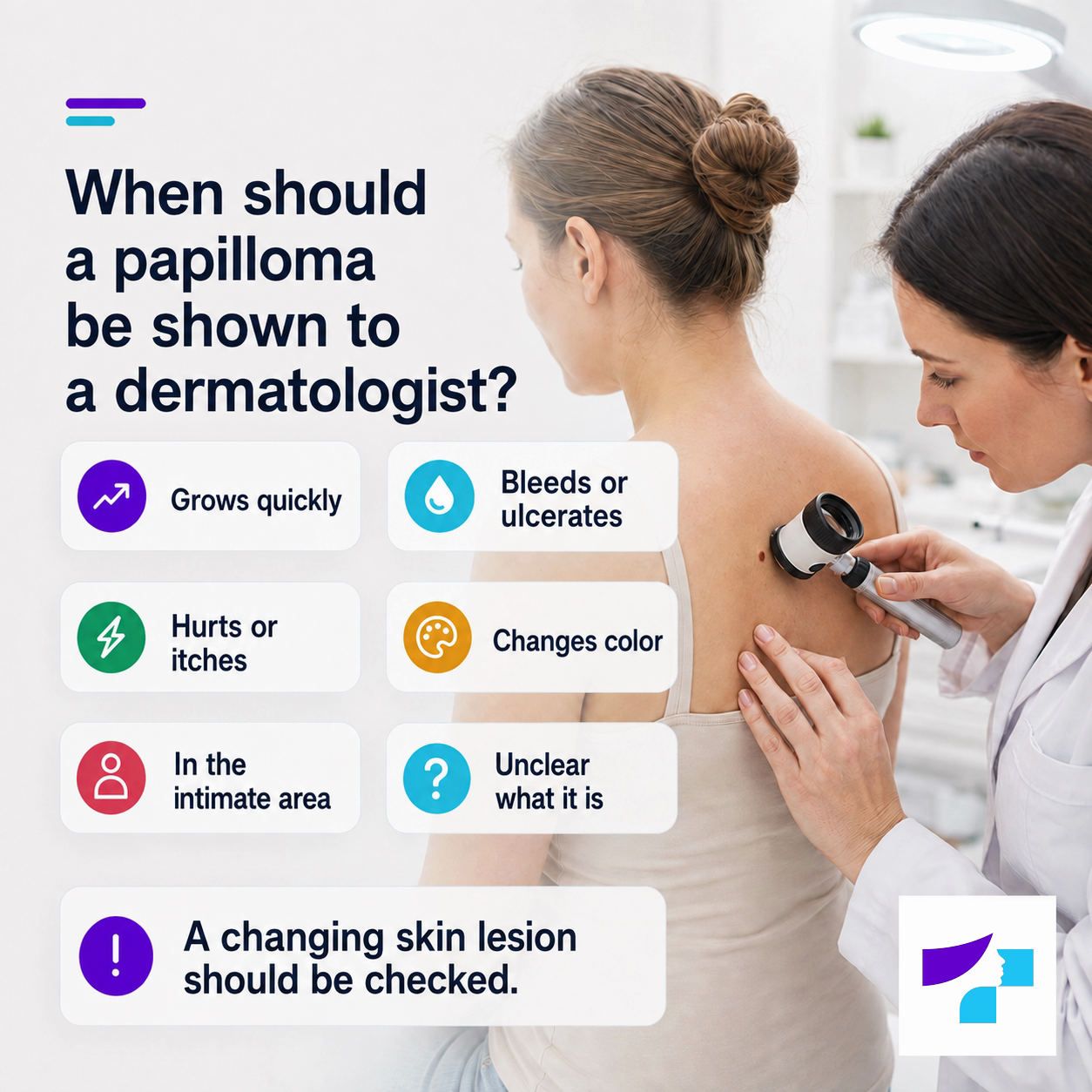
You should see a dermatologist if:
- it is not clear what the lesion is;
- the lesion grows quickly;
- it bleeds, hurts, itches, burns or ulcerates;
- its color, shape or surface changes;
- it is located on the face, eyelids, genitals or anal area;
- many lesions suddenly appear;
- the lesion is repeatedly traumatized;
- the patient has a weakened immune system;
- the lesion is in a child, pregnant woman or senior;
- the lesion is pigmented and changing.
Summary
Papillomas are a common but not always precise everyday term for different skin growths. Most often it refers to benign skin tags or acrochordons, which appear in areas of friction and are usually not contagious. However, some similar lesions may be HPV-related warts or condylomas, while others may require dermoscopy or histological examination. The safest approach is to first establish the diagnosis and only then choose the most appropriate removal or treatment method.
Medical disclaimer
This information is for educational purposes and does not replace a dermatologist consultation, diagnosis or treatment. Any new, changing, bleeding, ulcerating, painful, itchy or rapidly growing skin lesion should be shown to a dermatologist. Do not use prescription medicines, strong caustic products, antiviral medicines, antibiotics or aggressive home remedies without medical advice. In the case of genital or anal lesions, consult a dermatovenerologist, gynecologist, urologist, proctologist or another appropriate specialist.
References and authoritative sources
- DermNet: patient information about skin tags and acrochordons
- DermNet: patient information about anogenital warts and condylomas
- American Academy of Dermatology: skin tags
- American Academy of Dermatology: causes of warts
- National Health Service (NHS): human papillomavirus or HPV
- National Health Service (NHS): warts and verrucas
- National Health Service (NHS): genital warts
- U.S. Centers for Disease Control and Prevention (CDC): HPV vaccination recommendations
- U.S. National Cancer Institute: HPV and cancer risk
- MSD Manual for patients: warts
- U.S. Food and Drug Administration (FDA): warning about self-removal products for moles and skin tags
