Human papillomavirus, or HPV, is a very common group of viruses that can infect the skin and mucous membranes. In Latvian, HPV is often referred to as CPV — cilvēka papilomas vīruss. Both abbreviations refer to the same infection.
HPV is not a single disease with one specific symptom. Some HPV types cause benign skin or mucosal warts, including genital warts, while others — the so-called high-risk HPV types — can, if the infection persists, cause cell changes and increase the risk of certain cancers.
HPV is most often discussed in relation to cervical cancer, but human papillomavirus can also be associated with cancers of the anus, vulva, vagina, penis, mouth and throat. This is why HPV prevention is important for both women and men.
In most people, HPV infection causes no symptoms and clears over time. However, in some people the infection persists. Persistent high-risk HPV infection is medically the most important form, because it can lead to precancerous changes. Therefore, HPV prevention relies on vaccination, regular cervical cancer screening and timely medical consultation if symptoms or abnormal test results appear.
In brief: the most important facts about HPV
HPV, or human papillomavirus, is one of the most common sexually transmitted infections worldwide. It can affect both women and men. The virus is most often transmitted through intimate skin and mucous membrane contact, including vaginal, anal or oral sex.
HPV can occur completely without symptoms. This means that a person may be infected, not know it and pass the infection to a partner. A positive HPV test does not mean cancer. It means that human papillomavirus or a high-risk HPV group has been found in the sample, and further management depends on the HPV type, cytology result, age and the doctor’s assessment.
There is no universal medicine that directly eliminates HPV from the body. Treatment is aimed not at the virus itself, but at the consequences it may cause — for example, genital warts or precancerous changes of the cervix. The HPV vaccine is preventive: it helps protect against certain HPV types, but it does not treat an existing infection.
What is HPV?
Human papillomavirus is a group of viruses that includes many different types. Some of them cause common skin warts on the hands or feet, some cause genital warts, and some can affect mucosal cells and increase cancer risk.
In medicine, HPV types are usually divided into two major groups: low-risk HPV and high-risk HPV. Low-risk HPV types most often cause warts and are usually not associated with cancer development. High-risk HPV types can cause cell changes which, if the infection persists, may progress to precancerous changes and later to cancer.
In everyday language, HPV is sometimes associated only with “papillomas” or “venereal warts”. More precisely, genital warts are one possible manifestation of HPV infection, but they are not the whole infection. In modern medicine, the most important topic in HPV prevention is not only warts, but also reducing cancer risk through vaccination and screening.
How is HPV transmitted?
Human papillomavirus, or HPV, is mainly transmitted through close skin and mucous membrane contact, most commonly during vaginal, anal or oral sex. Infection is possible even without penetration if there is close contact with anogenital skin or mucosa. A condom reduces the risk of infection, but does not provide complete protection, because HPV may also be present on skin areas not covered by a condom. Transmission of genital HPV through everyday contact, such as toilets, towels or swimming pools, is not considered significant.
Nevertheless, condom use remains important because it reduces the risk not only of HPV, but also of other sexually transmitted infections.
HPV can be transmitted even when a person has no visible warts, pain, itching, burning or other symptoms. This is why people often do not know that they are infected. An HPV diagnosis does not mean that the infection was acquired recently, and it does not in itself prove infidelity. The virus may remain in the body for a long time and be detected only years later.
Mechanism of infection: how does HPV affect the body?
HPV infects the superficial layers of the skin and mucous membranes. If the infection is caused by a low-risk HPV type, warts may develop — benign growths of the skin or mucosa. If the infection is caused by a high-risk HPV type, there may be no visible symptoms, but the virus can affect cell division and renewal processes over time.
In most cases, the immune system limits HPV infection and the infection clears without lasting consequences. However, if a high-risk HPV infection persists, it may cause cell changes. In the cervix, these changes may be called CIN, or cervical intraepithelial neoplasia — precancerous changes in the superficial cell layer of the cervix.
CIN is not cancer. CIN means that changes have been found in the cells and that observation or treatment may be needed. Mild changes may resolve on their own, while more significant changes may require treatment to prevent cancer from developing in the future.
HPV infection development timeline
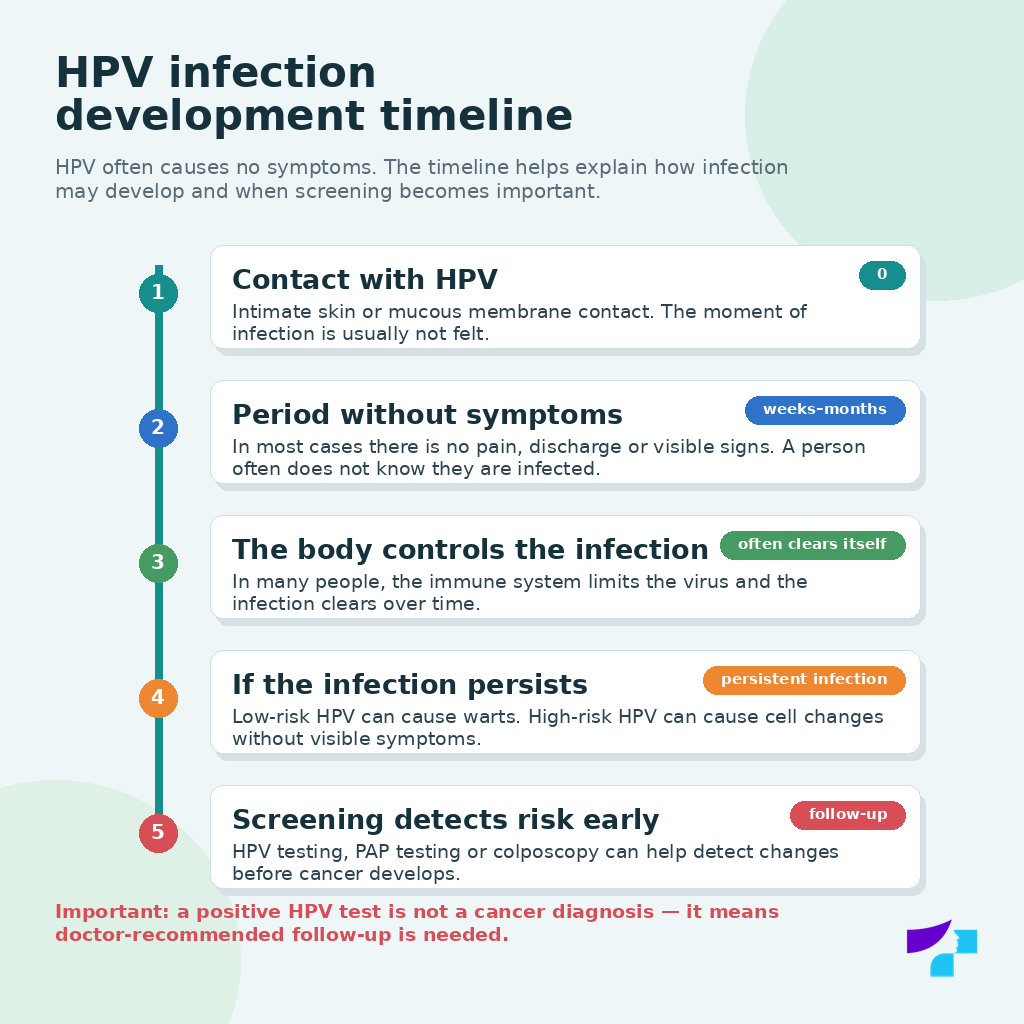
The course of HPV infection can differ from person to person, but it can be understood in several stages.
First, contact with the virus occurs. The moment of infection is usually not felt — there is no immediate pain, rash or other clear sign. This may be followed by a period without symptoms. During this time, a person often does not know that they are infected.
In many people, the immune system controls the virus and the infection clears. If the infection persists, low-risk HPV may cause genital warts. High-risk HPV often causes no visible symptoms, but cell changes may begin and can only be detected through screening or tests recommended by a doctor.
If persistent high-risk HPV infection is not detected and cell changes progress, precancerous changes may develop. Long-standing untreated high-grade precancerous changes can increase cancer risk. This is exactly why cervical cancer screening is so important — it allows risk to be detected before cancer develops.
HPV types: low-risk and high-risk viruses
Low-risk HPV types most often cause genital warts. They may be unpleasant, contagious and recurrent, but they are usually not associated with cervical cancer development.
High-risk HPV types are the most medically important in the context of cancer prevention. HPV types 16 and 18 are particularly significant, as are types 31, 33, 35, 39, 45, 51, 52, 56, 58 and 59, although their individual risk may differ. High-risk HPV can be associated with cancers of the cervix, anus, vulva, vagina, penis, mouth and throat.
The presence of high-risk HPV does not mean that a person will definitely develop cancer. Most infections are controlled by the body. The risk increases if the infection persists, if a person does not attend screening, smokes, has a weakened immune system or has other risk factors.
Low-risk HPV and high-risk HPV — key differences
| Question | Low-risk HPV | High-risk HPV |
|---|---|---|
| What does it most often cause? | Genital warts, also called condylomas | Cell changes and precancerous changes |
| Are symptoms usually visible? | Visible warts may appear | Often there are no symptoms |
| Is it associated with cancer risk? | Usually no | Yes, if the infection persists |
| How is it detected? | During a medical examination, if warts are present | By HPV testing, PAP testing, screening or colposcopy |
| How is it treated? | Warts are treated | Cell changes are monitored or treated |
| Can vaccination help? | It may help prevent some wart-causing types | It may help prevent the most important high-risk types |
HPV symptoms in women and men
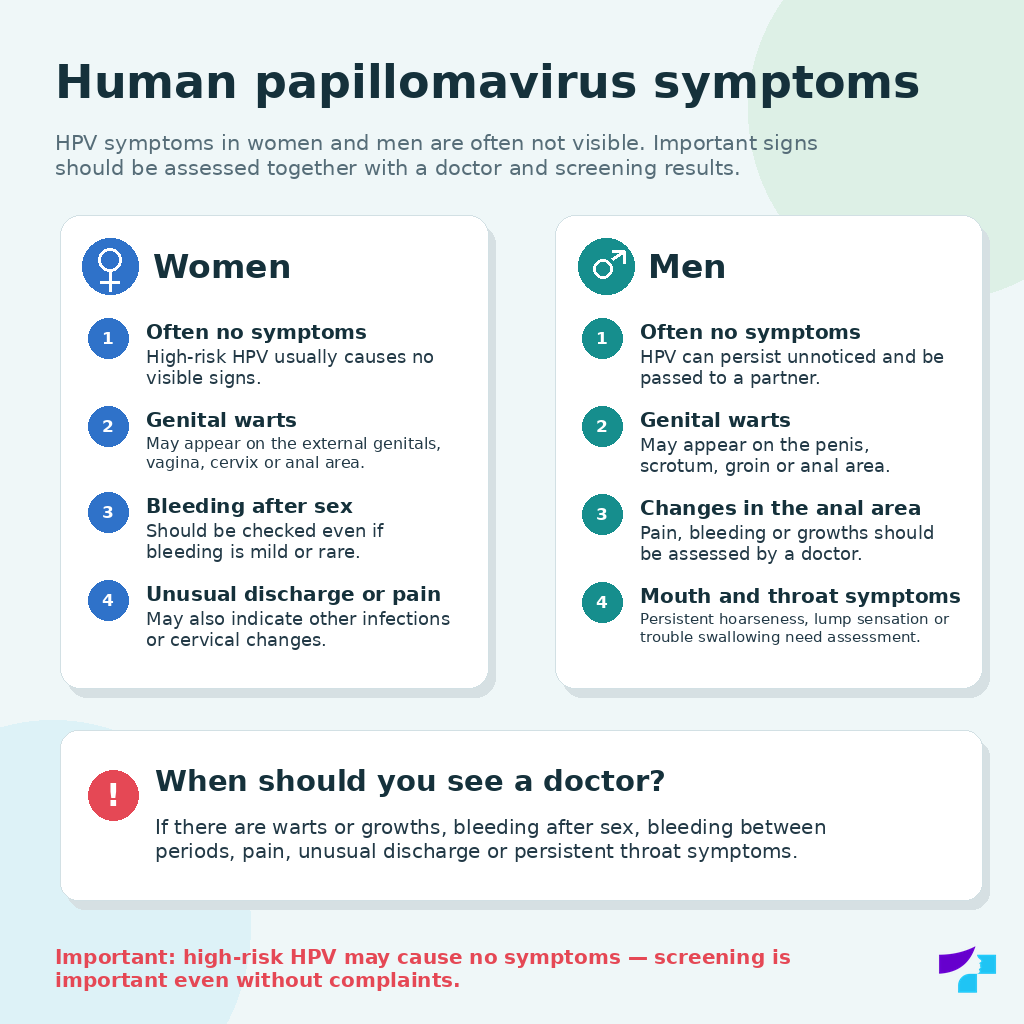
HPV very often causes no complaints. In both women and men, the infection may occur without symptoms. It often causes no visible signs, but can affect mucosal cells over time.
If symptoms are visible, they are most often related to genital warts. Warts may be small, soft, skin-coloured, pinkish or greyish growths. They may be flat or raised above the skin, single or multiple, and sometimes have a cauliflower-like surface.
In women, warts may appear on the external genitals, in the vagina, on the cervix or in the anal area. In men, they may appear on the penis, scrotum, groin or in the anal area. HPV may also be present in the mucosa of the mouth and throat, usually without visible symptoms.
Bleeding after sex, bleeding between periods, bleeding after menopause, unusual discharge, pelvic pain or pain during sex may indicate cervical changes. These symptoms are not specific only to HPV, but they always require medical assessment.
Main signs that may indicate HPV or HPV-related changes
Visible growths or warts in the genital or anal area may indicate genital warts caused by low-risk HPV.
Bleeding after sex, bleeding between periods or bleeding after menopause may indicate a cervical or other gynaecological problem that requires examination.
Unusual discharge, pelvic pain or pain during sex may be associated with different conditions, including infections or cervical changes.
Persistent hoarseness, difficulty swallowing, a lump sensation in the throat or enlarged neck lymph nodes may require medical assessment, especially if symptoms do not resolve.
A positive high-risk HPV test is also an important finding. It is not a reason to panic, but it means that the follow-up plan recommended by a doctor should be followed.
HPV and genital warts, or condylomas
Genital warts, also called condylomas and historically often referred to as venereal warts, are one of the most visible manifestations of HPV infection. They are usually caused by low-risk HPV types. Warts may appear weeks or months after infection, and sometimes later.
Genital warts are usually not life-threatening and usually do not mean a risk of cervical cancer. However, they are contagious, may spread, recur and cause psychological discomfort. They may itch, bleed or interfere with sexual life.
Genital warts should not be treated at home by cutting, burning or applying products intended for common warts on the hands or feet. Genital skin and mucosa are sensitive, and inappropriate self-treatment can cause burns, scarring, pain and inflammation.
The method of wart treatment is chosen by a doctor. Prescription topical medicines or procedures may be used, such as freezing, chemical treatment, laser therapy or surgical removal. The specific treatment is determined by the doctor after examination.
HPV and cervical cancer
Cervical cancer is closely linked to persistent high-risk HPV infection. This does not mean that every woman with HPV will develop cancer. Most infections clear on their own or are controlled by the body. A persistent infection that lasts longer and causes cell changes is more dangerous.
Cervical cancer usually develops gradually. Mild cell changes may appear at first. Some of these changes resolve on their own. If the changes become more pronounced, they may be classified as higher-grade precancerous changes. If they are not detected and treated, cancer may develop over time.
This is why cervical cancer screening is so important. Screening is not only about looking for cancer. Its main value is the possibility to detect high-risk HPV or precancerous changes early, when they are still treatable and have not become invasive cancer.
Other HPV-related cancer risks
HPV is not associated only with cervical cancer. High-risk HPV may also increase the risk of cancers of the anus, vulva, vagina, penis, mouth and throat. Therefore, HPV prevention is important for both women and men.
In men, HPV may cause genital warts and, more rarely, HPV-related malignant tumours. It is especially important to see a doctor if non-healing growths, ulcers, bleeding, pain or changes appear in the penile, anal, mouth or throat area.
Who has a higher risk of HPV complications?
Any sexually active person can become infected with HPV, but the risk of complications is not the same for everyone. A higher risk of persistent infection and cell changes may occur in people with a weakened immune system, for example because of certain chronic diseases, immunosuppressive treatment or other health conditions.
Smoking is an important risk factor, especially in the context of cervical precancerous changes and cervical cancer. Smoking may impair local mucosal defence and contribute to the progression of cell changes.
Multiple sexual partners over a lifetime, early onset of sexual activity, other sexually transmitted infections and non-participation in screening may also play a role. However, HPV can also be acquired by a person in a monogamous relationship, because the infection may have been acquired earlier and may persist for a long time without symptoms.
Can the body develop immunity against HPV?
Yes, the immune system plays a very important role in the course of HPV infection. In many cases, the body limits HPV and the infection clears. However, natural immunity after HPV infection is not always strong enough to reliably protect against reinfection with the same or another HPV type.
The HPV vaccine helps create targeted protection against specific HPV types. It does not treat an existing infection, but it may help protect against vaccine-included types with which a person has not yet been infected.
No dietary supplement, “immunity course” or home method has been proven to reliably cure HPV. A healthy lifestyle, stopping smoking, adequate sleep and control of chronic diseases may support overall health, but they do not replace screening, vaccination or doctor-recommended treatment.
HPV diagnosis: HPV test, PAP test and screening
HPV diagnosis depends on the situation. If genital warts are visible, a doctor can often recognise them during examination. If needed, additional tests may be performed to exclude other conditions.
The most important tests in cervical cancer prevention are the HPV test and cytology, often called the PAP test. The HPV test detects the presence of high-risk HPV. The PAP test assesses whether there are changes in cervical cells.
Therefore, an HPV test and a PAP test are not the same. The HPV test looks for the virus that may cause cell changes. The PAP test looks for the cell changes themselves.
In Latvia, state-funded cervical cancer screening is intended for women aged 25 to 70. Women aged 25–29 undergo cytology, while women aged 30–70 undergo high-risk HPV testing every five years.
HPV is usually not detected by blood tests. Testing is performed using a sample from the relevant mucosa or cells. Men do not have a national routine HPV screening programme comparable to cervical cancer screening in women, but if symptoms, warts or increased risk are present, medical consultation is necessary.
What does a positive HPV test mean?
A positive HPV test means that high-risk HPV has been found in the sample. It does not mean that a person has cancer. It also does not mean that cancer will definitely develop.
If an HPV test is positive, the most important thing is not to conclude that it means cancer. A positive test means that high-risk HPV has been detected in the sample, and further management depends on the cytology result, HPV type, age and previous test history. A doctor may recommend repeat testing after a certain period, cytology, colposcopy or another follow-up plan. Self-treatment or attempts to “remove the virus” using unverified methods are not recommended.
Further action depends on the specific result. The doctor considers the HPV type, cytology result, the patient’s age, previous screening results and other risk factors. In some cases, repeat testing after a certain time is needed. In other cases, colposcopy is required — an examination of the cervix under magnification, which allows suspicious areas to be assessed more precisely.
A negative HPV test means that high-risk HPV has not been detected in the specific sample. This usually means a low risk of cervical cancer in the coming years, but it does not mean that screening will never be needed again. Tests should be performed according to the national programme or a doctor’s recommendation.
HPV treatment and follow-up
HPV infection is not treated with antibiotics, because antibiotics work against bacteria, not viruses. There is also no universal antiviral medicine that reliably eliminates HPV from the body. Treatment focuses on the manifestations and complications caused by HPV.
Genital warts are treated using methods chosen by a doctor. These may include prescription topical medicines or procedures such as freezing, chemical treatment, laser therapy or surgical removal. The most appropriate method is chosen by the doctor, taking into account the location, number and size of the warts and the patient’s general health.
Treatment of cervical precancerous changes depends on the grade of the changes. Mild changes can often be observed, because they may resolve on their own. More significant changes may require treatment. One method is cervical conisation — a procedure in which a small part of cervical tissue containing the altered cells is removed. Decisions about this treatment are made by a gynaecologist or colposcopy specialist.
Follow-up examinations may be needed after treatment, because HPV or HPV-related changes can recur. The frequency of follow-up is determined by the doctor.
HPV vaccine: who should get it, when and why?
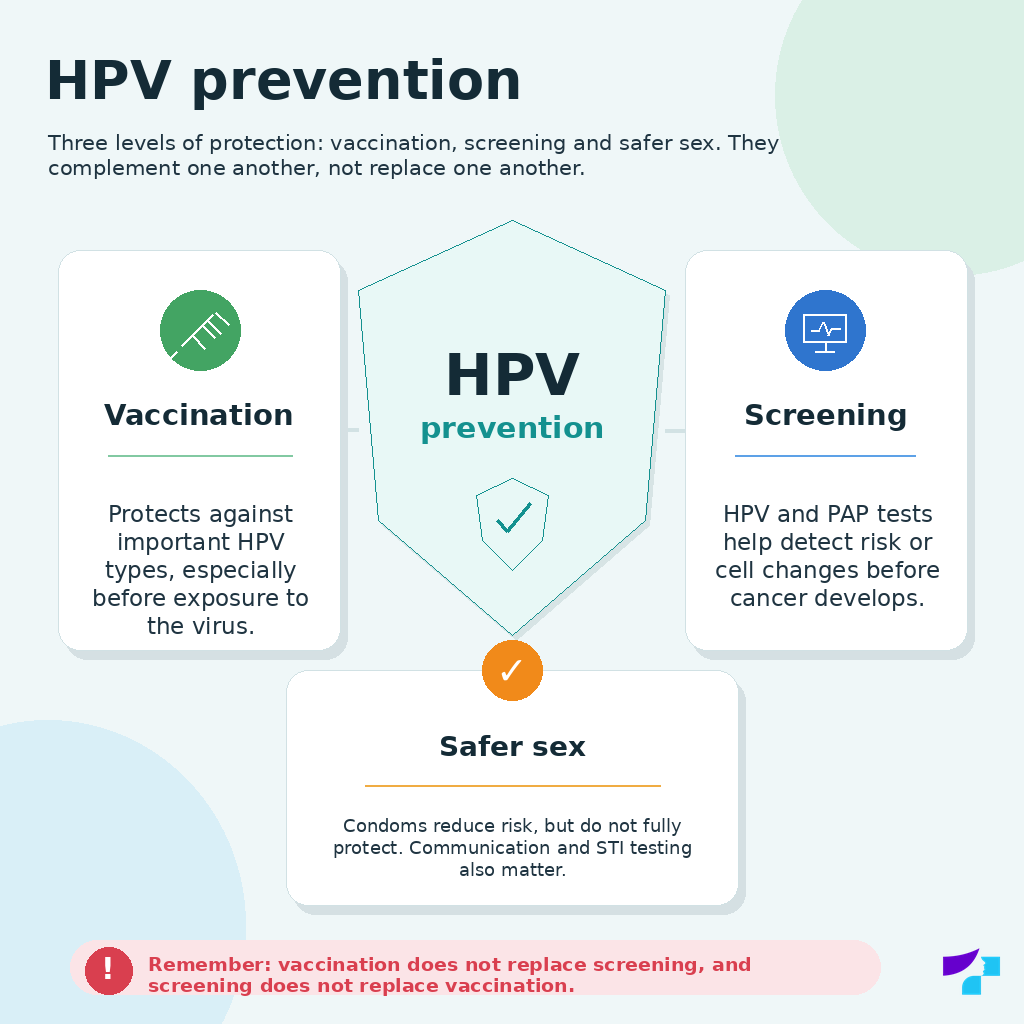
The HPV vaccine helps the body develop protection against certain HPV types before a person encounters them. The vaccine does not treat an existing HPV infection, does not treat genital warts and does not remove the need for screening.
Vaccination is most effective before the start of sexual activity, because at that point the chance that a person has already encountered the HPV types included in the vaccine is lower. However, vaccination may also be considered after the start of sexual activity, because a person may not have been infected with all HPV types included in the vaccine.
HPV vaccination is important for both girls and boys. Boys and men can become infected with HPV, transmit it to partners and develop HPV-related diseases themselves. Vaccination helps reduce the spread of HPV in society and protects both sexes.
In Latvia, a nine-valent HPV vaccine is available, protecting against the most common high-risk HPV types as well as HPV types that often cause genital warts. Availability of state-funded vaccination depends on age, risk group and the current national programme, so accurate information should be checked with a family doctor or in current materials from the Centre for Disease Prevention and Control.
Which HPV types are covered by the nine-valent vaccine?
The nine-valent HPV vaccine available in Latvia is intended to protect against several important HPV types. It includes HPV types 6 and 11, which are often associated with genital warts, as well as high-risk HPV types 16, 18, 31, 33, 45, 52 and 58, which may be associated with the risk of cervical and other HPV-related cancers. The vaccine does not cover all possible HPV types, which is why cervical cancer screening must continue even after vaccination.
HPV vaccine for adults: is it too late?
The HPV vaccine works best when it is given before the start of sexual activity and before exposure to the HPV types included in the vaccine. However, vaccination in adulthood may still be considered, because a person may not have encountered all HPV types included in the vaccine. It is especially worth discussing vaccination with a doctor if a person may have new partners in the future, has not been vaccinated before or has had HPV-related changes. The vaccine does not treat an existing infection, so the decision about vaccination in adults should preferably be made together with a doctor.
Can the vaccine help if the HPV test is already positive?
A positive HPV test does not mean that vaccination is always pointless. The HPV vaccine does not cure an existing infection and does not change a positive test result, but it may help protect against other HPV types included in the vaccine with which a person has not yet been infected. Therefore, the usefulness of vaccination after a positive HPV test should be assessed individually — taking into account age, sexual history, test results, previous vaccination and the doctor’s recommendations.
Is cervical cancer screening still needed after HPV vaccination?
Yes. The HPV vaccine significantly reduces risk, but it does not replace cervical cancer screening. The vaccine does not protect against every possible high-risk HPV type, and some people may have encountered HPV before vaccination.
Vaccination and screening are not alternatives. They complement each other. Vaccination reduces the risk of infection with the most important HPV types, while screening helps detect high-risk infection or cell changes in time.
Everyday HPV prevention
The most effective HPV prevention is a combination of several measures. The first level is vaccination. The second is regular cervical cancer screening. The third is safer sexual behaviour, including condom use and timely diagnosis and treatment of other sexually transmitted infections.
Stopping smoking is also important, because smoking increases the risk that cervical cell changes will progress. It is equally important not to delay a doctor’s visit if genital warts, bleeding after sex, unusual discharge, pain or other symptoms appear.
HPV during pregnancy
HPV infection itself is usually not a reason to avoid planning pregnancy. In most women, HPV does not significantly affect fertility or pregnancy. However, if cervical changes, a positive high-risk HPV test or previous cervical treatment have been identified, pregnancy planning should be discussed with a gynaecologist.
Genital warts may sometimes enlarge during pregnancy because of hormonal and immune system changes. Treatment methods during pregnancy are chosen with special care, so self-treatment is not acceptable.
Transmission of HPV to the baby during childbirth is possible, but serious consequences are rare. The mode of delivery is usually determined individually after assessment by a gynaecologist, not solely because HPV is present.
HPV and other infections: how to tell the difference?
HPV can be confused with other sexually transmitted or gynaecological infections, because symptoms may overlap or there may be no symptoms at all.
HPV and herpes are not the same. Herpes usually causes painful blisters or ulcers, while HPV more often causes warts or occurs without symptoms.
HPV and chlamydia are also not the same. Chlamydia is a bacterial infection treated with antibiotics. HPV is a viral infection for which there is no universal curative treatment.
HPV and HIV are different infections. HIV affects the immune system as a whole, while HPV infects the skin and mucous membranes. However, a weakened immune system may increase the risk of persistent HPV and complications.
HPV and candidiasis or bacterial vaginosis are also not the same. Itching, burning and discharge are more often related to vaginal microbiome changes or other infections, so a person should not diagnose themselves.
Common myths about HPV
One of the most common myths is that HPV only affects people with many partners. In reality, HPV is very common, and a person with one partner can also become infected.
Another myth is that a positive HPV test means cancer. This is not correct. A positive test means the presence of the virus, not a cancer diagnosis.
A third myth is that if there are no symptoms, HPV cannot be present. In fact, high-risk HPV very often causes no visible signs.
A fourth myth is that the HPV vaccine is needed only by girls. Modern practice includes vaccination for boys as well, because HPV can cause disease in both sexes.
A fifth myth is that screening is not needed after vaccination. Vaccinated women should still continue cervical cancer screening according to age and the national programme.
What is well proven in medicine and what is still being studied?
It is well proven that persistent high-risk HPV infection is the main cause of cervical cancer. It is also well proven that HPV vaccination reduces the risk of infection with vaccine-included HPV types and reduces the risk of HPV-related precancerous changes.
The importance of cervical cancer screening is also well proven. Screening helps detect high-risk HPV infection or cell changes before cancer develops.
Medicine continues to develop in several directions. One of them is the use of self-collected samples for HPV testing to increase screening accessibility. Another direction is more precise risk assessment by combining HPV genotype, cytology results, biomarkers and previous test history.
Therapeutic HPV vaccines are also being studied, with the aim of helping treat already existing HPV-related changes. However, in everyday clinical practice, the proven and main strategy remains preventive vaccination, screening and timely treatment of precancerous changes.
When should you see a doctor?
A doctor should be consulted if warts or growths appear in the genital, anal or mouth area, if there is bleeding after sex, bleeding between periods, bleeding after menopause, unusual discharge, pelvic pain or pain during sex.
Medical consultation is also needed if an HPV test is positive and it is not clear what to do next. In this situation, self-treatment or unverified methods to “remove the virus” should not be attempted. The correct approach is to follow the observation or additional testing plan recommended by the doctor.
For women, it is very important to attend cervical cancer screening even if there are no symptoms. HPV-related changes often develop without complaints, and screening is the way to detect them in time.
Medical disclaimer
The information in this article is intended for educational and informational purposes. It does not replace medical consultation, diagnosis or treatment. In the case of HPV infection, genital warts, abnormal test results, bleeding, pain, unusual discharge or other symptoms, a qualified healthcare professional should be consulted — a gynaecologist, dermatovenerologist, urologist, family doctor or another appropriate specialist. Do not attempt to remove warts yourself, use prescription medicines without a doctor’s instructions or postpone examinations recommended by a doctor. If symptoms are severe, rapidly progressing or concerning, medical help should be sought immediately.
References and authoritative sources
- Centre for Disease Prevention and Control of Latvia: information for the public about HPV and vaccination.
- Centre for Disease Prevention and Control of Latvia: preventive cervical cancer screening.
- National Health Service of Latvia: changes in cervical cancer screening and introduction of HPV testing.
- World Health Organization (WHO): human papillomavirus and cancer.
- World Health Organization (WHO): cervical cancer.
- Centers for Disease Control and Prevention (CDC): information about HPV.
- Centers for Disease Control and Prevention (CDC): HPV vaccination.
- Centers for Disease Control and Prevention (CDC): HPV vaccine safety.
- National Cancer Institute: HPV and cancer.
- National Cancer Institute: cervical cancer causes, risk factors and prevention.
- European Centre for Disease Prevention and Control (ECDC): HPV vaccination programmes in the European Union and European Economic Area.
Content author
Dermatologist Dr. med. Dace Buile
