Hepatitis is inflammation of the liver. It is most often caused by viruses, but the liver can also become inflamed due to alcohol, toxic substances, certain medicines, autoimmune diseases or metabolic disorders. In everyday searches, when people look for information about hepatitis, they most often mean viral hepatitis — hepatitis A, hepatitis B and hepatitis C.
It is important to understand that hepatitis is not one single disease with one route of transmission and one type of treatment. Hepatitis A usually spreads through contaminated water, food or unwashed hands and does not become chronic. Hepatitis B spreads through blood, sexual contact and from mother to child, and in some patients it can become chronic. Hepatitis C spreads mainly through infected blood, often causes no symptoms for a long time, but today in most cases it can be cured with doctor-prescribed antiviral treatment. The Centre for Disease Prevention and Control of Latvia (SPKC) states that rapid tests for hepatitis B and C in Latvia can be performed free of charge and anonymously at HIV prevention points.
One of the biggest mistakes in hepatitis is waiting for jaundice only. Yellowing of the whites of the eyes and skin is an important symptom, but hepatitis can also occur without jaundice, without obvious complaints or with very non-specific signs — fatigue, nausea, loss of appetite, dark urine, pain in the right upper abdomen or flu-like malaise. The U.S. Centers for Disease Control and Prevention particularly emphasises that hepatitis B may also be present in people without symptoms.
Key points in brief
Hepatitis is inflammation of the liver, most often caused by viruses, but it may also be caused by alcohol, toxic substances, medicines or autoimmune processes. Hepatitis A usually spreads through contaminated water, food or unwashed hands and does not become chronic. Hepatitis B spreads through blood, sexual contact and from mother to child; a vaccine is available, but chronic infection usually cannot be completely eliminated from the body. Hepatitis C most often spreads through infected blood, often causes no symptoms for a long time, but today it is curable in most cases. Hepatitis does not always cause jaundice, so after a risk contact or elevated liver tests, the most important step is to have blood tests and consult a doctor.
What is hepatitis?
Hepatitis means inflammation of the liver. The liver is an organ involved in metabolism, nutrient processing, bile production, blood clotting factor production and the neutralisation of various substances in the body. If the liver is inflamed, its function may deteriorate, and liver markers in the blood may increase — for example, ALT, AST and others.
Hepatitis can be divided into several groups:
| Type of hepatitis | What it means |
|---|---|
| Viral hepatitis | Inflammation of the liver caused by hepatitis viruses, such as hepatitis A, B, C, D or E. |
| Alcoholic hepatitis | Inflammation of the liver associated with alcohol-related liver damage. |
| Toxic hepatitis | Liver damage caused by toxic substances, certain medicines or chemical substances. |
| Autoimmune hepatitis | A condition in which the immune system mistakenly damages liver tissue. |
| Metabolic liver inflammation | Often associated with excess weight, insulin resistance and fatty liver disease. |
This article mainly explains viral hepatitis, because these infections most often raise questions about transmission, symptoms, testing, vaccination and treatment.
Types of hepatitis: hepatitis A, B, C, D and E
Hepatitis A is an acute infection that spreads by the faecal-oral route — through unwashed hands, contaminated water or food. It is sometimes called a “dirty hands disease”. Hepatitis A usually does not become chronic, but in adults it may be more severe than in children. SPKC explains that the incubation period of hepatitis A is on average about four weeks, although it may vary.
Hepatitis B is an infection caused by the hepatitis B virus. It can be acute or become chronic. The World Health Organization states that hepatitis B can be transmitted from mother to child during childbirth, in early childhood, and through contact with blood or other body fluids, including sexual contact or unsafe injections. An effective vaccine is available against hepatitis B.
Hepatitis C is an infection caused by the hepatitis C virus. It often remains without symptoms for a long time, so a person may not know that they are infected. Untreated hepatitis C can cause chronic liver inflammation, liver fibrosis, cirrhosis and increase the risk of liver cancer. The World Health Organization states that direct-acting antiviral medicines can cure more than 95% of people with hepatitis C infection, but there is currently no effective vaccine against hepatitis C.
Hepatitis D is possible only in people who have hepatitis B infection, because the hepatitis D virus needs the hepatitis B virus in order to replicate. Therefore, hepatitis B vaccination also indirectly protects against hepatitis D.
Hepatitis E spreads mainly through contaminated water or food. In Europe, hepatitis E is one of the viral hepatitides that is monitored, but in practical patient searches the most important types are usually hepatitis A, B and C. The World Health Organization states that the most common viral hepatitides in Europe are hepatitis A, B, C and E.
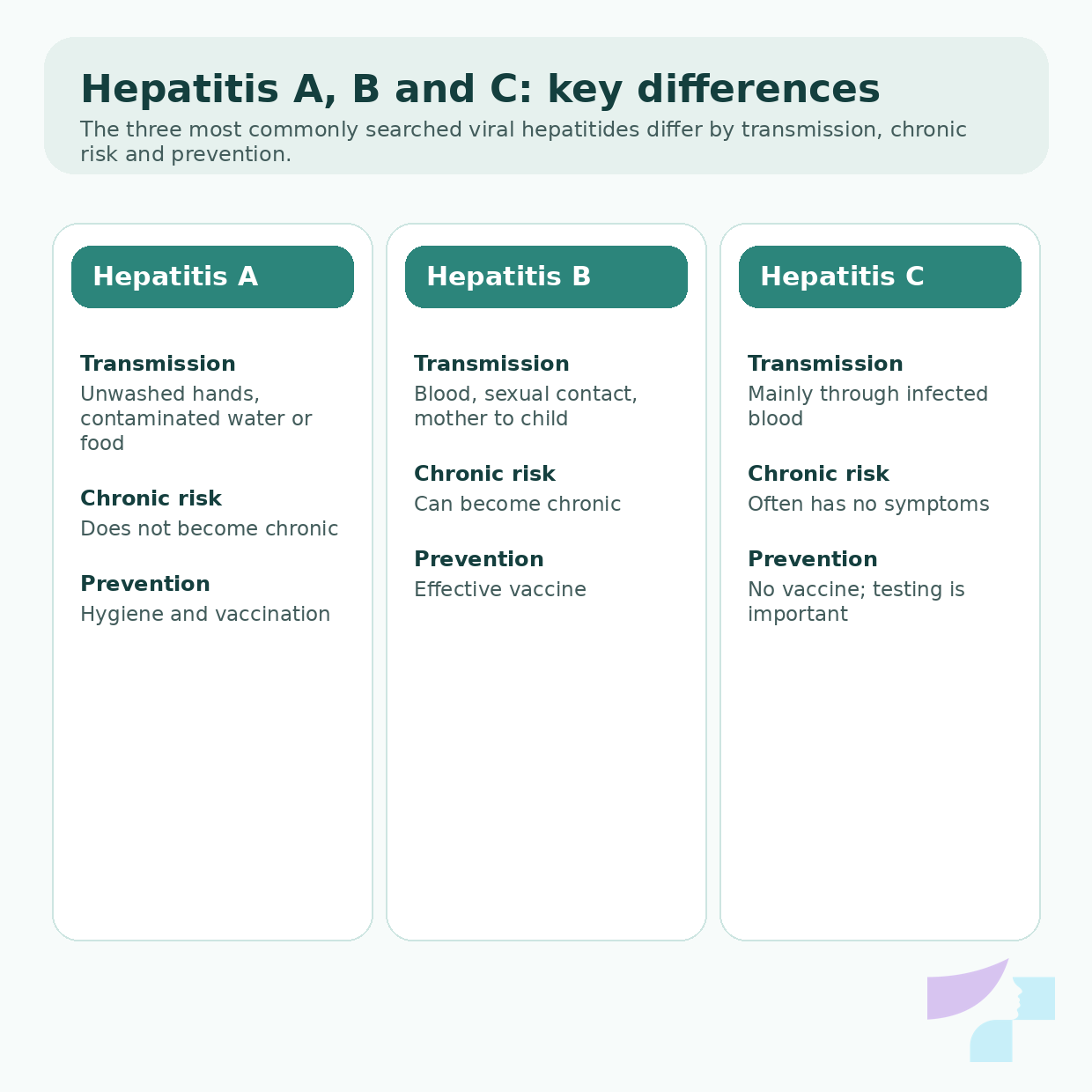
Hepatitis A, B and C — what should not be confused?
| Question | Hepatitis A | Hepatitis B | Hepatitis C |
|---|---|---|---|
| Main route of transmission | Unwashed hands, water, food | Blood, sexual contact, mother to child | Mainly blood |
| Can it become chronic? | No | Can become chronic | Often can become chronic |
| Is there a vaccine? | Yes | Yes | No |
| Can it be asymptomatic? | Yes, especially in children | Yes | Yes, very often |
| Can it be cured? | Usually resolves with supportive treatment | Often controllable; complete elimination is usually not possible | Curable in most cases |
| Main prevention | Hygiene, safe water, vaccination | Vaccination, safer sex, sterile instruments | Sterile instruments, reducing blood-contact risk, testing |
How can hepatitis be transmitted?
The route of transmission depends on the type of hepatitis. This is why it is not correct to talk about “hepatitis” as one single infection.
| Type of hepatitis | Main route of transmission |
|---|---|
| Hepatitis A | Unwashed hands, contaminated water, contaminated food, close household contact in poor hygiene conditions. |
| Hepatitis B | Blood, sexual contact, mother to child during pregnancy or childbirth, non-sterile injections or procedures. |
| Hepatitis C | Mainly blood contact — shared needles, non-sterile instruments, invasive procedures, less commonly sexual contact. |
| Hepatitis D | Only together with hepatitis B. |
| Hepatitis E | Mainly faecal-oral transmission, often associated with food or water. |
A person can become infected with hepatitis A if the virus from an infected person’s stool gets onto hands, surfaces, food or into water and then enters the mouth. Therefore, handwashing, safe water and food hygiene are especially important in hepatitis A prevention.
A person can become infected with hepatitis B if the blood, semen or other body fluids of an infected person enter another person’s body. The U.S. Centers for Disease Control and Prevention explains that hepatitis B can spread even through a very small amount of blood or body fluid.
Hepatitis C is most commonly transmitted through blood contact. This may happen through shared injecting equipment, procedures with non-sterile instruments, or sharing razors or toothbrushes if there is blood on them. SPKC states that hepatitis C, similarly to hepatitis B, spreads through infected blood.
Everyday household contact — talking, hugging, sneezing, coughing or being in the same room — is generally not a route of transmission for hepatitis B or C. However, it is not recommended to share items that may contain microscopic traces of blood, such as razors, toothbrushes, manicure tools or injecting equipment.
Mechanism of infection
The mechanism of hepatitis infection means the route by which the virus enters the body, reaches the liver and causes inflammation.
In hepatitis A, the virus enters the body through the mouth — with contaminated water, food or hands. It enters the digestive tract and can then reach the liver through the bloodstream, causing inflammation of liver cells. A person may be infectious even before clear symptoms appear, which is why hygiene and assessment of contacts are especially important during outbreaks. ECDC states that hepatitis A infectivity can be high even before jaundice appears.
In hepatitis B and C, the virus mainly enters the body through blood or body fluids. After entering the bloodstream, the virus reaches the liver, where it can cause damage to liver cells. Part of the damage is caused not only by the virus itself, but also by the immune system’s response — the body tries to destroy infected cells, and inflammation develops during this process.
If the infection is not cleared from the body and continues for a long time, hepatitis becomes chronic. Chronic inflammation can gradually lead to liver fibrosis — the formation of scar tissue in the liver. If scarring becomes extensive, cirrhosis may develop. Cirrhosis means a significant change in the structure of the liver and an increased risk of liver failure and liver cancer.
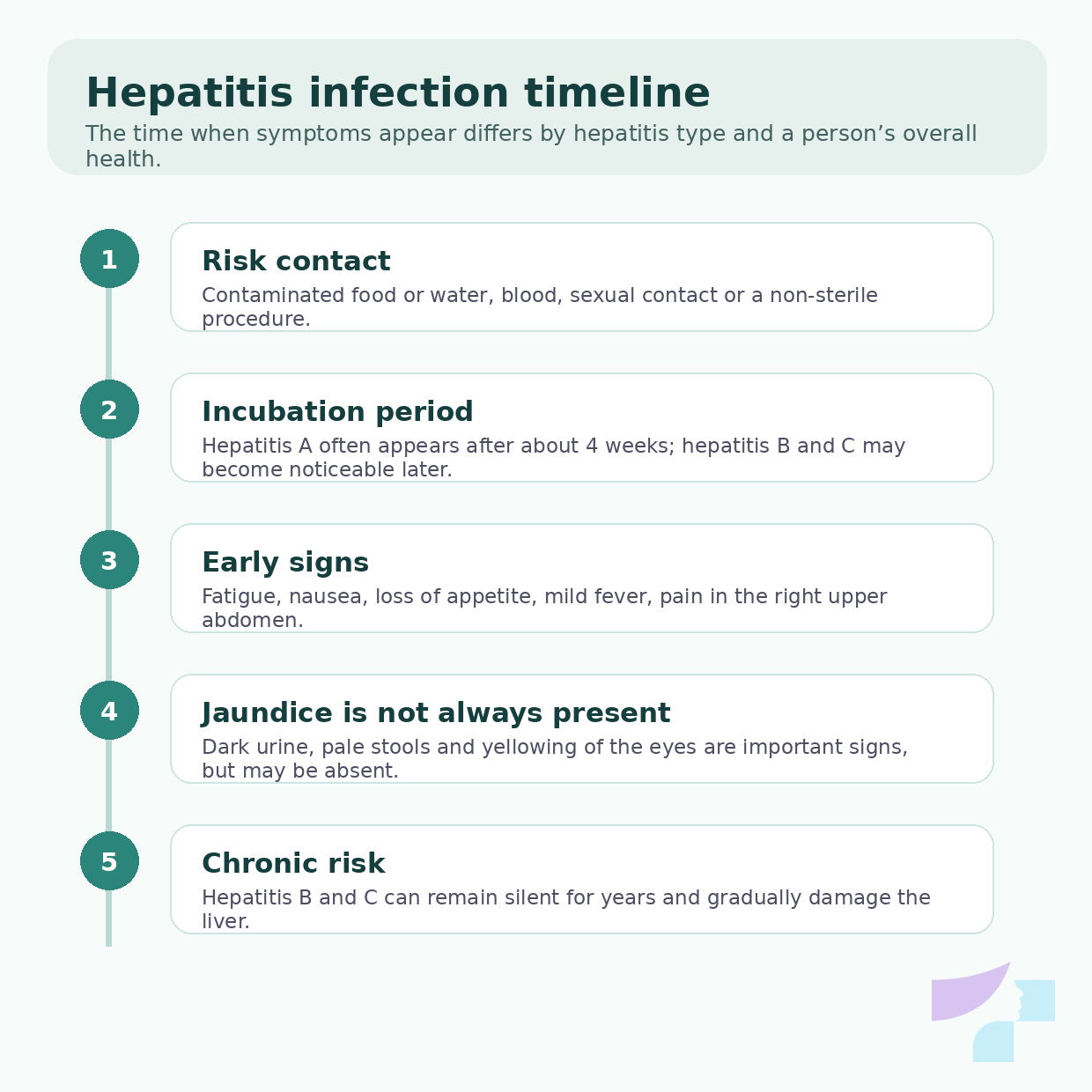
Timeline of infection and symptom development
The hepatitis timeline is not the same for all patients. It is influenced by the type of virus, infectious dose, the person’s age, immune system status, other illnesses and liver health before infection.
A typical sequence is as follows:
- A risk contact occurs — for example, contaminated food or water, a non-sterile procedure, blood contact, unprotected sexual contact or contact with an infected person.
- The incubation period follows — the time from infection to symptoms. During this time, the person may feel well.
- Non-specific symptoms may appear — fatigue, nausea, loss of appetite, mild fever, muscle or joint pain.
- Some patients develop signs more typical of liver inflammation — dark urine, pale stools, pain in the right upper abdomen, yellowing of the whites of the eyes or skin.
- In hepatitis A, the infection usually ends with recovery. In hepatitis B and C, some patients may develop chronic infection.
- In chronic hepatitis B or C, a person may feel well for years while liver damage progresses.
Who has a higher risk of hepatitis?
Higher risk is not limited to “certain groups”. The risk of hepatitis is related to a specific route of transmission.
The risk of hepatitis A is higher in people who travel to regions with lower water and food hygiene safety, live or work in settings where faecal-oral infections spread more easily, are in close contact with a person with hepatitis A, or are not vaccinated and have not previously had hepatitis A. The World Health Organization states that anyone who is not vaccinated or has not previously been infected can get hepatitis A.
The risk of hepatitis B is higher in people who have unprotected sexual contact, multiple sexual partners, contact with blood at work or in everyday life, shared injecting equipment, a partner or family member with hepatitis B, as well as in children whose mother has hepatitis B infection. Testing pregnant women is especially important, because timely action can significantly reduce the risk of transmission to the child. The U.S. Centers for Disease Control and Prevention recommends testing pregnant women for hepatitis B during every pregnancy.
The risk of hepatitis C is higher in people who have ever used injecting drugs, even once, have had medical or beauty procedures with insufficiently sterile instruments, have had tattoos or piercings in unsafe conditions, have received blood transfusions in countries or at a time when testing was insufficient, or are living with HIV infection. The U.S. Centers for Disease Control and Prevention states that hepatitis C testing is important because safe and effective treatment can cure most people within 8–12 weeks.
When should a hepatitis test definitely be performed?
| Situation | What to test / what to do |
|---|---|
| There has been contact with blood | Contact a doctor and have hepatitis B and C tests at the time recommended by the doctor. |
| A tattoo, piercing, manicure or another procedure was performed in a place where sterility was uncertain | Consider testing for hepatitis B and C. |
| There has been unprotected sexual contact with a partner whose infection status is unknown | A doctor may recommend testing for hepatitis B, hepatitis C, HIV and other infections. |
| Razors, toothbrushes, needles or injecting equipment have been shared | Have a hepatitis B and C test. |
| ALT or AST is elevated in blood tests | Medical interpretation and additional tests, including hepatitis markers, are needed. |
| There is dark urine, pale stools, jaundice or pain in the right upper abdomen | See a doctor in the near future. |
| Pregnancy or planning pregnancy | Have the infection tests prescribed by the doctor, especially assessment for hepatitis B. |
| A partner or family member has hepatitis B or C | Testing and medical advice on prevention are needed. |
What should be done after possible risk contact?
If there has been a possible risk contact, it is not advisable to wait for symptoms to appear. Hepatitis B and C can remain without complaints for a long time, while the infection may persist in the body. The first step is to contact a family doctor, infectious disease specialist or gastroenterologist and explain what type of contact occurred — blood contact, sexual contact, a non-sterile procedure, shared sharp hygiene items or contact with a person with hepatitis. The doctor will assess which tests should be done immediately and whether they should be repeated later, because some infections have a window period during which tests may still be negative.
Hepatitis symptoms
Hepatitis symptoms can vary widely. Some people have pronounced jaundice and feel very unwell, while others have almost no complaints. This is why hepatitis cannot be reliably excluded based on how a person feels.
Early symptoms may include:
| Symptom | How it may appear |
|---|---|
| Fatigue | Unusual weakness, sleepiness, lack of energy. |
| Nausea | May occur together with vomiting or aversion to food. |
| Loss of appetite | The person eats less and food may seem unpleasant. |
| Fever | May resemble a mild viral infection. |
| Muscle and joint pain | May feel like the onset of flu. |
| Pain in the right upper abdomen | Discomfort in the liver area. |
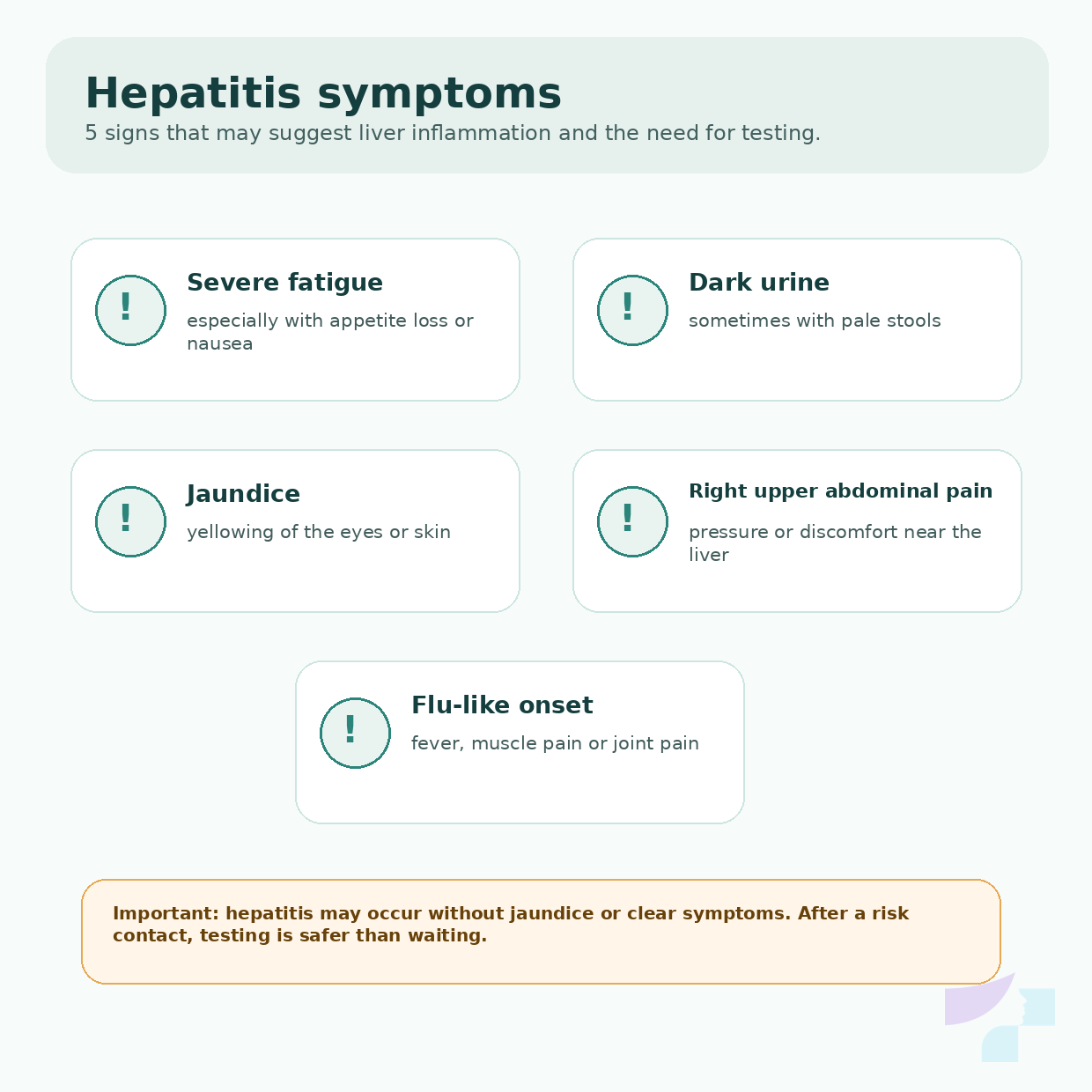
Later or more specific signs may include dark urine, pale or greyish stools, yellowing of the whites of the eyes, yellowish skin, itching, marked weakness, pain or pressure in the right upper abdomen.
The 3–5 main signs that may suggest hepatitis are severe fatigue together with nausea or loss of appetite, dark urine, pale stools, yellowing of the whites of the eyes or skin, and pain in the right upper abdomen. This combination of signs is not a diagnosis, but it is a sufficient reason to see a doctor and have blood tests.
Jaundice occurs because bilirubin — a substance formed when red blood cells break down — can accumulate in the body when there is liver inflammation or impaired bile flow. If bilirubin levels become too high, the skin and whites of the eyes may turn yellow, urine may become darker and stools may become paler.
Chronic hepatitis is often especially deceptive because a person may feel relatively well. Hepatitis C is often not noticed until a test is performed or elevated liver markers are detected. The U.S. Centers for Disease Control and Prevention states that many people with hepatitis C do not look or feel sick and therefore do not know that they have the infection.
Hepatitis A: the “dirty hands disease”
Hepatitis A is an acute viral hepatitis that spreads by the faecal-oral route. This means that the virus from an infected person’s stool enters the mouth — most often through unwashed hands, contaminated water, food or surfaces.
Hepatitis A is called the “dirty hands disease” because hand hygiene is one of the most important prevention measures. However, this name should not create the misleading impression that only people with poor personal hygiene become ill. Hepatitis A can also spread during travel, through food handling, in families, children’s groups or other situations where the virus gets into food or onto surfaces.
Symptoms of hepatitis A may include fatigue, nausea, vomiting, loss of appetite, abdominal pain, fever, dark urine, pale stools and jaundice. In children, hepatitis A more often may be mild or without pronounced symptoms, while in adults the disease may be more severe.
Hepatitis A does not become chronic. After recovery, immunity usually develops. Treatment is mainly supportive — fluids, rest, avoiding alcohol and medical supervision. Specific antiviral treatment is usually not needed for hepatitis A.
A vaccine is available against hepatitis A. SPKC states that vaccination against hepatitis A may be recommended after risk contact if it can be given within two weeks, but in Latvia hepatitis A vaccination is not included in the state-funded vaccination schedule.
During travel, the risk of hepatitis A is reduced by vaccination, safe drinking water, avoiding ice of unknown origin, careful handwashing, sufficiently heat-treated food and caution with raw products in places where water and food safety cannot be guaranteed.
Hepatitis B: transmission, risks and vaccination
Hepatitis B is a viral infection that affects the liver and can be acute or chronic. An acute infection may end with recovery and suppression of viral activity, but in some people the virus remains in the body for a long time and chronic hepatitis B develops.
The hepatitis B virus is a DNA virus. It can persist for a long time in liver cells, or hepatocytes, in a particularly stable form, which is why the infection usually cannot be completely eliminated from the body. If the immune system is suppressed, for example due to certain illnesses or treatment, the hepatitis B virus may reactivate. Therefore, people with previous or chronic hepatitis B need medical supervision in certain situations.
Hepatitis B can be transmitted through blood, semen and other body fluids. Infection may occur during sexual contact, when sharing needles or injecting equipment, during procedures with non-sterile instruments, and from mother to child during pregnancy or childbirth. The World Health Organization states that hepatitis B can also be transmitted in early childhood and through unsafe injections.
The symptoms of hepatitis B may be similar to other types of hepatitis: fatigue, loss of appetite, nausea, abdominal pain, dark urine, pale stools, joint pain, fever and jaundice. However, hepatitis B may also occur without symptoms, especially in its chronic form.
Hepatitis B is diagnosed with blood tests. A doctor usually evaluates hepatitis B markers — tests that show whether a person has an active infection, a past infection, immunity after vaccination or needs further testing. The U.S. Centers for Disease Control and Prevention recommends that adults be screened for hepatitis B at least once in their lifetime, and people with ongoing risk should be tested repeatedly.
An effective vaccine is available against hepatitis B. The World Health Organization states that the hepatitis B vaccine protects for at least 20 years and most likely for life if the vaccination course has been completed. In Latvia, hepatitis B vaccination is an important part of public health prevention; SPKC informational materials state that infant vaccination against hepatitis B has been carried out in Latvia since 1997.
Chronic hepatitis B cannot always be completely cured in the sense that the virus fully disappears from the body; however, modern therapy can suppress viral replication, reduce the progression of liver damage and lower the risk of complications. The need for treatment is determined by a doctor, taking into account viral activity, liver enzymes, liver fibrosis and other factors. EASL guidelines emphasise the importance of early diagnosis, risk stratification, regular monitoring and personalised treatment in hepatitis B care.
Hepatitis C: why is it often detected late?
Hepatitis C is a liver infection caused by the hepatitis C virus. The main route of transmission is blood contact. Hepatitis C is often detected late because symptoms during acute infection may be absent or very mild. A person can live for years without complaints while chronic inflammation gradually develops in the liver.
Risk factors for hepatitis C include sharing needles or injecting equipment, tattoos or piercings in unsafe conditions, medical or dental procedures with insufficiently sterile instruments, shared razors or toothbrushes that may have blood on them, and certain sexual practices involving blood contact. Sexual transmission of hepatitis C is less common than hepatitis B, but the risk is not zero, especially in the presence of bleeding, mucosal injury, HIV coinfection or other sexually transmitted infections.
Hepatitis C is diagnosed with blood tests. Initially, antibodies against hepatitis C may be tested, but a positive antibody test does not yet mean an active infection. To confirm active infection, an additional test that detects the virus’s genetic material in the blood is needed. The doctor then assesses the condition of the liver and the need for treatment.
Today, hepatitis C is one of the important infections where major progress has been made in medicine. Treatment uses direct-acting antiviral medicines. These medicines are prescribed by a doctor, and the specific treatment regimen depends on the patient’s situation. The U.S. Centers for Disease Control and Prevention states that hepatitis C can be cured in more than 95% of cases with 8–12 weeks of oral therapy using direct-acting antiviral agents.
There is no vaccine against hepatitis C. Therefore, the most important prevention is safe procedures, reducing blood-contact risk, sterile instruments and testing after risk contact. The World Health Organization confirms that there is currently no effective vaccine against hepatitis C.
Diagnosis: what tests are needed?
If hepatitis is suspected, the doctor usually begins with a discussion about symptoms, risk contacts, travel, medicines, alcohol use, procedures, sexual health and previous illnesses. Blood tests are then prescribed.
ALT and AST are liver enzymes. If they are elevated, this may indicate liver cell damage, but it does not automatically mean hepatitis. Elevated liver markers may also occur due to fatty liver disease, alcohol effects, medicines, bile duct problems, intense physical exertion or other causes. Therefore, results should be interpreted by a doctor.
A negative test immediately after risk contact does not always completely rule out infection, because some infections have a “window period” — the time when infection has already occurred, but it cannot yet be reliably detected in tests. Therefore, after risk contact, the timing of testing and repeat tests should be planned with a doctor.
Rapid tests for hepatitis B and C are available in Latvia at HIV prevention points. SPKC states that at these points it is possible to have HIV, syphilis, hepatitis B and C rapid tests free of charge, anonymously and confidentially, and to receive pre- and post-test counselling.
What does a positive test mean?
A positive hepatitis test does not always mean the same thing. Some tests show that a person has previously come into contact with an infection or has been vaccinated, while other tests indicate an active infection. For example, a positive hepatitis C antibody test means that the body has come into contact with the virus, but an additional test that detects the virus itself in the blood is needed to confirm active infection. In hepatitis B, several markers must be evaluated together, so results should always be interpreted by a doctor.
Treatment and recovery
Hepatitis treatment depends on the type of hepatitis, disease severity, liver condition and the patient’s overall health.
Treatment of hepatitis A is usually supportive. This means rest, adequate fluid intake, avoiding alcohol, avoiding substances potentially harmful to the liver and medical monitoring. Antibiotics do not help in hepatitis A because it is a viral infection.
In hepatitis B, acute infection is often treated supportively, while in chronic hepatitis B the doctor assesses whether prescription antiviral therapy is needed. Not all patients with hepatitis B need treatment immediately, but all require medical assessment and monitoring because chronic hepatitis B can progress even without pronounced symptoms.
In hepatitis C, modern treatment is usually based on direct-acting antiviral medicines. The specific treatment regimen, duration and necessary tests are determined by the doctor. Self-treatment is not acceptable. The aim of treatment is to make the virus undetectable in the blood and reduce the risk of liver damage.
Hospital treatment for hepatitis may be needed if there is pronounced jaundice, severe vomiting or dehydration, impaired consciousness, signs of bleeding, very poor liver test results, suspected liver failure or severe underlying disease. Urgent medical care is also needed if symptoms worsen rapidly.
Alcohol must not be consumed during hepatitis, because it increases the burden on the liver and may worsen liver damage. The diet should be balanced, with adequate fluid intake and easily tolerated foods. Extreme “liver cleansing” diets are not needed; the most important steps are to avoid alcohol, unverified dietary supplements and medicines without medical approval.
Recovery time is individual. After hepatitis A, fatigue may last for several weeks. In chronic hepatitis B or C, recovery means not only symptom improvement but also control of viral activity, assessment of liver condition and regular monitoring.
Prevention and vaccination
Hepatitis prevention begins with understanding the route of transmission.
Prevention of hepatitis A
- Wash hands with soap, especially after using the toilet and before eating.
- Use safe water when travelling.
- Avoid ice of unknown origin and insufficiently heat-treated food.
- Consider vaccination before travel or after risk contact.
- Follow food hygiene practices.
Prevention of hepatitis B
- Vaccination.
- Use condoms during sexual contact, especially if the partner’s infection status is unknown.
- Do not share needles, syringes or injecting equipment.
- Do not undergo procedures in places where sterility cannot be confirmed.
- Have the necessary tests during pregnancy.
Prevention of hepatitis C
- Do not share needles or injecting equipment.
- Choose only safe tattooing, piercing, manicure and medical procedure providers.
- Do not share razors, toothbrushes or other items that may have blood on them.
- Have a test after risk contact.
- People with hepatitis C should receive treatment to reduce the risk of complications and further transmission.
Vaccination is available against hepatitis A and B. There is no vaccine against hepatitis C. Professional materials from the U.S. Centers for Disease Control and Prevention state that no hepatitis C vaccine is available, while vaccination is an important part of prevention for hepatitis A and B.
Condom use reduces the risk of hepatitis B transmission during sexual contact, but full protection is vaccination against hepatitis B. The risk of sexual transmission of hepatitis C is generally lower, but it increases in situations where blood contact or mucosal injury is possible.
Is immunity against hepatitis possible?
Immunity depends on the type of hepatitis.
After hepatitis A, long-term immunity usually develops. Immunity against hepatitis A can also be obtained through vaccination.
Immunity against hepatitis B can be obtained through vaccination or after a past infection. Vaccination is the safest prevention method. The World Health Organization states that the hepatitis B vaccine provides long-term protection after a completed vaccination course.
There is no protective vaccine against hepatitis C, and having had the infection does not guarantee reliable protection against reinfection. A person can become infected with hepatitis C again if another risk contact occurs after treatment or spontaneous recovery.
Consequences and complications
Hepatitis A usually does not become chronic, but it can cause severe acute illness, especially in adults, older people and people with pre-existing liver disease.
Hepatitis B and C are more dangerous mainly because of their chronic potential. Chronic liver inflammation can gradually lead to fibrosis, cirrhosis, liver failure and an increased risk of liver cancer. In hepatitis C, the World Health Organization states that deaths are most often associated with cirrhosis and hepatocellular carcinoma, or primary liver cancer.
Important: not every person with hepatitis B or C develops severe complications, but without diagnosis and medical monitoring it is not possible to know the individual risk reliably.
Hepatitis and other liver diseases
Hepatitis and liver cirrhosis are not the same. Hepatitis is inflammation, while cirrhosis is the result of long-term damage, when scar tissue forms in the liver and its structure changes. Chronic hepatitis B or C may be one of the causes of cirrhosis.
Hepatitis and fatty liver disease may cause similar abnormalities in liver tests, such as elevated ALT or AST. Fatty liver disease is more often associated with excess weight, insulin resistance, diabetes or metabolic disorders, while hepatitis may be infectious, toxic or autoimmune. Accurate differentiation requires blood tests and medical evaluation.
Hepatitis and gallbladder diseases may cause similar complaints — pain in the right upper abdomen, nausea, jaundice, pale stools or dark urine. Therefore, in cases of jaundice, not only hepatitis but also bile duct obstruction and other diseases must be considered.
Hepatitis and alcohol-related liver damage may coexist. Alcohol worsens liver condition and may accelerate the progression of liver damage in chronic hepatitis.
Hepatitis and HIV are often mentioned together because hepatitis B, hepatitis C and HIV can share routes of transmission — blood contact and sexual contact. This is why HIV prevention points in Latvia also offer hepatitis B and C testing.
What is clearly proven in medicine, and what is still being developed?
Well established medically:
- Hepatitis A spreads by the faecal-oral route and usually does not become chronic.
- Hepatitis B can become chronic and can be prevented by vaccination.
- Hepatitis C often remains without symptoms for a long time.
- Hepatitis C can now be cured in most cases with direct-acting antiviral therapy.
- Early diagnosis of hepatitis B and C reduces the risk of complications.
- Alcohol increases the burden on the liver in hepatitis and is not recommended.
Areas where medicine is actively developing:
- Functional cure of hepatitis B — the aim is to achieve sustained viral control without long-term therapy.
- Hepatitis C elimination programmes — focusing on wider testing, faster linkage to treatment and reaching risk groups.
- Faster and more accessible diagnostics — rapid tests, simpler testing algorithms, testing outside hospitals.
- Development of a vaccine against hepatitis C — currently there is no effective vaccine.
- Personalised liver risk assessment — combining blood tests, non-invasive liver fibrosis tests and individual patient risk factors.
When should a doctor be consulted?
A doctor should be consulted if there is yellowing of the whites of the eyes or skin, dark urine, pale stools, severe fatigue together with nausea or loss of appetite, pain in the right upper abdomen, elevated liver tests or a previous risk contact.
Urgent medical help is needed if there is impaired consciousness, marked drowsiness, bleeding, severe vomiting, inability to take fluids, rapidly increasing jaundice, severe abdominal pain or very poor general condition.
After risk contact, symptoms should not be awaited. Especially in hepatitis B and C, symptoms may not appear, but the infection may persist in the body. The best action is to contact a family doctor, infectious disease specialist, gastroenterologist or hepatologist and agree on the timing of testing.
Medical disclaimer
This article is intended for informational and educational purposes only. It does not replace medical consultation, diagnosis or individually prescribed treatment. Hepatitis symptoms may be non-specific and resemble other liver, bile duct, digestive system or infectious diseases, so self-diagnosis and self-treatment may be incorrect. If you have yellowing of the whites of the eyes or skin, dark urine, pale stools, severe fatigue, nausea, pain in the right upper abdomen, elevated liver tests or a possible risk contact, consult the Medart clinic specialists listed below the article — a family doctor, infectious disease specialist, gastroenterologist or hepatologist. In the case of severe, rapidly worsening or high-risk symptoms, such as impaired consciousness, bleeding, inability to take fluids, rapidly increasing jaundice or very poor general condition, seek emergency medical help immediately.
References and authoritative sources
- Centre for Disease Prevention and Control of Latvia: hepatitis A, hepatitis B and hepatitis C; HIV prevention points and free rapid testing for hepatitis B and C in Latvia.
- World Health Organization (WHO): hepatitis A fact sheet; hepatitis B fact sheet; hepatitis C fact sheet.
- U.S. Centers for Disease Control and Prevention (CDC): basic information about hepatitis B; basic information about hepatitis C.
- European Centre for Disease Prevention and Control (ECDC): viral hepatitis; hepatitis A fact sheet.
- European Association for the Study of the Liver (EASL): clinical practice guidelines for hepatitis B.
